Featuring market attractiveness scoring, total addressable market sizing, company benchmarking matrices, interactive Excel dashboards, deeper supply chain intelligence, emerging startup tracking, and granular product-level insights, The Business Research Company’s 2026 market reports are built to deliver research that is both more actionable and more strategically valuable.
Pharmaceutical Grade Amino Acid Market Revenue Outlook: What CAGR Lies Ahead Through 2030?
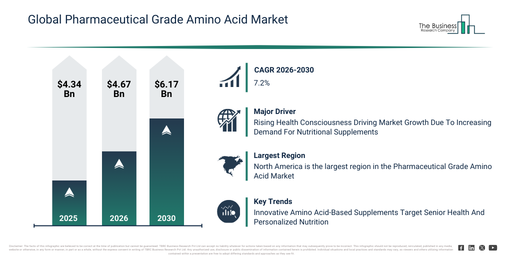
The pharmaceutical grade amino acid market size has experienced significant expansion in recent years. It is projected to increase from $4.34 billion in 2025 to $4.67 billion in 2026, driven by a compound annual growth rate (CAGR) of 7.6%. The historical growth of this market can be attributed to several factors including the restricted supply of pharmaceutical-grade amino acids, reliance on conventional production processes, the rising volume of pharmaceutical manufacturing, increased understanding of the therapeutic benefits of amino acids, and their integration into basic nutrition and supplement applications.
The pharmaceutical grade amino acid market is projected to experience robust expansion in the coming years, reaching a valuation of $6.17 billion by 2030, driven by a compound annual growth rate (CAGR) of 7.2%. This anticipated growth is linked to several factors, including improvements in GMP-compliant production, the creation of new injectable and capsule formulations, increasing consumption by the nutraceutical and cosmetic industries, stricter government regulations and quality benchmarks, and the broadening of direct sales and online distribution channels. Key developments expected during this period involve a heightened need for L-form and D-form amino acids in pharmaceutical uses, the wider availability of injectable and liquid formulations for clinical purposes, increased application of amino acids in anti-cancer and hormone treatments, greater utilization in nutraceuticals, food, and cosmetic products, and an emphasis on high-purity amino acids to meet regulatory and safety criteria.
Get A Free Sample Report With In-Depth Market Insights:
Pharmaceutical Grade Amino Acid Market Growth Catalysts And Demand Drivers
The increasing requirement for nutritional supplements is projected to boost the growth of the pharmaceutical-grade amino acid market in the foreseeable future. Nutritional supplements are defined as products that deliver essential nutrients, such as vitamins, minerals, or amino acids, to support health and compensate for dietary deficiencies when standard food intake is inadequate. The growing consumer health consciousness, with more individuals proactively striving to enhance their well-being and prevent lifestyle-related ailments, is behind this surge in demand for nutritional supplements. These supplements can function as pharmaceutical-grade amino acids when their production adheres to strict purity, quality, and regulatory benchmarks mandated for medical applications. Such amino acids are highly refined, standardized for consistent potency, and produced under Good Manufacturing Practices (GMP) to ensure their safety and efficacy. For instance, in September 2024, data from HerbalGram, a US-based international nonprofit organization, indicated that the total annual sales of herbal dietary supplements in the US rose by 4.4%, from $12.018 billion in 2022 to $12.551 billion in 2023. Therefore, the escalating demand for nutritional supplements is a primary factor driving the expansion of the pharmaceutical-grade amino acid market.
Pharmaceutical Grade Amino Acid Market Segment Breakdown: Which Categories Lead On Revenue?
The pharmaceutical grade amino acid market covered in this report is segmented –
1) By Type: L-Form Amino Acids, D-Form Amino Acids, Non-Essential Amino Acids, Essential Amino Acids
2) By Formulation Type: Powders, Capsules, Tablets, Liquids, Injectables
3) By Distribution Channel: Online Retail, Offline Retail, Direct Sales, Wholesale Distributors, Healthcare Institutions
4) By Application: Hormone, Antibacterial Agents, Anti-Cancer Drugs, Nutrition, Other Applications
5) By End-User: Pharmaceutical Companies, Nutraceutical Companies, Food Manufacturers, Cosmetic Manufacturers, Academic And Research Institutions
Subsegments:
1) By L-Form Amino Acids: L-Glutamine, L-Leucine, L-Arginine, L-Lysine, L-Valine
2) By D-Form Amino Acids: D-Alanine, D-Serine, D-Cysteine, D-Aspartic Acid, D-Phenylalanine
3) By Non-Essential Amino Acids: Alanine, Asparagine, Aspartic Acid, Glutamic Acid, Serine
4) By Essential Amino Acids: Histidine, Isoleucine, Leucine, Lysine, Methionine, Phenylalanine, Threonine, Tryptophan, Valine
Pharmaceutical Grade Amino Acid Market Trends Shaping Long-Term Demand
Leading companies in the pharmaceutical-grade amino acid market are prioritizing the development of innovative formulations, particularly amino acid-based specialized dietary supplements, to enhance therapeutic efficacy and meet the rising demand for personalized nutrition. These specialized dietary supplements, built on amino acids, are high-purity compositions that contain specific amino acids, formulated to support targeted health functions such as muscle recovery, metabolic balance, or neurological support. For example, in December 2023, Ajinomoto (Thailand) Co., a Thailand-based food and nutrition enterprise, introduced AminoMOF, a specialized dietary supplement aimed at seniors to bolster muscle strength and mobility. This product is enriched with nine essential amino acids, including substantial levels of L-leucine and fish collagen peptides, rendering it especially beneficial for preventing or mitigating age-related muscle loss and joint issues. Featuring a sugar-free, easily absorbed formula, AminoMOF supports elderly individuals in maintaining their independence and physical health.
Pharmaceutical Grade Amino Acid Market Leading Players And Competitive Positioning
Major companies operating in the pharmaceutical grade amino acid market are Archer Daniels Midland Company, Merck KGaA, Sumitomo Chemical Co. Ltd., CJ CheilJedang Corporation, Evonik Industries AG, Ajinomoto Co. Inc., Fresenius Kabi AG, Jingjing Pharmaceutical, Global Bio‑Chem Technology Group, Tokyo Chemical Industry Co. Ltd., AMINO GmbH, Hubei Bafeng Pharmaceuticals Co. Ltd., Kyowa Hakko Bio Co. Ltd., Shine Star Amino Acid Co. Ltd., Wuxi Jinghai Amino Acid Co. Ltd., Jiahe Biotech, Shijiazhuang Donghua Jinlong Chemical Co. Ltd., Sichuan Tongsheng Amino Acid Co. Ltd., Yichang Sanxia Proudin Pharmaceuticals Co. Ltd.
View The Full Pharmaceutical Grade Amino Acid Market Report:
Pharmaceutical Grade Amino Acid Market Geographic Landscape: Which Region Leads Industry Growth?
North America was the largest region in the pharmaceutical grade amino acid market in 2025. Asia-Pacific is expected to be the fastest-growing region in the forecast period. The regions covered in the pharmaceutical grade amino acid market report are Asia-Pacific, South East Asia, Western Europe, Eastern Europe, North America, South America, Middle East, Africa.
Reach Out To Our Team:
The Business Research Company: https://www.thebusinessresearchcompany.com/
Americas: +1 310-496-7795
Asia: +44 7882 955267 & +91 8897263534
Europe: +44 7882 955267
Email us at: marketing@tbrc.info
Follow us on:
LinkedIn: https://in.linkedin.com/company/the-business-research-company
YouTube: https://www.youtube.com/channel/UC24_fI0rV8cR5DxlCpgmyFQ
Global Market Model: https://www.thebusinessresearchcompany.com/global-market-model