Featuring market attractiveness scoring, total addressable market sizing, company benchmarking matrices, interactive Excel dashboards, deeper supply chain intelligence, emerging startup tracking, and granular product-level insights, The Business Research Company’s 2026 market reports are built to deliver research that is both more actionable and more strategically valuable.
Robot-Assisted Joint Replacement Systems Market Revenue Outlook: What CAGR Lies Ahead Through 2030?
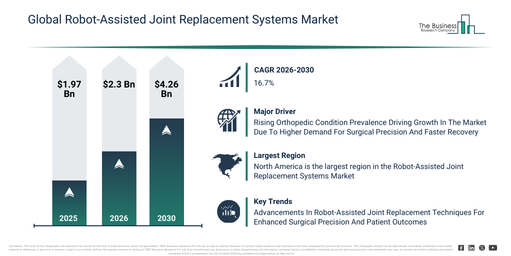
The market size for robot-assisted joint replacement systems has expanded notably in recent years. It is anticipated to increase from $1.97 billion in 2025 to $2.3 billion in 2026, reflecting a compound annual growth rate (CAGR) of 16.5%. The expansion observed in prior periods can be linked to factors such as the increasing prevalence of osteoarthritis, a rise in joint replacement volumes, the proliferation of orthopedic specialty hospitals, an expanding aging population, and improvements in surgical imaging systems.
The market size for robot-assisted joint replacement systems is expected to undergo rapid expansion in the coming years. It is projected to grow to $4.26 billion in 2030, with a compound annual growth rate (CAGR) of 16.7%. This anticipated growth is attributed to factors such as increased investments in robotic surgery, a rising demand for precision orthopedics, the expansion of outpatient joint replacement centers, greater surgeon training in robotic platforms, and an increase in the adoption of premium implants. Key trends in the forecast period include the growing adoption of robotic knee replacement systems, an increase in patient-specific surgical planning, the broader application of robotic arm-assisted orthopedic surgery, a rise in the use of real-time intraoperative navigation, and a higher demand for minimally invasive joint procedures.
Get A Free Sample Report With In-Depth Market Insights:
Robot-Assisted Joint Replacement Systems Market Growth Catalysts And Demand Drivers
The market for robot-assisted joint replacement systems is anticipated to grow in the coming years, primarily due to the increasing occurrence of degenerative joint and musculoskeletal (MSK) conditions. Degenerative orthopedic issues, such as osteoarthritis and age-related joint deterioration, principally affect the body’s movement and support structures, frequently leading to chronic pain, reduced mobility, and functional impairment. The incidence of these conditions is on the rise, largely attributable to the aging global population, as older adults are more susceptible to joint wear-and-tear, cartilage degeneration, and bone density loss. Robot-assisted joint replacement systems address advanced joint degeneration by enhancing surgical precision, improving implant alignment, and enabling more consistent outcomes, which can result in fewer complications and quicker postoperative recovery. For instance, data from the UK Office for Health Improvement and Disparities reveals that the prevalence of self-reported long-term musculoskeletal conditions among individuals aged 16 and over climbed to 18.4% in 2023 from 17.6% in 2022, indicating a growing patient population susceptible to progressive joint deterioration. Thus, the escalating prevalence of degenerative joint conditions serves as a significant driver for the growth of the robot-assisted joint replacement systems market.
Robot-Assisted Joint Replacement Systems Market Segmentation: How Does The Market Break Down By Category?
The robot-assisted joint replacement systems market covered in this report is segmented –
1) By Product Type: Knee Replacement Systems; Hip Replacement Systems; Shoulder Replacement Systems; Other Product Types
2) By Technology: Semi-Autonomous Systems; Fully Autonomous Systems
3) By End-Users: Orthopedic Surgeons; Hospitals; Clinics; Other End-Users
Subsegments:
1) By Knee Replacement Systems: Total Knee Replacement; Partial Knee Replacement; Revision Knee Replacement
2) By Hip Replacement Systems: Total Hip Replacement; Partial Hip Replacement; Revision Hip Replacement
3) By Shoulder Replacement Systems: Total Shoulder Replacement; Partial Shoulder Replacement; Reverse Shoulder Replacement
4) By Other Products: Ankle Replacement Systems; Elbow Replacement Systems; Custom Implant Guides
Robot-Assisted Joint Replacement Systems Market Trends Shaping Long-Term Demand
Leading companies in the robot-assisted joint replacement systems market are concentrating on developing advanced solutions, such as imageless intraoperative registration, to improve surgical precision, decrease operative time, and elevate patient outcomes in joint replacement procedures. Imageless intraoperative registration refers to a method employed in robot-assisted joint replacement surgery that creates a digital model of the patient’s joint during the procedure by utilizing anatomical landmarks and sensors, thereby eliminating the necessity for preoperative imaging while facilitating precise robotic guidance. For instance, in October 2023, DePuy Synthes, a US-based orthopedics company, introduced a VELYS Robotic-Assisted Solution for total knee arthroplasty. This imageless, table-mounted system is designed for accurate total knee arthroplasty (TKA), integrating with the ATTUNE knee system to provide individualized implant positioning and balanced soft tissue outcomes. Its primary advantages encompass enhanced surgical accuracy, shorter procedure times, reduced hospital stays (2.5 vs. 3.7 days), and superior early recovery metrics such as ambulation distance and pain relief at 6 months. Overall, it boosts patient satisfaction (95%), functional scores, and surgeon efficiency, while simultaneously minimizing errors in bone cuts and gap balancing.
Robot-Assisted Joint Replacement Systems Market Top Companies Driving Competitive Growth
Major companies operating in the robot-assisted joint replacement systems market are Johnson & Johnson, Medtronic plc., Stryker Corporation, B. Braun Melsungen AG., Zimmer Biomet Holdings Inc., Smith & Nephew plc., Meril Life Sciences, Globus Medical Inc., MicroPort Scientific Corporation, Brainlab, Corin Group, Exactech Inc., Think Surgical Inc., Curexo Inc., OMNIlife Science Inc., OrthAlign Inc., Kinamed Inc., Perlove Medical, Guangzhou Aimooe Technology Co. Ltd., Mako Surgical Corp., R2 Surgical,
View The Full Robot-Assisted Joint Replacement Systems Market Report:
Robot-Assisted Joint Replacement Systems Market Global Footprint: Which Region Leads The Industry?
North America was the largest region in the robot-assisted joint replacement systems market in 2025. Asia-Pacific is expected to be the fastest-growing region in the forecast period. The regions covered in the robot-assisted joint replacement systems market report are Asia-Pacific, South East Asia, Western Europe, Eastern Europe, North America, South America, Middle East, Africa.
Reach Out To Our Team:
The Business Research Company: https://www.thebusinessresearchcompany.com/
Americas: +1 310-496-7795
Asia: +44 7882 955267 & +91 8897263534
Europe: +44 7882 955267
Email us at: marketing@tbrc.info
Follow us on:
LinkedIn: https://in.linkedin.com/company/the-business-research-company
YouTube: https://www.youtube.com/channel/UC24_fI0rV8cR5DxlCpgmyFQ
Global Market Model: https://www.thebusinessresearchcompany.com/global-market-model