Built to provide research that’s more actionable and strategically valuable, The Business Research Company’s 2026 market reports include market attractiveness analysis, total addressable market sizing, company benchmarking matrices, interactive Excel dashboards, broader supply chain intelligence, emerging startup tracking, and in-depth product insights.
Systemic Amyloidosis Therapeutic Market Forecast: What Value Will The Market Reach By 2030?
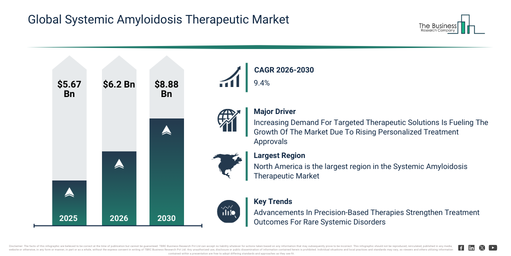
The systemic amyloidosis therapeutic market size has demonstrated robust growth in recent years. This market is projected to expand from $5.67 billion in 2025 to $6.2 billion in 2026, registering a compound annual growth rate (CAGR) of 9.2%. The market’s expansion historically can be linked to factors such as the past underdiagnosis of amyloidosis, a dependence on chemotherapy regimens, an increase in hematology treatment centers, heightened awareness of rare diseases, and the early embrace of proteasome inhibitors.
The systemic amyloidosis therapeutic market is projected to experience robust expansion over the coming years. Its valuation is set to reach $8.88 billion by 2030, exhibiting a compound annual growth rate (CAGR) of 9.4%. This anticipated growth stems from several factors, including an increase in rare disease diagnoses, the proliferation of targeted biologic medications, more approvals for gene silencing therapies, the expansion of specialized clinic networks, and enhanced incentives for orphan drugs. Key developments expected during this period encompass drugs designed to stabilize targeted amyloid proteins, gene silencing approaches for amyloidosis, treatments utilizing monoclonal antibodies, the adoption of combination therapy protocols, and supportive drug strategies tailored to specific organs.
Get A Free Sample Report With In-Depth Market Insights:
Systemic Amyloidosis Therapeutic Market Development Factors: What’s Supporting Demand?
The rising acceptance of personalized medicine approaches is anticipated to fuel the expansion of the systemic amyloidosis therapeutic market moving forward. This medical strategy involves tailoring treatment and prevention plans to an individual’s specific genetic profile, biomarkers, and distinct disease attributes. Demand for personalized medicine is escalating due to advancements in genomic and biomarker technologies, which enable medical professionals to precisely identify disease drivers and customize therapies, thereby boosting effectiveness and minimizing negative side effects for individual patients. The embrace of personalized medicine boosts the need for systemic amyloidosis therapeutics, as patients with systemic amyloidosis exhibit diverse amyloid subtypes (e.g., AL, ATTR) and genetic variations. Therefore, effective treatment requires therapies specifically designed to target the patient’s unique disease profile, ensuring maximum efficacy and minimal side effects. For instance, in April 2025, according to the Personalized Medicine Coalition (PMC), a US-based nonprofit advocacy and educational organization, in 2023, FDA approved 16 new personalized treatments for rare disease patients, an increase from six in 2022. Consequently, the increasing adoption of personalized medicine approaches is propelling the growth of the systemic amyloidosis therapeutic market.
Systemic Amyloidosis Therapeutic Market Segmentation And Category Overview
The systemic amyloidosis therapeutic market covered in this report is segmented –
1) By Product Type: Small Molecule Drugs; Biologic Therapies; Monoclonal Antibodies; Chemotherapy Based Regimens; Targeted Therapies; Supportive Treatments
2) By Formulation: Tablets; Capsules; Injection
3) By Route of Administration: Oral; Intravenous; Subcutaneous
4) By Distribution Channel: Hospital Pharmacies; Retail Pharmacies; Online Pharmacies
5) By End User: Hospitals; Specialty Clinics; Specialty Pharmacies; Research and Academic Institutes; Other End Users
Subsegments:
1) By Small Molecule Drugs: Proteasome Inhibitors; Stabilizers of Transthyretin Protein; Amyloid Fibril Disruptors; Immunomodulatory Small Molecules
2) By Biologic Therapies: Recombinant Protein Therapies; Gene Silencing Biologic Agents; Plasma Derived Biologic Products
3) By Monoclonal Antibodies: Anti Amyloid Fibril Antibodies; Anti Light Chain Antibodies; Targeted Clearance Antibodies
4) By Chemotherapy Based Regimens: Alkylating Agent Based Regimens; Proteasome Inhibitor Based Chemotherapy; Combination Chemotherapy Protocols
5) By Targeted Therapies: Targeted Light Chain Suppression Therapies; Targeted Transthyretin Reduction Therapies; Organ Specific Targeted Treatments
6) By Supportive Treatments: Cardiac Supportive Therapies; Renal Supportive Therapies; Neurological Symptom Management Therapies; Nutritional and Palliative Care Therapies
Systemic Amyloidosis Therapeutic Market Transformation Trends: What Innovations Are Driving Change?
Key companies operating within the systemic amyloidosis therapeutic market are concentrating on developing sophisticated, targeted treatment approaches, including RNA interference-based therapies, to address the core genetic origins of protein misfolding disorders, mitigate disease progression, and improve patient outcomes over the long term. RNA interference-based therapies function by selectively silencing specific disease-causing genes, thereby reducing the production of harmful proteins that cause systemic organ damage. For instance, in March 2025, Alnylam Pharmaceuticals, a US-based biotechnology company, launched AMVUTTRA. AMVUTTRA provides a targeted, disease-modifying treatment designed for adults diagnosed with transthyretin amyloidosis with cardiomyopathy (ATTR-CM). This therapeutic, developed by Alnylam Pharmaceuticals, is the first RNAi treatment proven to reduce cardiovascular death, hospitalizations, and urgent heart failure visits within this patient population. AMVUTTRA operates by rapidly suppressing transthyretin production directly at the source, effectively tackling the underlying cause of amyloid deposition. It demonstrates consistent benefits across cardiovascular outcomes, functional capacity, and quality of life.
Systemic Amyloidosis Therapeutic Market Leading Players And Competitive Positioning
Major companies operating in the systemic amyloidosis therapeutic market are Johnson & Johnson Services Inc., Sanofi SA, Novartis Plc, AstraZeneca Plc, GSK Plc, Novo Nordisk A/S, Takeda Pharmaceutical Company Limited, Regeneron Pharmaceuticals Inc., Alnylam Pharmaceuticals Inc., Ionis Pharmaceuticals, Arcturus Therapeutics Inc, Prothena Biosciences, Fortress Biotech Inc., Intellia Therapeutics Inc., Zentalis Pharmaceuticals Inc., BridgeBio Pharma Inc., Neurimmune AG, HaemaLogix Pty Ltd., Attralus Inc., and Oncopeptides AB.
View The Full Systemic Amyloidosis Therapeutic Market Report:
Systemic Amyloidosis Therapeutic Market Regional Split: Which Areas Are Fueling Growth?
North America was the largest region in the systemic amyloidosis therapeutic market in 2025. Asia-Pacific is expected to be the fastest-growing region in the forecast period. The regions covered in the systemic amyloidosis therapeutic market report are Asia-Pacific, South East Asia, Western Europe, Eastern Europe, North America, South America, Middle East, Africa.
Reach Out To Our Team:
The Business Research Company: https://www.thebusinessresearchcompany.com/
Americas: +1 310-496-7795
Asia: +44 7882 955267 & +91 8897263534
Europe: +44 7882 955267
Email us at: marketing@tbrc.info
Follow us on:
LinkedIn: https://in.linkedin.com/company/the-business-research-company
YouTube: https://www.youtube.com/channel/UC24_fI0rV8cR5DxlCpgmyFQ
Global Market Model: https://www.thebusinessresearchcompany.com/global-market-model