Featuring market attractiveness scoring, total addressable market sizing, company benchmarking matrices, interactive Excel dashboards, deeper supply chain intelligence, emerging startup tracking, and granular product-level insights, The Business Research Company’s 2026 market reports are built to deliver research that is both more actionable and more strategically valuable.
Mental Health-Sleep Overlap Market Value Analysis: What Growth Lies Ahead Over The Forecast Period?
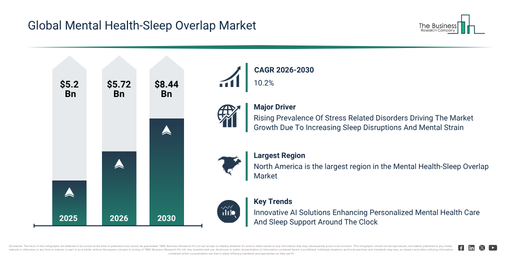
The mental health-sleep overlap market has shown strong expansion in recent years. It is forecast to rise from $5.2 billion in 2025 to $5.72 billion in 2026, achieving a compound annual growth rate (CAGR) of 10.0%. This historical growth can be attributed to factors such as the increasing prevalence of anxiety and depression disorders, growing recognition of sleep disorders, wider acceptance of behavioral therapy, the rise of telehealth services for mental health, and enhanced research into sleep and circadian rhythm science.
The mental health-sleep overlap market is projected to experience substantial expansion in the coming years, with its size forecast to reach $8.44 billion in 2030, growing at a compound annual growth rate (CAGR) of 10.2%. This anticipated growth during the forecast period can be attributed to various factors, including the increasing adoption of personalized sleep-mental health treatment plans, greater use of AI-driven behavioral analytics, rising employer investment in mental wellness programs, the expansion of remote patient monitoring technologies, and the increasing integration of sleep biomarkers in psychiatric care. Key trends expected over this period involve a greater integration of sleep assessment into mental health screening, the rising adoption of combined CBT-I and CBT treatment programs, a growing demand for digital tools to monitor sleep and mood, the expansion of tele-psychiatry services addressing sleep disorders, and an increased focus on preventive mental health and sleep wellness programs.
Get A Free Sample Report With In-Depth Market Insights:
Mental Health-Sleep Overlap Market Development Factors: What’s Supporting Demand?
The increasing occurrence of stress-related conditions is anticipated to fuel the expansion of the mental health–sleep overlap market in the future. These disorders are defined as states where prolonged encounters with psychological or environmental pressures lead to manifestations such as anxiety, depression, difficulties in emotional regulation, and hindered daily activities. Their incidence is growing because of ongoing exposure to persistent psychosocial stressors, including work pressures, financial strain, social challenges, and lifestyle changes that surpass individual coping abilities and detrimentally impact mental well-being. A strong connection exists between stress-related conditions and sleep disturbances, given that chronic stress interferes with neurobiological functions crucial for mood control and circadian cycles, resulting in issues like insomnia, fragmented sleep, or hypersomnia. As an illustration, data from May 2024, stemming from the 2024 annual mental health poll carried out by the American Psychiatric Association, a US-based organization, indicated that in 2024, 43% of adults reported elevated anxiety levels compared to the prior year, an increase from 37% in 2023 and 32% in 2022. Consequently, the expanding occurrence of stress-related conditions is propelling the growth of the mental health–sleep overlap market.
Mental Health-Sleep Overlap Market Segment Landscape: Which Areas Lead Development?
The mental health-sleep overlap market covered in this report is segmented –
1) By Treatment And Service Mix: Psychiatric Pharmacotherapy With Sleep Impact, Cognitive Behavioral Therapy (CBT-I) + Cognitive Behavioral Therapy (CBT) Integrated Programs, Tele-Psychiatry Or Therapy Services, Digital Monitoring And Relapse Prevention Tools, Adjunct Devices
2) By Age Group: Pediatric, Adult, Geriatric
3) By Delivery Mode: Mobile Applications, Web-Based Platforms, Telehealth Integrations
4) By Application: Preventive Healthcare And Wellness, Clinical Treatment And Disease Management, Long-Term Care And Assisted Living
5) By End User Or Channel: Outpatient Mental Health Clinics, Telehealth Platforms, Hospitals Or Behavioral Health Centers, Employer Or Payer Programs, Other End Users
Subsegments:
1) By Psychiatric Pharmacotherapy With Sleep Impact: Antidepressant Medications, Anxiolytic Medications, Mood Stabilizing Agents, Atypical Antipsychotic Medications, Sedative Hypnotic Medications
2) By Cognitive Behavioral Therapy (CBT-I) + Cognitive Behavioral Therapy (CBT) Integrated Programs: Sleep Restriction Therapy Programs, Stimulus Control Therapy Programs, Cognitive Restructuring Therapy, Relaxation Training Programs, Mindfulness-Based Behavioral Therapy
3) By Tele-Psychiatry Or Therapy Services: Video Consultation Services, Audio-Based Therapy Sessions, Text-Based Counseling Platforms, Remote Psychological Assessment Services, Virtual Group Therapy Programs
4) By Digital Monitoring And Relapse Prevention Tools: Sleep Pattern Tracking Software, Mood Monitoring Applications, Behavioral Analytics Platforms, Predictive Risk Assessment Tools, Remote Patient Monitoring Dashboards
5) By Adjunct Devices: Light Therapy Lamps, Smart Sleep Tracking Watches, Biometric Monitoring Bands, Heart Rate Variability Sensors, Circadian Rhythm Regulation Devices
Mental Health-Sleep Overlap Market Transformation Trends: What Innovations Are Driving Change?
Leading companies in the mental health-sleep overlap sector are concentrating on developing advanced solutions, such as artificial intelligence (AI)-powered mental health platforms, to deliver personalized, continuous support for issues related to stress and sleep. These AI-driven mental health platforms are digital tools that utilize AI to offer individualized mental health assistance, including real-time advice, coping mechanisms, and symptom monitoring, thereby assisting users in managing stress, improving sleep, and accessing care at any time without needing to wait for in-person appointments. For instance, in October 2025, Lyra Health, a US-based digital mental health company, introduced Lyra AI, a clinical-grade AI platform engineered to provide personalized mental health support. Lyra AI integrates sophisticated conversational AI with the existing Lyra Empower platform to offer 24/7 guidance for difficulties like stress, burnout, and sleep disturbances. The platform blends digital skill-building exercises with live provider sessions, incorporates a risk-flagging system that escalates urgent situations to human clinicians, and adheres to stringent clinical and ethical benchmarks through its Polaris Principles. Its applications include enhancing sleep quality, alleviating stress, and supporting overall mental wellness, delivering scalable, evidence-based care while maintaining human oversight.
Mental Health-Sleep Overlap Market Leading Players And Competitive Positioning
Major companies operating in the mental health-sleep overlap market are Johnson & Johnson, Koninklijke Philips N.V., Teladoc Health, Lyra Health Inc., Headspace Health Inc., Included Health Inc., Talkspace Inc., Spring Health, Whoop Inc., Transcarent Inc., Calm.com Inc., Modern Health Inc., Unmind Ltd., Big Health Inc., Click Therapeutics Inc., Welldoc Inc., Quartet Health Inc., Meru Health Inc., Ieso Digital Health Ltd., Wysa LTD., Oura Health Oy.
View The Full Mental Health-Sleep Overlap Market Report:
Mental Health-Sleep Overlap Market Regional Split: Which Areas Are Fueling Growth?
North America was the largest region in the mental health-sleep overlap market in 2025. Asia-Pacific is expected to be the fastest-growing region in the forecast period. The regions covered in the mental health-sleep overlap market report are Asia-Pacific, South East Asia, Western Europe, Eastern Europe, North America, South America, Middle East, Africa.
Reach Out To Our Team:
The Business Research Company: https://www.thebusinessresearchcompany.com/
Americas: +1 310-496-7795
Asia: +44 7882 955267 & +91 8897263534
Europe: +44 7882 955267
Email us at: marketing@tbrc.info
Follow us on:
LinkedIn: https://in.linkedin.com/company/the-business-research-company
YouTube: https://www.youtube.com/channel/UC24_fI0rV8cR5DxlCpgmyFQ
Global Market Model: https://www.thebusinessresearchcompany.com/global-market-model