Built to provide research that’s more actionable and strategically valuable, The Business Research Company’s 2026 market reports include market attractiveness analysis, total addressable market sizing, company benchmarking matrices, interactive Excel dashboards, broader supply chain intelligence, emerging startup tracking, and in-depth product insights.
Pediatric Allergy Care Market Growth Potential: How Will Market Size Shift Through 2030?
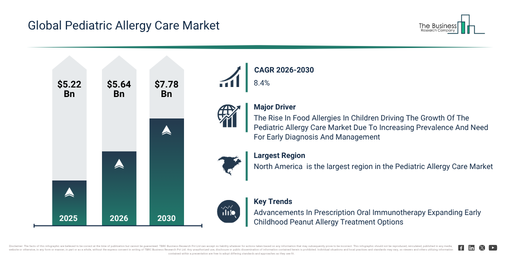
The pediatric allergy care market size has shown strong growth over recent years. It is anticipated to expand from $5.22 billion in 2025 to $5.64 billion in 2026, achieving a compound annual growth rate (CAGR) of 8.1%. The historical increase can be linked to the rising occurrence of pediatric allergies, enhanced awareness among parents, the progress in pediatric immunotherapy, the implementation of traditional allergy testing methods, and the establishment of specialty allergy clinics.
The pediatric allergy care market is projected to experience substantial growth over the coming years, reaching $7.78 billion by 2030, demonstrating a compound annual growth rate (CAGR) of 8.4%. This anticipated expansion is primarily driven by the increasing availability of telehealth services, the uptake of AI-driven diagnostic tools, the development of personalized treatment plans incorporating genomics, the broader integration of digital health platforms, and a rising need for remote monitoring solutions. Throughout the forecast period, significant trends are expected to encompass further telehealth expansion, advanced personalized allergy management strategies, continuous remote symptom monitoring, seamless integration with existing pediatric care platforms, and improved digital prescription management.
Get A Free Sample Report With In-Depth Market Insights:
Pediatric Allergy Care Market Industry Drivers: What’s Behind The Revenue Growth?
The increasing occurrence of food allergies in children is anticipated to drive the future expansion of the pediatric allergy care market. These allergies represent immune system reactions that manifest when a child’s body incorrectly identifies specific foods as harmful, leading to symptoms that can range from mild, such as hives or stomach upset, to severe reactions like anaphylaxis. The growing incidence of food allergies among children is linked to the hygiene hypothesis, which suggests that reduced early childhood exposure to microbes results in an underdeveloped immune system that overreacts to harmless foods. Pediatric allergy care assists children with food allergies by providing prompt diagnosis, customized management strategies, and educational support to prevent allergic reactions and enhance their overall quality of life. For instance, in January 2026, according to the Centers for Disease Control and Prevention, a US-based public health agency, the percentage of children diagnosed with a food allergy increased to 5.3% in 2024 from 3.5% in 2023. Thus, the rising incidence of food allergies in children is a primary factor fueling the growth of the pediatric allergy care market.
Pediatric Allergy Care Market Segmentation: How Does The Market Break Down By Category?
The pediatric allergy care market covered in this report is segmented –
1) By Care Modality: Drug Therapy, Allergy Testing, Pediatric Immunotherapy, Telehealth And Support
2) By Condition Type: Asthma, Food Allergy, Allergic Rhinitis, Eczema, Anaphylaxis
3) By Application: Pediatric Asthma Care, Food Allergy Diagnostics, Allergic Rhinitis And Eczema Integrated Management, Anaphylaxis Prevention, Immunotherapy Programs
4) By End User: Specialty Allergy Clinics, Hospitals, Diagnostic Laboratories, Telehealth Providers, Other End Users
Subsegments:
1) By Drug Therapy: Antihistamine Medications, Corticosteroid Medications, Leukotriene Receptor Antagonists, Biologic Therapies, Epinephrine Auto Injector Treatments
2) By Allergy Testing: Skin Prick Testing, Intradermal Testing, Patch Testing, Specific Immunoglobulin E Blood Testing, Oral Food Challenge Testing
3) By Pediatric Immunotherapy: Subcutaneous Immunotherapy, Sublingual Immunotherapy, Oral Immunotherapy, Epicutaneous Immunotherapy, Cluster Immunotherapy
4) By Telehealth And Support: Virtual Consultation Services, Remote Symptom Monitoring, Digital Prescription Management, Caregiver Education Programs, Mobile Health Application Support
#Pediatric Allergy Care Market Growth Trends: What’s Shaping The Future Outlook?
Leading firms within the pediatric allergy care market are prioritizing the creation of novel treatments, including prescription oral immunotherapy (OIT), aimed at desensitizing young patients to allergens and mitigating the potential for severe allergic responses. Prescription oral immunotherapy (OIT) is a clinically monitored therapy where patients are progressively exposed to minute, escalating quantities of an allergen, like peanuts, to foster tolerance and diminish the likelihood of intense allergic episodes. As an illustration, in February 2025, Stallergenes Greer International AG, a biopharmaceutical company headquartered in Switzerland, introduced Palforzia Oral Immunotherapy (OIT) in the U.S. for children aged 1 to 3 years. This launch broadened its prior approval to encompass toddlers with diagnosed peanut allergies. This treatment involves defatted peanut allergen powder, given orally via a structured regimen comprising initial dose increases, progressive up-dosing, and routine daily maintenance. Its purpose is to lessen allergic reactions, such as anaphylaxis, following unintentional peanut exposure. Distinctive features include precise age-based dosing and its application in conjunction with a peanut-avoidant diet to cultivate tolerance. Such therapy addresses a crucial unmet requirement for very young children, providing a proactive solution that goes beyond mere avoidance and emergency interventions, with the capacity to alter the natural progression of peanut allergy during early childhood.
Pediatric Allergy Care Market Key Participants And Competitive Landscape
Major companies operating in the pediatric allergy care market are market are AstraZeneca PLC, Thermo Fisher Scientific Inc., Abbott Laboratories, Quest Diagnostics Incorporated, Medicover Woman & Child Hospital, Nemours Children’s Health, EUROIMMUN Medizinische Labordiagnostika AG, ALK-Abelló A/S, Stallergenes Greer S.A., Rainbow Children’s Hospital, Continental Hospitals, Viracor Eurofins, R-Biopharm AESKU.GROUP GmbH And Co. KG, Apollo Cradle And Children’s Hospital, Hycor Biomedical Inc., AESKU.GROUP GmbH, Ankura Hospital for Women And Children, Nectar Allergy And Asthma, Ann And Robert H. Lurie Children’s Hospital of Chicago, DBV Technologies S.A.
View The Full Pediatric Allergy Care Market Report:
Pediatric Allergy Care Market Geographic Analysis: Where Is Demand Accelerating Fastest?
North America was the largest region in the pediatric allergy care market in 2025. Asia-Pacific is expected to be the fastest-growing region in the forecast period. The regions covered in the pediatric allergy care market report are Asia-Pacific, South East Asia, Western Europe, Eastern Europe, North America, South America, Middle East, Africa.
Reach Out To Our Team:
The Business Research Company: https://www.thebusinessresearchcompany.com/
Americas: +1 310-496-7795
Asia: +44 7882 955267 & +91 8897263534
Europe: +44 7882 955267
Email us at: marketing@tbrc.info
Follow us on:
LinkedIn: https://in.linkedin.com/company/the-business-research-company
YouTube: https://www.youtube.com/channel/UC24_fI0rV8cR5DxlCpgmyFQ
Global Market Model: https://www.thebusinessresearchcompany.com/global-market-model