Featuring market attractiveness scoring, total addressable market sizing, company benchmarking matrices, interactive Excel dashboards, deeper supply chain intelligence, emerging startup tracking, and granular product-level insights, The Business Research Company’s 2026 market reports are built to deliver research that is both more actionable and more strategically valuable.
Tumor-Informed Minimal Residual Disease (MRD) Tests Market Size, Value And Growth Trajectory Through 2030
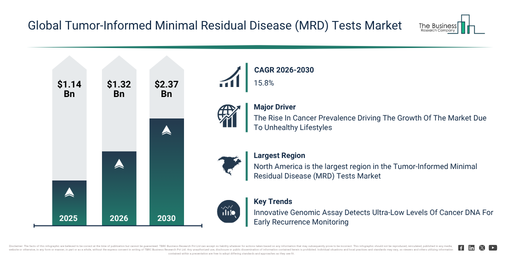
The tumor-informed minimal residual disease (MRD) tests market size has experienced considerable expansion in recent years. This market is forecasted to grow from $1.14 billion in 2025 to $1.32 billion in 2026, achieving a compound annual growth rate (CAGR) of 15.6%. The historical growth of this market can be attributed to several factors including the rising prevalence of cancer, continuous advancements in genetic sequencing, the increasing demand for post-treatment monitoring, various regulatory approvals for molecular diagnostics, and the broader adoption of PCR and NGS technologies.
The tumor-informed minimal residual disease (MRD) tests market is anticipated to experience swift expansion over the coming years. Its valuation is projected to reach $2.37 billion by 2030, exhibiting a compound annual growth rate (CAGR) of 15.8%. This expansion during the forecast period is primarily fueled by factors such as the rise of personalized medicine, the application of AI-driven data analytics for MRD, increased oncology research, the creation of non-invasive diagnostic assays, and the incorporation of these systems into hospital IT infrastructure. Key developments expected during this period involve personalized MRD monitoring, integration with clinical decision support tools, non-invasive sample analysis, detection of high-sensitivity ctDNA, and models for predicting disease recurrence.
Get A Free Sample Report With In-Depth Market Insights:
Tumor-Informed Minimal Residual Disease (MRD) Tests Market Growth Factors: What’s Supporting Expansion?
The expanding occurrence of cancer is anticipated to fuel the expansion of the tumor-informed minimal residual disease (MRD) tests market in the future. Cancer is defined as a collection of illnesses marked by the unregulated proliferation and division of atypical cells, capable of infiltrating adjacent tissues and disseminating throughout the body. The rising incidence of cancer stems from unhealthy habits such as inadequate nutrition, insufficient exercise, tobacco use, and excessive alcohol intake, all of which elevate the likelihood of developing diverse cancer forms. Tumor-informed minimal residual disease (MRD) tests assist in cancer management by identifying minute quantities of cancer-specific genetic material post-treatment, thereby allowing for prompt detection of recurrence and informing tailored treatment choices. For example, in February 2024, the World Health Organization, an international body based in Switzerland focused on global health policy and public health, projected that more than 35 million new cancer cases will arise in 2050, representing a 77% surge from the approximate 20 million cases in 2022. Consequently, the increasing prevalence of cancer is accelerating the swift expansion of the tumor-informed minimal residual disease (MRD) tests market.
Tumor-Informed Minimal Residual Disease (MRD) Tests Market Segment Landscape: Which Areas Lead Development?
The tumor-informed minimal residual disease (MRD) tests market covered in this report is segmented –
1) By Technology: Next-Generation Sequencing, Polymerase Chain Reaction (PCR)-based, Other Technologies
2) By Product Type: Assay Kits, Instruments, Software, Services
3) By Sample Type: Peripheral Blood (Ctdna), Bone Marrow, Tissue Biopsy, Other Body Fluids
4) By Application: Colorectal Cancer, Lung Cancer, Breast Cancer, Hematological Malignancies, Other Applications
5) By End-User: Hospitals, Diagnostic Laboratories, Research Institutes, Other End-Users
Subsegments:
1) By Next-Generation Sequencing: Targeted Sequencing, Whole Genome Sequencing, Whole Exome Sequencing, Single Cell Sequencing, Other Sequencing Approaches
2) By Polymerase Chain Reaction (PCR)-Based: Digital Polymerase Chain Reaction, Real Time Polymerase Chain Reaction, Multiplex Polymerase Chain Reaction, Other Polymerase Chain Reaction Methods
3) By Other Technologies: Hybrid Capture Based, Bead Based Assays, Electrochemical Detection, Other Emerging Technologies
Tumor-Informed Minimal Residual Disease (MRD) Tests Market Industry Trends: What’s Reshaping Demand?
Major companies within the tumor informed minimal residual disease (MRD) tests market are concentrating on developing novel solutions, such as tissue informed whole genome sequencing (WGS) MRD assays, designed to detect extremely low levels of circulating tumor DNA for the early monitoring of cancer recurrence and treatment response. A tissue-informed whole genome sequencing (WGS) MRD assay functions by using a patient’s tumor tissue to pinpoint specific genetic mutations, then tracking these mutations in blood samples to identify minimal residual disease at very low levels. As an illustration, in September 2025, Foundation Medicine, Inc., a US-based precision medicine company, introduced the Tissue-informed WGS MRD test via the FlexOMx Lab. This innovative, tumor-informed whole-genome sequencing test for molecular residual disease is purposed for research across early- to late-stage cancers. It accurately tracks hundreds to thousands of tumor-specific variants in circulating tumor DNA, facilitating the precise detection of minimal residual disease even at minute tumor levels, while also supplying comprehensive genomic profiling to enhance understanding of recurrence and treatment resistance in clinical studies.
Tumor-Informed Minimal Residual Disease (MRD) Tests Market Competitive Landscape: Which Companies Lead The Industry?
Major companies operating in the tumor-informed minimal residual disease (MRD) tests market are Roche Diagnostics International Ltd., Thermo Fisher Scientific Inc., Laboratory Corporation of America Holdings, ICON Public Limited Company, Illumina Inc., Bio-Rad Laboratories Inc., Exact Sciences Corporation, QIAGEN N.V., Integrated DNA Technologies Inc., Natera Inc., NeoGenomics Laboratories Inc., Veracyte Inc., Foundation Medicine Inc., Adaptive Biotechnologies Corporation, Genetron Holdings Limited, Burning Rock Biotech Co Ltd., Personalis Inc., Foresight Diagnostics Inc., Predicine Inc., Guardant Health Inc.
View The Full Tumor-Informed Minimal Residual Disease (MRD) Tests Market Report:
Tumor-Informed Minimal Residual Disease (MRD) Tests Market Regional Breakdown: Where Is Demand Concentrated?
North America was the largest region in the tumor-informed minimal residual disease (MRD) tests market in 2025. Asia-Pacific is expected to be the fastest-growing region in the forecast period. The regions covered in the tumor-informed minimal residual disease (MRD) tests market report are Asia-Pacific, South East Asia, Western Europe, Eastern Europe, North America, South America, Middle East, Africa.
Reach Out To Our Team:
The Business Research Company: https://www.thebusinessresearchcompany.com/
Americas: +1 310-496-7795
Asia: +44 7882 955267 & +91 8897263534
Europe: +44 7882 955267
Email us at: marketing@tbrc.info
Follow us on:
LinkedIn: https://in.linkedin.com/company/the-business-research-company
YouTube: https://www.youtube.com/channel/UC24_fI0rV8cR5DxlCpgmyFQ
Global Market Model: https://www.thebusinessresearchcompany.com/global-market-model