Built to provide research that’s more actionable and strategically valuable, The Business Research Company’s 2026 market reports include market attractiveness analysis, total addressable market sizing, company benchmarking matrices, interactive Excel dashboards, broader supply chain intelligence, emerging startup tracking, and in-depth product insights.
3D Dental Scanners Market Value Growth And Long-Term Outlook
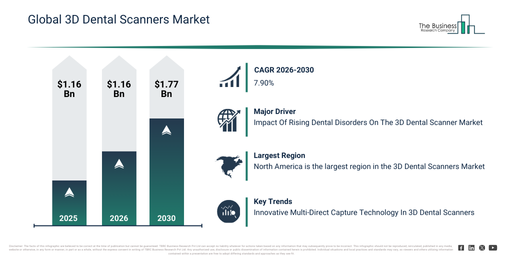
The 3D dental scanners market size has experienced strong growth in recent years. This market is projected to expand from $2.19 billion in 2025 to $2.36 billion in 2026, exhibiting a compound annual growth rate (CAGR) of 7.9%. The historical growth can be attributed to several factors, including an increase in orthodontic and prosthodontic treatment volumes, a growing shift from manual impressions to digital workflows, the rising installation of CBCT systems in dental practices, the expanding adoption of digital dentistry in hospitals and dental clinics, and the increasing usage of laboratory scanners for restoration fabrication.
The 3D dental scanners market is poised for significant expansion over the next few years, with projections indicating it will reach $3.19 billion in 2030, driven by a compound annual growth rate (CAGR) of 7.9%. This anticipated growth is primarily fueled by a rising demand for chairside intraoral scanning solutions, an increased preference for minimally invasive and precise dental procedures, the growing integration of digital scanning into implantology planning, the wider adoption of portable and handheld dental scanners, and enhanced investment in advanced 3D imaging capabilities across dental facilities. Throughout the forecast period, key trends are expected to include the expanding utilization of intraoral 3D dental scanners for chairside diagnostics and treatment planning, the increased application of CBCT scanners for detailed orthodontic and implantology imaging, a surge in demand for handheld and portable dental scanners in clinical environments, the broader implementation of laboratory dental scanners for precise prosthodontic workflows, and a noticeable shift towards digital impressions over traditional mold-based methods.
Get A Free Sample Report With In-Depth Market Insights:
3D Dental Scanners Market Demand Drivers Opening New Revenue Streams
An increasing number of dental disorders is projected to boost the expansion of the global 3D dental scanner market. Dental disorders encompass any irregularities, illnesses, or states within the oral cavity that necessitate evaluation, diagnosis, and often intervention by dental professionals to uphold oral health and avert complications. The rise in these disorders is attributable to factors such as inadequate oral hygiene routines, greater intake of sugary foods and beverages, and limited access to dental care services. 3D dental scanners are crucial for managing dental disorders, as they enable precise diagnosis, meticulous treatment planning, and the fabrication of personalized dental prosthetics with superior accuracy and efficiency. For instance, in October 2024, the Australian Institute of Health and Welfare, an Australia-based government agency, reported that in 2022–23, roughly 87,400 hospitalizations occurred due to dental conditions that could have been prevented with timely treatment. Children aged 5–9 years showed the highest rate of these preventable hospitalizations, reaching 12.3 per 1,000 population. Hence, the increasing prevalence of dental disorders is stimulating the growth of the 3D dental scanner market.
3D Dental Scanners Market Segment Breakdown: Which Categories Lead On Revenue?
The 3D dental scanners market covered in this report is segmented –
1) By Type: Desktop Or Laboratory 3D Dental Scanners, Intraoral 3D Dental Scanners, Hand-Held 3D Dental Scanners, Cone Beam Computerized Tomography
2) By Application: Prosthodontics, Orthodontics, Implantology
3) By End-User: Hospitals, Dental Clinics, Research And Academic Institutes
Subsegments:
1) By Desktop Or Laboratory 3D Dental Scanners: Optical Laboratory Scanners, Structured Light Laboratory Scanners
2) By Intraoral 3D Dental Scanners: Wireless Intraoral Scanners, Wired Intraoral Scanners
3) By Hand-Held 3D Dental Scanners: Laser-Based Hand-Held Scanners, Structured Light Hand-Held Scanners
4) By Cone Beam Computerized Tomography (CBCT): Standard Field-Of-View CBCT Scanners, Extended Field-Of-View CBCT Scanners
3D Dental Scanners Market Trends Powering Strategic Industry Growth
Leading companies in the dental 3D scanner sector are concentrating on developing advanced technology, such as multi-direct capture technology, to improve scanning precision and efficiency. This development aims to enable more accurate dental treatments and streamlined operational workflows. Multi-direct capture technology in 3D dental scanners refers to a method where multiple images or scans are simultaneously collected from various angles. For example, in January 2024, Align Technology Inc., a US-based medical device company, launched its iTero Lumina intraoral scanner. This scanner is notable for its unique ability to offer a 3X wider field of capture from a significantly smaller and lighter wand, ensuring faster scanning, higher accuracy, improved visualization, and a more comfortable user experience. It stands out with a larger capture distance of up to 25 mm, which simplifies the scanning of intricate oral areas like narrow or deep palates, edentulous spaces, and partially erupted teeth with minimal adjustments. This advanced technology effortlessly gathers extensive data and finer details, producing exceptional scan quality and photorealistic 3D models, thereby eliminating the need for bulky digital cameras and traditional cheek retractors.
3D Dental Scanners Market Leading Players And Competitive Positioning
Major companies operating in the 3d dental scanners market are Danaher Corporation, Dentsply Sirona Inc., Align Technology Inc., Midmark Corp., J. Morita Corporation, 3Shape Inc., Roland DG Corp., KaVo Dental GmbH, Amann Girrbach AG, Zirkonzahn, Carestream Health India Pvt. Ltd., Imes-icore GmbH, Planmeca Group Company, Hint-ELS GmbH, Dental Wings Inc., Condor Technologies Inc., Imetric 3D SA, Medit Corporation, Owandy Radiology, 3M Co.
View The Full 3D Dental Scanners Market Report:
3D Dental Scanners Market Regional Split: Which Areas Are Fueling Growth?
North America was the largest region in the 3D dental scanners market in 2025. Asia-Pacific is expected to be the fastest-growing region in the forecast period. The regions covered in the 3D dental scanners market report are Asia-Pacific, South East Asia, Western Europe, Eastern Europe, North America, South America, Middle East, Africa.
Reach Out To Our Team:
The Business Research Company: https://www.thebusinessresearchcompany.com/
Americas: +1 310-496-7795
Asia: +44 7882 955267 & +91 8897263534
Europe: +44 7882 955267
Email us at: marketing@tbrc.info
Follow us on:
LinkedIn: https://in.linkedin.com/company/the-business-research-company
YouTube: https://www.youtube.com/channel/UC24_fI0rV8cR5DxlCpgmyFQ
Global Market Model: https://www.thebusinessresearchcompany.com/global-market-model