Built to provide research that’s more actionable and strategically valuable, The Business Research Company’s 2026 market reports include market attractiveness analysis, total addressable market sizing, company benchmarking matrices, interactive Excel dashboards, broader supply chain intelligence, emerging startup tracking, and in-depth product insights.
Flexible Endoscopes Market Set To Climb From $11.13 Billion In 2026 To $15.08 Billion By 2030
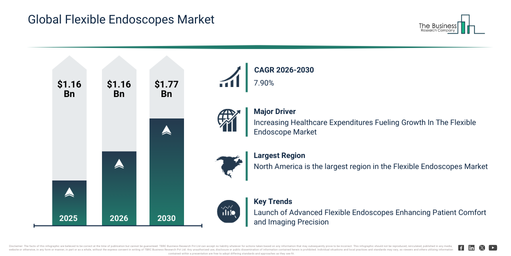
The flexible endoscopes market has shown substantial growth in recent years. It is projected to expand from $10.41 billion in 2025 to $11.13 billion in 2026, achieving a compound annual growth rate (CAGR) of 6.9%. Historically, this expansion has been driven by an increasing preference for minimally invasive surgical procedures, the broadening of hospital endoscopy departments, a greater accessibility of flexible endoscopic platforms, rising volumes of diagnostic procedures, and advancements in fiber optics technology.
The flexible endoscopes market size is anticipated to expand significantly over the next few years, with projections indicating it will reach $15.08 billion by 2030, driven by a compound annual growth rate (CAGR) of 7.9%. This growth in the forecast period is primarily due to an increasing demand for outpatient endoscopic procedures, rising investments in AI-assisted visualization tools, the broader application of endoscopy across various medical specialties, a growing adoption of disposable endoscopes, and an increased focus on procedure efficiency and patient outcomes. Key trends expected in this period include the rising adoption of video-based flexible endoscopes, an escalating demand for minimally invasive surgical procedures, the continuous integration of advanced imaging and visualization systems, the expansion of multi-specialty endoscopic applications, and an enhanced emphasis on device reprocessing and sterility.
Get A Free Sample Report With In-Depth Market Insights:
Flexible Endoscopes Market Demand Drivers: What’s Powering Industry Growth?
The future expansion of the flexible endoscope market is anticipated to be driven by increasing healthcare spending. Healthcare expenditures refer to the cumulative financial investment or costs linked to delivering medical care and services. Greater financial commitment to flexible endoscopes improves patient treatment and outcomes by facilitating the acquisition of sophisticated endoscopic devices, educating healthcare personnel, and supporting research and development efforts. For instance, in April 2025, the Office for National Statistics, a UK government department, reported that overall healthcare spending grew by 6.5% nominally between 2023 and 2024, and by 2.4% in real terms when adjusted for inflation. Consequently, the expansion of healthcare spending is stimulating the flexible endoscope market’s development.
Flexible Endoscopes Market Segment Outlook: Which Categories Are Growing Fastest?
The flexible endoscopes market covered in this report is segmented –
1) By Product: Fiberscope, Video Endoscope
2) By Application: GI Endoscopy, Pulmonary Endoscopy, ENT Endoscopy, Obstetrics or Gynecology, Urology, Other Applications
3) By End User: Hospitals, Ambulatory Surgery Centers, Other End Users
Subsegments:
1) By Fiberscope: Standard Fiberscope, Specialty Fiberscope
2) By Video Endoscope: Rigid Video Endoscope, Flexible Video Endoscope
Flexible Endoscopes Market Innovation Trends: What Developments Are Reshaping The Industry?
Leading firms in the flexible endoscopes sector are developing novel products and securing necessary approvals to maintain their competitive standing. Ongoing advancements in flexible endoscopes consistently offer increased patient comfort, refined ergonomics, and superior imaging performance. As an example, in September 2023, Olympus Corporation, a prominent Japanese company in endoscopic technology, introduced the EVIS X1 flexible endoscopy system. This system comprises the GIF 1100 gastrointestinal videoscope and the CF HQ1100DL/I colonovideoscope, intended for examining both upper and lower digestive tracts. These particular flexible endoscopes come with a lighter control unit for easier manipulation, high-definition imaging offering greater clarity, and enhanced navigability in constricted or winding anatomical structures. Their sophisticated design provides medical professionals with high-resolution visuals, increased accuracy during procedures, and less discomfort for patients throughout endoscopic examinations. Additionally, it facilitates streamlined workflows and decreases fatigue for the operator.
Flexible Endoscopes Market Competitive Overview And Top Companies
Major companies operating in the flexible endoscopes market are Medtronic Plc, Fujifilm Holdings Corporation, Stryker Corporation, Boston Scientific Corporation, Olympus Corporation, HOYA Corporation, Smith & Nephew Plc, EndoChoice International, Pentax Medical, Ambu Inc., Richard Wolf GmbH, Cooper Surgical Inc, Ethicon Endo-surgery LLC, Vimex Endoscopy, Endo-Flex GmbH, Machida Endoscope Co Ltd, XION GmbH, Huger Medical Instrument Co. Ltd., Endomed Systems Gmbh, Karl Storz GmbH & Co. KG., Laborie Medical Technologies Inc, ACMI Corporation
View The Full Flexible Endoscopes Market Report:
Flexible Endoscopes Market Top Region: Where Does Most Revenue Come From?
North America was the largest region in the flexible endoscopes market in 2025. Asia-Pacific is expected to be the fastest-growing region in the forecast period. The regions covered in the flexible endoscopes market report are Asia-Pacific, South East Asia, Western Europe, Eastern Europe, North America, South America, Middle East, Africa.
Reach Out To Our Team:
The Business Research Company: https://www.thebusinessresearchcompany.com/
Americas: +1 310-496-7795
Asia: +44 7882 955267 & +91 8897263534
Europe: +44 7882 955267
Email us at: marketing@tbrc.info
Follow us on:
LinkedIn: https://in.linkedin.com/company/the-business-research-company
YouTube: https://www.youtube.com/channel/UC24_fI0rV8cR5DxlCpgmyFQ
Global Market Model: https://www.thebusinessresearchcompany.com/global-market-model