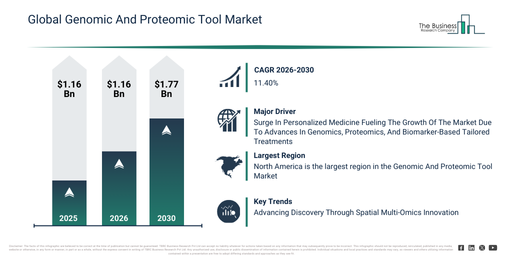
Backed by market attractiveness analysis, total addressable market sizing, company benchmarking matrices, interactive Excel dashboards, wider supply chain intelligence, emerging startup coverage, and detailed product-level insights, The Business Research Company’s 2026 market reports are designed to offer research that is more actionable and strategically valuable than ever.
Genomic And Proteomic Tool Market Size And Revenue Outlook Through 2030
The genomic and proteomic tool market has experienced significant expansion in recent years. Its size is anticipated to increase from $33.14 billion in 2025 to $37 billion by 2026, with a compound annual growth rate (CAGR) of 11.7%. Historically, this growth can be ascribed to several factors, including an increase in genomic research funding, the broader adoption of NGS technologies, advancements in pharmaceutical R&D, heightened academic research activities, and a reduction in sequencing expenses.
The market size for genomic and proteomic tools is anticipated to experience substantial growth in the coming years. This market is projected to reach $56.95 billion by 2030, demonstrating a compound annual growth rate (CAGR) of 11.4%. The expansion during this forecast period stems from the proliferation of precision medicine, increasing adoption of clinical genomics, rising demand for proteomics in drug discovery, the broadening of personalized diagnostics, and advancements in bioinformatics tools. Significant trends expected in the forecast period include the wider embrace of high-throughput sequencing, the development of integrated multi-omics platforms, enhanced automation in sample preparation, the growth of cloud-based bioinformatics, and the expansion of biomarker discovery.
Get A Free Sample Report With In-Depth Market Insights:
Genomic And Proteomic Tool Market Growth Momentum: What Factors Are Shaping Demand?
The expanding use of personalized medicine is anticipated to drive the advancement of the genomic and proteomic tool market in the future. Personalized medicine involves customizing prevention, diagnosis, and treatment for an individual’s unique molecular profile, utilizing biomarkers sourced from deoxyribonucleic acid (DNA), ribonucleic acid (RNA), and proteins. This rising adoption stems from progress in genomics, proteomics, and biomarker discovery, which facilitate customized treatments founded on individual genetic profiles, thereby boosting the demand for targeted therapies, enhanced diagnostics, and precise healthcare solutions. Significant advancements in genomics, proteomics, and biomarker discovery have allowed for the creation of targeted therapies and more precise diagnostic methods, all based on a patient’s genetic makeup. In this context, genomic and proteomic tools are vital, as they identify genetic variations and protein biomarkers, empowering clinicians to refine treatments and enhance patient outcomes. For example, in February 2024, the Personalized Medicine Coalition, a US-based nonprofit, reported that the USFDA cleared 16 new personalized treatments for rare disease patients in 2023, marking a considerable rise from 6 personalized treatments in 2022. Consequently, the expanding use of personalized medicine is a key driver for the genomic and proteomic tool market.
Genomic And Proteomic Tool Market Breakdown By Product Type And Application
The genomic and proteomic tool market covered in this report is segmented –
1) By Product Type: Instruments, Consumables, Software, Services
2) By Technology: Sequencing, Microarray, Polymerase Chain Reaction (PCR), Mass Spectrometry, Electrophoresis, Chromatography
3) By Workflow Stage: Sample Preparation, Library Preparation, Data Analysis, Reporting
4) By Application: Drug Discovery, Diagnostics, Personalized Medicine, Agriculture And Animal Research
5) By End User: Academic And Research Institutions, Pharmaceutical And Biotechnology Companies, Diagnostic Laboratories, Healthcare Providers
Subsegments:
1) By Instruments: DNA Sequencing Systems, Polymerase Chain Reaction (PCR) Systems, Microarray Analyzers, Mass Spectrometry Instruments, Electrophoresis Systems, Chromatography Instruments, Flow Cytometers
2) By Consumables: Reagents And Kits, Assay Kits, Sample Preparation Consumables, Sequencing Consumables, Protein Assay Reagents, Microarray Chips, Laboratory Chemicals
3) By Software: Genomic Data Analysis Software, Proteomic Data Analysis Software, Bioinformatics Platforms, Clinical Data Interpretation Tools, Workflow Management Software, Cloud-based Analysis Platforms
4) By Services: Next-Generation Sequencing (NGS) Services, Gene Expression And Genotyping Services, Protein Identification And Quantification Services, Biomarker Discovery Services, Structural Biology Analysis Services, Bioinformatics And Data Interpretation Services, Molecular Diagnostics Services
Genomic And Proteomic Tool Market Trends Redefining Industry Growth
Leading companies in the genomic and proteomic tools market are focusing on innovation by utilizing spatial multi-omics technologies. These technologies facilitate the in-situ, same-cell detection of RNA and proteins, enabling the integration of molecular data layers, preservation of tissue architecture, and acceleration of discovery. Spatial multi-omics involves the simultaneous measurement of gene expression and protein markers within intact tissue at single-cell or subcellular resolution, thereby offering more comprehensive biological insights than single-modality assays. For instance, in August 2025, 10x Genomics, a U.S.-based biotechnology company, launched Xenium Protein, an unparalleled assay designed for single-cell RNA and protein analysis on their Xenium in situ platform. This solution provides a seamless workflow using a single instrument, eliminating the need for cross-platform data integration, and includes validated, ready-to-use protein subpanels to simplify setup and quality control. Such advancements empower researchers to maintain spatial context while expanding biomarker panels for various applications, including target validation, patient stratification, and mechanism-of-action studies.
Genomic And Proteomic Tool Market Key Players Shaping Industry Direction
Major companies operating in the genomic and proteomic tool market are F. HoffmannLa Roche, Thermo Fisher Scientific Inc., Danaher Corporation, Merck KGaA, Becton Dickinson and Company, GE Healthcare, Eurofins Scientific SE, Agilent Technologies Inc., Illumina Inc., Bruker Corporation, Waters Corporation, Bio-Rad Laboratories Inc., QIAGEN N.V., PerkinElmer Inc., Promega, Novogene Corp., Oxford Nanopore Technologies Ltd., Pacific Biosciences of California Inc., Sophia Genetics, LC Sciences
View The Full Genomic And Proteomic Tool Market Report:
Genomic And Proteomic Tool Market Regional Analysis: Which Geography Leads On Revenue?
North America was the largest region in the genomic and proteomic tool market in 2025. Asia-Pacific is expected to be the fastest-growing region in the forecast period. The regions covered in the genomic and proteomic tool market report are Asia-Pacific, South East Asia, Western Europe, Eastern Europe, North America, South America, Middle East, Africa.
Reach Out To Our Team:
The Business Research Company: https://www.thebusinessresearchcompany.com/
Americas: +1 310-496-7795
Asia: +44 7882 955267 & +91 8897263534
Europe: +44 7882 955267
Email us at: marketing@tbrc.info
Follow us on:
LinkedIn: https://in.linkedin.com/company/the-business-research-company
YouTube: https://www.youtube.com/channel/UC24_fI0rV8cR5DxlCpgmyFQ
Global Market Model: https://www.thebusinessresearchcompany.com/global-market-model