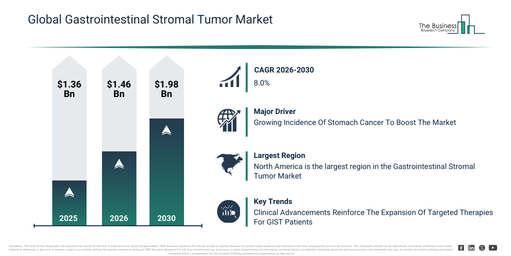
Featuring market attractiveness scoring, total addressable market sizing, company benchmarking matrices, interactive Excel dashboards, deeper supply chain intelligence, emerging startup tracking, and granular product-level insights, The Business Research Company’s 2026 market reports are built to deliver research that is both more actionable and more strategically valuable.
Gastrointestinal Stromal Tumor Market Value Growth And Long-Term Outlook
The gastrointestinal stromal tumor market size has demonstrated robust expansion in recent years. It is anticipated to increase from $1.36 billion in 2025 to $1.46 billion in 2026, registering a compound annual growth rate (CAGR) of 6.9%. The growth witnessed in the historic period stems from the approval of imatinib therapy, improved tumor classification, the expansion of oncology care centers, heightened awareness of rare gi tumors, and the availability of surgical interventions.
The gastrointestinal stromal tumor market size is anticipated to experience significant growth over the next few years. It is projected to expand to $1.98 billion by 2030, exhibiting a compound annual growth rate (CAGR) of 8.0%. The expansion during the forecast period is attributable to the development of next-generation targeted therapies, an increase in precision diagnostics, a rise in clinical trials, the broader adoption of personalized cancer treatment, and improved survival outcomes. Prominent trends for the forecast period include the increasing utilization of targeted tyrosine kinase inhibitors, a greater focus on molecular tumor profiling, the expansion of precision oncology approaches, an uptick in surgical and drug combination therapy, and enhanced long-term disease management.
Get A Free Sample Report With In-Depth Market Insights:
Gastrointestinal Stromal Tumor Market Growth Factors: What’s Supporting Expansion?
The increasing incidence of stomach cancer is anticipated to propel the expansion of the gastrointestinal stromal tumor market moving forward. Stomach cancer refers to the uncontrolled growth and multiplication of malignant cells within the stomach’s lining. While gastrointestinal stromal tumors (GISTs) can manifest in the stomach, they are distinct from stomach cancer. Patients with GISTs have been observed to have a heightened risk of developing additional cancers, such as small bowel adenocarcinoma, especially when two separate tumors collide and merge. For example, in January 2024, the American Cancer Society, a US-based professional organization, estimated that around 26,890 new cases of stomach cancer and 10,880 deaths are expected in the U.S. for 2024, constituting 1.5% of all new cancer diagnoses. Thus, the rising occurrence of stomach cancer is fueling the growth of the gastrointestinal stromal tumor market.
Gastrointestinal Stromal Tumor Market Segments: Where Is Growth Concentrated?
The gastrointestinal stromal tumor market covered in this report is segmented –
1) By Treatment Type: Chemotherapy, Targeted Therapy, Other Treatment Types
2) By Indication: Stomach, Small Intestine, Others Indications
3) By End-User: Hospitals, Clinics, Specialized Cancer Treatment Centers, Other End-Users
Subsegments:
1) By Chemotherapy: Traditional Chemotherapy Agents, Combination Chemotherapy Regimens
2) By Targeted Therapy: Tyrosine Kinase Inhibitors, Other Targeted Agents
3) By Other Treatment Types: Surgery, Radiation Therapy, Clinical Trials For Novel Therapies
Gastrointestinal Stromal Tumor Market Trends Shaping Long-Term Demand
Leading firms in the gastrointestinal stromal tumor market are developing novel medications, including signal transduction and targeted therapy, with the aim of enhancing treatment effectiveness, overcoming resistance to current therapies, and addressing unfulfilled clinical needs. Signal transduction and targeted therapy denote treatments crafted to obstruct or alter particular cellular signaling pathways responsible for tumor proliferation and survival. For example, in November 2025, Ascentage Pharma Group International Inc., a China-based commercial-stage biopharmaceutical company, reported the publication of Phase Ib clinical data for olverembatinib (HQP1351) in Signal Transduction and Targeted Therapy. This data emphasized encouraging efficacy and safety in SDH-deficient gastrointestinal stromal tumors (GIST), and also pinpointed a novel antitumor mechanism related to lipid metabolism modulation.
Gastrointestinal Stromal Tumor Market Key Participants And Competitive Landscape
Major companies operating in the gastrointestinal stromal tumor market are Pfizer Inc., F. Hoffmann-La Roche AG, Bayer AG, Novartis AG, Merck & Co. Inc., GlaxoSmithKline plc, Bristol-Myers Squibb Company, Sanofi S.A., AstraZeneca plc, Eli Lilly and Company, Daiichi Sankyo Co. Ltd., Eisai Co. Ltd., Sun Pharmaceutical Industries Limited, Jiangsu Hengrui Medicine Co. Ltd., Exelixis Inc., NATCO Pharma Ltd., Blueprint Medicines Corporation, Array BioPharma Inc., Deciphera Pharmaceuticals Inc., Ono Pharmaceutical Co. Ltd.
View The Full Gastrointestinal Stromal Tumor Market Report:
Gastrointestinal Stromal Tumor Market Top Region: Where Does Most Revenue Come From?
North America was the largest region in the gastrointestinal stromal tumor market in 2025. Asia-Pacific is expected to be the fastest-growing region in the forecast period. The regions covered in the gastrointestinal stromal tumor market report are Asia-Pacific, South East Asia, Western Europe, Eastern Europe, North America, South America, Middle East, Africa.
Reach Out To Our Team:
The Business Research Company: https://www.thebusinessresearchcompany.com/
Americas: +1 310-496-7795
Asia: +44 7882 955267 & +91 8897263534
Europe: +44 7882 955267
Email us at: marketing@tbrc.info
Follow us on:
LinkedIn: https://in.linkedin.com/company/the-business-research-company
YouTube: https://www.youtube.com/channel/UC24_fI0rV8cR5DxlCpgmyFQ
Global Market Model: https://www.thebusinessresearchcompany.com/global-market-model