Built to provide research that’s more actionable and strategically valuable, The Business Research Company’s 2026 market reports include market attractiveness analysis, total addressable market sizing, company benchmarking matrices, interactive Excel dashboards, broader supply chain intelligence, emerging startup tracking, and in-depth product insights.
Large Molecule Bioanalytical Technologies Market Forecast: Value Set To Climb From $13.36 Billion To $21.22 Billion
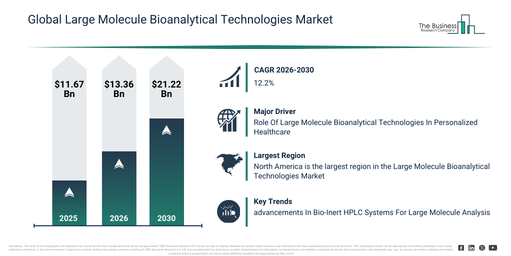
The large molecule bioanalytical technologies market size has experienced significant expansion in recent years. It is projected to increase from $11.67 billion in 2025 to $13.36 billion in 2026, achieving a compound annual growth rate (CAGR) of 14.5%. This growth observed in the past can be attributed to several factors, including the expansion of biologics development, a rise in the application of chromatography techniques, the broadening of protein characterization studies, the increasing adoption of ELISA-based assays, and a surge in pharmaceutical R&D spending.
The large molecule bioanalytical technologies market size is anticipated to experience substantial growth in the coming years, reaching $21.22 billion by 2030, at a compound annual growth rate (CAGR) of 12.2%. This expansion during the forecast period is driven by factors such as an escalating pipeline of monoclonal antibodies, advancements in cell and gene therapy research, an increasing need for biomarker validation, the rising complexity of biologics, and the broadening scope of bioanalytical outsourcing services. Key trends identified for this period include the increased adoption of sophisticated mass spectrometry techniques, a growing requirement for high-sensitivity bioanalytical assays, wider utilization of multiplex and high-throughput testing, expanded bioanalytical support for cell and gene therapies, and a surge in outsourcing large molecule bioanalysis to contract research organizations (CROs).
Get A Free Sample Report With In-Depth Market Insights:
Large Molecule Bioanalytical Technologies Market Development Factors: What’s Supporting Demand?
An increasing emphasis on personalized medicine is anticipated to drive the expansion of the large molecule bioanalytical technologies market in the future. Personalized medicine involves tailoring medical interventions and health-related choices based on individual patient characteristics, including their genetic profile, biomarkers, lifestyle habits, and environmental influences, with the goal of optimizing treatment effectiveness and minimizing adverse reactions. Several elements contribute to the heightened attention on personalized medicine, such as variations among individuals in their susceptibility to diseases, a movement towards healthcare centered on value, and a strong emphasis on patient-centric approaches. In the process of drug development, large-molecule bioanalytical technologies are employed to define the pharmacokinetics and pharmacodynamics of drugs composed of large molecules, including treatments like monoclonal antibodies or gene therapies. As an example, data from February 2024, provided by the Personalized Medicine Coalition, a US-based non-profit organization, shows that during 2023, the FDA approved 16 new personalized medicines for rare disease patients, marking an increase from six in 2022. Consequently, the growing emphasis on personalized medicine is a key driver for the expansion of the large molecule bioanalytical technologies market.
Large Molecule Bioanalytical Technologies Market Segment Landscape And Growth Outlook
The large molecule bioanalytical technologies market covered in this report is segmented –
1) By Product And Services: Instruments, Reagents And Consumables, Software, Services
2) By Technology: Chromatography, Mass Spectrometry, Enzyme-Linked Immunosorbent Assay, Electrophoresis, Polymerase Chain Reaction, Western Blot, Flow Cytometry
3) By Application: Biologics, Oligonucleotide Derived Drugs And Molecules, Viral Vector, Cell And Gene Therapy, Nanoparticles And Polymers, Disease Diagnosis, Other Applications
Subsegments:
1) By Instruments: Mass Spectrometers, Chromatography Systems, Immunoassay Analyzers
2) By Reagents And Consumables: Antibodies, Enzyme-Linked Immunosorbent Assay (Elisa) Kits
3) By Software: Data Analysis Software, Visualization Software
4) By Services: Analytical Testing Services, Contract Research Organization (CRO) Services, Method Development And Validation Services, Stability Testing Services
Large Molecule Bioanalytical Technologies Market Transformation Trends: What Innovations Are Driving Change?
Major companies within the large molecule bioanalytical technologies market are increasingly prioritizing the development of bio-inert, high-precision chromatographic and detection platforms. This focus aims to address the growing need for robust, reproducible, and sensitive bioanalysis, a demand propelled by accelerated biologics research and development, more stringent regulatory requirements, and the proliferation of complex therapeutic modalities such as monoclonal antibodies, bispecifics, and gene therapies. A bio-inert HPLC system functions as an analytical platform designed to minimize non-specific interactions between large biomolecules and the internal surfaces of the chromatography hardware, thereby enhancing recovery, reducing peak tailing, and delivering more accurate quantification. This is a significant improvement over traditional HPLC systems, which can suffer from analyte loss and poor reproducibility due to metal-binding and surface adsorption. For instance, in April 2024, Waters Corporation, a US-based analytical-instrument company, unveiled the Alliance iS Bio HPLC System. This system leverages MaxPeak High-Performance Surface (HPS) technology to provide bio-inert flow paths, reduce undesirable analyte interactions, and increase sensitivity, simultaneously cutting routine quality control lab errors by up to 40%. The system is integrated with Empower chromatography software for compliant data capture, supports modern column chemistries, and simplifies method transfer with its built-in intelligent method translation. Through the combination of surface inertness, a user-friendly design, and inherent error-reduction capabilities, the Alliance iS Bio system empowers biologics quality control laboratories to expedite analyses, enhance reproducibility, and diminish the risk of out-of-specification (OOS) results.
Large Molecule Bioanalytical Technologies Market Competitive Landscape: Who Leads The Industry?
Major companies operating in the large molecule bioanalytical technologies market are Thermo Fisher Scientific Inc., Danaher Corporation, Laboratory Corporation of America Holdings, Agilent Technologies Inc., Charles River Laboratories International Inc., Intertek Group plc, Shimadzu Corporation, Bio-Rad Laboratories Inc., Qiagen N.V., HORIBA Ltd., SCIEX, Bio-Techne Corporation, Hamilton Company, Promega Corporation, Verder Group, Solvias AG, Analytik Jena AG, Genedata AG, Wyatt Technology Corporation, Nanalysis Corporation, Avomeen Analytical Services, Cergentis B.V., Halo Labs Inc., Hitachi High-Technologies Corporation, Precision NanoSystems Inc.
View The Full Large Molecule Bioanalytical Technologies Market Report:
Large Molecule Bioanalytical Technologies Market Regional Analysis: Which Geography Leads On Revenue?
North America was the largest region in the large molecule bioanalytical technologies market in 2025. Asia-Pacific is expected to be the fastest-growing region in the forecast period. The regions covered in the large molecule bioanalytical technologies market report are Asia-Pacific, South East Asia, Western Europe, Eastern Europe, North America, South America, Middle East, Africa.
Reach Out To Our Team:
The Business Research Company: https://www.thebusinessresearchcompany.com/
Americas: +1 310-496-7795
Asia: +44 7882 955267 & +91 8897263534
Europe: +44 7882 955267
Email us at: marketing@tbrc.info
Follow us on:
LinkedIn: https://in.linkedin.com/company/the-business-research-company
YouTube: https://www.youtube.com/channel/UC24_fI0rV8cR5DxlCpgmyFQ
Global Market Model: https://www.thebusinessresearchcompany.com/global-market-model