Built to provide research that’s more actionable and strategically valuable, The Business Research Company’s 2026 market reports include market attractiveness analysis, total addressable market sizing, company benchmarking matrices, interactive Excel dashboards, broader supply chain intelligence, emerging startup tracking, and in-depth product insights.
Leber Hereditary Optic Neuropathy Treatment Market Growth Analysis: How Will Revenue Trend Over The Forecast Period?
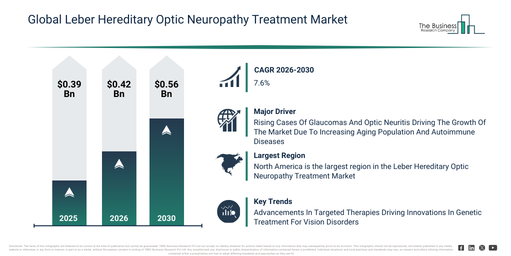
The leber hereditary optic neuropathy treatment market size has exhibited robust growth in recent years. It is projected to expand from $0.39 billion in 2025 to $0.42 billion in 2026, achieving a compound annual growth rate (CAGR) of 7.9%. The market’s historical growth can be linked to factors such as limited treatment options for mitochondrial disorders, an increase in the diagnosis of inherited optic neuropathies, the early implementation of idebenone therapy, rising awareness regarding genetic eye diseases, and progress in neuro-ophthalmology research.
The leber hereditary optic neuropathy treatment market is projected to experience robust expansion over the coming years. Its size is anticipated to reach $0.56 billion by 2030, driven by a compound annual growth rate (CAGR) of 7.6%. This growth during the projected period stems from increased investment in mitochondrial medicine research, a rise in clinical trials for gene and stem cell therapies, the broadening of precision medicine initiatives, enhanced access to genetic testing technologies, and an escalating emphasis on early intervention strategies. Key trends for the forecast duration encompass the expansion of mitochondrial gene therapy research, a growing uptake of antioxidant-based pharmacological treatments, an increase in genetic counseling and family risk assessment, heightened attention to early molecular diagnosis, and progress in stem cell–based optic nerve regeneration.
Get A Free Sample Report With In-Depth Market Insights:
Leber Hereditary Optic Neuropathy Treatment Market Demand Drivers Opening New Revenue Streams
The escalating prevalence of glaucoma and optic neuritis is anticipated to propel the expansion of the leber hereditary optic neuropathy treatment market in the coming years. Both glaucoma and optic neuritis are ocular conditions that cause damage to the optic nerve, with glaucoma commonly resulting from elevated intraocular pressure and optic neuritis frequently stemming from inflammation, often linked to autoimmune disorders, ultimately leading to impaired vision. The rising incidences of glaucoma and optic neuritis can be attributed to an aging demographic and enhancements in diagnostic methodologies. As the global population ages, the likelihood of developing glaucoma, an affliction characterized by heightened intraocular pressure leading to optic nerve damage, increases significantly. Glaucoma and optic neuritis both involve optic nerve deterioration and vision impairment, sharing commonalities with LHON. As the prevalence of these conditions expands, awareness and research efforts are increasingly concentrating on therapies addressing optic nerve degeneration. This research offers direct benefits for LHON treatment, given that the underlying mechanisms of optic nerve damage are fundamental across all three disorders. For instance, in October 2024, according to the Centers for Disease Control and Prevention, a US-based federal agency, more than 3 million Americans currently have glaucoma, and this number is projected to reach 6.3 million by 2050, driven by the aging U.S. population. Consequently, the growing incidence of glaucoma and optic neuritis is driving the growth of the leber hereditary optic neuropathy treatment market.
Leber Hereditary Optic Neuropathy Treatment Market Segment Analysis: What Are The Core Market Categories?
The leber hereditary optic neuropathy treatment market covered in this report is segmented –
1) By Treatment: Medication, Stem Cell Therapy, Gene Therapy, Genetic Counseling
2) By Route Of Administration: Intramuscular, Oral, Other Routes Of Administration
3) By Diagnosis: Molecular Genetic Testing, Magnetic Resonance Imaging (MRI), Blood tests, Other Diagnosis
4) By Distribution Channel: Hospital Pharmacy, Retail Pharmacy, Online Pharmacy
5) By End-Users: Clinic, Hospital, Other End-Users
Subsegments:
1) By Medication: Idebenone, Antioxidants, Mitochondrial-Targeted Therapies, Neuroprotective Agents
2) By Stem Cell Therapy: Autologous Stem Cell Therapy, Allogeneic Stem Cell Therapy, Induced Pluripotent Stem Cell (iPSC) Therapy
3) By Gene Therapy: Adeno-Associated Virus (AAV)-Mediated Therapy, Mitochondrial Gene Editing, RNA-Based Therapies
4) By Genetic Counseling: Carrier Screening, Predictive Testing, Family Risk Assessment, Pre-Symptomatic Genetic Counseling
Leber Hereditary Optic Neuropathy Treatment Market Trends Powering Strategic Industry Growth
Leading firms within the leber hereditary optic neuropathy (LHON) treatment market are prioritizing the creation of novel solutions, including gene therapy clinical trials, with the goal of enhancing treatment effectiveness, recovering mitochondrial function, and targeting the fundamental genetic origins of LHON. These gene therapy studies endeavor to bring back vision by inserting working copies of faulty mitochondrial genes, like ND4. Prior to obtaining regulatory clearance, these investigations proceed through several phases, encompassing preclinical research, as well as phase 1, phase 2, and phase 3 trials. As an example, in August 2023, Neurophth Therapeutics, a gene therapy company based in China, commenced a Phase I/II clinical trial aimed at addressing leber hereditary optic neuropathy, specifically targeting ND1-LHON, across both China and the U.S. This trial seeks to assess the safety, tolerability, and effectiveness of NFS-02, subsequent to receiving endorsements from the U.S. FDA and China’s NMPA. The administration of the initial dose to a patient signifies a crucial achievement in Neurophth’s worldwide push for prompt drug approval and eventual market launch. Furthermore, the company is expediting patient recruitment and investigating further gene therapy applications to address other unfulfilled medical requirements.
Leber Hereditary Optic Neuropathy Treatment Market Top Companies Driving Competitive Growth
Major companies operating in the leber hereditary optic neuropathy treatment market are GenSight Biologics S.A., Chiesi Farmaceutici S.p.A., Stealth BioTherapeutics Corp., Astellas Pharma Inc., BridgeBio Pharma Inc., Reneo Pharmaceuticals Inc., Abliva AB, Khondrion B.V., Mitotech S.A.P., Neurophth Therapeutics Co. Ltd., Genethon, F. Hoffmann-La Roche Ltd, Novartis AG, Pfizer Inc., Sanofi S.A., Bayer AG, Takeda Pharmaceutical Company Limited, AbbVie Inc., Johnson & Johnson, Biogen Inc.
View The Full Leber Hereditary Optic Neuropathy Treatment Market Report:
Leber Hereditary Optic Neuropathy Treatment Market Global Footprint: Which Region Leads The Market?
North America was the largest region in the leber hereditary optic neuropathy treatment market in 2025. Asia-Pacific is expected to be the fastest-growing region in the forecast period. The regions covered in the leber hereditary optic neuropathy treatment market report are Asia-Pacific, South East Asia, Western Europe, Eastern Europe, North America, South America, Middle East, Africa.
Reach Out To Our Team:
The Business Research Company: https://www.thebusinessresearchcompany.com/
Americas: +1 310-496-7795
Asia: +44 7882 955267 & +91 8897263534
Europe: +44 7882 955267
Email us at: marketing@tbrc.info
Follow us on:
LinkedIn: https://in.linkedin.com/company/the-business-research-company
YouTube: https://www.youtube.com/channel/UC24_fI0rV8cR5DxlCpgmyFQ
Global Market Model: https://www.thebusinessresearchcompany.com/global-market-model