Featuring market attractiveness scoring, total addressable market sizing, company benchmarking matrices, interactive Excel dashboards, deeper supply chain intelligence, emerging startup tracking, and granular product-level insights, The Business Research Company’s 2026 market reports are built to deliver research that is both more actionable and more strategically valuable.
Humanized Antibody Market Poised To Hit $72.47 Billion By 2030 With A 12.7% CAGR
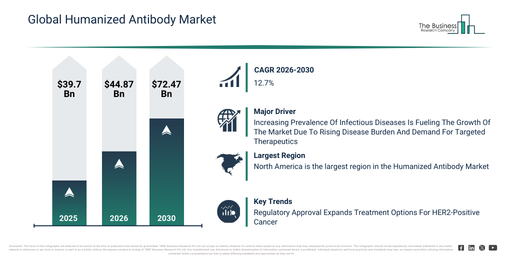
The humanized antibody market has witnessed substantial growth in recent years. Its value is expected to rise from $39.7 billion in 2025 to $44.87 billion in 2026, achieving a compound annual growth rate (CAGR) of 13.0%. This historical expansion can be attributed to advancements in monoclonal antibody engineering, early clinical success of antibody therapies, the expansion of oncology drug development, increasing biologics manufacturing capacity, and the growth of translational research programs.
The humanized antibody market is projected to experience substantial expansion in the coming years. This market is set to reach $72.47 billion by 2030, exhibiting a compound annual growth rate (CAGR) of 12.7%. This anticipated growth during the forecast period stems from several factors, including the increasing demand for personalized cancer therapies, heightened investments in next-generation biologics, the broadening of autoimmune and infectious disease indications, the rising adoption of precision medicine approaches, and the growing number of regulatory approvals for antibody-based drugs. Key trends anticipated during this period encompass the accelerated development of targeted antibody therapies, a greater emphasis on mitigating immunogenicity in biologics, the increasing embrace of antibody drug conjugates, the diversification into bispecific and multispecific antibody formats, and a sharpened focus on precision oncology applications.
Get A Free Sample Report With In-Depth Market Insights:
Humanized Antibody Market Growth Factors: What’s Supporting Expansion?
The increasing incidence of infectious diseases is anticipated to drive expansion in the humanized antibody market in the future. These diseases are health conditions resulting from disease-causing microorganisms, including bacteria, viruses, fungi, or parasites, which possess the capability of spreading between individuals either directly or indirectly. The frequency of infectious disease occurrences is escalating, largely attributed to heightened global travel, a factor that aids the swift dissemination of pathogens across different regions. Humanized antibody assists in managing infectious diseases by delivering precise immune reactions, rendering it suitable for fighting particular pathogens. Its close likeness to natural human antibodies diminishes the likelihood of immune rejection, thereby enhancing the safety and efficacy of treatments. As an illustration, in February 2024, the UK Health Security Agency, a government organization based in the UK, reported that cases of tuberculosis (a contagious bacterial infection predominantly impacting the lungs) in England climbed to 4,850 in 2023, marking a 10.7% increase from the 4,380 cases recorded in 2022. Consequently, the expanding occurrence of infectious diseases is propelling the development of the humanized antibody market.
Humanized Antibody Market Segment Landscape: Which Areas Lead Development?
The humanized antibody market covered in this report is segmented –
1) By Antibody Type: Humanized Antibodies, Chimeric Antibodies, Fully Human Antibodies, Murine Antibodies
2) By Application: Cancer, Autoimmune Diseases, Infectious Diseases, Cardiovascular Diseases, Other Applications
3) By End-User: Hospitals, Research Institutes, Diagnostic Laboratories, Other End-Users
Subsegments:
1) By Humanized Antibodies: Monospecific Therapeutic Antibodies, Bispecific And Multispecific Antibodies, Antibody Drug Conjugates, Single Chain Variable Fragment Based Antibodies, Fragment Antigen Binding Based Antibodies
2) By Chimeric Antibodies: Monospecific Therapeutic Antibodies, Bispecific And Multispecific Antibodies, Antibody Drug Conjugates, Single Chain Variable Fragment Based Antibodies, Fragment Antigen Binding Based Antibodies
3) By Fully Human Antibodies: Monospecific Therapeutic Antibodies, Bispecific And Multispecific Antibodies, Antibody Drug Conjugates, Single Chain Variable Fragment Based Antibodies, Long Acting Half Life Extended Antibodies
4) By Murine Antibodies: Monospecific Research Grade Antibodies, Hybridoma Derived Antibodies, Antibody Drug Conjugate Precursors, Single Chain Variable Fragment Based Antibodies, Fragment Antigen Binding Based Antibodies
Humanized Antibody Market Industry Trends: What’s Reshaping Demand?
Leading companies in the humanized antibody market are concentrating on creating novel products, such as humanized bispecific antibodies, with the aim of swiftly broadening eligible indications and providing more potent, lasting antitumor effects. Humanized Bispecific Antibodies are engineered antibodies capable of concurrently attaching to two separate antigens or two specific sites on the same antigen, all while being altered to closely mimic inherent human antibodies. As an example, during November 2024, Jazz Pharmaceuticals plc, a biopharmaceutical firm located in Ireland, secured accelerated approval from the Food and Drug Administration in the U.S. for Ziihera (zanidatamab-hrii), intended for previously treated, unresectable, or metastatic HER2-positive (IHC 3+) biliary tract cancer. This particular antibody is a humanized, immunoglobulin G (IgG)-like, bispecific human epidermal growth factor receptor 2 (HER2)-directed antibody that attaches to two external human epidermal growth factor receptor 2 (HER2) locations. Its proprietary mechanism of action involves activating both immune effector cells and directly prompting apoptosis in cancer cells, thus allowing a precise assault on malignant blasts without requiring prior immune system activation.
Humanized Antibody Market Industry Leaders And Competitive Landscape
Major companies operating in the humanized antibody market are Johnson & Johnson, Roche Holding AG, Merck & Co. Inc., Pfizer Inc., AbbVie Inc., Sanofi S.A., Novartis AG, AstraZeneca PLC, Bristol-Myers Squibb Company, GlaxoSmithKline plc, Eli Lilly and Company, Takeda Pharmaceutical Company Limited, Amgen Inc., Biogen Inc., Daiichi Sankyo Company Limited, UCB S.A., Genmab A/S, Xencor Inc., Zymeworks Inc., MacroGenics Inc.
View The Full Humanized Antibody Market Report:
Humanized Antibody Market Geographic Spread And Regional Opportunities
North America was the largest region in the humanized antibody market in 2025. Asia-Pacific is expected to be the fastest-growing region in the forecast period. The regions covered in the humanized antibody market report are Asia-Pacific, South East Asia, Western Europe, Eastern Europe, North America, South America, Middle East, Africa.
Reach Out To Our Team:
The Business Research Company: https://www.thebusinessresearchcompany.com/
Americas: +1 310-496-7795
Asia: +44 7882 955267 & +91 8897263534
Europe: +44 7882 955267
Email us at: marketing@tbrc.info
Follow us on:
LinkedIn: https://in.linkedin.com/company/the-business-research-company
YouTube: https://www.youtube.com/channel/UC24_fI0rV8cR5DxlCpgmyFQ
Global Market Model: https://www.thebusinessresearchcompany.com/global-market-model