Backed by market attractiveness analysis, total addressable market sizing, company benchmarking matrices, interactive Excel dashboards, wider supply chain intelligence, emerging startup coverage, and detailed product-level insights, The Business Research Company’s 2026 market reports are designed to offer research that is more actionable and strategically valuable than ever.
Opioid-Induced Constipation Treatment Market Size, Value And Growth Trajectory Through 2030
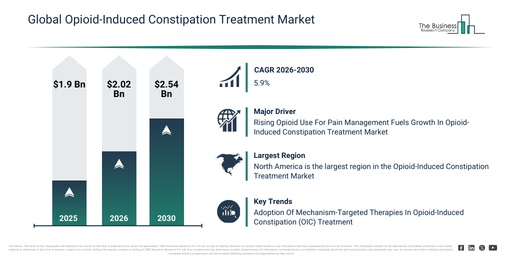
The opioid-induced constipation treatment market size has experienced substantial expansion in recent years. It is projected to increase from $1.9 billion in 2025 to $2.02 billion in 2026, achieving a compound annual growth rate (CAGR) of 6.7%. Historically, this market’s growth can be linked to the widespread application of opioids for chronic pain management, the limited efficacy of conventional laxatives, the rising prevalence of pain associated with cancer, the initial scarcity of OIC-specific treatments, and an uptick in hospitalizations due to the adverse effects of opioids.
The opioid-induced constipation treatment market is expected to experience substantial expansion in the coming years. It is projected to reach $2.54 billion by 2030, demonstrating a compound annual growth rate (CAGR) of 5.9%. This growth throughout the forecast period is propelled by factors such as an escalating demand for PAMORA-based treatments, a rise in long-term opioid prescriptions within aging demographics, an intensified clinical focus on patient-centric pain management, broader access to online and retail pharmacies, and increased investment in the development of gastrointestinal disorder drugs. Prominent trends anticipated in the forecast period include the wider adoption of peripherally acting µ-opioid receptor antagonists, a stronger preference for targeted OIC therapies that maintain analgesia, an increasing reliance on combined pharmacological and non-pharmacological treatments, a heightened emphasis on enhancing the quality of life for chronic pain sufferers, and improved awareness and diagnosis of opioid-induced constipation.
Get A Free Sample Report With In-Depth Market Insights:
Opioid-Induced Constipation Treatment Market Growth Backed By Core Demand Fundamentals
The increasing use of opioids for managing both cancer and non-cancer pain is anticipated to propel the growth of the opioid-induced constipation treatment market in the foreseeable future. Cancer pain refers to discomfort linked to cancer and its therapeutic interventions, while non-cancer pain denotes discomfort arising from conditions unrelated to cancer. The application of opioids for these pain types is driven by the necessity for effective management of moderate to severe pain, taking into account factors like the intensity and duration of pain, the patient’s response to other therapies, and the overarching aim of enhancing quality of life while minimizing potential risks such as addiction and side effects. Opioid-induced constipation (OIC) treatment assists individuals experiencing cancer and non-cancer pain by alleviating constipation caused by opioid use, thereby enhancing overall comfort, adherence to pain management regimens, and quality of life without compromising pain relief. Hence, the increasing administration of opioids for cancer and non-cancer pain is driving the expansion of the opioid-induced constipation treatment market.
Opioid-Induced Constipation Treatment Market Segment Landscape And Growth Outlook
The opioid-induced constipation treatment market covered in this report is segmented –
1) By Drug Class: Laxatives, Peripherally Acting µ-opioid Receptor Antagonists, Serotonin Receptor Agonists
2) By Type: Oral, Parenteral
3) By Distribution Channel: Hospital Pharmacies, Online Pharmacies, Retail Pharmacies
Subsegments:
1) By Laxatives: Osmotic Laxatives, Stimulant Laxatives, Bulk-Forming Laxatives
2) By Peripherally Acting µ-Opioid Receptor Antagonists: Naloxegol, Methylnaltrexone, Alvimopan
3) By Serotonin Receptor Agonists: Prucalopride, Tegaserod
Opioid-Induced Constipation Treatment Market Growth Trends Reshaping The Competitive Landscape
Leading companies within the opioid-induced constipation treatment market are concentrating on advancing innovative solutions like peripherally acting µ-opioid receptor antagonists (PAMORAs). These are designed for precise modulation of gut receptors, aiming to boost effectiveness, increase patient adherence, and minimize systemic adverse reactions during opioid use. PAMORAs specifically inhibit µ-opioid receptors within the gastrointestinal tract without penetrating the blood–brain barrier. This mechanism helps reinstate normal bowel function while preserving central pain relief, distinguishing them from conventional laxatives that fail to target the fundamental receptor-driven origin of constipation. An example of this trend is the launch by Luye Pharma, a China-based pharmaceutical company, of Mimeixin in May 2025. This product is an oral oxycodone/naloxone sustained-release tablet specifically formulated for OIC. Mimeixin provides once-daily analgesia while simultaneously counteracting gut opioid receptors, leading to enhanced bowel regularity and fewer gastrointestinal side effects compared to earlier treatments. It presents a convenient option for patients, integrating pain management and constipation relief into one tablet.
Opioid-Induced Constipation Treatment Market Competitive Landscape: Who Leads The Industry?
Major companies operating in the opioid-induced constipation treatment market are Pfizer Inc., AstraZeneca plc, Takeda Pharmaceutical Company Limited, Bausch Health Companies Inc., Ironwood Pharmaceuticals Inc., Collegium Pharmaceutical Inc., Cumberland Pharmaceuticals Inc., RedHill Biopharma Ltd., Theravance Biopharma Inc., Mundipharma International Limited, Daiichi Sankyo Co Ltd, Progenics Pharmaceuticals Inc, Shionogi & Co Ltd, Purdue Pharma, Nektar Therapeutics, S L A Pharma AG, Bristol-Myers Squibb Company, Fresenius Kabi AG, Viatris Inc, Novartis AG, Teva Pharmaceutical Industries Ltd, F Hoffmann-La Roche Ltd, Aurobindo Pharma, Abbott Laboratories, Daewoong Pharmaceutical Company
View The Full Opioid-Induced Constipation Treatment Market Report:
Opioid-Induced Constipation Treatment Market Regional Breakdown: Where Is Demand Concentrated?
North America was the largest region in the opioid-induced constipation treatment market in 2025. Asia-Pacific is expected to be the fastest-growing region in the forecast period. The regions covered in the opioid-induced constipation treatment market report are Asia-Pacific, South East Asia, Western Europe, Eastern Europe, North America, South America, Middle East, Africa.
Reach Out To Our Team:
The Business Research Company: https://www.thebusinessresearchcompany.com/
Americas: +1 310-496-7795
Asia: +44 7882 955267 & +91 8897263534
Europe: +44 7882 955267
Email us at: marketing@tbrc.info
Follow us on:
LinkedIn: https://in.linkedin.com/company/the-business-research-company
YouTube: https://www.youtube.com/channel/UC24_fI0rV8cR5DxlCpgmyFQ
Global Market Model: https://www.thebusinessresearchcompany.com/global-market-model
Leave a Reply