Backed by market attractiveness analysis, total addressable market sizing, company benchmarking matrices, interactive Excel dashboards, wider supply chain intelligence, emerging startup coverage, and detailed product-level insights, The Business Research Company’s 2026 market reports are designed to offer research that is more actionable and strategically valuable than ever.
Neurocutaneous Disorder Market Value Analysis: What Growth Lies Ahead Over The Forecast Period?
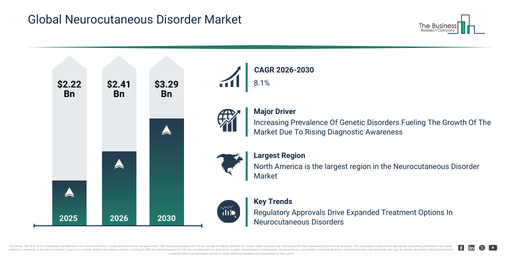
The neurocutaneous disorder market has demonstrated considerable growth in recent years. This market is projected to expand from $2.22 billion in 2025 to $2.41 billion in 2026, reflecting a compound annual growth rate (CAGR) of 8.3%. The historical increase can be ascribed to factors such as enhanced awareness of rare genetic disorders, advancements in neurological and dermatological diagnostics, the expansion of specialized treatment centers, greater availability of symptomatic therapies, and the proliferation of rare disease research initiatives.
The neurocutaneous disorder market is projected to experience substantial expansion over the coming years, reaching $3.29 billion by 2030, driven by a compound annual growth rate (CAGR) of 8.1%. This projected growth throughout the forecast period stems from the increasing progress in gene-based therapies, a surge in investments aimed at rare disease drug development, the broadening application of precision medicine, the growing integration of digital tools for patient monitoring, and an intensified focus on early intervention methods. Key developments anticipated during this period encompass a greater acceptance of genetic testing for early detection, a strengthened emphasis on multidisciplinary care, an increase in targeted therapeutic choices, a rise in the utilization of advanced imaging and diagnostic techniques, and a heightened commitment to managing diseases over the long term.
Get A Free Sample Report With In-Depth Market Insights:
Neurocutaneous Disorder Market Growth Backed By Core Demand Fundamentals
The expanding occurrence of genetic disorders is projected to boost the neurocutaneous disorder market moving forward. Genetic disorders are conditions that stem from anomalies in an individual’s DNA, which can be passed down or emerge spontaneously. Neurocutaneous disorders, such as tuberous sclerosis complex and neurofibromatosis, result from particular genetic mutations impacting both the nervous system and the skin, leading to neurological signs alongside distinct skin irregularities. Developments in genetic testing and heightened awareness are facilitating earlier detection, thereby contributing to a greater reported prevalence. Consequently, the growing prevalence of genetic disorders is stimulating the expansion of the neurocutaneous disorder market.
Neurocutaneous Disorder Market Segment Landscape: Which Areas Lead Development?
The neurocutaneous disorder market covered in this report is segmented –
1) By Type Of Neurocutaneous Disorder: Neurofibromatosis, Tuberous Sclerosis Complex, Sturge-Weber Syndrome, Angiomatosis, Hypomelanosis Of Ito
2) By Treatment Type: Pharmacological Treatment, Surgical Intervention, Laser Therapy, Physical Therapy, Psychosocial Support
3) By Age Group: Pediatric Patients (0-18 Years), Adult Patients (19-65 Years), Geriatric Patients (65 Years And Above)
4) By Severity Of Condition: Mild Cases, Moderate Cases, Severe Cases, Critical Cases
5) By End User: Hospitals, Specialist Clinics, Homecare Settings, Research Organizations, Pharmaceutical Companies
Subsegments:
1) By Neurofibromatosis: Peripheral Neurofibromatosis, Central Neurofibromatosis, Plexiform Neurofibromatosis
2) By Tuberous Sclerosis Complex: Classic Tuberous Sclerosis, Infantile-Onset Tuberous Sclerosis, Adult-Onset Tuberous Sclerosis
3) By Sturge-Weber Syndrome: Facial Sturge-Weber Syndrome, Cerebral Sturge-Weber Syndrome, Ophthalmic Sturge-Weber Syndrome
4) By Angiomatosis: Generalized Angiomatosis, Localized Angiomatosis, Mixed Angiomatosis
5) By Hypomelanosis Of Ito: Linear Hypomelanosis, Segmental Hypomelanosis, Whorled Hypomelanosis
Neurocutaneous Disorder Market Growth Trends Reshaping The Competitive Landscape
Leading companies within the neurocutaneous disorder market are focused on securing regulatory approvals to broaden their range of available treatments, improve patient outcomes, and capitalize on the rising demand for innovative medical solutions. Such regulatory approvals represent official permissions issued by government bodies, allowing a firm to legally market, sell, or test a drug or therapy subsequent to verifying its safety and effectiveness. For example, in September 2025, AstraZeneca plc, a UK-based pharmaceutical and biotechnology company, obtained Food and Drug Administration (FDA) approval for selumetinib (brand name Koselugo) to treat pediatric patients aged 1 year and older who have neurofibromatosis type 1 (NF1) with symptomatic, inoperable plexiform neurofibromas (PNs). This particular approval extends the prior indication, which was applicable to children aged 2 years and older. Selumetinib, classified as a MEK inhibitor, functions by blocking the MAPK pathway, which is responsible for tumor growth in NF1. Patients are administered oral selumetinib twice daily until their disease progresses or unacceptable side effects manifest, with common adverse effects including gastrointestinal, skin, cardiac, and ocular toxicities. This significant approval provides a vital therapeutic choice for young children confronting these challenging and often disfiguring tumors, which are frequently difficult to manage through surgical intervention.
Neurocutaneous Disorder Market Industry Leaders And Competitive Landscape
Major companies operating in the neurocutaneous disorder market are Merck KGaA, Novartis AG, Recursion Pharmaceuticals Inc., Marinus Pharmaceuticals Inc., Healx Limited, NF2 Therapeutics Inc., NFlection Therapeutics Inc., SpringWorks Therapeutics, Pfizer Inc., Johnson & Johnson, AstraZeneca PLC, GSK plc, Takeda Pharmaceutical Company Limited, Eli Lilly and Company, Bristol Myers Squibb, Teva Pharmaceutical Industries, Vertex Pharmaceuticals, Regeneron Pharmaceuticals, Horizon Therapeutics, Aleva NeurOthersapeutics
View The Full Neurocutaneous Disorder Market Report:
Neurocutaneous Disorder Market Global Footprint: Which Region Leads The Market?
North America was the largest region in the neurocutaneous disorder market in 2025. Asia-Pacific is expected to be the fastest-growing region in the forecast period. The regions covered in the neurocutaneous disorder market report are Asia-Pacific, South East Asia, Western Europe, Eastern Europe, North America, South America, Middle East, Africa.
Reach Out To Our Team:
The Business Research Company: https://www.thebusinessresearchcompany.com/
Americas: +1 310-496-7795
Asia: +44 7882 955267 & +91 8897263534
Europe: +44 7882 955267
Email us at: marketing@tbrc.info
Follow us on:
LinkedIn: https://in.linkedin.com/company/the-business-research-company
YouTube: https://www.youtube.com/channel/UC24_fI0rV8cR5DxlCpgmyFQ
Global Market Model: https://www.thebusinessresearchcompany.com/global-market-model
Leave a Reply