Built to provide research that’s more actionable and strategically valuable, The Business Research Company’s 2026 market reports include market attractiveness analysis, total addressable market sizing, company benchmarking matrices, interactive Excel dashboards, broader supply chain intelligence, emerging startup tracking, and in-depth product insights.
Non-Proliferative Diabetic Retinopathy Market Value Growth And Long-Term Outlook
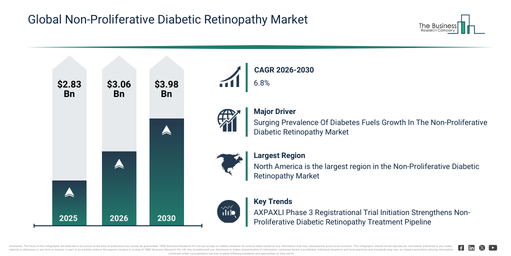
The non-proliferative diabetic retinopathy market has experienced substantial growth in recent years. It is projected to expand from $2.83 billion in 2025 to $3.06 billion in 2026, demonstrating a compound annual growth rate (CAGR) of 8.0%. The growth observed in the historic period can be attributed to the high prevalence of diabetes, limited awareness of retinal complications, reliance on conventional laser treatments, low adoption of intravitreal injections, and insufficient screening infrastructure.
The market size for non-proliferative diabetic retinopathy is projected to experience substantial growth in the coming years. It is expected to expand to $3.98 billion by 2030, achieving a compound annual growth rate (CAGR) of 6.8%. This expansion during the forecast period can be attributed to the rising incidence of diabetic retinopathy, the increasing acceptance of anti-VEGF and steroid treatments, the growth of ophthalmology clinics and specialized centers, advancements in retinal imaging technologies, and improvements in patient awareness and early detection programs. Significant trends anticipated for this period include the rising adoption of anti-VEGF therapy in NPDR, an increase in the use of intraocular steroid injections, the growing implementation of advanced laser surgery techniques, the expanding deployment of vitrectomy procedures, and the progressive integration of AI-powered retinal imaging and diagnosis.
Get A Free Sample Report With In-Depth Market Insights:
Non-Proliferative Diabetic Retinopathy Market Demand Drivers: What’s Powering Industry Growth?
The rising occurrence of diabetes is projected to fuel the expansion of the non-proliferative diabetic retinopathy market in the foreseeable future. Diabetes is a long-term metabolic condition characterized by elevated blood glucose (blood sugar) due to inadequate insulin production by the pancreas or the body’s cells developing resistance to insulin’s effects. This condition is caused by sedentary lifestyles, unhealthy dietary habits, and genetic predispositions. Diabetes leads to non-proliferative diabetic retinopathy by damaging the blood vessels in the retina, primarily owing to prolonged exposure to high levels of glucose in the bloodstream, which can result in vision impairment and potential blindness. Therefore, the increasing prevalence of diabetes is driving the growth of the non-proliferative diabetic retinopathy market.
Non-Proliferative Diabetic Retinopathy Market Segment Outlook: Which Categories Are Growing Fastest?
The non-proliferative diabetic retinopathy market covered in this report is segmented –
1) By Treatment Type: Anti-Vascular Endothelial Growth Factor (VEGF) Therapy, Intraocular Steroid Injection, Laser Surgery, Vitrectomy
2) By Disease Severity Level: Mild Non-Proliferative Diabetic Retinopathy, Moderate Non-Proliferative Diabetic Retinopathy, Severe Non-Proliferative Diabetic Retinopathy
3) By End-User: Hospitals, Specialty Clinics, Ambulatory Surgical Centers, Other End-Users
Subsegments:
1) By Anti-Vascular Endothelial Growth Factor (VEGF) Therapy: Bevacizumab (Avastin), Ranibizumab (Lucentis), Aflibercept (Eylea), Pegaptanib (Macugen)
2) By Intraocular Steroid Injection: Triamcinolone Acetonide, Dexamethasone Implant (Ozurdex), Fluocinolone Acetonide Implant (Iluvien)
3) By Laser Surgery: Focal Laser Photocoagulation, Panretinal Photocoagulation
4) By Vitrectomy: Pars Plana Vitrectomy (PPV), Membrane Peeling Vitrectomy, Phaco-Vitrectomy (Combined Cataract And Vitrectomy Surgery)
Non-Proliferative Diabetic Retinopathy Market Innovation Trends: What Developments Are Reshaping The Industry?
Key entities within the non-proliferative diabetic retinopathy (NPDR) market are concentrating on creating sophisticated clinical solutions, including Phase 3 registrational trial enrollment, to bolster therapeutic validation, produce strong evidence, and facilitate regulatory clearance for new NPDR therapies. This type of enrollment signifies the official commencement and patient assignment within a crucial late-stage clinical study, intended to gather extensive data on efficacy and safety essential for a therapeutic intervention’s market approval. As an illustration, in November 2025, Ocular Therapeutix, a US-based biopharmaceutical firm focused on retinal conditions, disclosed the initial patient randomization for its HELIOS-3 Phase 3 registrational program, which is assessing AXPAXLI (OTX-TKI) for NPDR. AXPAXLI is an experimental bioresorbable intravitreal hydrogel composed of axitinib, a tyrosine kinase inhibitor possessing anti-angiogenic properties, designed to provide prolonged treatment with a reduced frequency of injections. The HELIOS-3 study, in conjunction with HELIOS-2, employs an innovative ordinal =2-step Diabetic Retinopathy Severity Score (DRSS) improvement as its main objective and enrolls individuals with non-center-involved diabetic macular edema (non-CI-DME), thereby establishing AXPAXLI as a potentially groundbreaking choice for lasting and efficacious NPDR management.
Non-Proliferative Diabetic Retinopathy Market Leading Companies And Competitive Benchmarking
Major companies operating in the non-proliferative diabetic retinopathy market are Pfizer Inc., Johnson & Johnson, F. Hoffmann-La Roche AG, AbbVie Inc., Bayer AG, Abbott Laboratories, Novartis AG, Regeneron Pharmaceuticals Inc., Bausch Health Companies Inc., Genentech Inc., Carl Zeiss Meditec AG, ZEISS Group, Santen Pharmaceutical Co. Ltd., Santen Inc., Topcon Corporation, Lumenis Ltd., Alimera Science, Ocular Therapeutix Inc., Acucela Inc., Kowa Company Ltd.
View The Full Non-Proliferative Diabetic Retinopathy Market Report:
Non-Proliferative Diabetic Retinopathy Market Geographic Landscape: Which Region Leads Industry Growth?
North America was the largest region in the non-proliferative diabetic retinopathy market in 2025. Asia-Pacific is expected to be the fastest-growing region in the forecast period. The regions covered in the non-proliferative diabetic retinopathy market report are Asia-Pacific, South East Asia, Western Europe, Eastern Europe, North America, South America, Middle East, Africa.
Reach Out To Our Team:
The Business Research Company: https://www.thebusinessresearchcompany.com/
Americas: +1 310-496-7795
Asia: +44 7882 955267 & +91 8897263534
Europe: +44 7882 955267
Email us at: marketing@tbrc.info
Follow us on:
LinkedIn: https://in.linkedin.com/company/the-business-research-company
YouTube: https://www.youtube.com/channel/UC24_fI0rV8cR5DxlCpgmyFQ
Global Market Model: https://www.thebusinessresearchcompany.com/global-market-model
Leave a Reply