Built to provide research that’s more actionable and strategically valuable, The Business Research Company’s 2026 market reports include market attractiveness analysis, total addressable market sizing, company benchmarking matrices, interactive Excel dashboards, broader supply chain intelligence, emerging startup tracking, and in-depth product insights.
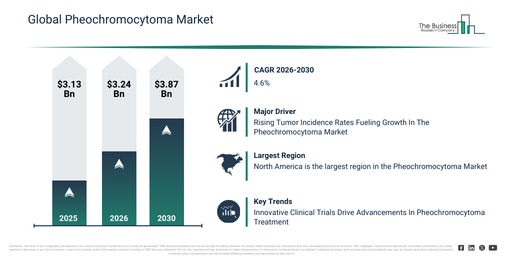
Pheochromocytoma Market Growth From $3.24 Billion In 2026 To $3.87 Billion By 2030 At A CAGR Of 4.6%
The pheochromocytoma market size has exhibited consistent growth in recent years. It is projected to expand from $3.13 billion in 2025 to $3.24 billion in 2026, registering a compound annual growth rate (CAGR) of 3.5%. Historically, this growth can be ascribed to advancements in diagnosing adrenal tumors, the provision of surgical treatment alternatives, increasing clinical recognition of endocrine tumors, the proliferation of imaging-based diagnostic instruments, and a rise in documented cases of hypertension-related ailments.
The pheochromocytoma market size is anticipated to experience consistent expansion over the upcoming years. It is projected to reach $3.87 billion by 2030, exhibiting a compound annual growth rate (CAGR) of 4.6%. This projected growth during the forecast period stems from the increasing integration of precision oncology strategies, augmented investments in rare tumor investigations, the broadening scope of genetic screening initiatives, the heightened application of targeted therapies, and innovations in radionuclide treatment methodologies. Key developments anticipated in this period encompass the greater adoption of sophisticated imaging diagnostics, the rising utilization of genetic testing for tumor identification, a developing preference for minimally invasive surgical interventions, the continued expansion of targeted radionuclide therapies, and an intensified focus on detecting diseases early.
Get A Free Sample Report With In-Depth Market Insights:
Pheochromocytoma Market Demand Drivers: What’s Powering Industry Growth?
The increasing occurrence of tumors is projected to boost the expansion of the pheochromocytoma market in the future. Tumors are defined as unusual cell growths, which can be either benign (non-cancerous) or malignant (cancerous). The rising prevalence of tumors and cancers highlights the necessity for enhanced medical understanding, precise diagnostic methods, and customized treatment plans to effectively manage desmoid pheochromocytoma. Pheochromocytoma, a rare tumor originating in the adrenal glands, contributes to the rising frequency of tumors by increasing the total count of diagnosed endocrine neoplasms, as advancements in detection and greater awareness result in more identified cases.
Pheochromocytoma Market Segment Landscape And Growth Outlook
The pheochromocytoma market covered in this report is segmented –
1) By Type: Adrenal Pheochromocytoma, Extra-Adrenal Pheochromocytoma
2) By Treatment: Medication, Surgery, Radionuclide Treatment, Other Treatments
3) By Diagnosis: Laboratory Tests, Imaging Tests, Genetic Testing
4) By End Users: Hospitals, Clinics, Research And Academic Institutes, Other End Users
Subsegments:
1) By Adrenal Pheochromocytoma: Unilateral Adrenal Pheochromocytoma, Bilateral Adrenal Pheochromocytoma
2) By Extra-Adrenal Pheochromocytoma: Sympathetic Paraganglioma, Parasympathetic Paraganglioma
Pheochromocytoma Market Innovation Trends Shaping Future Development
Leading corporations within the pheochromocytoma market are actively conducting clinical trials to examine novel treatment approaches, therapies, and medications for pheochromocytoma, which facilitates the development of more effective and targeted treatments and subsequently improves patient outcomes. For example, in May 2025, Merck & Co., a US-based biopharmaceutical company, obtained Food and Drug Administration (FDA) approval for Welireg (belzutifan), an oral therapy for adults and pediatric patients (= 12 years) diagnosed with locally advanced pheochromocytoma or paraganglioma (PPGL). This treatment operates by selectively inhibiting hypoxia-inducible factor 2 alpha (HIF 2a), a key molecular driver in numerous PPGL tumors, thereby aiding in the reduction of tumor progression. Moreover, Welireg is designed as a convenient oral therapy, offering a targeted, non-surgical option for the long-term management of advanced pheochromocytoma and paraganglioma (PPGL) in eligible patients.
Pheochromocytoma Market Competitive Landscape: Who Leads The Industry?
Major companies operating in the pheochromocytoma market are Pfizer Inc., Novartis AG, Sanofi S.A., Bristol-Myers Squibb Company, AstraZeneca Plc, Abbott Laboratories, Takeda Pharmaceutical Company Limited, Merck KGaA, Teva Pharmaceutical Company Limited, Mylan N.V., Bausch Health Companies Inc., Daiichi Sankyo Company Limited, Eisai Co. Ltd., Apotex Inc., Sun Pharmaceutical Industries Ltd., Hikma Pharmaceuticals PLC, Endo International plc, Exelixis Inc., Lupin Limited, Lantheus Holdings Inc., Curium Pharma, ANI Pharmaceuticals Inc., Jubilant Cadista Pharmaceuticals Inc., WellSpring Pharmaceutical Corporation, HRA Pharma SE
View The Full Pheochromocytoma Market Report:
Pheochromocytoma Market Regional Split: Which Areas Are Fueling Growth?
North America was the largest region in the pheochromocytoma market in 2025. Asia-Pacific is expected to be the fastest-growing region in the forecast period. The regions covered in the pheochromocytoma market report are Asia-Pacific, South East Asia, Western Europe, Eastern Europe, North America, South America, Middle East, Africa.
Reach Out To Our Team:
The Business Research Company: https://www.thebusinessresearchcompany.com/
Americas: +1 310-496-7795
Asia: +44 7882 955267 & +91 8897263534
Europe: +44 7882 955267
Email us at: marketing@tbrc.info
Follow us on:
LinkedIn: https://in.linkedin.com/company/the-business-research-company
YouTube: https://www.youtube.com/channel/UC24_fI0rV8cR5DxlCpgmyFQ
Global Market Model: https://www.thebusinessresearchcompany.com/global-market-model
Leave a Reply