Featuring market attractiveness scoring, total addressable market sizing, company benchmarking matrices, interactive Excel dashboards, deeper supply chain intelligence, emerging startup tracking, and granular product-level insights, The Business Research Company’s 2026 market reports are built to deliver research that is both more actionable and more strategically valuable.
Rett Syndrome Market Revenue Outlook: What CAGR Lies Ahead Through 2030?
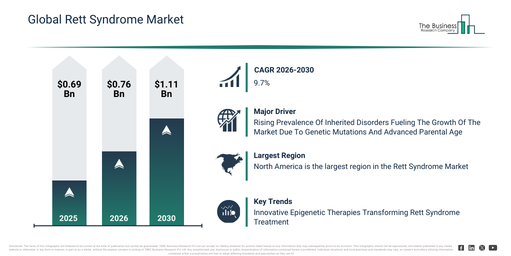
The rett syndrome market size has experienced robust growth in recent years. It is forecast to expand from $0.69 billion in 2025 to $0.76 billion in 2026, exhibiting a compound annual growth rate (CAGR) of 9.9%. This historical growth can be attributed to several factors including heightened clinical awareness of rare neurological disorders, the increased availability of genetic testing for MECP2 mutations, the development of specialized care centers, the proliferation of supportive therapy programs, and increasing advocacy and patient support initiatives.
The rett syndrome market size is anticipated to experience substantial growth in the coming years. It is projected to reach $1.11 billion by 2030, demonstrating a compound annual growth rate (CAGR) of 9.7%. This expansion during the forecast period is primarily driven by advancements in gene therapy platforms, increasing investment in rare disease drug development, the broadening of personalized medicine approaches, the growing utilization of digital health tools in neurology, and an elevated focus on early-stage diagnosis and intervention. Prominent trends expected within this period include the expansion of gene-based therapeutic research, a heightened emphasis on precision diagnosis tools, the increasing adoption of multidisciplinary care approaches, the accelerating development of symptom-targeted therapies, and enhanced integration of digital patient monitoring.
Get A Free Sample Report With In-Depth Market Insights:
Rett Syndrome Market Growth Catalysts And Demand Drivers
The increasing occurrence of inherited disorders is projected to boost the expansion of the rett syndrome market moving forward. These are medical conditions caused by genetic alterations passed from parents to their children, including cystic fibrosis, sickle cell anemia, hemophilia, and Huntington’s disease. The rise in inherited disorders can be attributed to advanced parental age, which heightens the probability of genetic mutations being transmitted to offspring. Rett syndrome enhances the understanding of inherited disorders by emphasizing the crucial role of genetic mutations, specifically within the methyl-CpG-binding protein 2 (MECP2) gene. It offers insights into neurodevelopmental processes, thereby advancing research into genetically based treatments and therapies for other similar conditions.
Rett Syndrome Market Segmentation: How Does The Market Break Down By Category?
The rett syndrome market covered in this report is segmented –
1) By Type: Classic Rett Syndrome, Atypical Rett Syndrome
2) By Stages: Stage IV Late Motor Deterioration, Stage III Plateau, Stage II Rapid Destruction, Stage I Early Onset
3) By Treatment: Medication, Physical Therapy, Occupational Therapy, Speech Language Therapy, Other Treatments
4) By Diagnosis: Blood Test, Genetic Testing, Other Diagnosis
5) By End-Users: Hospitals, Specialty Clinics, Homecare, Other End Users
Subsegments:
1) By Classic Rett Syndrome: Early-Onset Classic Rett Syndrome, Late-Onset Classic Rett Syndrome
2) By Atypical Rett Syndrome: Rett-Like Syndrome, Syndrome With Neurodevelopmental Delays, Sporadic Atypical Rett Syndrome
Rett Syndrome Market Industry Trends: What’s Reshaping Demand?
Leading companies in the rett syndrome market are concentrating their efforts on creating novel treatments, including epigenetic therapies designed to address the fundamental genetic origins of the condition, re-establish the proper function of methyl-CpG-binding protein 2 (MECP2), and potentially alleviate or substantially diminish its symptoms. These epigenetic approaches involve medical interventions intended to alter gene activity without making changes to the primary deoxyribonucleic acid (DNA) sequence, usually by focusing on processes like DNA methylation, histone modification, or ribonucleic acid (RNA) regulation to control gene function. As an example, Unravel Biosciences Inc., a US-based biotechnology firm, secured approval from the U.S.
Rett Syndrome Market Competitive Overview And Top Companies
Major companies operating in the rett syndrome market are Sarepta Therapeutics Inc., Ionis Pharmaceuticals Inc., Acadia Pharmaceuticals Inc., Regenxbio Inc., Beam Therapeutics Inc., Shape Therapeutics Inc., Unravel Biosciences Inc., Neuren Pharmaceuticals Limited, Taysha Gene Therapies, Prilenia Therapeutics Inc., Anavex Life Sciences Corp, Neurogene Inc., Neurolixis Inc., Neurotech International Limited, PTC Therapeutics Inc., Ultragenyx Pharmaceutical Inc., Zogenix Inc., Bluebird Bio Inc., Astellas Gene Therapies Inc., Rocket Pharmaceuticals Inc., Passage Bio Inc., Homology Medicines Inc., Abeona Therapeutics Inc., Orchard Therapeutics plc
View The Full Rett Syndrome Market Report:
Rett Syndrome Market Global Footprint: Which Region Leads The Market?
North America was the largest region in the rett syndrome market in 2025. Asia-Pacific is expected to be the fastest-growing region in the forecast period. The regions covered in the rett syndrome market report are Asia-Pacific, South East Asia, Western Europe, Eastern Europe, North America, South America, Middle East, Africa.
Reach Out To Our Team:
The Business Research Company: https://www.thebusinessresearchcompany.com/
Americas: +1 310-496-7795
Asia: +44 7882 955267 & +91 8897263534
Europe: +44 7882 955267
Email us at: marketing@tbrc.info
Follow us on:
LinkedIn: https://in.linkedin.com/company/the-business-research-company
YouTube: https://www.youtube.com/channel/UC24_fI0rV8cR5DxlCpgmyFQ
Global Market Model: https://www.thebusinessresearchcompany.com/global-market-model
Leave a Reply