Featuring market attractiveness scoring, total addressable market sizing, company benchmarking matrices, interactive Excel dashboards, deeper supply chain intelligence, emerging startup tracking, and granular product-level insights, The Business Research Company’s 2026 market reports are built to deliver research that is both more actionable and more strategically valuable.
Spinal Stenosis Devices Market Growth Analysis: How Will Revenue Trend Over The Forecast Period?
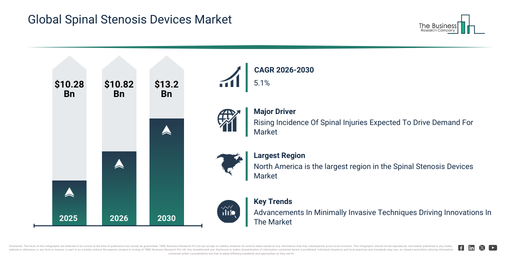
The spinal stenosis devices market has shown robust expansion over recent years. Its valuation is anticipated to climb from $10.28 billion in 2025 to $10.82 billion in 2026, demonstrating a compound annual growth rate (CAGR) of 5.2%. The expansion observed historically stems from an increase in lumbar stenosis cases, an aging demographic, progress in surgical techniques, innovations in orthopedic devices, and the growth of hospital spine programs.
The spinal stenosis devices market is projected to experience robust expansion over the coming years, reaching a valuation of $13.2 billion by 2030, with a compound annual growth rate (CAGR) of 5.1%. This anticipated growth during the forecast period is driven by factors such as advanced implant designs, an increasing need for non-fusion devices, the expansion of ambulatory surgery centers, enhancements in material technology, and a patient preference for less invasive treatment alternatives. Key developments expected within this period include the rise of motion-preserving implants, minimally invasive decompression devices, the development of superior biocompatible materials, procedures leading to quicker recovery times, and spine interventions conducted in outpatient settings.
Get A Free Sample Report With In-Depth Market Insights:
Spinal Stenosis Devices Market Growth Factors Behind Sustained Expansion
An increasing occurrence of spinal injuries is anticipated to boost the expansion of the spinal stenosis devices market in the future. Spinal injuries are characterized as harm to the spinal cord or adjacent components, specifically traumatic damage that disrupts the transmission of sensory and motor signals, potentially resulting in impaired movement, function, and sensation beneath the injury location. This escalating frequency of spinal injuries primarily stems from a rise in traumatic events like automobile accidents and falls, especially among the elderly, alongside an increasing prevalence of non-traumatic factors such as degenerative illnesses and age-related conditions. Spinal stenosis devices offer specific relief and structural stability by easing nerve compression, correcting spinal alignment, and improving movement, consequently enhancing the quality of life for individuals with spinal injuries. The growing occurrence of spinal injuries is fueling the expansion of the spinal stenosis devices market.
Spinal Stenosis Devices Market Segment Outlook: Which Categories Are Growing Fastest?
The spinal stenosis devices market covered in this report is segmented –
1) By Product Type: Interspinous Spacers, Stabilization Systems, Spinal Arthroplasty System, Interbody Fusion Devices
2) By Application: Lumbar Spinal Stenosis, Cervical Spinal Stenosis, Thoracic Spinal Stenosis
3) By End User: Hospitals, Ambulatory Surgical Centres, Others End Users
Subsegments:
1) By Interspinous Spacers: Single-Level Spacers, Multi-Level Spacers, Expandable Spacers
2) By Stabilization Systems: Pedicle Screw Systems, Lateral Screw Systems, Dynamic Stabilization Systems
3) By Spinal Arthroplasty System: Cervical Arthroplasty Systems, Lumbar Arthroplasty Systems, Artificial Disc Replacements
4) By Interbody Fusion Devices: PEEK (Polyetheretherketone) Devices, Titanium Interbody Devices, Bioactive And Biocompatible Devices
Spinal Stenosis Devices Market Strategic Trends: What Defines The Next Growth Phase?
Leading companies within the spinal stenosis devices market are prioritizing technological advancements, such as minimally invasive surgical techniques, to boost surgical precision and shorten patient recovery periods. These minimally invasive methods are surgical operations that employ small incisions, often called ports, to access internal organs, thereby significantly reducing bodily trauma. Such techniques utilize specialized instruments, including cameras and trocars, enabling surgeons to conduct procedures with less discomfort, quicker healing, and fewer complication risks compared to traditional open surgery.
Spinal Stenosis Devices Market Leading Companies And Competitive Benchmarking
Major companies operating in the spinal stenosis devices market are Johnson & Johnson, Medtronic plc, Stryker Corporation, Boston Scientific Corporation, Zimmer Biomet Holdings Inc., Globus Medical Inc., NuVasive Inc., Orthofix Medical Inc., B. Braun Melsungen AG, Xtant Medical, Alphatec Holdings Inc., Vertos Medical Inc., Spineart SA, Spine Wave Inc., Spinal Simplicity LLC, Premia Spine, Meril Life Sciences Pvt. Ltd., Empirical Spine Inc., K2M Group Holdings Inc., RTI Surgical Inc., Camber Spine, SeaSpine Holdings Corporation
View The Full Spinal Stenosis Devices Market Report:
Spinal Stenosis Devices Market Top Region By Revenue And Market Share
North America was the largest region in the spinal stenosis devices market in 2025. Asia-Pacific is expected to be the fastest-growing region in the forecast period. The regions covered in the spinal stenosis devices market report are Asia-Pacific, South East Asia, Western Europe, Eastern Europe, North America, South America, Middle East, Africa.
Reach Out To Our Team:
The Business Research Company: https://www.thebusinessresearchcompany.com/
Americas: +1 310-496-7795
Asia: +44 7882 955267 & +91 8897263534
Europe: +44 7882 955267
Email us at: marketing@tbrc.info
Follow us on:
LinkedIn: https://in.linkedin.com/company/the-business-research-company
YouTube: https://www.youtube.com/channel/UC24_fI0rV8cR5DxlCpgmyFQ
Global Market Model: https://www.thebusinessresearchcompany.com/global-market-model
Leave a Reply