Backed by market attractiveness analysis, total addressable market sizing, company benchmarking matrices, interactive Excel dashboards, wider supply chain intelligence, emerging startup coverage, and detailed product-level insights, The Business Research Company’s 2026 market reports are designed to offer research that is more actionable and strategically valuable than ever.
Spinal Stenosis Treatment Market Revenue Outlook: What CAGR Lies Ahead Through 2030?
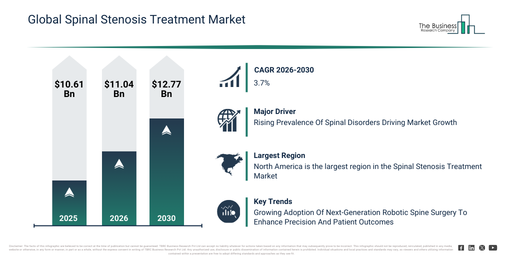
The spinal stenosis treatment market has demonstrated consistent expansion in recent years. Its size is expected to grow from $10.61 billion in 2025 to $11.04 billion in 2026, exhibiting a compound annual growth rate (CAGR) of 4.0%. Historically, this market expansion can be linked to the rise in degenerative spine disorders, the broadening of physical therapy services, advancements in pharmaceutical pain management, improvements in diagnostic techniques, and increased awareness of non-surgical care.
The market for spinal stenosis treatment is projected to experience consistent expansion over the upcoming years. By 2030, this market is anticipated to reach a valuation of $12.77 billion, demonstrating a compound annual growth rate (CAGR) of 3.7%. Factors contributing to this growth during the projection period include sophisticated interventional pain management methods, tailored treatment protocols, remote rehabilitation offerings, a decrease in reliance on surgical procedures, and evolved long-term care frameworks. Key developments anticipated in this period encompass integrated therapy strategies, interventions guided by imaging technology, increasing acceptance of non-surgical treatments, customized rehabilitation programs, and the expansion of outpatient care models.
Get A Free Sample Report With In-Depth Market Insights:
Spinal Stenosis Treatment Market Growth Drivers: What’s Behind The Acceleration?
The escalating occurrence of spinal disorders is projected to fuel the expansion of the spinal stenosis treatment market in the foreseeable future. These disorders encompass conditions impacting the vertebral bones, intervertebral discs, nerves, or surrounding soft tissues of the spine, leading to discomfort, restricted movement, or neurological manifestations. Factors contributing to the increasing incidence of spinal disorders include an aging population, inactive lifestyles, excess weight, incorrect posture, job-related hazards, and more effective diagnostic methods. Treatments for spinal stenosis are applied in cases of spinal disorders to ease nerve impingement, lessen pain, and enhance range of motion in conditions such as degenerative disc disease and herniated discs. The rising occurrence of spinal disorders is a key driver for the growth of the spinal stenosis treatment market.
Spinal Stenosis Treatment Market Segmentation And Category Overview
The spinal stenosis treatment market covered in this report is segmented –
1) By Type: Cervical Stenosis, Lumbar Stenosis
2) By Treatment: Medication, Physical Therapy, Surgery, Other Treatments
3) By End Users: Hospitals, Homecare, Specialty Clinics, Other End-Users
Subsegments:
1) By Cervical Stenosis: Physical Therapy, Medications, Spinal Injections, Decompression Surgery, Spinal Fusion
2) By Lumbar Stenosis: Pain Management, Epidural Steroid Injections, Minimally Invasive Procedures, Laminectomy, Artificial Disc Replacement
Spinal Stenosis Treatment Market Trends Redefining Industry Growth
Leading companies within the spinal stenosis treatment market are concentrating on technological innovations, specifically robotic-assisted minimally invasive spine surgeries, to improve surgical accuracy, reduce post-operative complications, and accelerate recovery time for patients with spinal disorders. These robotic surgical systems enable enhanced navigation, real-time visualization, and exceptionally precise implant placement, which supports better clinical outcomes and greater operational efficiency. For instance, in July 2025, Yas Clinic, a UAE-based, research-driven healthcare provider, launched an advanced robotic spine surgery programme. This initiative is designed to treat complex spinal conditions, including lumbar and cervical stenosis, with heightened safety, diminished tissue damage, and quicker rehabilitation. By integrating next-generation robotics into surgical workflows, the programme reinforces the adoption of minimally invasive techniques and reflects the growing emphasis on precision-based and patient-centric interventions within spinal stenosis treatment.
Spinal Stenosis Treatment Market Competitive Analysis Of Leading Industry Participants
Major companies operating in the spinal stenosis treatment market are Johnson & Johnson, Medtronic plc, Zimmer Biomet Holdings Inc., Sumitomo Dainippon Pharma Co. Ltd, Ono Pharmaceutical Co. Ltd, Stryker Corporation, Globus Medical Inc., Orthofix Holdings Inc., Aesculap Implant Systems LLC, Alphatec Spine Inc, RTI Surgical Holdings Inc, B. Braun Melsungen AG, Spinal Elements Inc., Xtant Medical Holdings Inc., Precision Spine Inc., Spineart SA, Yungjin Pharm Co. Ltd, Zavation Medical Products LLC, Aurora Spine Corporation, Empirical Spine Inc.
View The Full Spinal Stenosis Treatment Market Report:
Spinal Stenosis Treatment Market Geographic Spread And Regional Opportunities
North America was the largest region in the spinal stenosis treatment market in 2025. Asia-Pacific is expected to be the fastest-growing region in the forecast period. The regions covered in the spinal stenosis treatment market report are Asia-Pacific, South East Asia, Western Europe, Eastern Europe, North America, South America, Middle East, Africa.
Reach Out To Our Team:
The Business Research Company: https://www.thebusinessresearchcompany.com/
Americas: +1 310-496-7795
Asia: +44 7882 955267 & +91 8897263534
Europe: +44 7882 955267
Email us at: marketing@tbrc.info
Follow us on:
LinkedIn: https://in.linkedin.com/company/the-business-research-company
YouTube: https://www.youtube.com/channel/UC24_fI0rV8cR5DxlCpgmyFQ
Global Market Model: https://www.thebusinessresearchcompany.com/global-market-model
Leave a Reply