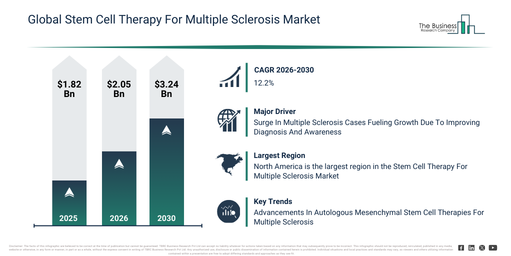
Backed by market attractiveness analysis, total addressable market sizing, company benchmarking matrices, interactive Excel dashboards, wider supply chain intelligence, emerging startup coverage, and detailed product-level insights, The Business Research Company’s 2026 market reports are designed to offer research that is more actionable and strategically valuable than ever.
Stem Cell Therapy For Multiple Sclerosis Market Forecast: What Value Will The Market Reach By 2030?
The stem cell therapy for multiple sclerosis market has seen substantial growth in recent years. It is anticipated to expand from $1.82 billion in 2025 to $2.05 billion in 2026, achieving a compound annual growth rate (CAGR) of 12.4%. Historically, this growth has been fueled by advancements in multiple sclerosis treatment research, an increase in the diagnosis rates of autoimmune disorders, the expansion of stem cell clinical trials, improved patient selection protocols, and the growing availability of specialized neurology centers.
The stem cell therapy for multiple sclerosis market is projected to experience substantial expansion in the coming years. This market is anticipated to reach $3.24 billion by 2030, growing at a compound annual growth rate (CAGR) of 12.2%. The increase during the forecast period is attributable to factors such as increasing long-term efficacy data for stem cell therapies, rising demand for disease-modifying treatments, the expansion of personalized neurology care, growing investments in neuro-regenerative research, and increasing collaboration between hospitals and research institutes. Prominent trends expected in this period include the increasing adoption of autologous hematopoietic stem cell transplants, a growing focus on immune system reset therapies, rising adoption of mesenchymal stem cell applications, increasing use of targeted delivery methods, and enhanced clinical monitoring and outcome tracking.
Get A Free Sample Report With In-Depth Market Insights:
Stem Cell Therapy For Multiple Sclerosis Market Industry Drivers: What’s Behind The Revenue Growth?
The rising occurrence of multiple sclerosis (MS) is anticipated to substantially fuel the expansion of the stem cell therapy for multiple sclerosis market in the future. MS is a long-term autoimmune condition characterized by damage to the central nervous system, specifically impacting the protective myelin sheath around nerve fibers. This damage disrupts communication between the brain and body, resulting in symptoms like fatigue, muscle weakness, and issues with vision. This increase in MS prevalence is mainly due to enhanced diagnostic methods; progress in medical imaging and greater public awareness allow for more precise and earlier diagnosis of cases, thereby leading to a higher count of reported instances. Stem cell therapy for multiple sclerosis offers benefits by assisting in the repair of damaged myelin, regulating irregular immune responses, and fostering the regeneration of nerve cells, which in turn helps alleviate symptoms and may decelerate the disease’s progression. The growing occurrence of multiple sclerosis is projected to propel the growth of the stem cell therapy for multiple sclerosis market.
Stem Cell Therapy For Multiple Sclerosis Market Breakdown By Product Type And Application
The stem cell therapy for multiple sclerosis market covered in this report is segmented –
1) By Type Of Stem Cell: Embryonic Stem Cells, Adult Stem Cells, Induced Pluripotent Stem Cells, Mesenchymal Stem Cells, Hematopoietic Stem Cells
2) By Treatment Approach: Autologous Stem Cell Therapy, Allogeneic Stem Cell Therapy
3) By Delivery Method: Intravenous Injection, Intrathecal Injection, Direct Intraspinal Administration
4) By Application: Relapsing-Remitting Multiple Sclerosis (RRMS), Primary Progressive Multiple Sclerosis (PPMS), Secondary Progressive Multiple Sclerosis (SPMS), Progressive Relapsing Multiple Sclerosis (PRMS)
5) By End-User: Hospitals, Specialty Clinics, Research Institutes, Other End-Users
Subsegments:
1) By Embryonic Stem Cells: Inner Cell Mass Cells, Blastocyst Derived Cells, Totipotent Stem Cells
2) By Adult Stem Cells: Bone Marrow Stem Cells, Neural Stem Cells, Tissue Specific Stem Cells
3) By Induced Pluripotent Stem Cells: Reprogrammed Somatic Cells, Patient Derived Cells
4) By Mesenchymal Stem Cells: Adipose Derived Stem Cells, Umbilical Cord Derived Stem Cells, Bone Marrow Derived Stem Cells
5) By Hematopoietic Stem Cells: Peripheral Blood Stem Cells, Bone Marrow Stem Cells, Umbilical Cord Blood Stem Cells
Stem Cell Therapy For Multiple Sclerosis Market Growth Trends Reshaping The Competitive Landscape
Leading firms within the stem cell therapy for multiple sclerosis market are prioritizing the creation of novel products, like adipose-derived mesenchymal stem cells, to improve the effectiveness, safety, and regenerative capabilities of therapies for individuals suffering from both relapsing-remitting and progressive forms of multiple sclerosis. Adipose-derived mesenchymal stem cells (ADMSCs) are multipotent cells sourced from fat tissue, capable of differentiating into various cell types and possessing regenerative and immunomodulatory characteristics that prove advantageous in addressing autoimmune and neurodegenerative conditions like multiple sclerosis. As an example, during August 2025, Hope Biosciences, LLC, a biopharmaceutical company based in the US, unveiled its HB-adMSCs therapy. This treatment employs adipose-derived mesenchymal stem cells, delivered via high-dose infusions and repeated administrations across a 32-week period. This therapy integrates immunomodulatory and neuroregenerative mechanisms, providing the prospect of decelerating disease advancement and mending myelin damage, thereby setting it apart from standard immunosuppressive treatments.
Stem Cell Therapy For Multiple Sclerosis Market Company Landscape And Competitive Strategy
Major companies operating in the stem cell therapy for multiple sclerosis market are Sana Biotechnology Inc., Century Therapeutics Inc., Reelabs Private Limited, PlacidWay LLC, MedAccess Guarantee Ltd, Celltex Therapeutics Corporation, CELLTEX THERAPEUTICS CORP, BrainStorm Cell Therapeutics Ltd., Athersys Inc., Advancells Dermaceuticals Private Limited, ImStem Biotechnology Inc., NeuroGenesis Bio Inc., Stem Cell Medicine Ltd., Biotherapy International, R3 Stem Cell, Hope Biosciences LLC, FibroBiologics Inc., Global Institute of Stem Cell Therapy and Research Inc., ProgenCell, Stemwell
View The Full Stem Cell Therapy For Multiple Sclerosis Market Report:
Stem Cell Therapy For Multiple Sclerosis Market Regional Breakdown: Where Is Demand Concentrated?
North America was the largest region in the stem cell therapy for multiple sclerosis market in 2025. Asia-Pacific is expected to be the fastest-growing region in the forecast period. The regions covered in the stem cell therapy for multiple sclerosis market report are Asia-Pacific, South East Asia, Western Europe, Eastern Europe, North America, South America, Middle East, Africa.
Reach Out To Our Team:
The Business Research Company: https://www.thebusinessresearchcompany.com/
Americas: +1 310-496-7795
Asia: +44 7882 955267 & +91 8897263534
Europe: +44 7882 955267
Email us at: marketing@tbrc.info
Follow us on:
LinkedIn: https://in.linkedin.com/company/the-business-research-company
YouTube: https://www.youtube.com/channel/UC24_fI0rV8cR5DxlCpgmyFQ
Global Market Model: https://www.thebusinessresearchcompany.com/global-market-model
Leave a Reply