Backed by market attractiveness analysis, total addressable market sizing, company benchmarking matrices, interactive Excel dashboards, wider supply chain intelligence, emerging startup coverage, and detailed product-level insights, The Business Research Company’s 2026 market reports are designed to offer research that is more actionable and strategically valuable than ever.
Systemic Juvenile Idiopathic Arthritis Market Revenue Outlook: What CAGR Lies Ahead Through 2030?
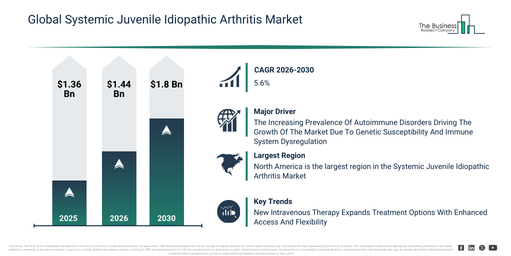
The market size for systemic juvenile idiopathic arthritis has demonstrated robust growth in recent years. It is projected to increase from $1.36 billion in 2025 to $1.44 billion in 2026, at a compound annual growth rate (CAGR) of 5.9%. The expansion observed historically can be attributed to improved recognition of sjia as a distinct condition, the increasing availability of biologic drugs, the expansion of pediatric specialty care, the growth of academic research programs, and enhanced diagnostic criteria for inflammatory diseases.
The market for systemic juvenile idiopathic arthritis is projected to experience substantial expansion over the upcoming years. By 2030, this market is anticipated to reach a valuation of $1.8 billion, demonstrating a compound annual growth rate (CAGR) of 5.6%. This growth during the projection period stems from several factors, including escalating investments in pediatric autoimmune research, the increasing uptake of interleukin-targeted therapies, the expansion of clinical trials for rare diseases, a heightened emphasis on personalized medicine, and improved access to specialized pediatric care. Key trends observed within the forecast timeframe encompass the wider adoption of targeted biologic therapies, a greater emphasis on early and precise sjia diagnosis, the expanding application of personalized treatment protocols, the growth of clinical research within pediatric rheumatology, and improved monitoring of disease progression.
Get A Free Sample Report With In-Depth Market Insights:
Systemic Juvenile Idiopathic Arthritis Market Industry Drivers: What’s Behind The Revenue Growth?
The rising occurrence of autoimmune conditions is anticipated to fuel expansion in the systemic juvenile idiopathic arthritis market moving ahead. Autoimmune disorders are characterized by the immune system erroneously attacking the body’s healthy cells, tissues, or organs. This increase in autoimmune disorder prevalence largely stems from genetic susceptibility, where inherited genes can make individuals prone to atypical immune responses that incorrectly target the body’s tissues. Systemic juvenile idiopathic arthritis, a specific autoimmune condition, provides significant understanding into the mechanisms of immune system dysfunction and the inflammatory processes contributing to disease progression. Through the study of SJIA, researchers acquire a more profound grasp of how irregular immune responses lead to the widespread inflammation and tissue damage typical of autoimmune disorders. The rising occurrence of autoimmune disorders is fueling the expansion of the systemic juvenile idiopathic arthritis market.
Systemic Juvenile Idiopathic Arthritis Market Segment Outlook: Which Categories Are Growing Fastest?
The systemic juvenile idiopathic arthritis market covered in this report is segmented –
1) By Treatment Type: Drug Treatment, Biologics, Other Treatment Types
2) By Age Group: Infants, Children, Adolescents
3) By Distribution Channel: Hospital Pharmacies, Retail Pharmacies, Online Pharmacies
4) By End-User: Hospitals, Specialty Clinics, Academic Research Centers, Other End-Users
Subsegments:
1) By Drug Treatment: Nonsteroidal Anti-Inflammatory Drugs, Corticosteroids, Disease-Modifying Antirheumatic Drugs
2) By Biologics: Interleukin-1 Inhibitors, Interleukin-6 Inhibitors, Tumor Necrosis Factor Inhibitors
3) By Other Treatment Types: Physical Therapy, Occupational Therapy, Supportive Care, Experimental Therapies
Systemic Juvenile Idiopathic Arthritis Market Growth Trends Reshaping The Competitive Landscape
Companies operating in the systemic juvenile idiopathic arthritis market are concentrating on developing innovative products, such as intravenous formulations, to enhance efficacy, safety, and patient compliance. Intravenous formulations are medications prepared for direct administration into a vein, enabling swift drug entry into the bloodstream for rapid and controlled therapeutic effects. For example, in October 2025, Celltrion Inc., a South Korea-based biopharmaceutical company, introduced AVTOZMA, a tocilizumab biosimilar intravenous formulation, in the United States. This biosimilar acts as an alternative to the reference product Actemra and has obtained regulatory approval for several indications, including systemic juvenile idiopathic arthritis (sJIA), rheumatoid arthritis, and cytokine release syndrome. The launch of AVTOZMA is anticipated to considerably broaden patient access to advanced therapies by offering a cost-effective treatment option while maintaining comparable safety, efficacy, and quality standards to the originator drug. By providing both intravenous and subcutaneous formulations, AVTOZMA offers clinicians greater flexibility in customizing treatment regimens to address the diverse needs of individual patients, thereby optimizing therapeutic outcomes across various clinical settings.
Systemic Juvenile Idiopathic Arthritis Market Leading Companies And Competitive Benchmarking
Major companies operating in the systemic juvenile idiopathic arthritis market are Johnson And Johnson, F. Hoffmann-La Roche Limited, Merck & Co. Inc., Pfizer Inc., AbbVie Inc., Sanofi S.A., Novartis AG, AstraZeneca PLC, Bristol-Myers Squibb Company, Eli Lilly And Company, Takeda Pharmaceutical Company Limited, Amgen Incorporated, Boehringer Ingelheim, Regeneron Pharmaceuticals Incorporated, Chugai Pharmaceutical Company Limited, Genentech Incorporated, Swedish Orphan Biovitrum Aktiebolag, Zydus Lifesciences Limited, Celltrion Incorporated, Mycenax Biotech Incorporated.
View The Full Systemic Juvenile Idiopathic Arthritis Market Report:
Systemic Juvenile Idiopathic Arthritis Market Global Footprint: Which Region Leads The Market?
North America was the largest region in the systemic juvenile idiopathic arthritis market in 2025. Asia-Pacific is expected to be the fastest-growing region in the forecast period. The regions covered in the systemic juvenile idiopathic arthritis market report are Asia-Pacific, South East Asia, Western Europe, Eastern Europe, North America, South America, Middle East, Africa.
Reach Out To Our Team:
The Business Research Company: https://www.thebusinessresearchcompany.com/
Americas: +1 310-496-7795
Asia: +44 7882 955267 & +91 8897263534
Europe: +44 7882 955267
Email us at: marketing@tbrc.info
Follow us on:
LinkedIn: https://in.linkedin.com/company/the-business-research-company
YouTube: https://www.youtube.com/channel/UC24_fI0rV8cR5DxlCpgmyFQ
Global Market Model: https://www.thebusinessresearchcompany.com/global-market-model
Leave a Reply