Backed by market attractiveness analysis, total addressable market sizing, company benchmarking matrices, interactive Excel dashboards, wider supply chain intelligence, emerging startup coverage, and detailed product-level insights, The Business Research Company’s 2026 market reports are designed to offer research that is more actionable and strategically valuable than ever.
Treatment-Resistant Depression Market CAGR Outlook And Future Development
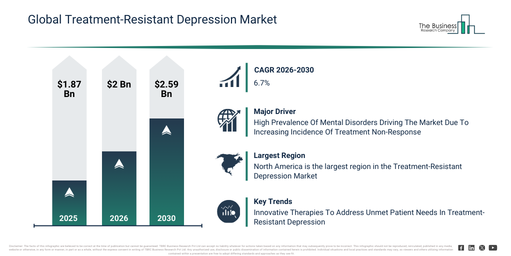
The treatment-resistant depression market has shown robust expansion in recent years. It is projected to grow from $1.87 billion in 2025 to $2 billion in 2026, at a compound annual growth rate (CAGR) of 6.9%. This historical growth can be attributed to several factors, including the rising prevalence of major depressive disorder, the limited efficacy of conventional antidepressants, an increased diagnosis of refractory depression cases, the expansion of psychiatric specialty clinics, and the growing acceptance of advanced mental health therapies.
The market for treatment-resistant depression is anticipated to experience substantial expansion over the coming years. Projections indicate it will reach a valuation of $2.59 billion by 2030, exhibiting a compound annual growth rate (CAGR) of 6.7%. This anticipated growth during the forecast period stems from factors such as heightened investments in precision psychiatry, the expanding approval of ketamine and esketamine treatments, the broader adoption of biomarker-guided treatment selection, an escalating need for sustained depression management options, and the increased utilization of digital therapeutic support instruments. Key trends projected for the forecast timeframe encompass the increasing embrace of innovative rapid-acting antidepressants, a growing application of neuromodulation therapies, an intensified emphasis on individualized psychiatry methods, the broadening of research into psychedelic-based treatments, and improved incorporation of digital mental health instruments.
Get A Free Sample Report With In-Depth Market Insights:
Treatment-Resistant Depression Market Growth Momentum: What Factors Are Shaping Demand?
The increasing occurrence of mental disorders is projected to fuel the expansion of the treatment-resistant depression market in the future. These conditions encompass a wide spectrum of ailments impacting a person’s thought processes, feelings, and actions, frequently resulting in considerable suffering and functional limitations in everyday activities. A key reason for the widespread nature of mental disorders includes genetic predisposition, where inherited genetic differences can alter brain chemistry, making individuals more vulnerable to conditions like depression, anxiety, and schizophrenia. Treatment-resistant depression (TRD) offers assistance to those with mental disorders by advocating for tailored and innovative therapeutic approaches when conventional treatments prove ineffective, thereby enhancing their prospects for recovery and overall well-being. The widespread occurrence of mental disorders is propelling the expansion of the treatment-resistant depression market.
Treatment-Resistant Depression Market Segments: Where Is Growth Concentrated?
The treatment-resistant depression market covered in this report is segmented –
1) By Drug Class: Selective Serotonin Reuptake Inhibitors (SSRIs), Monoamine Oxidase Inhibitors, Tricyclic Antidepressants, Psychedelics
2) By Route Of Administration: Oral, Parenteral, Other Routes Of Administration
3) By Distribution Channel: Hospital Pharmacies, Retail Pharmacies, Online Pharmacies
4) By End-User: Hospitals, Homecare, Specialty Clinics, Other End-Users
Subsegments:
1) By Selective Serotonin Reuptake Inhibitors (SSRIs): Fluoxetine, Sertraline, Paroxetine, Citalopram, Escitalopram
2) By Monoamine Oxidase Inhibitors (MAOIs): Phenelzine, Tranylcypromine, Isocarboxazid, Selegiline
3) By Tricyclic Antidepressants (TCAs): Amitriptyline, Nortriptyline, Imipramine, Clomipramine, Doxepin
4) By Psychedelics: Ketamine, Esketamine, Psilocybin, Lysergic Acid Diethylamide (LSD), 3,4-Methylenedioxymethamphetamine (MDMA)
Treatment-Resistant Depression Market Trends: What’s Defining The Industry’s Next Phase?
Companies active in the treatment-resistant depression market are concentrating on creating novel therapies, such as monotherapy, to fulfill unmet patient requirements, enhance effectiveness, and minimize adverse effects. Monotherapy involves using a single treatment or medication for a condition, rather than combining multiple approaches. It aids in treating treatment-resistant depression by providing a singular, concentrated treatment that may prove more beneficial for patients who have not responded to various medications. For example, in January 2025, Johnson & Johnson Services Inc., a pharmaceutical, biotechnology, and medical technology firm based in the US, announced the U.S. Food and Drug Administration (FDA), a US-based government regulatory body, had approved SPRAVATO (esketamine) nasal spray. This is a rapid-acting treatment intended for adults suffering from treatment-resistant depression (TRD). SPRAVATO is administered in conjunction with an oral antidepressant when individuals have not adequately responded to a minimum of two other antidepressant therapies. The drug’s swift actions address the shortcomings of conventional antidepressants, which often take several weeks to show results. As a derivative of ketamine, esketamine functions by targeting the brain’s NMDA receptors, potentially elevating mood within hours. This approval represented a substantial stride forward in the realm of mental health treatment.
Treatment-Resistant Depression Market Key Participants And Competitive Landscape
Major companies operating in the treatment-resistant depression market are Pfizer Inc., Johnson & Johnson Services Inc., Neurocrine Biosciences Inc., Relmada Therapeutics Inc., Neuronetics Inc., COMPASS Pathways, BrainsWay Ltd., Magstim Company Limited, MindMed, Alto Neuroscience, Sage Therapeutics Inc., MindBio Therapeutics Ltd., Reunion Neuroscience
View The Full Treatment-Resistant Depression Market Report:
Treatment-Resistant Depression Market Regional Breakdown: Where Is Demand Concentrated?
North America was the largest region in the treatment-resistant depression market in 2025. Asia-Pacific is expected to be the fastest-growing region in the forecast period. The regions covered in the treatment-resistant depression market report are Asia-Pacific, South East Asia, Western Europe, Eastern Europe, North America, South America, Middle East, Africa.
Reach Out To Our Team:
The Business Research Company: https://www.thebusinessresearchcompany.com/
Americas: +1 310-496-7795
Asia: +44 7882 955267 & +91 8897263534
Europe: +44 7882 955267
Email us at: marketing@tbrc.info
Follow us on:
LinkedIn: https://in.linkedin.com/company/the-business-research-company
YouTube: https://www.youtube.com/channel/UC24_fI0rV8cR5DxlCpgmyFQ
Global Market Model: https://www.thebusinessresearchcompany.com/global-market-model
Leave a Reply