With a focus on actionable insights and strategic value, The Business Research Company’s 2026 market reports include market attractiveness scoring, total addressable market sizing, company benchmarking matrices, interactive Excel dashboards, deeper supply chain intelligence, emerging startup tracking, and granular product-level insights.
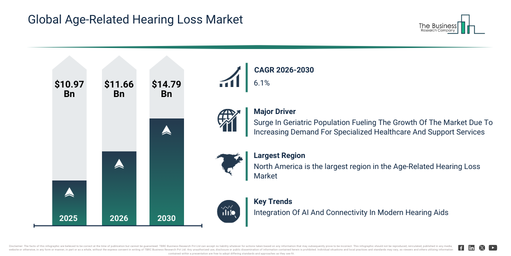
Age-Related Hearing Loss Market Size Forecast Points To $14.79 Billion In Revenue By 2030
The age-related hearing loss market has demonstrated significant growth in recent years. Projections indicate its expansion from $10.97 billion in 2025 to $11.66 billion in 2026, exhibiting a compound annual growth rate (CAGR) of 6.3%. Historically, this growth has been linked to factors such as limited awareness of hearing loss in older adults, high cost of hearing devices, a shortage of trained audiologists, reliance on hospital-based distribution, and the low adoption of cochlear implants.
The market for age-related hearing loss is projected to experience robust expansion over the coming years. By 2030, this market is anticipated to reach $14.79 billion, demonstrating a compound annual growth rate (CAGR) of 6.1%. This anticipated growth during the forecast period is attributable to several factors, including advancements in smart and AI-powered hearing aid technologies, the expanding elderly population, a surge in governmental initiatives promoting hearing healthcare, the rise of tele-audiology and digital distribution channels, and broader insurance coverage for hearing devices. Key trends expected during this period involve a greater embrace of sophisticated hearing aid technologies, a heightened inclination towards cochlear implants for severe hearing loss cases, increased deployment of assistive listening devices in public areas, the broadening of online sales avenues for hearing devices, and enhanced awareness and diagnosis of age-related hearing impairments.
Get A Free Age-Related Hearing Loss Market Sample Covering Drivers, Trends And Key Players:
Age-Related Hearing Loss Market Driver Analysis: Key Factor Supporting Revenue Growth
The expanding geriatric population, defined as individuals aged 65 years and older, is poised to drive the growth of the age-related hearing loss market moving forward. This increase in the elderly population is a result of rising life expectancy, stemming from advancements in healthcare, improved living standards, and more effective management of chronic illnesses, which allow a greater number of people to live longer. Managing age-related hearing loss supports this demographic by highlighting the importance of specialized hearing aids, communication strategies, and healthcare services to enhance their quality of life and promote social participation. Therefore, the expanding geriatric population is a key driver for the growth of the age-related hearing loss market.
Age-Related Hearing Loss Market Segmentation Framework: Major Segments At A Glance
The age-related hearing loss market covered in this report is segmented –
1) By Product Type: Hearing Aids, Cochlear Implants, Assistive Listening Devices, Other Product Types
2) By Distribution Channel: Hospitals, Audiology Clinics, Online Stores, Other Distribution Channel
3) By End-User: Adults, Geriatric Population
Subsegments:
1) By Hearing Aids: Behind-the-Ear (BTE), In-the-Ear (ITE), Receiver-in-the-Ear (RITE), Completely-in-the-Canal (CIC), In-the-Canal (ITC), Invisible-in-the-Canal (IIC), Smart Hearing Aids
2) By Cochlear Implants: Unilateral Cochlear Implants, Bilateral Cochlear Implants, Wireless Cochlear Implants, Hybrid Cochlear Implants
3) By Assistive Listening Devices: FM Systems, Infrared Systems, Induction Loop Systems, Personal Amplifiers, TV Streamers and Amplifiers
4) By Other Product Types: Bone Anchored Hearing Systems, Tinnitus Maskers
Latest Age-Related Hearing Loss Market Developments And Emerging Trends
Leading companies within the age-related hearing loss market are prioritizing the creation of advanced technologies, including smart hearing aids equipped with AI-based sound processing and Bluetooth connectivity. Their aim is to boost auditory performance, decrease listening strain, and elevate both user experience and overall quality of life. Such hearing aids, featuring AI-based sound processing and Bluetooth connectivity, automatically adjust to diverse listening situations by optimizing sound in real-time, while also allowing for smooth audio streaming and device management via smartphone integration.
Which Companies Are Shaping The Age-Related Hearing Loss Market?
Major companies operating in the age-related hearing loss market are Sonova Holding AG, Bose Corporation, Demant A/S, Amplifon S.p.A., WS Audiology, Cochlear Limited, Starkey Hearing Technologies, MED-EL Elektromedizinische Geräte GmbH, Miracle-Ear Inc., Audina Hearing Instruments Inc., SeboTek Hearing Systems LLC, Sound World Solutions Inc., GN Hearing A/S, Audicus Inc., Lexie Hearing, Nuheara Limited, Audien Hearing, Orka Hearing, Envoy Medical Corporation, Nurotron Biotechnology Co. Ltd.
Dive Deeper Into The Age-Related Hearing Loss Market With The Full Report:
Age-Related Hearing Loss Market Regional Distribution: Where Is Revenue Concentrated?
North America was the largest region in the age-related hearing loss market in 2025. Asia-Pacific is expected to be the fastest-growing region in the forecast period. The regions covered in the age-related hearing loss market report are Asia-Pacific, South East Asia, Western Europe, Eastern Europe, North America, South America, Middle East, Africa.
Reach Out To Our Team:
The Business Research Company: https://www.thebusinessresearchcompany.com/
Americas: +1 310-496-7795
Asia: +44 7882 955267 & +91 8897263534
Europe: +44 7882 955267
Email us at: marketing@tbrc.info
Follow us on:
LinkedIn: https://in.linkedin.com/company/the-business-research-company
YouTube: https://www.youtube.com/channel/UC24_fI0rV8cR5DxlCpgmyFQ
Global Market Model: https://www.thebusinessresearchcompany.com/global-market-model
Leave a Reply