Claim your 30% discount on Global Market Reports with code ONLINE30. Limited time only.
What Is the Forecast for the Dysautonomia (Autonomic Dysfunction) Market from 2024 to 2025?
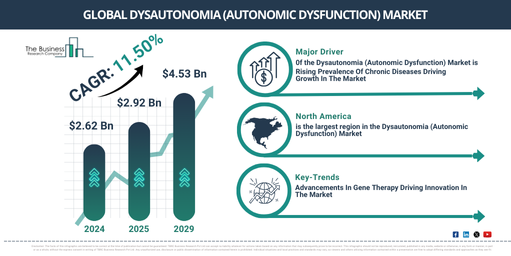
The market for dysautonomia (autonomic dysfunction) has seen swift expansion in the past few years. It’s projected to rise from $2.62 billion in 2024 to $2.92 billion in 2025, boasting a compound annual growth rate (CAGR) of 11.8%. Several factors contributed to the growth during the historical period including a higher incidence of autonomic disorders, increased awareness about dysautonomia, growing healthcare spending, more extensive research into neurodegenerative diseases, and enhanced government backing for rare diseases.
What Is the Projected Market Size of the Dysautonomia (Autonomic Dysfunction) Market?
In the coming years, the dysautonomia (autonomic dysfunction) market is projected to experience a swift expansion, reaching $4.53 billion in 2029 with a compound annual growth rate (CAGR) of 11.5%. This growth during the projected period is due to several factors including, the heightened adaptation of personalized medicine, a rise in clinical trials for groundbreaking treatments, increasing government aid for the research of rare diseases, expansion of telemedicine and remote monitoring solutions, and the augmented availability of orphan drugs. Future trends predicted for this timeframe encompass the integration of artificial intelligence in diagnostics, the evolution of targeted therapies, the use of wearable devices for autonomic monitoring, progress in gene therapies, as well as innovative patient-centric treatment methods.
Download The Free Sample Report Here:
https://www.thebusinessresearchcompany.com/sample.aspx?id=21177&type=smp
Who are the Major Competitors in the Dysautonomia (Autonomic Dysfunction) Market Outlook?
Major companies operating in the dysautonomia (autonomic dysfunction) market are Teva Pharmaceutical Industries Ltd., H. Lundbeck A/S, Aurobindo Pharma Limited, Hikma Pharmaceuticals PLC, Cadila Healthcare Limited (Zydus Cadila), Lupin Limited, Nemours Children’s Health Delaware, Alnylam Pharmaceuticals Inc., Biohaven Pharmaceuticals Holding Company Ltd., Aurora Health Care Inc., Camber Pharmaceuticals Inc., Theravance Biopharma Inc., Tocris Bioscience, Celltex Therapeutics Corporation, DyAnsys Inc., Axplora Inc., MODAG GmbH, Inhibikase Therapeutics Inc., Mylan Pharmaceuticals Private Limited, Chelsea Therapeutics International Ltd.
What Is Fueling Growth in the Dysautonomia (Autonomic Dysfunction) Market?
The surge in chronic disease prevalence is likely to fuel the expansion of the dysautonomia (autonomic dysfunction) market in the future. Chronic diseases are health conditions enduring three months or longer. The escalating incidence of chronic diseases is influenced by the increasing prevalence of multimorbidity, where individuals are simultaneously diagnosed with multiple chronic disorders. Dysautonomia (autonomic dysfunction) significantly impacts chronic diseases by tampering the body’s capacity to regulate vital functions such as heart rate, blood pressure, and digestion, often intensifying symptoms and creating complexities in disease control. For instance, a report from the National Health Service, a UK-based healthcare system, in October 2023 demonstrated that the incidence of Type 1 diabetes in England rose from 261,710 cases in 2020-21 to 270,935 cases in 2021-22, a year-over-year increase of 3.5%. Therefore, the surging incidence of chronic diseases is fuelling dysautonomia (autonomic dysfunction) market growth. Autoimmune And Neurological Disorders Increments Fuel Market Expansion
Request For A Customized Report:
https://www.thebusinessresearchcompany.com/customise?id=21177&type=smp
Which Dysautonomia (Autonomic Dysfunction) Market Segments Are Growing the Fastest?
The dysautonomia (autonomic dysfunction) market covered in this report is segmented –
1) By Type: Neurogenic Orthostatic Hypotension (NOH), Postural Orthostatic Tachycardia Syndrome (POTS), Multiple System Atrophy (MSA), Pure Autonomic Failure (PAF), Other Types
2) By Tests: Cardiovagal and Vasomotor Function Tests, Thermoregulatory Sweat Test (TST), Sympathetic Skin Response (SSR), Quantitative Sudomotor Axon Reflex Test, Other Tests
3) By Treatment: Physical Therapy, Exercise Therapy, Counseling, Other Treatments
4) By Distribution Channel: Hospital Pharmacy, Online Pharmacy, Retail Pharmacy
5) By End User: Hospitals, Clinics, Diagnostic Centers, Research Institutes
Subsegments:
1) By Neurogenic Orthostatic Hypotension (NOH): Primary NOH, Secondary NOH (due to Parkinson’s Disease, Diabetes, etc.), Pharmacological Management of NOH, Non-Pharmacological Interventions
2) By Postural Orthostatic Tachycardia Syndrome (POTS): Hyperadrenergic POTS, Hypovolemic POTS, Neuropathic POTS, Autoimmune POTS, Treatment With Beta-Blockers, Fludrocortisone, And Salt Supplements
3) By Multiple System Atrophy (MSA): MSA-P (Parkinsonism), MSA-C (Cerebellar), MSA-A (Autonomic), Disease-Modifying and Symptomatic Treatment
4) By Pure Autonomic Failure (PAF): Idiopathic PAF, Secondary PAF (due to neurodegenerative diseases), Autonomic Supportive Treatments
5) By Other Types: Familial Dysautonomia (FD), Diabetic Autonomic Neuropathy, Horner’s Syndrome, Autoimmune Autonomic Ganglionopathy, Chronic Fatigue Syndrome-related Dysautonomia
Which Industry Trends Are Shaping the Future of the Dysautonomia (Autonomic Dysfunction) Market?
Prominent firms in the dysautonomia (autonomic dysfunction) market are concentrating their efforts on creating advanced gene therapies, including recombinant adeno-associated virus, with the goal of improving the delivery of therapeutic genes to targeted cells. This is in a bid to enhance treatment results for numerous kinds of dysautonomia. Recombinant adeno-associated virus (rAAV) is a tailored virus that’s utilized in gene therapy to transmit genetic material into cells without provoking illnesses. To illustrate, Tikun Therapeutics Inc., a US-based biotech firm, procured approval from the Food and Drug Administration (FDA) in January 2025 for Orphan Drug and Rare Pediatric Disease Designations for rAAV2-U1a-hELP1, a gene therapy for optic neuropathy in familial dysautonomia, and BPN-36964, a splicing modulator for systemic FD therapy. These ground-breaking treatments are designed to deal with the root genetic reasons for FD, presenting potential lasting advantages beyond symptomatic management.
Access The Full Report Here:
Which Countries Are Leading the Dysautonomia (Autonomic Dysfunction) Market?
North America was the largest region in the dysautonomia (autonomic dysfunction) market in 2024. Asia-Pacific is expected to be the fastest-growing region in the forecast period. The regions covered in the dysautonomia (autonomic dysfunction) market report are Asia-Pacific, Western Europe, Eastern Europe, North America, South America, Middle East, Africa.
Purchase The Full Report Today:
https://www.thebusinessresearchcompany.com/purchaseoptions.aspx?id=21177
This Report Delivers Insight On:
1. How big is the dysautonomia (autonomic dysfunction) market, and how is it changing globally?
2. Who are the major companies in the dysautonomia (autonomic dysfunction) market, and how are they performing?
3. What are the key opportunities and risks in the dysautonomia (autonomic dysfunction) market right now?
4. Which products or customer segments are growing the most in the dysautonomia (autonomic dysfunction) market?
5. What factors are helping or slowing down the growth of the dysautonomia (autonomic dysfunction) market?
About The Business Research Company:
With over 15000+ reports from 27 industries covering 60+ geographies, The Business Research Company has built a reputation for offering comprehensive, data-rich research and insights. Armed with 1,500,000 datasets, the optimistic contribution of in-depth secondary research, and unique insights from industry leaders, you can get the information you need to stay ahead in the game.
Get in touch with us:
The Business Research Company: https://www.thebusinessresearchcompany.com/
Americas +1 310-496-7795
Asia +44 2071930708
Europe +44 7882 955267
Email us at info@tbrc.info
Follow us on:
LinkedIn: https://in.linkedin.com/company/the-business-research-company
YouTube: https://www.youtube.com/channel/UC24_fI0rV8cR5DxlCpgmyFQ
Global Market Model: https://www.thebusinessresearchcompany.com/global-market-model