Acquired Autoimmune Hemolytic Anemia Market Forecast To Reach $3.01 Billion By 2030: Key Trends Explained
Backed by market attractiveness analysis, total addressable market sizing, company benchmarking matrices, interactive Excel dashboards, wider supply chain intelligence, emerging startup coverage, and detailed product-level insights, The Business Research Company’s 2026 market reports are designed to offer research that is more actionable and strategically valuable than ever.
Acquired Autoimmune Hemolytic Anemia Market Size, Value And Growth Trajectory Through 2030
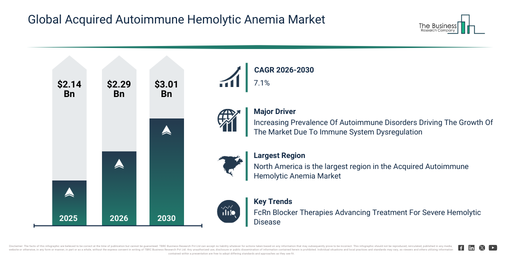
The market size for acquired autoimmune hemolytic anemia has experienced robust expansion in recent years. It is forecast to increase from $2.14 billion in 2025 to $2.29 billion in 2026, growing at a compound annual growth rate (CAGR) of 7.1%. The expansion observed historically is attributable to enhancements in autoimmune disease diagnosis, the dependence on corticosteroid treatments, the specialization of hematology within hospitals, an increase in anemia cases linked to malignancy, and the broader accessibility of diagnostic tests.
The acquired autoimmune hemolytic anemia market size is projected to experience significant expansion in the coming years. It is forecast to reach $3.01 billion by 2030, exhibiting a compound annual growth rate (CAGR) of 7.1%. This expansion during the forecast period can be attributed to factors such as increased rare disease awareness, the adoption of biologic therapies, the integration of advanced diagnostics, heightened funding for hematology research, and the emergence of personalized treatment protocols. Prominent trends expected over this period include the rising utilization of targeted immunosuppressive therapies, the growing uptake of rituximab-based treatments, an increase in hospital-based hematology care, wider adoption of improved diagnostic testing, and the expansion of rare disease treatment programs.
Get A Free Sample Report With In-Depth Market Insights:
Acquired Autoimmune Hemolytic Anemia Market Industry Drivers: What’s Behind The Revenue Growth?
The growing occurrence of autoimmune disorders is projected to fuel the expansion of the acquired autoimmune hemolytic anemia market moving forward. Autoimmune disorders are conditions where the immune system erroneously attacks the body’s own healthy cells and tissues, believing them to be dangerous invaders. The increasing prevalence of these disorders is predominantly attributed to a rise in environmental triggers and shifts in lifestyle that can upset immune system regulation. This heightened prevalence of autoimmune disorders leads to a higher incidence of acquired autoimmune hemolytic anemia, as individuals with autoimmune conditions are more prone to developing secondary AIHA due to compromised immune system control. For instance, in 2023, according to the Gastro-Intestinal Epidemiology Consortium (CanGIEC), a Canada-based national network of researchers and clinicians, the prevalence of inflammatory bowel disease was estimated at 825 cases per 100,000 people. This prevalence is forecasted to rise by 2.44% annually, reaching 1,075 cases per 100,000 people by 2035. Thus, the escalating prevalence of autoimmune disorders will drive the growth of the acquired autoimmune hemolytic anemia market.
Acquired Autoimmune Hemolytic Anemia Market Segmentation And Category Overview
The acquired autoimmune hemolytic anemia market covered in this report is segmented –
1) By Diagnosis Method: Complete Blood Count, Peripheral Blood Smear, Direct Coombs Test, Indirect Coombs Test
2) By Treatment Type: Corticosteroids, Immunosuppressive Agents, Intravenous Immunoglobulin, Rituximab
3) By Severity: Mild, Moderate, Severe
4) By End User: Hospitals, Specialty Clinics, Research Institutions
Subsegments:
1) By Complete Blood Count: Hemoglobin Level, Hematocrit (HCT), Reticulocyte Count, White Blood Cell Count, Platelet Count
2) By Peripheral Blood Smear: Spherocytes, Polychromasia, Schistocytes, Increased Reticulocyte Count
3) By Direct Coombs Test: Immunoglobulin G Coombs Test, Immunoglobulin M Coombs Test, Complement Coombs Test
4) By Indirect Coombs Test: Screening For Alloantibodies, Detection Of Sensitizing Antibodies, Crossmatch Testing
#Acquired Autoimmune Hemolytic Anemia Market Growth Trends: What’s Shaping The Future Outlook?
Leading companies operating within the acquired autoimmune hemolytic anemia market are concentrating on progress in targeted therapies, including neonatal Fc receptor (FcRn) blockers. This emphasis seeks to improve treatment effectiveness, enhance outcomes for mothers and fetuses, and offer more impactful interventions for high-risk pregnancies complicated by severe hemolytic disease. An FcRn blocker is a therapeutic antibody designed to obstruct the neonatal Fc receptor, which is responsible for circulating immunoglobulin G (IgG) antibodies within the body. This action consequently reduces harmful antibody levels that lead to red blood cell destruction and hemolytic issues in both maternal and fetal populations. For instance, in January 2025, Johnson & Johnson, a US-based pharmaceutical and healthcare company, received U.S. Food and Drug Administration (FDA) Breakthrough Therapy Designation for nipocalimab, intended for the treatment of individuals at high risk for severe hemolytic disease of the fetus and newborn (HDFN). Nipocalimab functions by selectively inhibiting the neonatal Fc receptor (FcRn), thereby lowering maternal IgG antibody levels that cross the placenta and attack fetal red blood cells. This prevents severe hemolytic disease, reduces the need for intrauterine transfusions, and improves outcomes for at-risk pregnancies. Nipocalimab specifically targets FcRn-mediated IgG recycling without influencing other immune functions.
Acquired Autoimmune Hemolytic Anemia Market Competitive Analysis Of Leading Industry Participants
Major companies operating in the acquired autoimmune hemolytic anemia market are F. Hoffmann-La Roche Ltd., Alexion Pharmaceuticals Inc., Apellis Pharmaceuticals Inc., Sanofi S.A., AbbVie Inc., Novartis AG, Incyte Corporation, BioCryst Pharmaceuticals Inc., Annexon Inc., Rigel Pharmaceuticals Inc., Zenas BioPharma Inc., Immunovant Sciences GmbH, Alpine Immune Sciences Inc., Agios Pharmaceuticals Inc., Johnson & Johnson, Merck KGaA, Bristol Myers Squibb Company, Takeda Pharmaceutical Company Limited, CSL Behring, Grifols S.A.
View The Full Acquired Autoimmune Hemolytic Anemia Market Report:
Acquired Autoimmune Hemolytic Anemia Market Geographic Spread And Regional Opportunities
North America was the largest region in the acquired autoimmune hemolytic anemia market in 2025. Europe is expected to be the fastest-growing region in the forecast period. The regions covered in the acquired autoimmune hemolytic anemia market report are Asia-Pacific, South East Asia, Western Europe, Eastern Europe, North America, South America, Middle East, Africa.
Reach Out To Our Team:
The Business Research Company: https://www.thebusinessresearchcompany.com/
Americas: +1 310-496-7795
Asia: +44 7882 955267 & +91 8897263534
Europe: +44 7882 955267
Email us at: marketing@tbrc.info
Follow us on:
LinkedIn: https://in.linkedin.com/company/the-business-research-company
YouTube: https://www.youtube.com/channel/UC24_fI0rV8cR5DxlCpgmyFQ
Global Market Model: https://www.thebusinessresearchcompany.com/global-market-model