Built to provide research that’s more actionable and strategically valuable, The Business Research Company’s 2026 market reports include market attractiveness analysis, total addressable market sizing, company benchmarking matrices, interactive Excel dashboards, broader supply chain intelligence, emerging startup tracking, and in-depth product insights.
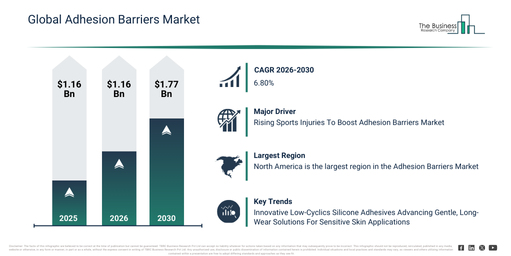
Adhesion Barriers Market Revenue Growth On Track For A 6.8% CAGR Through 2030
The adhesion barriers market size has demonstrated robust growth in recent years. This market is expected to expand from $0.89 billion in 2025 to $0.96 billion in 2026, achieving a compound annual growth rate (CAGR) of 7.1%. The increase observed in the past can be attributed to several factors, including the limited availability of adhesion barrier types, a reliance on conventional film and gel formulations, a global increase in surgical procedures, a heightened awareness of postoperative complications, and a dependence on hospital-centric applications.
The adhesion barriers market is projected to experience substantial expansion over the coming years, reaching $1.24 billion in 2030, exhibiting a compound annual growth rate (CAGR) of 6.8%. This projected growth can be ascribed to several factors, including the creation of advanced hydrogel and thermoreversible barriers, the rising utilization of cross-linked hyaluronic acid products, the proliferation of ambulatory surgical centers, the incorporation of adhesion barriers into orthopedic and cardiovascular procedures, and an increasing commitment to patient-focused postoperative care. Key developments anticipated during this timeframe involve a greater uptake of collagen and protein-based adhesion barriers, the growing application of synthetic hydrogels and polylactide barriers, the broadening scope of minimally invasive surgical techniques, an increase in gynecological and abdominal operations, and an emphasis on minimizing postoperative complications and improving patient recuperation.
Get A Free Sample Report With In-Depth Market Insights:
Adhesion Barriers Market Development Factors: What’s Supporting Demand?
An increasing prevalence of sports-related injuries is anticipated to drive the expansion of the adhesion barriers market moving forward. These injuries are defined as physical harm sustained during athletic activities or exercise, with their rise attributed to factors such as increased participation, elevated competition levels, insufficient training, and inadequate recovery time. Adhesion barriers are utilized for sports-related injuries to prevent scar tissue from adhering to surrounding tissues, thereby supporting smoother recovery and rehabilitation. For example, according to the Australian Institute of Health and Welfare, an Australia-based government department, data from July 2025 revealed that Cycling accounted for the largest share of sports injury hospitalisations in 2023–24, representing 12% (or 7,500 cases) of the total. This was followed by Australian rules football with 8.7% (or 5,400 cases), and soccer with 8.6% (or 5,300 cases). Thus, the rising occurrence of sports-related injuries is set to propel the growth of the adhesion barriers market.
Adhesion Barriers Market Segmentation And Category Overview
The adhesion barriers market covered in this report is segmented –
1) By Type: Natural Adhesion Barriers, Collagen And Protein, Fibrin, Synthetic Adhesion Barriers, Hyaluronic Acid, Regenerated Cellulose, Polyethylene Glycol
2) By Formulation: Film Formulations, Gel Formulations, Liquid Formulations
3) By Application Area Or Surgical Procedure: Gynecological Surgeries, General Or Abdominal Surgeries, Orthopedic Surgeries, Cardiovascular Surgeries, Neurological Surgeries, Urological Surgeries, Reconstructive Surgeries
4) By End User: Hospitals And Clinics, Ambulatory Surgical Centers, Other End Users
Subsegments:
1) By Natural Adhesion Barriers: Collagen-Based Adhesion Barriers, Protein-Based Adhesion Barriers, Fibrin-Based Adhesion Barriers
2) By Collagen And Protein: Bovine-Derived Collagen Adhesion Barriers, Porcine-Derived Collagen Adhesion Barriers, Human-Derived Protein Adhesion Barriers
3) By Fibrin: Fibrin Sealant Adhesion Barriers, Fibrin Matrix Adhesion Barriers
4) By Synthetic Adhesion Barriers: Hydrogels, Thermoreversible Adhesion Barriers, Polylactide Adhesion Barriers, Silicon-Based Adhesion Barriers
5) By Hyaluronic Acid: Cross-Linked Hyaluronic Acid Adhesion Barriers, Non-Cross-Linked Hyaluronic Acid Adhesion Barriers
6) By Regenerated Cellulose: Oxidized Regenerated Cellulose Adhesion Barriers, Non-Oxidized Regenerated Cellulose Adhesion Barriers
7) By Polyethylene Glycol: Hydrophilic Polyethylene Glycol Adhesion Barriers, Polyethylene Glycol Hydrogel Adhesion Barriers
Adhesion Barriers Market Transformation Trends: What Innovations Are Driving Change?
Leading companies within the adhesion barriers market are concentrating on developing innovative products, such as low-cyclics silicone soft-skin adhesives, aimed at enhancing long wear-time and facilitating gentle, atraumatic removal on sensitive skin. Soft-skin adhesive (SSA) is defined as a biocompatible, silicone-based adhesive engineered for secure adherence to skin over extended periods while minimizing damage or irritation during its removal. For instance, in October 2023, DuPont, a US-based chemical company, unveiled its new DuPont Liveo MG 7-9960 Soft Skin Adhesive. This adhesive delivers the highest peel adhesion within the Liveo SSA family, ensuring strong, durable attachment, high repositionability, improved wear performance, excellent conformability, and atraumatic removal, making it highly suitable for advanced wound dressings and wearable medical devices. The product is non-sensitizing, non-irritating, and non-cytotoxic, thereby protecting fragile skin, including that of children, the elderly, or patients with open wounds. Additionally, DuPont allows device manufacturers to customize performance by adjusting the adhesive coat weight to meet specific device design requirements, which contributes to expanding the adoption of advanced wound care solutions.
Adhesion Barriers Market Company Landscape And Competitive Strategy
Major companies operating in the adhesion barriers market are Johnson & Johnson Services Inc., Terumo Corporation, Atrium Medical Corporation, Integra LifeSciences Holdings Corporation, Gunze Industries Co. Ltd., Anika Therapeutics Inc., CG Bio Inc., Seikagaku Corporation, Hangzhou Singclean Medical Products Co. Ltd., FzioMed Inc., MAST Biosurgery Inc., Betatech Medical Ltd., PlantTec Medical GmbH, Actamax Surgical Materials LLC, Arc Medical Devices Inc., CorMatrix Cardiovascular Inc., Innocoll Biotherapeutics N.A. Inc., Leader Biomedical, BiosCompass Inc.
View The Full Adhesion Barriers Market Report:
Adhesion Barriers Market Largest Region: Which Geography Holds The Highest Market Share?
North America was the largest region in the adhesion barriers market in 2025. Asia-Pacific is expected to be the fastest-growing region in the forecast period. The regions covered in the adhesion barriers market report are Asia-Pacific, South East Asia, Western Europe, Eastern Europe, North America, South America, Middle East, Africa.
Reach Out To Our Team:
The Business Research Company: https://www.thebusinessresearchcompany.com/
Americas: +1 310-496-7795
Asia: +44 7882 955267 & +91 8897263534
Europe: +44 7882 955267
Email us at: marketing@tbrc.info
Follow us on:
LinkedIn: https://in.linkedin.com/company/the-business-research-company
YouTube: https://www.youtube.com/channel/UC24_fI0rV8cR5DxlCpgmyFQ
Global Market Model: https://www.thebusinessresearchcompany.com/global-market-model