
Airborne Pathogen Detector Market Growth To $3.63 Billion By 2030: What’s Driving The Expansion?
Built to provide research that’s more actionable and strategically valuable, The Business Research Company’s 2026 market reports include market attractiveness analysis, total addressable market sizing, company benchmarking matrices, interactive Excel dashboards, broader supply chain intelligence, emerging startup tracking, and in-depth product insights.
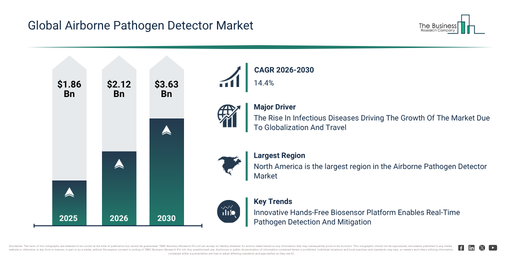
Airborne Pathogen Detector Market Set To Climb From $2.12 Billion In 2026 To $3.63 Billion By 2030
The airborne pathogen detector market has experienced swift expansion recently. Projections indicate an increase from $1.86 billion in 2025 to $2.12 billion in 2026, demonstrating a compound annual growth rate (CAGR) of 14.1%. This historical growth can be linked to heightened awareness concerning airborne illnesses, the proliferation of public health monitoring programs, the uptake of fixed and stationary detection apparatus, advancements in pathogen sensing technologies, and the broadening of healthcare infrastructure.
The airborne pathogen detector market is projected to expand significantly in the coming years. Its valuation is anticipated to reach $3.63 billion by 2030, exhibiting a compound annual growth rate (CAGR) of 14.4%. This expansion during the forecast timeframe is primarily driven by an increasing need for IoT-enabled detection tools, greater incorporation of AI-driven analytical solutions, a heightened requirement for portable and wearable pathogen surveillance devices, the broadening of safety protocols in industrial and commercial air environments, and wider deployment in transport hubs and public areas. Key developments expected during this period involve the greater acceptance of portable and wearable detection instruments, an escalating call for continuous pathogen surveillance, enhanced connectivity with cloud-based platforms, the broadening of capabilities for detecting multiple pathogens, and an intensified concentration on applications for healthcare and public safety.
Get A Free Sample Report With In-Depth Market Insights:
Airborne Pathogen Detector Market Demand Drivers: What’s Powering Industry Growth?
The anticipated expansion of the airborne pathogen detector market is linked to the growing occurrence of infectious diseases throughout the forecast period. These diseases, caused by pathogenic microorganisms, are capable of spreading through environmental exposure, notably via airborne transmission. Several factors contribute to the escalating prevalence of such illnesses, including heightened global connectivity and international travel, increasing urban populations and density, the rise of antimicrobial resistance, and the effects of climate change on pathogen survival and dissemination. Airborne pathogen detectors play a crucial role in enabling early detection and ongoing surveillance of infectious agents across various settings, both indoors and outdoors. This capability facilitates timely public health responses, aids in preventing outbreaks, and enhances infection control measures in critical locations like healthcare facilities, transportation hubs, and general public areas. For instance, data from March 2024, provided by the Centers for Disease Control and Prevention, a US-based government agency, indicated a rise in tuberculosis cases within the United States from 8,320 in 2022 to 9,615 in 2023, marking an increase of 1,295 cases. Consequently, the increasing prevalence of infectious diseases is a primary driver for the growth of the airborne pathogen detector market.
Airborne Pathogen Detector Market Segment Landscape: Which Areas Lead Development?
The airborne pathogen detector market covered in this report is segmented –
1) By Product Type: Fixed Or Stationary Systems, Portable Devices, Handheld Detectors, Wearable Detectors
2) By Pathogen Type: Viral Pathogen Detection, Bacterial Pathogen Detection, Fungal Pathogen Detection, Multi-Pathogen Detection
3) By Connectivity: Standalone Systems, Cloud-Based Systems, Internet Of Things Enabled Systems
4) By Application: Healthcare Facilities, Airports And Transportation Hubs, Industrial And Commercial Buildings, Military And Defense, Public Spaces, Other Applications
5) By End-User: Hospitals And Clinics, Government And Public Health Agencies, Research Institutes, Commercial And Industrial, Other End-Users
Subsegments:
1) By Fixed Or Stationary Systems: Room Air Monitors, Duct Mounted Detectors, Facility Wide Surveillance Systems, Centralized Laboratory Based Systems, Industrial Grade Air Samplers
2) By Portable Devices: Battery Operated Air Samplers, Backpack Mounted Detectors, Transportable Laboratory Systems, Field Deployable Units
3) By Handheld Detectors: Single Pathogen Testers, Multiplex Assay Devices, Real Time Polymerase Chain Reaction Analyzers, Immunoassay Based Testers
4) By Wearable Detectors: Personal Exposure Monitors, Badge Style Detectors, Clip On Sensors, Smart Clothing Integrated Sensors
Airborne Pathogen Detector Market Innovation Trends: What Developments Are Reshaping The Industry?
Leading companies in the airborne pathogen detector market are concentrating on developing innovative solutions, such as hands-free biosensor platforms, to enable rapid, real-time detection and mitigation of airborne pathogens. A hands-free biosensor platform functions as an automated device that continuously samples and analyzes air or surfaces for pathogens, eliminating the need for manual handling or intervention. For instance, in July 2025, SafeTraces, Inc., a U.S. biotechnology company, launched PathogenSentinel, the first integrated qPCR-based biosensor and software platform designed for the swift detection and management of airborne pathogens, marking a significant advancement in this technology. The system pairs a compact, desktop-sized unit with a high-flow air sampler and replaceable cartridges, capable of automatically detecting up to four user-specified pathogens. Complemented by a web-based application, it provides near real-time alerts, API integration, and data trending for proactive risk management. Its hands-free operation and laboratory-quality results substantially improve responsiveness and scalability in environments such as biosafety laboratories and other high-risk indoor settings.
Airborne Pathogen Detector Market Industry Leaders And Competitive Landscape
Major companies operating in the airborne pathogen detector market are Thermo Fisher Scientific Inc., Honeywell International Inc., 3M Company, Charles River Laboratories International Inc., Smiths Detection Group Limited, Sartorius Aktiengesellschaft, Shimadzu Corporation, Teledyne FLIR LLC, TSI Incorporated, Particle Measuring Systems Inc., Bertin Technologies SAS, Kanomax USA Inc., RION Co Ltd., Kromek Group plc, Climet Instruments Company Inc., Varro Life Sciences Inc., Aerosol Devices Inc., SafeTraces Inc., Health Enviro Testing Inc., Scanit Technologies Pvt. Ltd.
View The Full Airborne Pathogen Detector Market Report:
Airborne Pathogen Detector Market Regional Analysis And Top Geography
North America was the largest region in the airborne pathogen detector market in 2025. Asia-Pacific is expected to be the fastest-growing region in the forecast period. The regions covered in the airborne pathogen detector market report are Asia-Pacific, South East Asia, Western Europe, Eastern Europe, North America, South America, Middle East, Africa.
Reach Out To Our Team:
The Business Research Company: https://www.thebusinessresearchcompany.com/
Americas: +1 310-496-7795
Asia: +44 7882 955267 & +91 8897263534
Europe: +44 7882 955267
Email us at: marketing@tbrc.info
Follow us on:
LinkedIn: https://in.linkedin.com/company/the-business-research-company
YouTube: https://www.youtube.com/channel/UC24_fI0rV8cR5DxlCpgmyFQ
Global Market Model: https://www.thebusinessresearchcompany.com/global-market-model