Anti-Tumor Drugs Market Outlook Highlights The Next Major Growth Opportunities
Delivering more actionable and strategically valuable research, The Business Research Company’s 2026 market reports feature market attractiveness analysis, total addressable market evaluation, company benchmarking matrices, interactive Excel dashboards, expanded supply chain intelligence, emerging startup coverage, and detailed product insights.
Anti-Tumor Drugs Market CAGR Analysis And Future Market Development
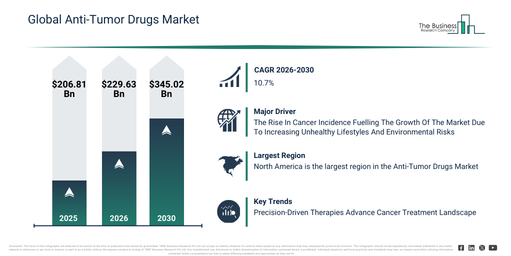
The market for anti-tumor drugs has experienced rapid expansion in recent years. Valued at $206.81 billion in 2025, it is projected to reach $229.63 billion by 2026, reflecting a compound annual growth rate (CAGR) of 11.0%. This historical growth has been driven by several factors, such as the restricted access to targeted therapies, a heavy dependence on traditional cytotoxic medications, a rising prevalence of major cancer types, improvements in fundamental hospital pharmacy infrastructure, and heightened awareness surrounding available cancer treatment options.
The market for anti-tumor drugs is projected to experience significant expansion over the coming years, reaching an estimated value of $345.02 billion by 2030, with a compound annual growth rate (CAGR) of 10.7%. This anticipated growth during the forecast period is driven by factors such as progress in gene therapy and immunotherapy, the broadening of precision medicine efforts, heightened research and development spending in the pharmaceutical sector, increased use of online pharmacies, and the creation of innovative drug delivery systems. Key trends shaping this period include a growing emphasis on personalized cancer treatments, greater funding for immunotherapy and targeted therapies, the proliferation of injectable and oral anti-tumor drug options, the expansion of hospital and oncology clinic pharmacies, and a heightened focus on drug safety, adherence, and pharmacovigilance.
Download A Free Sample Report For Comprehensive Market Insights:
Anti-Tumor Drugs Market Development Factors: Which Trends Are Supporting Demand?
The rising prevalence of cancer is set to drive expansion in the anti-tumor drugs market in the coming period. Cancer encompasses a range of conditions marked by the abnormal, uncontrolled proliferation and dissemination of malignant cells, which can infiltrate adjacent tissues and potentially metastasize through the bloodstream or lymphatic system. This surge in cancer cases stems largely from detrimental lifestyle choices, including poor dietary habits, insufficient physical exertion, tobacco use, heavy alcohol intake, and extended contact with environmental contaminants, all of which substantially heighten susceptibility to various cancer forms. Anti-tumor medications function by targeting and eliminating cancerous cells, curbing tumor expansion, and halting disease advancement. As an example, in October 2025, the National Health Service (NHS), a government-run health agency in the UK, reported that 354,820 new cancer diagnoses were recorded in 2023—averaging 972 daily and marking an increase of 8,605 from 2022. Consequently, the growing incidence of cancer is propelling the anti-tumor drug market forward.
Anti-Tumor Drugs Market Segment Landscape And Growth Potential
The anti-tumor drugs market covered in this report is segmented –
1) By Drug Type: Cytotoxic Drugs, Targeted Therapy Drugs, Hormonal Therapy Drugs, Immunotherapy Drugs, Other Drug Types
2) By Cancer Type: Lung Cancer, Breast Cancer, Colorectal Cancer, Prostate Cancer, Other Cancer Types
3) By Route of Administration: Oral, Injectable, Other Routes Of Administration
4) By Distribution Channel: Hospital Pharmacies, Retail Pharmacies, Online Pharmacies, Other Distribution Channels
Subsegments:
1) By Cytotoxic Drugs: Alkylating Agents, Antimetabolites, Plant Alkaloids, Antitumor Antibiotics, Other Cytotoxic Drugs
2) By Targeted Therapy Drugs: Monoclonal Antibodies, Tyrosine Kinase Inhibitors, Mechanistic Target Of Rapamycin Inhibitors, Poly Polymerase Inhibitors, Other Targeted Therapy Drugs
3) By Hormonal Therapy Drugs: Selective Estrogen Receptor Modulators, Aromatase Inhibitors, Luteinizing Hormone-Releasing Hormone Agonists, Anti-Androgens, Other Hormonal Therapy Drugs
4) By Immunotherapy Drugs: Checkpoint Inhibitors, Chimeric Antigen Receptor T-Cell Therapy, Cancer Vaccines, Cytokines, Other Immunotherapy Drugs
5) By Other Drug Types: Gene Therapy Drugs, Anti-Angiogenic Agents, Radioisotope-Based Drugs, Photodynamic Therapy Agents
Anti-Tumor Drugs Market Transformation Trends: Which Innovations Are Driving Change?
Leading firms within the anti-tumor drugs sector are concentrating their efforts on creating advanced therapies, particularly targeted treatments for breast cancer, to improve outcomes in patients with hormone receptor-positive metastatic disease. This form of therapy utilizes precision medicines that selectively interfere with pathways driving cancer cell proliferation, thereby reducing harm to healthy tissues and boosting patient tolerability. A case in point occurred in January 2023, when Sun Pharmaceutical Industries Ltd., a pharmaceutical company headquartered in India, introduced Palbociclib, a new anticancer medication for managing advanced breast cancer within the country. Palbociclib functions as a highly specific oral inhibitor targeting cyclin-dependent kinases 4 and 6 (CDK4/6), which are crucial for governing the cell cycle progression. By hindering the progression from the G1 to the S phase, this agent triggers a halt in the cell cycle, consequently suppressing tumor expansion. Its primary application is in treating hormone receptor-positive, HER2-negative advanced breast cancer, where it specifically addresses the unregulated division of malignant cells.
Anti-Tumor Drugs Market Competitive Landscape: Who Are The Leading Companies?
Major companies operating in the anti-tumor drugs market are Pfizer Inc, Johnson And Johnson, Roche Holding AG, Merck And Co. Inc., AbbVie Inc., Bayer AG, Sanofi S.A., Bristol-Myers Squibb Company, AstraZeneca PLC, Novartis AG., GlaxoSmithKline plc, Eli Lilly And Company, Gilead Sciences Inc., Amgen Inc., Boehringer Ingelheim GmbH, Astellas Pharma Inc., Incyte Corporation, BeOne Medicines Inc., Getwell Oncology Pvt Ltd., Shanghai Haihe Pharmaceutical Co. Ltd.
Access The Complete Anti-Tumor Drugs Market Report:
Anti-Tumor Drugs Market Largest Region: Which Geography Holds The Highest Market Share?
North America was the largest region in the anti-tumor drugs market in 2025. Asia-Pacific is expected to be the fastest-growing region in the forecast period. The regions covered in the anti-tumor drugs market report are Asia-Pacific, South East Asia, Western Europe, Eastern Europe, North America, South America, Middle East, Africa.
Get in touch with us:
The Business Research Company: https://www.thebusinessresearchcompany.com/?utm_source=BlogsPR&utm_medium=Paid&utm_campaign=home_page_test
Americas: +1 310-496-7795
Asia: +44 7882 955267 & +91 8897263534
Europe: +44 7882 955267
Email us at: marketing@tbrc.info
Follow us on:
LinkedIn: https://in.linkedin.com/company/the-business-research-company
YouTube: https://www.youtube.com/channel/UC24_fI0rV8cR5DxlCpgmyFQ
Global Market Model: https://www.thebusinessresearchcompany.com/global-market-model