Antibody Fragments Market Trends And Growth Drivers Point To Strong Future Potential
Delivering more actionable and strategically valuable research, The Business Research Company’s 2026 market reports feature market attractiveness analysis, total addressable market evaluation, company benchmarking matrices, interactive Excel dashboards, expanded supply chain intelligence, emerging startup coverage, and detailed product insights.
Antibody Fragments Market Size, Value And Growth Trends Through 2030
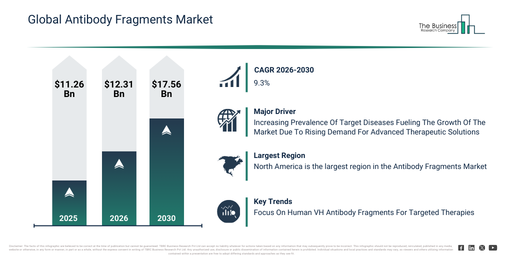
The antibody fragments market has experienced robust expansion in recent times. Projected to rise from $11.26 billion in 2025 to $12.31 billion in 2026, this growth reflects a compound annual growth rate (CAGR) of 9.3%. Historic progress was driven by improvements in monoclonal antibody technologies, the clinical effectiveness of antibody-based treatments, heightened activity in cancer biologics research, broader application of diagnostic antibodies, and greater funding allocated to biologics research and development.
The antibody fragments market is poised for substantial expansion over the coming years, with projections indicating it will reach $17.56 billion by 2030, representing a compound annual growth rate (CAGR) of 9.3%. This anticipated growth during the forecast period is driven by factors such as the rise of targeted cancer therapies, the broadening of antibody fragment pipelines, a heightened need for precision biologics, their growing application in companion diagnostics, and progress in recombinant antibody engineering. Key trends shaping this period encompass the increasing preference for fragment-based biologics, their expanded utilization in oncology and targeted treatments, a higher demand for high-penetration antibody formats, widening diagnostic uses, and an intensified emphasis on therapies with reduced immunogenicity.
Download A Free Sample Report For Comprehensive Market Insights:
Antibody Fragments Market Opportunity Drivers: What Is Creating New Revenue Potential?
The growing frequency of target diseases is anticipated to fuel the expansion of the antibody fragments market moving forward. These target conditions refer to specific illnesses or health disorders that a medication, treatment, or research initiative aims to prevent, manage, or cure. Key examples of such diseases include cancer, infectious diseases, and bacterial infections. This rise in prevalence is largely driven by unhealthy lifestyles and pollution, which compromise the body’s natural defenses and contribute to chronic health issues. Antibody fragments offer highly precise, targeted, and adaptable solutions for managing a wide range of diseases, often resulting in fewer side effects compared to conventional approaches. Their capacity to be tailored and engineered for particular targets enhances their value as a crucial tool in contemporary healthcare. As an example, in January 2025, a report from the American Cancer Society, a US-based nonprofit, projected that the United States would see 2,041,910 new cancer cases and 618,120 cancer deaths in 2025, up from 2,001,140 cases and 611,720 deaths in 2024. Consequently, the escalating occurrence of target diseases is propelling the antibody fragments market forward.
Antibody Fragments Market Segment Analysis: What Are The Major Market Categories?
The antibody fragments market covered in this report is segmented –
1) By Type: F(ab) Fragments, F(ab’)2 Fragments, Single-Chain Variable Fragments (scFvs), Single Domain Antibody Fragments (sdAbs), Other Types
2) By Specificity: Monoclonal Antibody, Polyclonal Antibody
3) By Delivery Method: Intravenous (IV), Subcutaneous (SC)
4) By Application: Cancer, Immunodeficiencies, Other Applications
5) By End User: Pharmaceutical Companies, Biotechnology Companies, Research Institutions, Diagnostic Laboratories, Contract Research Organizations (CROs)
Subsegments:
1) By F(ab) Fragments: Recombinant F(ab) Fragments, Enzymatically Derived F(ab) Fragments
2) By F(ab’)2 Fragments: Pepsin-Derived F(ab’)2 Fragments, Recombinant F(ab’)2 Fragments
3) By Single-Chain Variable Fragments (scFvs): Bacterial-Produced Single-Chain Variable Fragments (scFvs), Mammalian Cell-Produced Single-Chain Variable Fragments (scFvs), Yeast-Produced Single-Chain Variable Fragments (scFvs)
4) By Single Domain Antibody Fragments (sdAbs): Camelid-Derived Single Domain Antibody Fragments (sdAbs), Shark-Derived Single Domain Antibody Fragments (sdAbs), Synthetic Single Domain Antibody Fragments (sdAbs)
5) By Other Types: Bispecific Antibody Fragments, Multispecific Antibody Fragments, Fusion Protein Antibody Fragments
Antibody Fragments Market Innovation Trends Driving Future Development
Key players within the antibody fragments market are placing significant emphasis on advancing clinical trials to create novel solutions, particularly human VH antibody fragments, with the goal of boosting targeted therapy efficacy while minimizing immunogenicity when addressing cancers, autoimmune conditions, and infectious diseases. A human VH antibody fragment represents the variable domain derived from a human antibody’s heavy chain, uniquely capable of binding antigens on its own. It facilitates the formation of antibody fragments by acting as the critical antigen-binding region, frequently utilized independently or linked with other molecules to construct compact, stable, high-affinity antibodies for therapeutic or diagnostic applications. As an example, in May 2024, Zai Lab Limited, a pharmaceutical firm based in China, launched a global Phase 2 clinical trial to assess the effectiveness and safety of ZL-1102. ZL-1102 is an innovative human VH antibody fragment, also referred to as a Humabody, specifically targeting IL-17. It is being formulated as a topical treatment for mild-to-moderate chronic plaque psoriasis, aiming to enhance treatment accuracy and simultaneously reduce systemic side effects as well as immunogenic reactions.
Antibody Fragments Market Leading Companies Driving Competitive Growth
Major companies operating in the antibody fragments market are Pfizer Inc., Johnson & Johnson Services Inc., F. Hoffmann-La Roche AG, AbbVie Inc., Sanofi S.A., AstraZeneca PLC, Novartis AG, GSK plc, Eli Lilly and Company, Amgen Inc., Boehringer Ingelheim International GmbH, Regeneron Pharmaceuticals Inc., Biogen Inc., UCB S.A., Bio-Rad Laboratories Inc., Genmab A/S, WuXi Biologics Co. Ltd., Abcam plc, MacroGenics Inc., Harbour BioMed, Creative Biolabs Inc.
Access The Complete Antibody Fragments Market Report:
Antibody Fragments Market Largest Region: Which Geography Holds The Highest Market Share?
North America was the largest region in the antibody fragments market in 2025. Asia-Pacific is expected to be the fastest-growing region in the forecast period. The regions covered in the antibody fragments market report are Asia-Pacific, South East Asia, Western Europe, Eastern Europe, North America, South America, Middle East, Africa.
Get in touch with us:
The Business Research Company: https://www.thebusinessresearchcompany.com/?utm_source=BlogsPR&utm_medium=Paid&utm_campaign=home_page_test
Americas: +1 310-496-7795
Asia: +44 7882 955267 & +91 8897263534
Europe: +44 7882 955267
Email us at: marketing@tbrc.info
Follow us on:
LinkedIn: https://in.linkedin.com/company/the-business-research-company
YouTube: https://www.youtube.com/channel/UC24_fI0rV8cR5DxlCpgmyFQ
Global Market Model: https://www.thebusinessresearchcompany.com/global-market-model