The Business Research Company’s 2026 market reports feature enhanced tools like market attractiveness analysis, TAM assessment, and company scoring matrices, along with interactive dashboards, deeper supply chain insights, and startup coverage strengthening the depth, usability, and strategic value of insights.
How Large Will The Anticoccidial Drugs Market Be By 2030 Compared To Its 2026 Market Size?
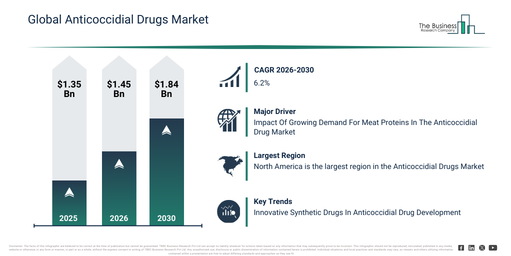
The anticoccidial drugs market has experienced robust expansion in recent years. It is projected to increase from $1.35 billion in 2025 to $1.45 billion in 2026, with a compound annual growth rate (CAGR) of 6.9%. Factors contributing to this historical growth include a high prevalence of coccidiosis in poultry, limited availability of effective drug classes, growing demand for livestock products, traditional farming practices, and increasing awareness of animal health management.
The market for anticoccidial drugs is projected to experience substantial expansion over the upcoming years. This market is set to reach $1.84 billion by 2030, exhibiting a compound annual growth rate (CAGR) of 6.2%. This anticipated growth during the forecast period stems from factors such as advancements in drug delivery systems, an increase in intensive poultry farming practices, the broadening of veterinary services in developing areas, heightened governmental backing for animal well-being, and a rise in worldwide meat and poultry consumption. Key trends anticipated during this period encompass the creation of new anticoccidial drug formulations, a greater emphasis on poultry health management, the growing embrace of combination treatments, an expansion of distribution networks for veterinary pharmaceuticals, and improved regulatory adherence for veterinary medications.
Access Your Free Sample Report For In-Depth Market Analysis:
https://www.thebusinessresearchcompany.com/sample.aspx?id=15723&type=smp
Which Key Drivers Are Affecting The Anticoccidial Drugs Market Development?
The growing demand for meat proteins is expected to propel the growth of the anticoccidial drug market going forward. Meat proteins are naturally present in animal flesh, comprising various amino acids essential for various bodily functions. The rising demand for meat proteins is due to population growth, increasing disposable income, urbanization, and changing dietary preferences toward protein-rich foods. Anticoccidial drugs are essential tools in modern livestock farming. They help maintain the health and productivity of animals, ensuring that farmers can meet the growing demand for meat proteins efficiently and sustainably. For instance in October 2025 according to the Meat And Livestock Australia Limited a Australia-based non-profit organization in 2024, Australia’s red meat and livestock exports increased by 3.2% year-on-year, reaching a value of $19.5 billion. Therefore, the growing demand for meat proteins is driving the growth of the anticoccidial drug market. The rise in poultry farming is expected to propel the growth of the anticoccidial drug market going forward. Poultry farming refers to raising domesticated birds, such as chickens, turkeys, ducks, and geese, to produce meat, eggs, and feathers. The rise in poultry farming is due to increasing demand for protein, improved farming techniques, and the expansion of global trade. Anticoccidial drugs are often added to poultry feed or water as a preventive measure to protect the birds from coccidiosis during the early and most vulnerable stages of growth. For instance, in April 2024, according to the USDA Economic Research Service, a US-based government administration, in 2023, the number of chickens sold totaled 178 million, up 4 percent from the previous year, and turkey numbers increased by 4 percent as well. Therefore, the rise in poultry farming is driving the growth of the anticoccidial drug market.
What Segment Categories Shape The Anticoccidial Drugs Market Segment Landscape?
The anticoccidial drugs market covered in this report is segmented –
1) By Drug Class: Ionophore, Antibiotic, Sulphonamides, Chemical Derivative, Other Drug Classes
2) By Drug Action: Coccidiostatic, Coccidiocidal
3) By Application: Poultry, Swine, Fish, Cattle, Companion Animals
4) By Distribution Channel: Veterinary Hospitals, Retail Pharmacy, Other Distribution Channels
Subsegments:
1) By Ionophore: Monensin, Lasalocid, Salinomycin
2) By Antibiotic: Tylosin, Lincomycin, Bacitracin
3) By Sulphonamides: Sulfadimethoxine, Sulfaquinoxaline
4) By Chemical Derivative: Diclazuril, Clopidol
5) By Other Drug Classes: Amprolium, Robenidine
Which Trends Are Guiding The Direction Of The Anticoccidial Drugs Market?
Leading companies operating in the anticoccidial drugs market are concentrating on developing innovative solutions, such as synthetic coccidiostats, to enhance efficacy, minimize resistance development, and address emerging challenges in poultry and livestock management. A synthetic coccidiostat is a chemically engineered compound utilized to prevent or control coccidiosis by impeding the growth and reproduction of coccidia parasites in animals. For instance, in March 2023, Zoetis, a US-based animal health company, introduced Avi-Deccox, a reformulated synthetic coccidiostat specifically designed to manage coccidiosis in broiler chickens. This product particularly targets the pathogens Eimeria acervulina and Eimeria tenella, which are responsible for significant economic losses in poultry farming. Its active ingredient is decoquinate, mirroring that of its forerunner, Deccox. Avi-Deccox tackles the increasing problem of resistance associated with the frequent use of ionophores in poultry farming by employing an alternative mode of action, thereby offering a more effective short-term knock-down effect.
Who Are The Companies Operating Across The Anticoccidial Drugs Market Value Chain?
Major companies operating in the anticoccidial drugs market are Zoetis Inc., Elanco Animal Health Incorporated, Huvepharma AD, Phibro Animal Health Corporation, Ceva Santé Animale S.A., Boehringer Ingelheim International GmbH, Merck & Co. Inc, Bayer AG, Virbac S.A., Vetoquinol SA, Intas Pharmaceuticals Ltd, Alpharma BVBA, Kepro B.V., Kemin Industries Inc., Tianjin Ringpu Bio-Technology Co. Ltd., Hester Biosciences Limited, Biovet S.A., HIPRA, Impextraco NV, Lallemand Animal Nutrition
Get The Full Anticoccidial Drugs Market Report:
https://www.thebusinessresearchcompany.com/report/anticoccidial-drugs-global-market-report
Which Region Is The Leading Market For The Anticoccidial Drugs Market?
North America was the largest region in the anticoccidial drugs market in 2025. Asia-Pacific is expected to be the fastest-growing region in the forecast period. The regions covered in the anticoccidial drugs market report are Asia-Pacific, South East Asia, Western Europe, Eastern Europe, North America, South America, Middle East, Africa.
Request A Customized Anticoccidial Drugs Market Report For Competitive Insights:
https://www.thebusinessresearchcompany.com/report/anticoccidial-drugs-global-market-report
Browse Through More Reports Similar to the Global Anticoccidial Drugs Market 2026, By The Business Research Company
Anticoccidial Drugs Market Report 2026
https://www.thebusinessresearchcompany.com/report/anticoccidial-drugs-global-market-report
Anti Infective Drugs Market 2026
https://www.thebusinessresearchcompany.com/report/anti-infective-drugs-market
Anti Infective Drugs Market 2026
https://www.thebusinessresearchcompany.com/report/anti-infective-drugs-market
Get in touch with us:
The Business Research Company: https://www.thebusinessresearchcompany.com/
Americas +1 310-496-7795
Asia +44 7882 955267 & +91 8897263534
Europe +44 7882 955267
Email us at: marketing@tbrc.info
Follow us on:
LinkedIn: https://in.linkedin.com/company/the-business-research-company
YouTube: https://www.youtube.com/channel/UC24_fI0rV8cR5DxlCpgmyFQ
Global Market Model: https://www.thebusinessresearchcompany.com/global-market-model