Antiglaucoma Drugs Market Trends And Growth Drivers Point To Strong Future Potential
Through market attractiveness analysis, total addressable market evaluation, company benchmarking matrices, interactive Excel dashboards, expanded supply chain intelligence, emerging startup coverage, and detailed product insights, The Business Research Company’s 2026 market reports provide more actionable and strategically valuable research.
Antiglaucoma Drugs Market CAGR Analysis And Future Market Development
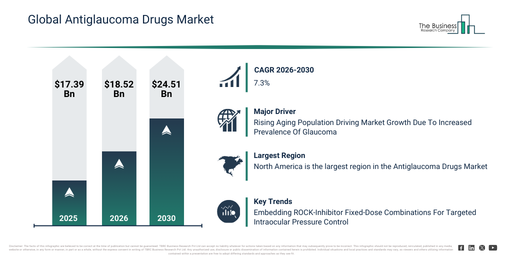
The antiglaucoma drugs market has experienced robust expansion in recent years, rising from $17.39 billion in 2025 to an anticipated $18.52 billion in 2026, reflecting a compound annual growth rate (CAGR) of 6.5%. This historical growth has been driven by factors such as an increasing elderly population worldwide, proactive early diagnosis programs, the widespread application of beta blockers, sustained demand for chronic glaucoma care, and the broader availability of ophthalmology services.
The antiglaucoma drugs market is projected to experience robust expansion over the coming years, reaching $24.51 billion by 2030 with a compound annual growth rate (CAGR) of 7.3%. This anticipated growth in the forecast period is driven by a rise in vision impairment cases, broader access to eye care services, the development of innovative glaucoma medications, heightened awareness initiatives, and a growing demand for therapies offering extended duration of action. Key trends shaping the market during this period include the increasing occurrence of glaucoma, a higher preference for prostaglandin analogs, the growing utilization of combination treatments, the widening availability of over-the-counter eye care products, and enhanced strategies focused on improving patient adherence to treatment regimens.
Download A Free Sample Report For Comprehensive Market Insights:
Antiglaucoma Drugs Market Growth Factors Supporting Long-Term Expansion
The growing elderly population is anticipated to drive the antiglaucoma drugs market forward in the coming years. Glaucoma encompasses a set of eye conditions that harm the optic nerve, typically from elevated intraocular pressure, and this issue is more common among older individuals. This demographic increase stems from longer life expectancies, better healthcare access, and worldwide population shifts toward older age brackets. An expanding elderly demographic supports the antiglaucoma drugs market by boosting demand for medications that control intraocular pressure, slow disease advancement, and lower the chances of vision impairment in aging people. To illustrate, the World Health Organization—a Switzerland-based public health agency—reported in October 2025 that by 2030, one out of every six people globally will be aged sixty or older, and the number of individuals aged sixty and above is expected to reach 2.1 billion by 2050, a twofold increase. Thus, the rising number of older adults is propelling the antiglaucoma drugs market ahead.
The growing incidence of myopia is predicted to fuel expansion of the antiglaucoma drugs market in the future. Myopia is a refractive vision disorder where nearby objects are seen clearly, but distant ones appear blurry. This condition is becoming more common due to extended periods of near-work activities such as reading, along with heavy use of digital screens and limited exposure to natural sunlight outdoors. Antiglaucoma drugs represent the most effective approach for slowing myopia progression and preventing refractive regression in patients, thereby reducing the need for surgical eye procedures. For example, The Guardian—a UK-based news outlet—noted in September 2024 that myopia is expected to impact over one-third of children and teenagers worldwide, with cases likely exceeding 740 million by 2050. Consequently, the rising prevalence of myopia is driving the antiglaucoma drugs market.
Antiglaucoma Drugs Market Segment Outlook: Which Categories Are Expanding The Fastest?
The antiglaucoma drugs market covered in this report is segmented –
1) By Mode Of Availability: Hospital Prescription Drugs, Non-Prescription Drugs
2) By Product Type: Alpha Agonist, Beta Blockers, Prostaglandin Analogs, Combined Medication, Other Types
3) By Disease Condition Type: Open-Angle Glaucoma, Angle-Closure Glaucoma, Normal-Tension Glaucoma, Congenital Glaucoma, Other Types Of Glaucoma
Subsegments:
1) By Hospital Prescription Drugs: Beta-Blockers (Timolol), Prostaglandin Analogs (Latanoprost), Alpha Agonists (Brimonidine), Carbonic Anhydrase Inhibitors (Dorzolamide), Rho Kinase Inhibitors (Netarsudil)
2) By Non-Prescription Drugs: Ocular Lubricants, Natural Support Eye Drops
Antiglaucoma Drugs Market Industry Trends Shaping Future Revenue Growth
Key players within the antiglaucoma drugs market are prioritizing innovations in product development and formulation, particularly through Rho-kinase (ROCK) inhibitor-based therapeutics, which directly target the impaired function of the trabecular meshwork (TM) to enhance aqueous humor drainage and lower intraocular pressure (IOP). These treatments introduce a distinct mode of action compared to standard glaucoma therapies, focusing on addressing the fundamental causes of outflow obstruction to achieve more effective disease control. For example, in July 2023, Santen, a Japanese ophthalmology firm, introduced Roclanda in the UK, a fixed-dose combination eye drop containing netarsudil and latanoprost. This medication is intended for adults with primary open-angle glaucoma or ocular hypertension who have shown an inadequate response to single-agent therapy. The dual-action formula of netarsudil and latanoprost facilitates increased outflow through both the trabecular, or conventional, route and the uveoscleral pathway, utilizing complementary mechanisms to achieve its effect. Evidence from the MERCURY-3 trial revealed that Roclanda provided a consistent reduction in IOP over a six-month period that was on par with a bimatoprost/timolol combination, while no serious treatment-related adverse events were reported. The debut of Roclanda represents the first new category of glaucoma medication introduced in Europe in 25 years, indicating a shift in the approach to glaucoma management toward therapies that are more targeted and mechanism-driven.
Antiglaucoma Drugs Market Key Companies And Competitive Benchmarking
Major companies operating in the antiglaucoma drugs market are Aerie Pharmaceuticals Inc., Allergan Inc., Novartis AG, Alcon AG, Santen Pharmaceutical Company Ltd., Bausch + Lomb Inc., Pfizer Inc., Merck & Co. Inc., Johnson & Johnson, Teva Pharmaceutical Industries Ltd., Sun Pharmaceutical Industries Ltd., Lupin Limited, Zydus Lifesciences Ltd., Wockhardt Ltd., Apotex Inc., Mylan N.V., Akorn Inc., Fera Pharmaceuticals LLC, Thea Pharma Inc., Rafarm S.A.
Access The Complete Antiglaucoma Drugs Market Report:
Antiglaucoma Drugs Market Global Footprint: Which Region Holds Market Leadership?
North America was the largest region in the antiglaucoma drugs market in 2025. Middle East is expected to be the fastest-growing region in the antiglaucoma drugs market during the forecast period. The regions covered in the antiglaucoma drugs market report are Asia-Pacific, South East Asia, Western Europe, Eastern Europe, North America, South America, Middle East, Africa.
Get in touch with us:
The Business Research Company: https://www.thebusinessresearchcompany.com/?utm_source=BlogsPR&utm_medium=Paid&utm_campaign=home_page_test
Americas: +1 310-496-7795
Asia: +44 7882 955267 & +91 8897263534
Europe: +44 7882 955267
Email us at: marketing@tbrc.info
Follow us on:
LinkedIn: https://in.linkedin.com/company/the-business-research-company
YouTube: https://www.youtube.com/channel/UC24_fI0rV8cR5DxlCpgmyFQ
Global Market Model: https://www.thebusinessresearchcompany.com/global-market-model