The Business Research Company’s 2026 market reports feature enhanced tools like market attractiveness analysis, TAM assessment, and company scoring matrices, along with interactive dashboards, deeper supply chain insights, and startup coverage strengthening the depth, usability, and strategic value of insights.
What Changes In Market Value Are Expected For The Antispasmodics Drugs Market Over The 2026–2030 Period?
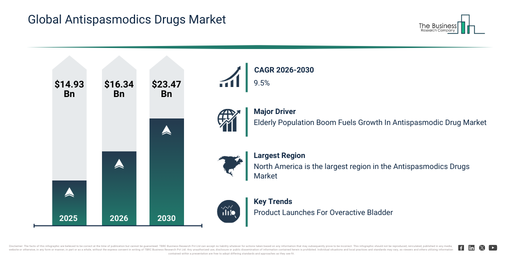
The antispasmodics drugs market size has demonstrated robust growth in recent years. It is anticipated to expand from $14.93 billion in 2025 to $16.34 billion in 2026, achieving a compound annual growth rate (CAGR) of 9.5%. The historical growth of this market is attributable to the rising incidence of IBS and stomach cramps, the expanding hospital pharmacy infrastructure, the adoption of oral antispasmodic tablets, increasing awareness about gastrointestinal health, and improvements in drug formulation technologies.
The antispasmodics drugs market is projected to experience robust expansion in the coming years. This market is anticipated to reach $23.47 billion by 2030, demonstrating a compound annual growth rate (CAGR) of 9.5%. Factors driving this growth during the forecast period include advancements in precision medicine, the creation of injectable and liquid antispasmodic formulations, the expansion of online pharmacy platforms, an increasing population of elderly and young patients, and the adoption of digital health monitoring systems. Key trends observed within the forecast period encompass personalized antispasmodic therapies, sophisticated drug delivery mechanisms, a heightened incidence of gastrointestinal conditions, the increasing embrace of homecare medication, and an elevated emphasis on pediatric and geriatric patient care.
Access Your Free Sample Report For In-Depth Market Analysis:
https://www.thebusinessresearchcompany.com/sample.aspx?id=9414&type=smp
What Primary Drivers Are Shaping The Antispasmodics Drugs Market?
The expanding elderly demographic is anticipated to stimulate the future growth of the antispasmodic drug market. Individuals aged 65 and above are classified as elderly and often encounter numerous physical and psychological health challenges. Antispasmodic medications are beneficial for this demographic in alleviating symptoms linked to various ailments that cause muscle spasms or cramping, and they can also be utilized for conditions such as irritable bowel syndrome (IBS), gastroesophageal reflux disease (GERD), interstitial cystitis, and uterine cramping. For example, data from July 2024 by the UK Parliament’s House of Commons Library, a UK-based government administration, indicated that in 2022, there were 12.7 million people aged 65 or older in the UK. This figure is forecast to climb to 22.1 million by 2072, constituting 27% of the population. Consequently, a rise in the elderly population will fuel the antispasmodic drug market. The increasing prevalence of irritable bowel syndrome (IBS) is projected to boost the future growth of the antispasmodic drug market. Irritable Bowel Syndrome (IBS) is a widespread digestive condition marked by a collection of symptoms impacting the large intestine (colon), which result in discomfort and interfere with normal digestive processes. Antispasmodic medications are employed in the management of irritable bowel syndrome (IBS) to target and alleviate muscle spasms and cramps within the gastrointestinal tract, thereby providing relief from abdominal pain and discomfort for patients. For instance, in June 2024, the Centers for Disease Control and Prevention, a US-based federal agency, reported that the estimated prevalence of inflammatory bowel disease (IBD) in the U.S. spans from 2.4 to 3.1 million, with varying impacts across different groups. Furthermore, Oxford University Press, a UK-based publishing company, estimates that in 2023, 322,600 Canadians are living with inflammatory bowel disease (IBD). Consequently, the rising occurrence of irritable bowel syndrome (IBS) stimulates the expansion of the antispasmodic drug market.
What Are The Key Segment Divisions In The Antispasmodics Drugs Market Segment Structure?
The antispasmodics drugs market covered in this report is segmented –
1) By Drug: Dicyclomine Hydrochloride, Loperamide Hydrochloride, Other Drugs
2) By Indication: Irritable Bowel Syndrome, Stomach Cramps, Other Indications
3) By Route Of Administration: Oral, Parenteral, Other Modes Of Administrations
4) By Distribution Channel: Hospital Pharmacy, Online Pharmacy, Retail Pharmacy
5) By End-User: Hospitals, Homecare, Specialty Clinics, Other End-Users
Subsegments:
1) By Dicyclomine Hydrochloride: Oral Tablets, Injectable Formulations
2) By Loperamide Hydrochloride: Oral Tablets, Liquid Formulations
3) By Other Drugs: Hyoscine Butylbromide (Scopolamine), Peppermint Oil, Atropine, Other Antispasmodics
What Trends Are Influencing The Antispasmodics Drugs Market?
Leading companies active in the antispasmodics drugs market are launching new products to sustain their presence. For instance, in January 2023, Lupin Limited, an Indian pharmaceutical company, launched Fesoterodine Fumarate, which received approval from the US-based federal government agency, the Food and Drug Administration (FDA). Fesoterodine fumarate is a generic antispasmodic medication used to address certain bladder issues, such as overactive bladder and neurogenic detrusor overactivity. This drug, categorized as an antispasmodic, operates by relaxing bladder muscles and is available as extended-release tablets.
Which Organizations Are Engaged In The Antispasmodics Drugs Market?
Major companies operating in the antispasmodics drugs market are Daiichi Sankyo Company Limited, Fresenius Kabi AG, Hikma Pharmaceuticals plc, Johnson & Johnson Services Inc., Pfizer Inc., Shanghai Fosun Pharmaceutical Co. Ltd., Takeda Pharmaceutical Company Limited, Akorn Inc., Aurobindo Pharma Limited, Lannett Company Inc., Nexus Pharmaceuticals Inc., Actiza Pharmaceutical Private Limited, Blue Cross Laboratories Pvt. Ltd., Dr. Reddy’s Laboratories Ltd., Lexicare Pharma Pvt. Ltd., Solitaire Pharmacia Private Limited, Strides Pharma Science Limited, Wellona Pharma Private Limited, SunGen Pharma LLC, GlaxoSmithKline plc, Novartis AG, Sanofi SA, AstraZeneca plc, Merck & Co. Inc., Bayer AG, Teva Pharmaceutical Industries Ltd., Endo Pharmaceuticals Inc., Sun Pharmaceutical Industries Ltd., Cipla Ltd., Lupin Ltd.
Get The Full Antispasmodics Drugs Market Report:
https://www.thebusinessresearchcompany.com/report/antispasmodics-drugs-global-market-report
Where Is The Antispasmodics Drugs Market Primarily Concentrated By Region?
North America was the largest region in the antispasmodics drugs market in 2025. Asia-Pacific is expected to be the fastest-growing region in the antispasmodics drugs market report during the forecast period. The regions covered in the antispasmodics drugs market report are Asia-Pacific, South East Asia, Western Europe, Eastern Europe, North America, South America, Middle East, Africa.
Request A Customized Antispasmodics Drugs Market Report For Competitive Insights:
https://www.thebusinessresearchcompany.com/report/antispasmodics-drugs-global-market-report
Browse Through More Reports Similar to the Global Antispasmodics Drugs Market 2026, By The Business Research Company
Antispasmodics Drugs Market Report 2026
https://www.thebusinessresearchcompany.com/report/antispasmodics-drugs-global-market-report
Antiparasitic Drugs Market Report 2026
https://www.thebusinessresearchcompany.com/report/antiparasitic-drugs-global-market-report
Anticoccidial Drugs Market Report 2026
https://www.thebusinessresearchcompany.com/report/anticoccidial-drugs-global-market-report
Get in touch with us:
The Business Research Company: https://www.thebusinessresearchcompany.com/
Americas +1 310-496-7795
Asia +44 7882 955267 & +91 8897263534
Europe +44 7882 955267
Email us at: marketing@tbrc.info
Follow us on:
LinkedIn: https://in.linkedin.com/company/the-business-research-company
YouTube: https://www.youtube.com/channel/UC24_fI0rV8cR5DxlCpgmyFQ
Global Market Model: https://www.thebusinessresearchcompany.com/global-market-model