Delivering more actionable and strategically valuable research, The Business Research Company’s 2026 market reports feature market attractiveness analysis, total addressable market evaluation, company benchmarking matrices, interactive Excel dashboards, expanded supply chain intelligence, emerging startup coverage, and detailed product insights.
Artificial Intelligence (AI)-Driven Retinal Screening Device Market Size Outlook: How Fast Will Revenue Grow Through 2030?
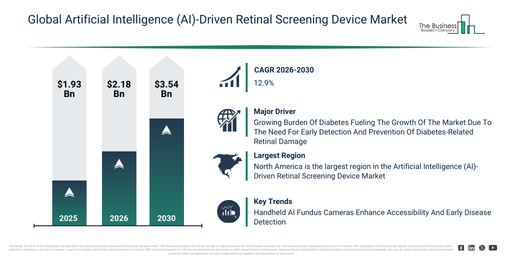
The artificial intelligence (AI)-driven retinal screening device market has experienced rapid expansion in recent years. It is projected to grow from $1.93 billion in 2025 to $2.18 billion in 2026, at a compound annual growth rate (CAGR) of 13.1%. The historical period’s growth can be attributed to the increasing adoption of artificial intelligence (AI)-enabled ophthalmic diagnostics, the growing incidence of diabetic retinopathy, a rising demand for early retinal disease detection, the increasing integration of digital health screening programs, and a growing healthcare focus on preventive eye care.
The artificial intelligence (AI)-driven retinal screening device market is projected for significant expansion in the coming years, anticipated to reach $3.54 billion by 2030, exhibiting a compound annual growth rate (CAGR) of 12.9%. This growth throughout the forecast period stems from factors such as the expanding adoption of autonomous AI-based screening systems, the increasing implementation of point-of-care retinal devices, enhanced government backing for digital eye screening programs, broader integration of AI tools within teleophthalmology, and a rising need for swift and affordable retinal assessment solutions. Key developments expected during this time comprise improvements in AI algorithms for interpreting retinal images, novelties in edge-computing retinal screening devices, technological progress enhancing image acquisition quality, ongoing research and development in multimodal eye-disease detection platforms, and sophisticated cloud-based AI screening workflows.
Download A Free Sample Report For Comprehensive Market Insights:
#Artificial Intelligence (AI)-Driven Retinal Screening Device Market Demand Drivers Creating New Revenue Opportunities
The increasing prevalence of diabetes is anticipated to fuel the expansion of the AI-driven retinal screening device market in the future. Diabetes, a persistent metabolic condition, is defined by consistently elevated blood glucose, which progressively harms blood vessels, notably those in the retina, making it a primary cause of avoidable global vision impairment. The rise in diabetes cases stems from an aging global demographic and shifts in lifestyle, leading to higher obesity rates and decreased physical activity in both established and emerging economies. AI-driven retinal screening devices play a crucial role in diabetes management by facilitating the early identification of diabetes-related retinal damage, broadening screening availability on a large scale, and aiding prompt medical intervention to avert vision loss. As an illustration, the International Diabetes Federation, a Belgium-based global health organization, reported in April 2025 that around 589 million adults aged 20–79 had diabetes globally in 2024, with forecasts suggesting this figure might reach 853 million by 2050, marking a substantial growth from prior decades. Consequently, the expanding worldwide incidence of diabetes is propelling the growth of the AI-Driven Retinal Screening Device market.
Artificial Intelligence (AI)-Driven Retinal Screening Device Market Categorization By Product Type And Application
The artificial intelligence (AI)-driven retinal screening device market covered in this report is segmented –
1) By Component: Hardware, Software, Services
2) By Technology: Fundus Image-Based Artificial Intelligence (AI), Optical Coherence Tomography (OCT)-Based Artificial Intelligence (AI), Multi-Modal Artificial Intelligence (AI), Machine Learning (ML), Deep Learning (DL), Natural Language Processing (NLP)
3) By Deployment: Cloud-Based, On-Premise
4) By Application: Diabetic Retinopathy, Age-Related Macular Degeneration, Glaucoma, Cataract, Other Applications
5) By End-User: Hospitals, Ophthalmology Clinics, Mobile Clinics Or Rural Camps, Diagnostic Centers, Research And Academia, Telemedicine Providers
Subsegments:
1) By Hardware: Imaging Devices, Sensor Modules, Display Units, Storage Devices
2) By Software: Image Processing Software, Diagnostic Analysis Software, Data Management Software, Reporting And Visualization Software
3) By Services: Installation And Setup, Maintenance And Support, Training And Education, Consulting Services
Artificial Intelligence (AI)-Driven Retinal Screening Device Market Trends Driving Strategic Industry Expansion
Leading companies in the artificial intelligence (AI)-driven retinal screening device market are concentrating on developing sophisticated products, such as handheld AI fundus cameras, to boost accessibility, enhance diagnostic speed, and enable earlier disease detection. Handheld AI fundus cameras are portable imaging instruments that employ artificial intelligence to automatically analyze images of the retina for signs of disease. For instance, in May 2024, Optomed USA Inc., a US-based medical technology company, launched the Optomed Aurora AEYE, which is the first FDA-cleared, handheld AI fundus camera for the detection of more than mild diabetic retinopathy. The device features automatic, AI-based image analysis that provides an immediate screening result at the point of care, enabling clinical decision support without requiring a specialist to be present. It is battery-operated and highly portable, designed to increase access to sight-saving screenings in primary care, endocrinology, and other non-specialist settings.
Artificial Intelligence (AI)-Driven Retinal Screening Device Market Company Landscape And Strategic Competition
Major companies operating in the artificial intelligence (AI)-driven retinal screening device market are Carl Zeiss Meditec AG, Topcon Corporation, Canon Medical Systems Corporation, Bosch Healthcare Solutions GmbH, Heidelberg Engineering GmbH, Shenzhen Sibionics Technology Co. Ltd., Digital Diagnostics Inc., Optomed Plc, Optain Health Inc., NIDEK Co. Ltd., Airdoc Technology Co. Ltd., Identifeye Health Ltd., Kowa Company Ltd., RetinaLyze System A/S, EyRIS Pte. Ltd., Eyenuk Inc., EYRIS Pte. Ltd., VUNO Inc., Eyenuk Inc., AEYE Health Inc.
Access The Complete Artificial Intelligence (AI)-Driven Retinal Screening Device Market Report:
#Artificial Intelligence (AI)-Driven Retinal Screening Device Market Largest Region: Which Geography Holds The Highest Market Share?
North America was the largest region in the artificial intelligence (AI)-driven retinal screening device market in 2025. Asia-Pacific is expected to be the fastest-growing region in the forecast period. The regions covered in the artificial intelligence (AI)-driven retinal screening device market report are Asia-Pacific, South East Asia, Western Europe, Eastern Europe, North America, South America, Middle East, Africa.
Get in touch with us:
The Business Research Company: https://www.thebusinessresearchcompany.com/
Americas: +1 310-496-7795
Asia: +44 7882 955267 & +91 8897263534
Europe: +44 7882 955267
Email us at: marketing@tbrc.info
Follow us on:
LinkedIn: https://in.linkedin.com/company/the-business-research-company
YouTube: https://www.youtube.com/channel/UC24_fI0rV8cR5DxlCpgmyFQ
Global Market Model: https://www.thebusinessresearchcompany.com/global-market-model