Delivering more actionable and strategically valuable research, The Business Research Company’s 2026 market reports feature market attractiveness analysis, total addressable market evaluation, company benchmarking matrices, interactive Excel dashboards, expanded supply chain intelligence, emerging startup coverage, and detailed product insights.
Artificial Intelligence (AI) Tele-Oncology Radiation Dose Scheduler Market Expansion From $0.99 Billion In 2026 To $2.28 Billion In 2030
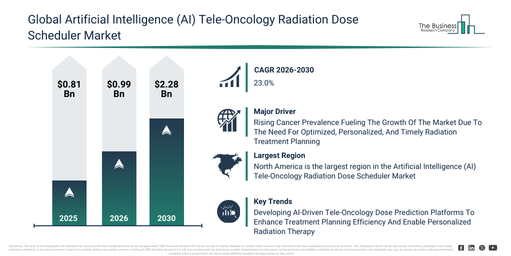
The artificial intelligence (AI) tele-oncology radiation dose scheduler market has experienced significant growth in recent years. This market is projected to expand from $0.81 billion in 2025 to $0.99 billion in 2026, achieving a compound annual growth rate (CAGR) of 23.3%. The growth observed in the historical period can be attributed to a confluence of factors, including the increasing need for remote cancer treatment planning, the rising adoption of tele-oncology platforms, a growing demand for precise radiation dose calculation, the expanding use of AI in oncology decision support, a worldwide increase in cancer incidence, the ongoing digital transformation within hospitals, the increasing deployment of cloud-based medical systems, an escalating requirement for workflow automation in radiotherapy, an enhanced focus on minimizing treatment errors, and the growing uptake of smart oncology scheduling tools.
The artificial intelligence (AI) tele-oncology radiation dose scheduler market size is projected to experience substantial expansion in the coming years. This market is anticipated to reach $2.28 billion by 2030, demonstrating a compound annual growth rate (CAGR) of 23.0%. The growth during this forecast period can be attributed to several factors, including the expansion of tele-oncology networks, increased adoption of AI-enabled treatment planning platforms, a rising demand for automated dose calculation systems, the uptake of cloud-based oncology scheduling modules, the deployment of predictive oncology algorithms, the development of remote radiotherapy review tools, a growing demand for precision-based cancer care, the integration of AI tools into oncology departments, strategic partnerships between AI vendors and cancer centers, and the growing acceptance of tele-radiation workflows. Concurrently, major trends expected in the forecast period involve advancements in AI-driven radiotherapy dose prediction, progress in cloud-based oncology scheduling platforms, developments in real-time dose optimization engines, innovations in automated treatment planning systems, breakthroughs in predictive oncology algorithms, novelties in virtual radiation oncology workflows, the integration of tele-oncology with hospital information systems, the merging of AI dose schedulers with imaging platforms, the incorporation of remote dose-review tools for oncologists, and the establishment of multi-center tele-radiation networks.
Download A Free Sample Report For Comprehensive Market Insights:
Artificial Intelligence (AI) Tele-Oncology Radiation Dose Scheduler Market Opportunity Drivers: What Is Creating New Revenue Potential?
The increasing incidence of cancer is anticipated to drive the expansion of the artificial intelligence (AI) tele-oncology radiation dose scheduler market in the future. This disease is defined by the unrestrained proliferation and dissemination of atypical cells, which can harm adjacent tissues and organs if left untreated. Its prevalence is growing due to lifestyle factors like inadequate nutrition, smoking, alcohol intake, and exposure to environmental contaminants, which heighten the risk of developing various forms of cancer. Artificial intelligence (AI) tele-oncology radiation dose schedulers assist in cancer management by optimizing and customizing radiation treatment regimens through remote, data-driven analysis. These tools enhance patient results by guaranteeing precise dosing, minimizing treatment postponements, and facilitating uniform care across different geographical areas. For example, data from NHS Digital, a UK government body, indicated 354,820 new cancer diagnoses in England in 2023 by October 2025, with an average of 972 daily diagnoses. This marked an increase of 8,605 cases from 2022. Prostate cancer was the most prevalent diagnosis, accounting for 58,137 new cases, showing a 6% rise in registrations compared to the prior year. Consequently, the increasing prevalence of cancer is fueling the expansion of the artificial intelligence (AI) tele-oncology radiation dose scheduler market.
Artificial Intelligence (AI) Tele-Oncology Radiation Dose Scheduler Market Segment Outlook: Which Categories Are Expanding The Fastest?
The artificial intelligence (AI) tele-oncology radiation dose scheduler market covered in this report is segmented –
1) By Component: Software, Hardware, Services
2) By Technology: Machine Learning Algorithms, Natural Language Processing, Computer Vision, Predictive Analytics
3) By Deployment Mode: On-Premise (Local Installation), Cloud-Based (SaaS), Hybrid Deployment
4) By Application: Auto-Contouring And Segmentation (OAR Or Target), Treatment Plan Generation And Optimization, Dose Prediction And Quality Assurance (QA), Workflow And Resource Scheduling Optimization, Adaptive Radiotherapy Planning
5) By End-User: Hospitals, Cancer Treatment Centers, Research Institutes, Other End-Users
Subsegments:
1) By Software: Analytics And Reporting Software, Recommendation Engine Software, Natural Language Processing Software, Machine Learning Model Management Tools, Computer Vision Software, Integration And API Management Software, Mobile And Web Application Software
2) By Hardware: AI-Optimized Servers, Edge Computing Devices, Sensors And IoT Devices, Smart Cameras, GPUs And AI Accelerators, Storage Systems, Networking And Connectivity Hardware
3) By Services: Consulting Services, Implementation And Integration Services, Training And Support Services, Managed AI Services, Maintenance And Upgradation Services, Custom AI Development Services, Data Management And Annotation Services
Artificial Intelligence (AI) Tele-Oncology Radiation Dose Scheduler Market Innovation Trends Driving Future Development
Key companies within the AI tele-oncology and radiation therapy market are concentrating on creating sophisticated tools, particularly AI-driven dose prediction systems, to forecast individualized radiation dosages and enhance treatment planning efficiency. These AI-powered dose prediction platforms are software-based tools that process imaging and anatomical information, produce clinically viable three-dimensional dose maps, and facilitate prompt modifications for therapy optimization. For example, in March 2025, MVision AI, a Finland-based health-tech company, introduced Dose+. This AI-enhanced dose prediction platform integrates specialized algorithms for prostate and pelvic lymph node scenarios, customizes dose profiles based on individual patient anatomy, and ensures compatibility with standard treatment planning systems via DICOM for streamlined planning processes. The introduction of Dose+ signifies a considerable technological leap, embedding AI-powered dose forecasting into regular clinical procedures, connecting conventional planning approaches with automated, patient-specific enhancements, and offering medical professionals a scalable, effective tool for accurate, tailored radiation treatment.
Artificial Intelligence (AI) Tele-Oncology Radiation Dose Scheduler Market Key Companies And Competitive Benchmarking
Major companies operating in the artificial intelligence (AI) tele-oncology radiation dose scheduler market are IBM Corporation, Siemens Healthineers AG, GE HealthCare Technologies Inc., Koninklijke Philips N.V., Varian Medical Systems Inc., Elekta AB, Shanghai United Imaging Healthcare Co. Ltd., Accuray Incorporated, Brainlab AG, RaySearch Laboratories AB, MIM Software Inc., Sun Nuclear Corp., DeepHealth, Radformation Inc., MVision AI Ltd., Mirada Medical Ltd., ViewRay Inc., Oncora Medical, Enlitic, Optellum Ltd.
Access The Complete Artificial Intelligence (AI) Tele-Oncology Radiation Dose Scheduler Market Report:
Artificial Intelligence (AI) Tele-Oncology Radiation Dose Scheduler Market Largest Region By Revenue And Market Share
North America was the largest region in the AI tele-oncology radiation dose scheduler market in 2025. Asia-Pacific is expected to be the fastest-growing region in the forecast period. The regions covered in the artificial intelligence (AI) tele-oncology radiation dose scheduler market report are Asia-Pacific, South East Asia, Western Europe, Eastern Europe, North America, South America, Middle East, Africa.
Get in touch with us:
The Business Research Company: https://www.thebusinessresearchcompany.com/
Americas: +1 310-496-7795
Asia: +44 7882 955267 & +91 8897263534
Europe: +44 7882 955267
Email us at: marketing@tbrc.info
Follow us on:
LinkedIn: https://in.linkedin.com/company/the-business-research-company
YouTube: https://www.youtube.com/channel/UC24_fI0rV8cR5DxlCpgmyFQ
Global Market Model: https://www.thebusinessresearchcompany.com/global-market-model