Cancer Antibody Drug Conjugates Market Growth Is Accelerating As Industry Transformation Continues
Enhanced with market attractiveness analysis, total addressable market evaluation, company benchmarking matrices, interactive Excel dashboards, expanded supply chain intelligence, emerging startup coverage, and detailed product insights, The Business Research Company’s 2026 market reports deliver more actionable and strategically valuable research.
Cancer Antibody Drug Conjugates Market Size And Revenue Forecast Through 2030
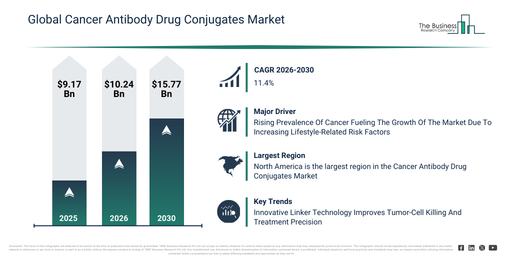
The market for antibody-drug conjugates in oncology has experienced rapid expansion over the past few years, with projections showing an increase from $9.17 billion in 2025 to $10.24 billion in 2026, reflecting an 11.7% compound annual growth rate (CAGR). This historic growth has been driven by progress in monoclonal antibody engineering, a higher prevalence of cancer cases, greater utilization of targeted cancer treatments, broader clinical investigations into biologic therapies, and the regulatory endorsement of initial ADC-based treatments.
The market for cancer antibody drug conjugates is anticipated to expand at a rapid pace in the coming years, reaching a valuation of $15.77 billion by 2030, driven by a compound annual growth rate (CAGR) of 11.4%. This projected growth is fueled by several key factors, including heightened investment in precision oncology initiatives, a broader adoption of combination cancer therapies, the widening of ADC indications to include non-solid tumors, an increasing demand for safer, more targeted treatments, and continuous advancements in linker and payload technologies. Notable trends shaping the forecast period encompass the accelerated development of next-generation antibody drug conjugates, a heightened emphasis on tumor-specific targeting approaches, the growing utilization of cleavable linker technologies, the expansion of ADC applications across diverse cancer types, and a stronger focus on enhancing the therapeutic index.
Download A Free Sample Report For Comprehensive Market Insights:
Cancer Antibody Drug Conjugates Market Expansion Supported By Key Demand Factors
The growing incidence of cancer is anticipated to drive expansion in the cancer antibody drug conjugate market moving forward. Cancer prevalence is defined as the total number of individuals—both newly and previously diagnosed—who remain alive with a cancer history at a given point in time. This prevalence is on the rise due to lifestyle-associated factors like unhealthy eating habits, tobacco use, alcohol intake, and exposure to environmental contaminants, all of which heighten the likelihood of developing various cancer types. Cancer antibody-drug conjugates support cancer management by delivering potent chemotherapeutic agents directly to malignant cells, thereby reducing damage to healthy tissues. They increase treatment accuracy by focusing on specific tumor antigens, boosting therapeutic efficacy while minimizing adverse effects for patients. As an example, in February 2025, Cancer Australia, a government body based in Australia, reported 4,641 new pancreatic cancer cases in 2024, comprising 2,414 in males and 2,227 in females. Consequently, the increasing prevalence of cancer is fueling growth in the cancer antibody drug conjugate market.
Cancer Antibody Drug Conjugates Market Segment Outlook: Which Categories Are Expanding The Fastest?
The cancer antibody drug conjugates market covered in this report is segmented –
1) By Type Of Antibody: Monoclonal Antibodies, Bispecific Antibodies, Low Molecular Weight Antibodies, Polyclonal Antibodies
2) By Mechanism Of Action: Cell Death Signal (CDS) Inducers, Microtubule Disruptors, Deoxyribonucleic Acid (DNA) Damage Inducers, Immune Checkpoint Inhibitors
3) By Technology: Cleavable Linker, Non-Cleavable Linker
4) By Disease Indication: Breast Cancer, Blood Cancers, Lung Cancer, Gastrointestinal Cancers, Prostate Cancer
5) By End-User: Hospitals, Specialty Clinics, Research Institutes
Subsegments:
1) By Monoclonal Antibodies: Fully Human Monoclonal Antibodies, Humanized Monoclonal Antibodies, Chimeric Monoclonal Antibodies, Murine Monoclonal Antibodies
2) By Bispecific Antibodies: T Cell Engager Bispecific Antibodies, Dual Specific Antigen Targeting Bispecific Antibodies, Immune Checkpoint Modulating Bispecific Antibodies, Cytokine Redirecting Bispecific Antibodies
3) By Low Molecular Weight Antibodies: Single Chain Variable Fragment Antibodies, Nanobody Antibodies, Antibody Fragment Antibodies, Domain Antibodies
4) By Polyclonal Antibodies: Purified Polyclonal Antibodies, Recombinant Polyclonal Antibodies, Animal Derived Polyclonal Antibodies, Human Derived Polyclonal Antibodies
Cancer Antibody Drug Conjugates Market Growth Trends Influencing Competitive Dynamics
Major players within the cancer antibody-drug conjugates market are increasingly investing in the development of advanced technological innovations, particularly cleavable tumor-activated linker systems, aimed at improving targeted delivery, treatment accuracy, and safety profiles. These cleavable tumor-activated linkers represent a specialized chemical mechanism employed in antibody-drug conjugates (ADCs) that attach the cytotoxic agent to the antibody and selectively trigger its release upon reaching the tumor microenvironment. In a notable example from June 2025, Daiichi Sankyo Co. Ltd., a Japanese biopharmaceutical firm, secured approval from the United States Food and Drug Administration (FDA) for Datroway (datopotamab deruxtecan-dlnk), a TROP-2-directed antibody-drug conjugate featuring a cleavable linker intended for treating adults diagnosed with locally advanced or metastatic EGFR-mutated non-small cell lung cancer (NSCLC) who have previously undergone EGFR-directed therapy along with platinum-based chemotherapy. This product enables targeted drug release, augments tumor cell elimination via bystander effects, and ensures better treatment tolerability. It enhances precision in therapeutic delivery and broadens treatment possibilities for challenging-to-manage solid tumors.
Cancer Antibody Drug Conjugates Market Key Companies And Competitive Benchmarking
Major companies operating in the cancer antibody drug conjugates market are Johnson & Johnson, Roche Holding AG, Merck and Co. Inc., Pfizer Inc., AbbVie Inc., Bayer AG, Sanofi S.A., AstraZeneca PLC, Bristol-Myers Squibb Company, GlaxoSmithKline PLC, Eli Lilly and Company, Takeda Pharmaceutical Company Limited, Amgen Inc., Gilead Sciences Inc., Astellas Pharma Inc., Daiichi Sankyo Company Limited, Byondis BV, Adienne Pharma and Biotech SA, Helix BioPharma Corp., Adcytherix SAS
Access The Complete Cancer Antibody Drug Conjugates Market Report:
Cancer Antibody Drug Conjugates Market Leading Geography: Which Region Generates The Most Revenue?
North America was the largest region in the cancer antibody drug conjugates market in 2025. Asia-Pacific is expected to be the fastest-growing region in the forecast period. The regions covered in the cancer antibody drug conjugates market report are Asia-Pacific, South East Asia, Western Europe, Eastern Europe, North America, South America, Middle East, Africa.
Get in touch with us:
The Business Research Company: https://www.thebusinessresearchcompany.com/?utm_source=BlogsPR&utm_medium=Paid&utm_campaign=home_page_test
Americas: +1 310-496-7795
Asia: +44 7882 955267 & +91 8897263534
Europe: +44 7882 955267
Email us at: marketing@tbrc.info
Follow us on:
LinkedIn: https://in.linkedin.com/company/the-business-research-company
YouTube: https://www.youtube.com/channel/UC24_fI0rV8cR5DxlCpgmyFQ
Global Market Model: https://www.thebusinessresearchcompany.com/global-market-model