Category: HealthcareServices

  • Global Digital Diabetes Management Market Analysis: Estimated Market Size And Growth Rate

    Global Digital Diabetes Management Market Analysis: Estimated Market Size And Growth Rate

    The Business Research Company’s global market reports are now updated with the latest market sizing information for the year 2024 and forecasted to 2033

    The digital diabetes management market has witnessed exponential growth, surging from $13.27 billion in 2023 to $16.23 billion in 2024, with a remarkable Compound Annual Growth Rate (CAGR) of 22.3%. This historical surge is attributed to the rising prevalence of diabetes, technological advancements, personalized healthcare, regulatory support, and the widespread adoption of telehealth and remote monitoring.

    Anticipated Expansion
    The trajectory of growth is set to continue, with projections indicating an even more substantial market size of $37.4 billion in 2028, reflecting a robust CAGR of 23.2%. The forecasted expansion is linked to factors such as the persistent diabetes epidemic, integration of artificial intelligence (AI) and machine learning, data integration, and the rise of remote care models.

    Rising Healthcare Expenditures Propel Growth

    Healthcare Spending Dynamics
    Increasing healthcare expenditures play a pivotal role in propelling the growth of the digital diabetes management market. The surge in spending on healthcare services, products, and activities is driven by the escalating prevalence of diabetes and a greater focus on research and development. This heightened investment results in the advancement of digital diabetes care devices, including improved glucose monitoring systems and insulin delivery devices.

    Global Spending Trends
    In the UK, for instance, healthcare spending witnessed a substantial increase of 9.4% in nominal terms and 9.7% in real terms. The total healthcare expenditure in 2021 reached $367.25 billion (£280.7 billion), with pharmaceutical expenditure amounting to $51.84 billion (£39.6 billion). The significant rise in preventive care spending, reaching $45.93 billion (£35.1 billion) in 2021, underscores the commitment to addressing healthcare needs comprehensively.

    View More On The Digital Diabetes Management Market Report 2024 – https://www.thebusinessresearchcompany.com/report/digital-diabetes-management-global-market-report

    Innovative Products Revolutionizing the Market

    Continuous Glucose Monitoring Revolution
    Major players in the digital diabetes management market are actively developing innovative products to gain a competitive edge. Dexcom, Inc., for example, launched the Dexcom ONE Continuous Glucose Monitoring System in April 2022. This user-friendly, real-time continuous glucose monitoring solution eliminates the need for fingerpricks, providing accurate data for effective diabetes management.

    Empowering Wearable Technology
    Dexcom ONE, a wearable sensor and transmitter, empowers users by sending continuous glucose monitoring data in real-time to a compatible smart device. This technology not only enhances user convenience but also facilitates in-the-moment treatment decisions with trend arrows and customizable alerts.

    Medtronic’s Strategic Move towards Automated Management

    Strategic Acquisition for Automation
    In May 2023, Medtronic PLC made a strategic move by acquiring EOFLOW Co., Ltd. for $738 million. This acquisition positions Medtronic to advance automated diabetes management by combining tubeless devices with continuous glucose monitors and a meal-detection algorithm. EOFLOW, a South Korea-based smart wearable diabetes management solutions provider, aligns with Medtronic’s vision for a more sophisticated closed-loop system.

    Pioneering Automation in Diabetes Care
    Medtronic’s endeavor to integrate tubeless devices with continuous glucose monitors and a meal-detection algorithm marks a significant step towards automating diabetes care. This strategic move demonstrates the industry’s commitment to innovation and addressing the evolving needs of individuals managing diabetes.

    Market Segmentation and Regional Dominance

    Segmentation Overview
    The digital diabetes management market is segmented based on product & service, device type, and end-user. Key segments include Devices, Applications, Data Management Software & Platforms, and Services. Device types range from Handheld Devices to Wearable Devices, while end-users encompass Self/Home Healthcare, Hospitals & Specialty Diabetes Clinics, and other end-users.

    Regional Dominance
    North America emerged as the largest region in the digital diabetes management market in 2023. This regional dominance reflects the region’s proactive adoption of digital healthcare solutions and the presence of major industry players.

    Conclusion
    In conclusion, the digital diabetes management market’s exponential growth is a testament to the industry’s commitment to addressing the evolving landscape of diabetes care. Driven by rising healthcare expenditures, innovative product developments, strategic acquisitions, and a focus on automation, the market is poised for a transformative journey. As technologies continue to advance, the digital diabetes management sector stands at the forefront of revolutionizing diabetes care, offering hope and improved quality of life for millions worldwide.

    Request A Sample Of The Global Digital Diabetes Management Market Report 2024:
    https://www.thebusinessresearchcompany.com/sample_request?id=3414&type=smp

  • Biophotonics Global Market Outlook 2024-2033: Size And Growth Rate Analysis

    Biophotonics Global Market Outlook 2024-2033: Size And Growth Rate Analysis

    The Business Research Company’s global market reports provide comprehensive analysis on the various markets in 27 industries across 60 geographies.

    The biophotonics market has witnessed remarkable growth in recent years, driven by advancements in medical imaging, disease diagnosis, and life sciences research. In 2023, the market size reached an impressive $74.36 billion and is set to surge to $82.74 billion in 2024, boasting a compound annual growth rate (CAGR) of 11.3%.

    The Prodigy of Growth

    1. Short-term Projections (2023-2024):
      • Projected market size: $82.74 billion.
      • CAGR: 11.3%.
      • Key drivers: Medical imaging advancements, disease diagnosis, life sciences research, optical sensing, spectroscopy, laser and light source innovations.
    2. Long-term Forecasts (2024-2028):
      • Anticipated market size: $130.07 billion.
      • CAGR: 12.0%.
      • Emerging factors: Personalized medicine, precision agriculture, global health initiatives, wearable and mobile health devices, environmental monitoring, and safety.
      • Noteworthy trends: Miniaturization, point-of-care devices, multimodal imaging, optogenetics, machine learning, data analytics, smart imaging probes.

    Chronic Conditions Fueling The Biophotonics Market
    The escalating prevalence of chronic conditions serves as a powerful catalyst for the biophotonics market’s continued expansion. Chronic diseases, persisting for three months or more, account for a significant portion of global fatalities. Biophotonics contributes to early detection, monitoring, and treatment through non-invasive imaging and diagnostics, improving patient outcomes and curbing healthcare costs.

    1. Global Health Challenge:
      • WHO reports 41 million deaths annually due to chronic diseases.
      • Breakdown: 17.9 million cardiovascular deaths, 9.3 million cancer deaths, 4.1 million chronic respiratory deaths, 2.0 million diabetes deaths.
      • Biophotonics’ role: Driving growth by aiding in the battle against chronic conditions.

    View More On The Biophotonics Market Report 2024 – https://www.thebusinessresearchcompany.com/report/biophotonics-global-market-report

    Innovations In The Biophotonics Market
    Major players in the biophotonics market are actively engaged in pioneering advancements, especially in the medical field. Innovative products, such as advanced bronchoscopes, demonstrate the industry’s commitment to pushing boundaries.

    1. Bronchoscopes Redefined:
      • Olympus Corporation introduces H-SteriScope, a line of single-use bronchoscopes.
      • Purpose: Advanced diagnostic and therapeutic procedures.
      • Features: Disposable, premium features for precise targeting, diagnosis, and treatment.
      • Specifications: Outer diameters from 2.2 mm to 6.2 mm, working channel range of 1.2 mm to 3.2 mm.

    CellaVision’s Strategic Acquisition
    In a significant move, CellaVision, a Swedish company specializing in digital Morphology Solutions, acquired exclusive rights to the Fourier Ptychographic Microscopy patent portfolio from Clearbridge BioPhotonics for $3.28 million (SEK 28.7 million). This strategic acquisition positions CellaVision at the forefront of future technology development, particularly in automated microscopes for hematology and related fields.

    1. Acquisition Highlights:
      • CellaVision’s acquisition of Fourier Ptychographic Microscopy patent portfolio.
      • Transaction value: $3.28 million (SEK 28.7 million).
      • Potential applications: Future automated microscopes for hematology and related fields.

    Segmentation Insight

    1. Product Technology:
      • In-Vitro.
      • In-Vivo.
    2. Application:
      • See-Through Imaging.
      • Inside Imaging.
      • Spectromolecular.
      • Surface Imaging.
      • Microscopy.
      • Light Therapy.
      • Biosensors.
      • Other Applications.
    3. End Use:
      • Diagnostics.
      • Therapeutic.
      • Tests.
      • Other End Uses.

    Regional Dominance
    In 2023, North America emerged as the epicenter of the biophotonics market, establishing itself as the largest region. The region’s dominance underscores the robust growth and strategic significance of biophotonics technologies in the continent.

    In conclusion, the biophotonics market’s trajectory is on a spectacular ascent, fueled by technological innovations, strategic acquisitions, and a steadfast focus on addressing global health challenges. As the market continues to evolve, stakeholders should stay attuned to emerging trends and transformative breakthroughs shaping the radiant future of biophotonics.

    Request A Sample Of The Global Biophotonics Market Report 2024:
    https://www.thebusinessresearchcompany.com/sample_request?id=3270&type=smp

  • Key Trends And Drivers In The Influenza Diagnostic Market 2024

    Key Trends And Drivers In The Influenza Diagnostic Market 2024

    The Business Research Company’s market reports offer an in-depth analysis on the market’s growth potential, major drivers, key trends and more.

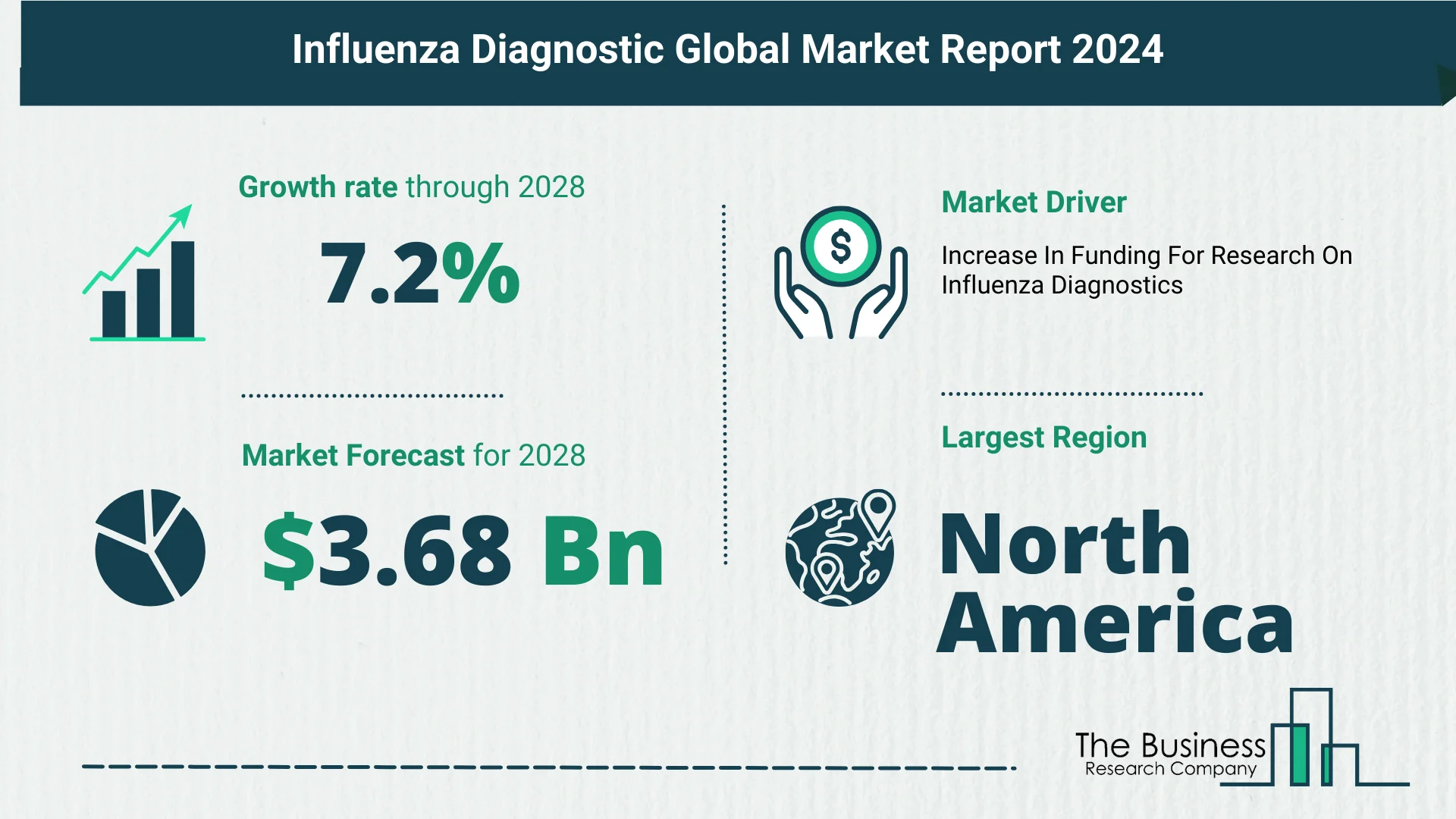
    The influenza diagnostic market is poised for substantial growth in the coming years, with an expected surge to $3.68 billion in 2028, boasting a Compound Annual Growth Rate (CAGR) of 7.2%. This growth is attributed to factors such as the prevalence of seasonal influenza, the rise of point-of-care testing, the adoption of remote and home testing, and the integration of digital health solutions.

    Rapid Diagnostic Tests: Propelling Market Growth

    Understanding Diagnostic Tests
    Diagnostic tests play a crucial role in confirming or ruling out various conditions and diseases. Rapid influenza diagnostic tests (RIDTs) are set to be a significant driver in the influenza diagnostic market. These tests can swiftly detect influenza viral antigens within 10-15 minutes, offering moderate sensitivity (50-70%). According to the Centers for Disease Control and Prevention (CDC), during September 2020 to May 2021 in the United States, 0.2% of respiratory specimens tested were positive for an influenza virus, highlighting the importance of rapid diagnostic tests.

    Key Market Players
    Major players in the influenza diagnostic market include F. Hoffmann-La Roche Ltd., Quidel Corporation, Thermo Fisher Scientific Inc., Abbott Laboratories, and Hologic Inc., among others. These companies are at the forefront of developing and providing innovative diagnostic solutions to meet the growing demand for influenza testing.

    Simultaneous Detection: A Breakthrough in Diagnosis
    Innovative Products Leading the Way
    Major companies in the influenza diagnostic market are focusing on innovation, introducing breakthrough products like the Lucira COVID-19 & Flu Home Test. This at-home test kit allows simultaneous qualitative detection of influenza A and B (commonly known as the flu) and SARS-CoV-2 (the virus causing COVID-19). Pfizer Inc. received approval for this test in February 2023, highlighting the industry’s commitment to providing convenient and comprehensive diagnostic solutions.

    Read More On The Influenza Diagnostic Market Report 2024 – https://www.thebusinessresearchcompany.com/report/influenza-diagnostic-global-market-report

    Strength in Integration
    The Lucira COVID-19 & Flu Home Test exemplifies the integration of diagnostic capabilities. With results available in approximately 30 minutes from self-collected nasal swab samples, this test showcases the industry’s dedication to offering rapid and reliable diagnostic solutions for both influenza and COVID-19.

    Thermo Fisher’s Strategic Move: Mesa Biotech Acquisition
    Strengthening Diagnostic Capabilities
    In February 2021, Thermo Fisher Scientific Inc. made a strategic move by acquiring Mesa Biotech, Inc., an infectious disease diagnostic company. This acquisition aims to enhance Thermo Fisher’s manufacturing volume, achieve cost efficiencies, and expedite the delivery of diagnostics to the market on a larger scale. Such strategic partnerships and acquisitions contribute to the overall advancement and growth of the influenza diagnostic market.

    Market Segmentation: Navigating the Landscape
    Understanding Diagnostic Tests
    The influenza diagnostic market is intricately segmented based on traditional diagnostic tests and molecular diagnostic tests. Traditional diagnostic tests include Rapid Influenza Diagnostic Tests (RIDT), Viral Culture, DFA, Serological assays, and other traditional diagnostic tests. On the other hand, molecular diagnostic tests encompass Reverse Transcription Polymerase Chain Reaction (RT-PCR), Isothermal Nucleic Acid Amplification Tests (INAAT), Loop-Mediated Isothermal Based Amplification Assays, and other molecular diagnostic tests.

    End User Perspectives
    End-user segments in the influenza diagnostic market include Hospitals and Clinical Laboratories, Diagnostic Reference Laboratories, Academic/Research Institutes, and Other End Users. Understanding these segments is crucial for comprehending the diverse applications and demands within the influenza diagnostic landscape.

    Regional Leadership: North America Takes the Lead
    Dominance in 2023
    In 2023, North America emerged as the largest region in the influenza diagnostic market. This regional dominance can be attributed to a robust healthcare infrastructure, technological advancements, and a proactive approach in adopting diagnostic solutions. As the market continues to evolve, North America remains a key player shaping the trajectory of influenza diagnostics.

    In conclusion, the influenza diagnostic market is on the cusp of significant growth, driven by the rise of rapid diagnostic tests, simultaneous detection solutions, strategic acquisitions, and a comprehensive understanding of market segmentation. With advancements in diagnostic technologies, the industry is poised to play a pivotal role in efficiently managing influenza and other respiratory illnesses in the years to come.

    Request for A Sample Of The Global Influenza Diagnostic Market Report:
    https://www.thebusinessresearchcompany.com/sample_request?id=3237&type=smp

  • What’s The Growth Forecast For 3D Diagnostic Imaging Services Market Through 2024-2033?

    What’s The Growth Forecast For 3D Diagnostic Imaging Services Market Through 2024-2033?

    The Business Research Company’s global market reports provide comprehensive analysis on the various markets in 27 industries across 60 geographies.

     The 3D diagnostic imaging services market has experienced robust growth, reaching $207.38 billion in 2023 and set to climb further to $219.96 billion in 2024, showcasing a compound annual growth rate (CAGR) of 6.1%. This growth is attributed to various factors, including the increase in the need for point-of-care imaging systems, a rise in chronic diseases, a surge in demand for optical imaging, the adoption of 3D imaging, and escalating healthcare expenditure.

    Anticipated Surge and Key Drivers in the Coming Years

    1. The market is projected to witness substantial growth, reaching $279.17 billion by 2028, with a CAGR of 6.1%.
    2. Key drivers include the growing need for early diagnosis and preventive medicine, increased investments in healthcare infrastructure, rising demand for 3D accelerometers in smartphones and gaming consoles, and a growing geriatric population.
    3. Major trends in the forecast period encompass technological advancements, the integration of artificial intelligence (AI), increased investments, product innovation, and collaborations and acquisitions.

    Rising Prevalence Of Chronic Diseases Fuels Growth In The 3D Diagnostic Imaging Services Market

    1. Impact of Chronic Diseases on Market Growth
      • Chronic diseases necessitate ongoing management and treatment.
      • 3D diagnostic imaging services assist in managing chronic diseases by providing detailed visualization for precise monitoring.
    2. Projection for the Future
      • By 2050, the number of individuals aged 50 and older with at least one chronic illness is projected to surge by 99.5%, reaching 142.66 million.
    3. Driving Force for Market Growth
      • The prevalence of chronic diseases is a significant driver for the growth of the 3D diagnostic imaging services market.

    Key Players Driving Market Innovation

    1. Prominent Companies in the 3D Diagnostic Imaging Services Market
      • Major companies shaping the market include Laboratory Corporation of America Holdings, Quest Diagnostics Inc., Koninklijke Philips N.V., GE Healthcare Technologies Inc., and many others.
    2. Innovation for Global Presence
      • Companies are developing advanced imaging solutions to gain a competitive edge.
      • Example: Koninklijke Philips N.V.’s Compact 5000 Series offers premium image quality in a portable ultrasound unit, aiming to enhance diagnostic confidence.

    View More On The 3D Diagnostic Imaging Services Market Report 2024 – https://www.thebusinessresearchcompany.com/report/3d-diagnostic-imaging-services-global-market-report

    Molecular Devices Expands Mobile Medical Imaging Offerings Through Acquisition

    1. Strategic Acquisition by Molecular Devices
      • In April 2023, Molecular Devices acquired Interim Diagnostic Imaging, enhancing its mobile cardiac catheter and angiography lab solutions.
      • The acquisition diversifies and improves the product offering, providing a full range of medical imaging labs.
    2. Expanded Services by Interim Diagnostic Imaging
      • Interim Diagnostic Imaging offers long- and short-term rentals of mobile CT scanners, mobile MRI scanners, and mobile PET scanners.

    Segmentation and Market Dynamics

    1. Market Segmentation
      • The 3D diagnostic imaging services market is segmented by technique (ultrasound, MRI, X-ray, CT, and others), application (oncology, cardiology, orthopedic, and others), and end-user (diagnostic centers, hospitals, research centers).
    2. Regional Dominance
      • North America emerged as the largest region in the 3D diagnostic imaging services market in 2023, showcasing its pivotal role in market dynamics.

    Conclusion: A Visionary Future for 3D Diagnostic Imaging The 3D diagnostic imaging services market’s trajectory, fueled by the increasing prevalence of chronic diseases, technological advancements, and strategic acquisitions, presents a dynamic landscape. As companies innovate and expand their global presence, the market is poised for remarkable growth. With a focus on early diagnosis, preventive medicine, and the integration of cutting-edge technologies, the future holds promising opportunities for stakeholders in the 3D diagnostic imaging services sector.

    Request A Sample Of The Global 3D Diagnostic Imaging Services Market Report 2024:
    https://www.thebusinessresearchcompany.com/sample_request?id=3180&type=smp

  • Understand How The 3D Cell Culture Technologies Market Is Poised To Grow Through 2024-2033

    Understand How The 3D Cell Culture Technologies Market Is Poised To Grow Through 2024-2033

    The Business Research Company’s global market reports are now updated with the latest market sizing information for the year 2024 and forecasted to 2033

    As per The Business Research Company’s 3D Cell Culture Technologies Global Market Report 2024, the 3D cell culture technologies market is expected to show significant growth in the forecast period.

    The 3D cell culture technologies market has experienced rapid expansion, projecting a promising trajectory. From $2.85 billion in 2023, it is set to reach $3.39 billion in 2024 at an impressive CAGR of 19.0%. Looking ahead, the market is expected to burgeon to $6.94 billion by 2028, with a compounded annual growth rate of 19.6%. This remarkable growth is attributed to several historical and forecasted factors.

    • Historic Growth Drivers: Advances in cell biology, drug development, the surge in chronic diseases, and government funding have been pivotal in driving historical market growth.
    • Forecasted Growth Factors: The pharmaceutical industry’s role, escalating research and development activities, and growing environmental and ethical considerations are poised to steer the market toward further growth.

    Organ Transplantation Fuels Demand
    The 3D cell culture technologies market is witnessing a significant boost due to the escalating demand for organ transplantation. The ability of 3D cell cultures to mimic tissues or organs proves instrumental in transplantation procedures, aiding in tissue and organ regeneration. This technology also facilitates drug toxicology screening.

    • Organ Transplants Surge: In 2022, the United States saw a 3.7% increase in organ transplants, reaching 42,887. Deceased organ donors also marked a record year with a 7.5% increase. The broadening criteria for deceased organ donation and an increase in donations after circulatory death (DCD donors) contribute to this surge.

    Industry Giants: Key Players in 3D Cell Culture Technologies
    Leading the charge in the 3D cell culture technologies market are major companies dedicated to advancing research and technology. These companies play a crucial role in shaping the industry landscape.

    • Key Market Players: Becton Dickinson and Company, Corning Incorporated, Eppendorf AG, GE Healthcare, Merck KGaA, Thermo Fisher Scientific Inc., Lonza Group AG, HiMedia Laboratories Pvt. Ltd., Agilent Technologies Inc., PromoCell GmbH, and more.

    Innovations Transforming Cell Culture
    In a bid to gain a competitive edge, major players are introducing groundbreaking products. One notable innovation is the PODS-PeptiGels, a combination of synthetic peptide hydrogels (PeptiGels) and sustained-release growth factors (PODS), providing a highly adaptable environment for 3D cell culture.

    • PeptiGels and Pods Synergy: Companies like Cell Guidance Systems and Manchester BIOGEL collaborated to launch PODS-PeptiGels. This ready-to-use kit offers researchers flexibility, allowing them to select from over 70 growth factors and combine them with various hydrogels, each offering mechanical and biomimetic tuneability.

    View More On The 3D Cell Culture Technologies Market Report 2024 – https://www.thebusinessresearchcompany.com/report/3d-cell-culture-technologies-global-market-report

    Strategic Moves: CELLINK’s Entry Into Contract Research
    In a strategic move, CELLINK Group acquired Visikol Corporation for $7.5 million in May 2021, marking their entry into the contract research market. Visikol Corp., known for its services in 3D cell culture, tissue imaging, multiplex imaging, and digital pathology, adds a new dimension to CELLINK’s capabilities.

    • CELLINK’s Acquisition: The acquisition of Visikol Corporation broadens CELLINK’s offerings and positions them as a key player in the contract research services market.

    Market Segmentation: Understanding Diverse Applications
    The 3D cell culture technologies market is intricately segmented to cater to the diverse needs of end-users. Key segments include types of technologies, applications, and end-users.

    • Technology Types: Scaffold-based, Scaffold-free, 3D Bioreactors.
    • Applications: Cancer Research, Stem Cell Research, Drug Discovery, Regenerative Medicine.
    • End Users: Research Laboratories and Institutes, Biotechnology and Pharmaceutical Companies, Hospitals and Diagnostic Centers, and Other End Users.

    Regional Dynamics: North America Takes the Lead
    In 2023, North America emerged as the largest region in the 3D cell culture technologies market. This prominence underscores the region’s robust healthcare infrastructure and technological advancements, contributing significantly to the market’s global standing.

    In conclusion, the 3D cell culture technologies market is on a robust growth trajectory, driven by factors such as increased demand for organ transplantation, innovative product introductions, strategic acquisitions, and expanding applications. As the industry continues to evolve, it presents exciting opportunities for both established players and emerging entrants in the field.

    Request A Sample Of The Global 3D Cell Culture Technologies Market Report 2024:
    https://www.thebusinessresearchcompany.com/sample_request?id=2462&type=smp