Category: Medical Equipment

  • Global Multi-Port Robot  Market Set To Expand To $5.95 Billion By 2030 At 18.8% CAGR

    Global Multi-Port Robot Market Set To Expand To $5.95 Billion By 2030 At 18.8% CAGR

    The Business Research Company’s 2026 market reports feature enhanced tools like market attractiveness analysis, TAM assessment, and company scoring matrices, along with interactive dashboards, deeper supply chain insights, and startup coverage strengthening the depth, usability, and strategic value of insights.

    What Is The Anticipated Rise In Market Value Of The Multi-Port Robot Market During The Forecast Period?

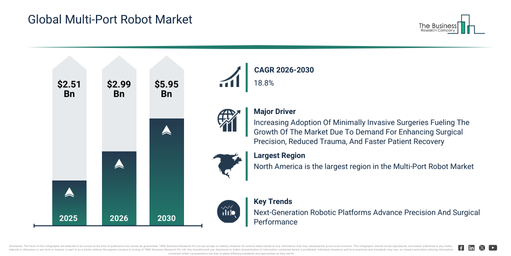
    The multi-port robot market has experienced substantial expansion recently. This market is projected to expand from $2.51 billion in 2025 to reach $2.99 billion by 2026, demonstrating a compound annual growth rate (CAGR) of 19.1%. This historical growth is a result of several factors, including the increased embrace of minimally invasive procedures, a heightened need for high-precision surgical instruments, expanding investments in healthcare infrastructure, the proliferation of robotic-assisted surgery initiatives, and greater access to sophisticated imaging components.

    The multi-port robot market size is anticipated to experience substantial growth in the coming years. By 2030, this market is projected to reach a valuation of $5.95 billion, exhibiting a compound annual growth rate (CAGR) of 18.8%. This expansion during the forecast period is largely driven by factors such as the increasing integration of AI-enabled robotic control, the growing installation of multi-port surgical systems, the rising demand for robotic instruments and accessories, the broadening scope of medical and industrial automation applications, and an intensified focus on mobility and adaptable robotic platforms. Key trends anticipated during this period encompass technological advancements in multi-arm coordination, innovations in imaging and visualization systems, ongoing developments in cloud-based robotic software, research and development efforts in ergonomic robotic interfaces, and further technological progress in autonomous assistance systems.

    Access Your Free Sample Report For In-Depth Market Analysis:

    https://www.thebusinessresearchcompany.com/sample.aspx?id=30666&type=smp

    Which Drivers Are Supporting The Multi-Port Robot Market Growth?

    The growing embrace of minimally invasive surgeries is anticipated to fuel the expansion of the multi-port robot market moving forward. Minimally invasive surgeries are surgical interventions performed through small incisions or a single entry point, leading to reduced patient trauma, quicker recovery times, and lower risks of complications. The uptake of minimally invasive surgeries is on the rise as healthcare institutions and patients increasingly prioritize shorter recovery periods, less post-operative pain, diminished complication risks, and minimal scarring when compared to conventional open procedures. Multi-port robots facilitate minimally invasive surgeries by offering enhanced dexterity, precision, and control through multiple points of instrument access. They contribute to better surgical outcomes by enabling complex operations with smaller incisions, reduced trauma, and faster patient recovery. For instance, in January 2025, according to Intuitive Surgical Inc., a US-based medical technology company, worldwide da Vinci procedures, a type of minimally invasive robotic-assisted surgery, escalated by approximately 18% in the fourth quarter of 2024 versus the fourth quarter of 2023. Full year 2024 procedures grew by approximately 17% compared with 2023, and the company forecasts worldwide da Vinci procedures to increase by approximately 13% to 16% in 2025 in comparison to 2024. Therefore, the increasing adoption of minimally invasive and single-port surgeries is a key driver for the growth of the multi-port robot market.

    Which Segment Classifications Are Used In The Multi-Port Robot Market Segment Analysis?

    The multi-port robot market covered in this report is segmented –

    1) By Product Type: Multi-Port Robotic Surgical Systems, Accessories And Instruments, System Services And Maintenance

    2) By Technology: Fully Automated Multi-Port Robots, Semi-Automated Multi-Port Robots, AI-Enabled Multi-Port Surgical Platforms, Teleoperated Multi-Port Robotic Systems

    3) By Application: General Surgery, Gynecological Surgery, Urological Surgery, Cardiothoracic Surgery, Orthopedic Surgery, Neurosurgery, Others

    4) By End-User: Hospitals, Ambulatory Surgical Centers, Specialty Surgical Centers, Academic And Research Institutions

    Subsegments:

    1) By Multi-Port Robotic Surgical Systems: Laparoscopic Multi-Port Surgical Systems, Thoracoscopic Multi-Port Surgical Systems, Robotic-Assisted General Surgery Systems, Robotic-Assisted Endoscopic Surgery Systems, Robotic-Assisted Specialty Surgery Systems

    2) By Accessories And Instruments: Robotic Surgical Arms, Endoscopic Visualization Instruments, Robotic Energy Devices, Suturing And Stapling Instruments, Robotic Surgical Consumables

    3) By System Services And Maintenance: Installation And Integration Services, Preventive Maintenance Services, Software Upgrade Services, Technical Support Services, Training And Education Services

    Which Trends Are Expected To Impact The Multi-Port Robot Market?

    Leading companies within the multi-port surgical robot market are focusing on developing advanced robotic systems, such as next-generation platforms, to enhance surgical precision, optimize workflow efficiency, and broaden clinical capabilities across various specialties. These next-generation multi-port robotic platforms are technologies designed to improve surgical accuracy, deliver real-time procedural data, and support complex workflows across a wide range of surgical interventions. For example, in July 2025, Intuitive Surgical, a US-based medical technology company, obtained CE clearance to introduce the da Vinci 5 Surgical System in the United States, which is a next-generation robotic platform. This system incorporates more than 150 design innovations, enhanced data analytics for improved procedural outcomes, and an architecture built for expanded clinical workflows. The da Vinci 5 also received CE marking for broader clinical use in Europe in 2025, facilitating wider adoption across healthcare centers. This launch represents a significant technological advancement by integrating high-precision robotic assistance with data-driven surgical workflows, effectively bridging traditional surgery with next-generation robotic platforms, and providing surgeons with a scalable, efficient solution for enhanced procedural performance.

    Which Firms Are Contributing To The Multi-Port Robot Market Ecosystem?

    Major companies operating in the multi-port robot market are Johnson & Johnson, Hanwha Group, ABB Ltd., Medtronic plc, Stryker Corporation, Intuitive Surgical Inc., Avatera Medical GmbH, CMR Surgical Ltd., Flexiv Ltd., Distalmotion SA, RobotLAB Inc., Shanghai MicroPort MedBot (Group) Co. Ltd., WEGO Medical Holdings Ltd., Asensus Surgical Inc., Microsure BV, Medicaroid Corporation, Sudhir Srivastava Innovations Pvt. Ltd., Riverfield Inc., Beijing Surgerii Robotics Co. Ltd., Shenzhen Jingfeng Medical Technology Co. Ltd.

    Get The Full Multi-Port Robot Market Report:

    https://www.thebusinessresearchcompany.com/report/multi-port-robot-market-report

    Which Region Is The Largest In The Multi-Port Robot Market?

    North America was the largest region in the multi-port robot market in 2025. Asia-Pacific is expected to be the fastest-growing region in the forecast period. The regions covered in the multi-port robot market report are Asia-Pacific, South East Asia, Western Europe, Eastern Europe, North America, South America, Middle East, Africa.

    Request A Customized Multi-Port Robot Market Report For Competitive Insights:

    https://www.thebusinessresearchcompany.com/customise?id=30666&type=smp

    Browse Through More Reports Similar to the Global Multi-Port Robot Market 2026, By The Business Research Company

    Mobile Robots Market Report 2026

    https://www.thebusinessresearchcompany.com/report/mobile-robots-global-market-report

    Industrial Robots Warehousing And Storage Robots Market Report 2026

    https://www.thebusinessresearchcompany.com/report/industrial-robots-warehousing-and-storage-robots-global-market-report

    road logistics global market report

    https://www.thebusinessresearchcompany.com/report/road-logistics-global-market-report

    Get in touch with us:

    The Business Research Company: https://www.thebusinessresearchcompany.com/

    Americas +1 310-496-7795

    Asia +44 7882 955267 & +91 8897263534

    Europe +44 7882 955267

    Email us at info@tbrc.info

    Follow us on:

    LinkedIn: https://in.linkedin.com/company/the-business-research-company

    YouTube: https://www.youtube.com/channel/UC24_fI0rV8cR5DxlCpgmyFQ

    Global Market Model: https://www.thebusinessresearchcompany.com/global-market-model
  • Modular Process Skid Packages  Market Forecast 2026–2030 Highlighting Expansion Across Industries

    Modular Process Skid Packages Market Forecast 2026–2030 Highlighting Expansion Across Industries

    The Business Research Company’s 2026 market reports feature enhanced tools like market attractiveness analysis, TAM assessment, and company scoring matrices, along with interactive dashboards, deeper supply chain insights, and startup coverage strengthening the depth, usability, and strategic value of insights.

    What Level Of Market Value Growth Is Predicted For The Modular Process Skid Packages Market From 2026 To 2030?

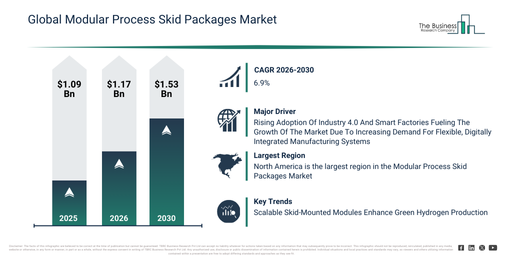
    The modular process skid packages market has seen substantial growth over recent years. It is anticipated to increase from $1.09 billion in 2025 to $1.17 billion in 2026, achieving a compound annual growth rate (CAGR) of 7.2%. This historical expansion can be attributed to several factors, including the provision of solutions for chemical and oil sectors, the rise of industrial automation in manufacturing facilities, an increasing need for adaptable and portable processing systems, a growing move towards offsite fabrication for safety improvements, an intensified focus on reducing construction timelines in various industries, expanding investments in pharmaceutical and biotech facilities, and the broader application of modular systems in energy and gas uses.

    The modular process skid packages market is anticipated to experience robust expansion over the coming years. Its valuation is predicted to reach $1.53 billion by 2030, demonstrating a compound annual growth rate (CAGR) of 6.9%. This growth in the forecast period is primarily attributable to advances in automation-enabled skid systems, innovations in compact and energy-efficient designs, the integration of IoT monitoring, progress in modularization techniques, novel multifunctional skid units, the incorporation of digital twin technology, developments in sustainable skid systems, inventive plug-and-play skid designs, the adoption of AI control systems, and improvements in corrosion-resistant materials. Significant trends during this forecast period encompass advancements in automation-enabled skid systems, the creation of compact and energy-efficient skid designs, the integration of IoT-based monitoring systems, ongoing improvements in modularization techniques, the development of multifunctional skid units, the implementation of digital twin systems, new eco-friendly skid technologies, innovative plug-and-play modular solutions, the incorporation of AI-powered controls, and progress in durable and corrosion-resistant materials.

    Access Your Free Sample Report For In-Depth Market Analysis:

    https://www.thebusinessresearchcompany.com/sample.aspx?id=30663&type=smp

    Which Primary Drivers Are Impacting The Modular Process Skid Packages Market Growth?

    The increased implementation of Industry 4.0 and smart factories is anticipated to fuel the expansion of the modular process skid packages market going forward. Industry 4.0 and smart factories involve integrating advanced digital technologies like the Internet of Things (IoT), artificial intelligence, automation, robotics, and data analytics into manufacturing processes to enable real-time monitoring, intelligent decision-making, and highly flexible production. The uptake of Industry 4.0 and smart factories is increasing as manufacturers pursue improved productivity, reduced operational costs, mass customization, and faster time-to-market. Modular process skid packages support Industry 4.0 and smart factories by providing standardized, pre-engineered, and easily integrated manufacturing units. They enhance operational efficiency and flexibility by facilitating automation, real-time monitoring, and rapid reconfiguration to meet evolving production demands. For instance, in September 2025, the International Federation of Robotics, a Germany-based non-profit organization, reported that 4,664,000 robotic units were operating in factories globally in 2024, representing a 9% increase from 4,281,585 units in 2023. Consequently, the rising adoption of Industry 4.0 and smart factories is driving the growth of the modular process skid packages market.

    Which Segments Define The Modular Process Skid Packages Market Segment Structure?

    The modular process skid packages market covered in this report is segmented –

    1) By Type: Open Type, Closed Type

    2) By Component: Pressure Vessels, Piping Systems, Pumping and Metering Systems

    3) By Deployment: Onsite Integrated Systems, Offsite Modular Units, Mobile Skid Packages

    4) By Skid Function: Pumping Skids, Filtration Skids, Separation Skids

    5) By Application: Oil And Gas, Chemical Processing, Pharmaceuticals, Food And Beverage, Water And Wastewater Treatment, Other Applications

    Subsegments:

    1) By Open Type: Non-Enclosed Insulator Design, Air-Cooled Configurations, Outdoor Installation Designs, Exposed Conductor Support Insulators, Low-Voltage Open Structure Insulators, Medium-Voltage Open Structure Insulators, Open-Frame Post Insulators, Open-Pin and Open-Suspension Styles

    2) By Closed Type: Enclosed Insulator Design, Weatherproof Insulated Housings, Fully Sealed Insulator Assemblies, Indoor Protection-Type Insulators, High-Voltage Enclosed Insulators, Composite Closed-Body Insulators, Encapsulated Post Insulators, Closed Suspension and Strain Designs

    Which Trends Are Shaping Growth In The Modular Process Skid Packages Market?

    Leading companies active in the modular process skid packages market are concentrating on developing advanced solutions, such as scalable skid-mounted electrolyzer modules, to boost green hydrogen production efficiency. A scalable skid-mounted module refers to a prefabricated and pre-tested unit designed to reduce deployment timelines, lower construction expenses, and de-risk large-scale undertakings. For instance, in August 2023, ITM Power, a UK-based energy firm, introduced the POSEIDON 20 MW electrolyzer module. This advancement enables large-scale hydrogen production through an optimized skid footprint suitable for indoor and outdoor setups, allowing developers to efficiently integrate the module into commercial hydrogen projects. It delivers pre-fabricated and pre-tested units, thereby simplifying project execution and lowering risks. Integrated with ITM Power’s existing electrolyzer platforms, including the Trident and Neptune 2 MW plug-and-play electrolyzers for small to mid-size projects, it offers a continuous large-scale hydrogen production solution. The POSEIDON module improves operational efficiency, simplifies project implementation, and aids in scaling green hydrogen infrastructure.

    Who Are The Established Players Within The Modular Process Skid Packages Market?

    Major companies operating in the modular process skid packages market are Fluor Corporation, Technip Energies N.V., GEA Group AG, Zeton Inc., Gray Construction Inc., INMA Steel Inc., Integrated Flow Solutions LLC, ASL Group, EPIC Systems Inc., ABJ Engineering & Contracting Co., ViENERG Resources Pvt Ltd., Udkam Process Equipment India Pvt Ltd., Nano-Purification Solutions, BlissFlow Systems, Robinson Inc., Petrak Industries Inc., SalCon SA, Khaas Designing and Engineering, Integra Skid Systems, Flomek Singapore Private Limited, PT Perkasa Marine Indonesia

    Get The Full Modular Process Skid Packages Market Report:

    https://www.thebusinessresearchcompany.com/report/modular-process-skid-packages-market-report

    Which Region Leads The Modular Process Skid Packages Market In Overall Market Size?

    North America was the largest region in the modular process skid packages market in 2025. Asia-Pacific is expected to be the fastest-growing region in the forecast period. The regions covered in the modular process skid packages market report are Asia-Pacific, South East Asia, Western Europe, Eastern Europe, North America, South America, Middle East, Africa.

    Request A Customized Modular Process Skid Packages Market Report For Competitive Insights:

    https://www.thebusinessresearchcompany.com/customise?id=30663&type=smp

    Browse Through More Reports Similar to the Global Modular Process Skid Packages Market 2026, By The Business Research Company

    Packaging Machinery Market Report 2026

    https://www.thebusinessresearchcompany.com/report/packaging-machinery-global-market-report

    Packaging Robots Market Report 2026

    https://www.thebusinessresearchcompany.com/report/packaging-robots-global-market-report

    packaging automation global market report

    https://www.thebusinessresearchcompany.com/report/packaging-automation-global-market-report

    Get in touch with us:

    The Business Research Company: https://www.thebusinessresearchcompany.com/

    Americas +1 310-496-7795

    Asia +44 7882 955267 & +91 8897263534

    Europe +44 7882 955267

    Email us at info@tbrc.info

    Follow us on:

    LinkedIn: https://in.linkedin.com/company/the-business-research-company

    YouTube: https://www.youtube.com/channel/UC24_fI0rV8cR5DxlCpgmyFQ

    Global Market Model: https://www.thebusinessresearchcompany.com/global-market-model
  • Metaverse Retail  Market Outlook 2026–2030 Driven By Growth Factors And Projections

    Metaverse Retail Market Outlook 2026–2030 Driven By Growth Factors And Projections

    The Business Research Company’s 2026 market reports feature enhanced tools like market attractiveness analysis, TAM assessment, and company scoring matrices, along with interactive dashboards, deeper supply chain insights, and startup coverage strengthening the depth, usability, and strategic value of insights.

    What Are The Market Size Estimates For The Metaverse Retail Market In 2026 And 2030?

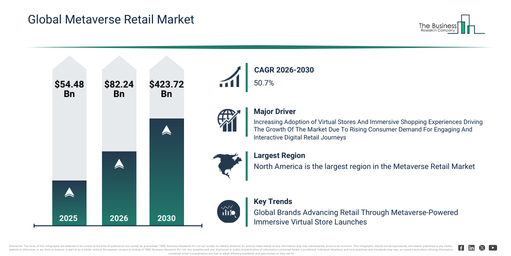
    The size of the metaverse retail market has expanded rapidly over recent years. This market is projected to expand from $54.48 billion in 2025 to $82.24 billion in 2026, demonstrating a compound annual growth rate (CAGR) of 50.9%. The historical growth in this market can be linked to factors such as the increasing adoption of virtual and augmented reality platforms, enhanced consumer engagement within digital worlds, the growing implementation of immersive shopping experiences, the broadening of online and interactive retail channels, and a heightened emphasis on brand innovation and experiential marketing.

    The metaverse retail market size is anticipated to expand significantly in the forthcoming years, reaching $423.72 billion by 2030, fueled by a compound annual growth rate (CAGR) of 50.7%. This expansion during the forecast period is largely due to the increasing integration of artificial intelligence (AI) for customized virtual shopping, a growing demand for immersive and interactive retail experiences, the rising adoption of blockchain for digital ownership and transactions, the proliferation of virtual commerce platforms, and an increase in investment for augmented and virtual reality-enabled retail solutions. Significant trends expected in this period include technology-driven innovations in immersive retail interfaces, advancements in artificial intelligence (AI) powered recommendation systems, developments in virtual reality (VR) and augmented reality (AR) shopping technologies, increased research and development in digital asset and payment integration, and innovations in interactive and gamified consumer engagement platforms.

    Access Your Free Sample Report For In-Depth Market Analysis:

    https://www.thebusinessresearchcompany.com/sample.aspx?id=30656&type=smp

    Which Important Drivers Are Guiding The Metaverse Retail Market Growth?

    The increasing embrace of virtual stores and immersive shopping experiences is anticipated to drive the future expansion of the metaverse retail market. These digital retail environments allow consumers to browse, interact with, and purchase products through 3D and extended reality platforms like virtual reality (VR) and augmented reality (AR). The rising demand from consumers for more engaging, interactive, and personalized shopping journeys, which traditional e-commerce often fails to deliver, is fueling the growing adoption of virtual stores and immersive experiences. Metaverse retail supports these experiences by enabling brands to establish digital storefronts, offer interactive try-on features, and create avatar-based shopping environments, thereby enhancing customer engagement and expanding access beyond physical locations. For instance, in 2023, Adobe Inc., a US-based software and digital experience company, reported that retailers utilizing 3D renders on their e-commerce sites observed a rise in the share of shoppers adding items to their carts from 32% in 2022 to 45% in 2023, marking a 40.6% year-on-year increase. Ultimately, the growing integration of virtual stores and immersive shopping experiences is a key driver for the metaverse retail market’s growth.

    What Are The Main Segments Within The Metaverse Retail Market Segment Structure?

    The metaverse retail market covered in this report is segmented –

    1) By Platform: Desktop, Virtual Reality (VR) Headsets, Mobile, Smart Glasses

    2) By Technology: Blockchain, Artificial Intelligence (AI), Augmented Reality (AR), Virtual Reality (VR), Cloud Computing, Other Technologies

    3) By Retail Activity Type: Virtual Storefronts And Showrooms, Virtual Try-On And Product Customization, Fashion And Apparel, Beauty And Cosmetics, Home And Automotive, Immersive Marketing And Live Events, Digital Product Commerce, Virtual Only Goods, Phygital Goods, Social Shopping And Advisory, Other Retail Activities

    4) By Application: Electronics, Automotive, Beauty And Personal Care, Clothing And Apparel, Footwear, Furniture And Home Décor, Sports And Fitness, Other Applications

    Subsegments:

    1) By Desktop: Web Browser Based Platform, Standalone Application Platform, Cloud Connected Platform

    2) By Virtual Reality (VR) Headsets: Tethered Headset Platform, Standalone Headset Platform, Mixed Reality Headset Platform

    3) By Mobile: iOS Platform, Android Platform, Cross Platform Mobile Application

    4) By Smart Glasses: Augmented Reality Glasses Platform, Mixed Reality Glasses Platform, Standalone Smart Glasses Platform

    What Trends Are Influencing The Evolution Of The Metaverse Retail Market?

    Major companies operating in the metaverse retail market are emphasizing the creation of sophisticated user experiences, such as immersive virtual store environments, to enable consumers to explore and acquire products within virtual domains. Immersive virtual store experiences themselves represent digitally engineered retail settings that allow customers to interact with merchandise and brands in a realistic, engaging, and frequently 3D or VR-enabled context. For example, in October 2023, Casio Computer Co. Ltd., a Japan-based electronics and watch manufacturer, launched its virtual G-SHOCK STORE on the VRChat metaverse platform, providing a deeply engaging virtual store experience within a specialized virtual reality environment. Users are empowered to craft their personalized G-SHOCK watches inside the G-SHOCK STORE virtual world by blending various components. Additionally, they can visualize how their VRChat avatars look while wearing the watches they have designed.

    Who Are The Companies Participating In The Metaverse Retail Market?

    Major companies operating in the metaverse retail market are Walmart Inc., Samsung Electronics Co. Ltd., Meta Platforms Inc., Alibaba Group Holding Limited, Nike Inc., H&M Group, Adidas AG, Ralph Lauren Corporation, Louis Vuitton, Roblox Corporation, Epic Games Inc., Balenciaga, Guccio Gucci SPA, Immutable Pty Ltd., The Sandbox, OpenSea Inc., ZEPETO Corporation, Decentraland, VRChat Inc., Spatial Systems Inc., Voxels LLC, Somnium Space Ltd., DRESSX

    Get The Full Metaverse Retail Market Report:

    https://www.thebusinessresearchcompany.com/report/metaverse-retail-market-report

    Which Region Represents The Largest Share Of The Metaverse Retail Market?

    North America was the largest region in the metaverse retail market in 2025. Asia-Pacific is expected to be the fastest-growing region in the forecast period. The regions covered in the metaverse retail market report are Asia-Pacific, South East Asia, Western Europe, Eastern Europe, North America, South America, Middle East, Africa.

    Request A Customized Metaverse Retail Market Report For Competitive Insights:

    https://www.thebusinessresearchcompany.com/customise?id=30656&type=smp

    Browse Through More Reports Similar to the Global Metaverse Retail Market 2026, By The Business Research Company

    Retail Market Report 2026

    https://www.thebusinessresearchcompany.com/report/retail-global-market-report

    Miscellaneous Store Retailers Market Report 2026

    https://www.thebusinessresearchcompany.com/report/miscellaneous-store-retailers-global-market-report

    retail and wholesale global market report

    https://www.thebusinessresearchcompany.com/report/retail-and-wholesale-global-market-report

    Get in touch with us:

    The Business Research Company: https://www.thebusinessresearchcompany.com/

    Americas +1 310-496-7795

    Asia +44 7882 955267 & +91 8897263534

    Europe +44 7882 955267

    Email us at info@tbrc.info

    Follow us on:

    LinkedIn: https://in.linkedin.com/company/the-business-research-company

    YouTube: https://www.youtube.com/channel/UC24_fI0rV8cR5DxlCpgmyFQ

    Global Market Model: https://www.thebusinessresearchcompany.com/global-market-model

  • Medical Microfluidic Devices  Market Growth Analysis 2026–2030 Highlighting Innovation And Competitive Landscape

    Medical Microfluidic Devices Market Growth Analysis 2026–2030 Highlighting Innovation And Competitive Landscape

    The Business Research Company’s 2026 market reports feature enhanced tools like market attractiveness analysis, TAM assessment, and company scoring matrices, along with interactive dashboards, deeper supply chain insights, and startup coverage strengthening the depth, usability, and strategic value of insights.

    What Is The Projected Increase In Market Value Of The Medical Microfluidic Devices Market During 2026–2030?

    The medical microfluidic devices market size has experienced significant expansion recently. Looking ahead, this market is projected to expand from $6.35 billion in 2025 to reach $7.32 billion in 2026, demonstrating a compound annual growth rate (CAGR) of 15.3%. Historically, this market’s growth is largely due to factors such as the greater acceptance of point-of-care diagnostics, the expanding application of lab-on-a-chip technology in research settings, a heightened need for clinical testing based on microfluidics, the broadening scope of pharmaceutical and biotech R&D applications, and an increased preference for polymer-based microfluidic materials.

    The medical microfluidic devices market size is anticipated to undergo substantial expansion in the coming years. This market is projected to reach $12.79 billion by 2030, exhibiting a compound annual growth rate (CAGR) of 15.0%. The expansion during the forecast period is primarily driven by the escalating demand for personalized medicine and organ-on-chip models, the increasing integration of microfluidics into decentralized and home diagnostics, the growing adoption of microfluidic platforms for infectious disease monitoring, the broadening of microfluidic applications in high-throughput drug screening, and the rising penetration of microfluidic devices in burgeoning healthcare markets. Significant trends expected during this period involve technological advancements in integrated lab-on-a-chip platforms, innovations in droplet-based and paper-based microfluidics, the evolution of miniaturized biosensors and detectors, ongoing research and development in organ-on-chip and tissue engineering systems, and technological advancements in automated and AI-enabled microfluidic analysis.

    Access Your Free Sample Report For In-Depth Market Analysis:

    https://www.thebusinessresearchcompany.com/sample.aspx?id=30652&type=smp

    What Factors Are Contributing To The Growth Of The Medical Microfluidic Devices Market?

    The rising incidence of chronic illnesses is anticipated to fuel the expansion of the medical microfluidic devices market moving forward. These are enduring health conditions, such as diabetes, heart disease, and arthritis, that typically advance slowly and often necessitate ongoing medical care and lifestyle adjustments to manage symptoms and avert complications. The growth in chronic diseases is largely attributed to unhealthy lifestyle choices, including inadequate diet, lack of physical activity, and smoking, which elevate the risk of conditions like diabetes, heart disease, and obesity. Medical microfluidic devices contribute to the management of chronic diseases by allowing for accurate manipulation and examination of tiny fluid samples for consistent monitoring and diagnostic purposes. They enhance patient care through facilitating quick testing, customized treatment modifications, and less invasive long-term disease surveillance. For instance, in June 2024, the National Health Service, a UK-based government department, reported that 3,615,330 individuals registered with a general practitioner (GP) had been diagnosed with non-diabetic hyperglycemia or pre-diabetes (a state with elevated blood sugar levels, insufficient to be classified as diabetes) in 2023. This represented an 18% rise from 3,065,825 cases in 2022. Consequently, the growing occurrence of chronic diseases is boosting the development of the medical microfluidic devices market.

    Which Segment Types Are Examined In The Medical Microfluidic Devices Market Segment Study?

    The medical microfluidic devices market covered in this report is segmented –

    1) By Product Type: Lab-On-A-Chip (LOC) Systems, Microfluidic Chips And Cartridges, Droplet-Based Microfluidic Systems, Paper-Based Microfluidic Devices, Continuous-Flow Microfluidic Systems, Organ-On-A-Chip Platforms

    2) By Material: Glass, Polymer, Silicon, Metals, Ceramics

    3) By Application: Point-Of-Care Diagnostics, Drug Discovery And Development, Organ-On-Chip And Tissue Engineering, Infectious Disease Monitoring

    4) By End User: Hospitals And Diagnostic Clinics, Diagnostic And Research Laboratories, Pharmaceutical And Biotechnology Companies, Academic And Research Institutes, Home Care Settings

    Subsegments:

    1) By Lab-On-A-Chip Systems: Clinical Diagnostic Chips, Environmental Monitoring Chips, Biochemical Analysis Chips, Single-Cell Analysis Platforms

    2) By Microfluidic Chips And Cartridges: Point-Of-Care Diagnostic Cartridges, Sample Preparation Chips, Cell Culture And Assay Chips, Polymerase Chain Reaction Chips

    3) By Droplet-Based Microfluidic Systems: Water-In-Oil Emulsion Systems, Oil-In-Water Emulsion Systems, Digital Droplet Systems, High-Throughput Screening Platforms

    4) By Paper-Based Microfluidic Devices: Lateral Flow Assay Strips, Three-Dimensional Paper Networks, Multiplexed Detection Devices, Colorimetric Analysis Strips

    5) By Continuous-Flow Microfluidic Systems: Microreactor Systems, Cell Sorting And Separation Systems, Micromixer Devices, Chemical Synthesis Platforms

    6) By Organ-On-A-Chip Platforms: Liver-On-A-Chip Models, Lung-On-A-Chip Models, Heart-On-A-Chip Models, Multi-Organ System Models

    What Trends Are Shaping The Future Of The Medical Microfluidic Devices Market?

    Leading companies within the medical microfluidic devices market are prioritizing the creation of sophisticated platforms, such as fully integrated microfluidic chip-based systems, aiming to optimize the development of biopharmaceutical treatments for conditions like renal care. These fully integrated microfluidic chip-based platforms function as lab-on-a-chip systems, integrating numerous laboratory processes including sample preparation, fluid handling, chemical reactions, separations, and detection onto a single microscopic chip. An illustrative example occurred in June 2023 when AB Sciex LLC, a US-based analytical technology firm for life sciences, introduced its Intabio ZT system, which stands as the inaugural fully-integrated microfluidic chip-based platform combined with imaged capillary isoelectric focusing (icIEF) separation and UV detection. This platform is specifically designed to gather extensive data on charge isoforms relevant to biopharmaceuticals, seamlessly integrating with the ZenoTOF 7600 system. Furthermore, the solution offers advanced data processing capabilities through its Biologics Explorer software, facilitating deeper understanding of protein therapeutics and thereby speeding up the delivery of secure and efficacious biological treatments.

    Which Players Are Part Of The Competitive Landscape Of The Medical Microfluidic Devices Market?

    Major companies operating in the medical microfluidic devices market are Roche Diagnostics, Thermo Fisher Scientific Inc, Abbott Laboratories, Danaher Corporation, Agilent Technologies Inc., Illumina Inc., BioMérieux, PerkinElmer Inc., Bio-Rad Laboratories Inc., Fluidigm Corporation, Spectrum Fluidics, Biosurfit SA, Cellix Ltd., 3M Company, Dolomite Microfluidics, Micronit Microtechnologies B.V., Sphere Fluidics Ltd., BioFluidica Inc., uFluidix Inc., Elveflow, On-chip Biotechnologies, Achira Labs Pvt. Ltd., Akkonni Biosystems Inc.

    Get The Full Medical Microfluidic Devices Market Report:

    https://www.thebusinessresearchcompany.com/report/medical-microfluidic-devices-market-report

    Where Is The Medical Microfluidic Devices Market Primarily Concentrated By Region?

    North America was the largest region in the medical microfluidic devices market in 2025. Asia-Pacific is expected to be the fastest-growing region in the forecast period. The regions covered in the medical microfluidic devices market report are Asia-Pacific, South East Asia, Western Europe, Eastern Europe, North America, South America, Middle East, Africa.

    Request A Customized Medical Microfluidic Devices Market Report For Competitive Insights:

    https://www.thebusinessresearchcompany.com/customise?id=30652&type=smp

    Browse Through More Reports Similar to the Global Medical Microfluidic Devices Market 2026, By The Business Research Company

    Microfluidics Market Report 2026

    https://www.thebusinessresearchcompany.com/report/microfluidics-global-market-report

    Medical Device Technologies Market Report 2026

    https://www.thebusinessresearchcompany.com/report/medical-device-technologies-global-market-report

    nanotechnology based medical devices global market report

    https://www.thebusinessresearchcompany.com/report/nanotechnology-based-medical-devices-global-market-report

    Get in touch with us:

    The Business Research Company: https://www.thebusinessresearchcompany.com/

    Americas +1 310-496-7795

    Asia +44 7882 955267 & +91 8897263534

    Europe +44 7882 955267

    Email us at info@tbrc.info

    Follow us on:

    LinkedIn: https://in.linkedin.com/company/the-business-research-company

    YouTube: https://www.youtube.com/channel/UC24_fI0rV8cR5DxlCpgmyFQ

    Global Market Model: https://www.thebusinessresearchcompany.com/global-market-model

  • Medical Microbiology Testing Technology  Market Forecast Through 2030 With Insights On Market Patterns And Developments

    Medical Microbiology Testing Technology Market Forecast Through 2030 With Insights On Market Patterns And Developments

    The Business Research Company’s 2026 market reports feature enhanced tools like market attractiveness analysis, TAM assessment, and company scoring matrices, along with interactive dashboards, deeper supply chain insights, and startup coverage strengthening the depth, usability, and strategic value of insights.

    How Is The Market Size Of The Medical Microbiology Testing Technology Market Expected To Change From 2026 To 2030?

    The medical microbiology testing technology market size has experienced robust growth in recent years. It is anticipated to expand from $6.00 billion in 2025 to $6.50 billion in 2026, reflecting a compound annual growth rate (CAGR) of 8.2%. The expansion witnessed in previous periods can be linked to several factors, including the increasing occurrence of infectious diseases, a growing awareness of antimicrobial resistance, rising healthcare expenditure, the proliferation of clinical laboratories, and the increased integration of automated systems.

    The medical microbiology testing technology market size is anticipated to experience substantial expansion over the coming years. This market is projected to reach $8.82 billion by 2030, exhibiting a compound annual growth rate (CAGR) of 8.0%. The projected growth during this period is primarily driven by factors such as an increasing need for rapid and point-of-care testing, expanding government initiatives and public health programs, a heightened emphasis on food and pharmaceutical safety testing, market penetration into emerging economies, and the growing incorporation of laboratory information systems. Key trends anticipated in the forecast period encompass progress in molecular diagnostics, breakthroughs in high-throughput testing platforms, the evolution of multiplex and rapid diagnostic tests, heightened research and development activities in microbiology, and the technological merging with serological and immunological testing.

    Access Your Free Sample Report For In-Depth Market Analysis:

    https://www.thebusinessresearchcompany.com/sample.aspx?id=30651&type=smp

    Which Strong Drivers Are Impacting The Medical Microbiology Testing Technology Market Growth?

    The growing need for swift pathogen identification and detection is projected to fuel the expansion of the medical microbiology testing technology market. This refers to diagnostic tools that quickly and precisely identify microbes like bacteria, viruses, and other pathogens directly from patient samples, bypassing lengthy culture processes. This significantly shortens diagnostic times and enables quicker clinical decisions. Global public health systems and clinical laboratories are increasingly seeking rapid pathogen detection to enhance turnaround times and effectively manage infectious disease outbreaks and antimicrobial resistance challenges. Medical microbiology testing technology plays a crucial role in rapid pathogen detection by employing advanced diagnostic methods to swiftly and accurately pinpoint infectious agents, thereby facilitating prompt treatment and limiting disease transmission. For instance, the Infectious Disease Surveillance Center, a Japan-based public health organization, reported in November 2025, based on April 2025 data, that 2,104 to 2,153 respiratory pathogen tests were carried out per pathogen category within a single reporting period. During this time, positivity rates for severe acute respiratory syndrome coronavirus 2, influenza, respiratory syncytial virus, and parainfluenza varied from 5.7% to 11.5%. Consequently, the escalating demand for rapid pathogen detection and identification is a primary force behind the growth of the medical microbiology testing technology market.

    How Are Different Segments Classified In The Medical Microbiology Testing Technology Market Segment Analysis?

    The medical microbiology testing technology market covered in this report is segmented –

    1) By Product Type: Reagents, Instruments, Consumables, Software, Services

    2) By Testing Method: Culture Test, Polymerase Chain Reaction, Immunoassays, Deoxyribonucleic Acid Sequence

    3) By Technology: Cell Culture, Microscopy, Serology

    4) By Application: Infectious Diseases, Non-infectious Diseases, Research And Development, Clinical Trials

    5) By End Use: Hospitals, Diagnostic Laboratories, Pharmaceutical Companies, Research Institutes, Food And Beverage Industry

    Subsegments:

    1) By Reagents: Culture Media, Detection Reagents, Antigen And Antibody Reagents, Molecular Diagnostic Kits, Stains And Dyes, Antibiotic Or Susceptibility Testing Reagents

    2) By Instruments: Microscopes, Incubators, Automated Culture Systems Or Microbiology Analyzers, Spectrophotometers, Centrifuges, Colony Counters Or Plate Readers, Autoclaves Or Sterilizers, Bioreactors Or Environmental Monitoring Systems

    3) By Consumables: Petri Dishes, Test Tubes, Pipette Tips, Microplates, Sample Swabs Or Collection Containers, Slides And Cover Slips, Disposable Filters Or Membranes, Disposable Consumable Kits

    4) By Software: Laboratory Information Management Software, Data Analysis Or Result Reporting Software, Quality Control Or Workflow Management Software, Automated Instrument Control Software, Database Or Reference Strain Or Pathogen Registry Software

    5) By Services: Contract Testing Or Outsourced Microbiological Testing, Equipment Maintenance And Calibration, Training And Technical Support, Consulting And Compliance Services, Validation And Quality Assurance Services

    Which Trends Are Contributing To Changes In The Medical Microbiology Testing Technology Market?

    Major companies within the medical microbiology testing technology market are concentrating on creating advanced molecular analysis products, such as digital PCR (dPCR) assays. Their objective is to enhance research efficiency, improve detection accuracy, and strengthen public health surveillance. Digital PCR assays represent highly sensitive technologies capable of detecting and precisely quantifying specific DNA sequences, even in very low concentrations, thereby enabling accurate pathogen identification and monitoring. For instance, in June 2024, QIAGEN N.V., a molecular biology and life sciences solution provider from the Netherlands, introduced 35 new wet-lab tested digital PCR Microbial DNA Detection Assays designed for its QIAcuity digital PCR platform. These assays are accessible on QIAGEN’s GeneGlobe research platform and are engineered to target a wide array of pathogens responsible for tropical diseases (e.g., Dengue, Chikungunya, Malaria), sexually transmitted infections (STIs), and urinary tract infections (UTIs).

    Who Are The Companies Driving Activity In The Medical Microbiology Testing Technology Market?

    Major companies operating in the medical microbiology testing technology market are F. Hoffmann-La Roche Ltd., Thermo Fisher Scientific Inc., Siemens Healthineers AG, Danaher Corporation, Becton Dickinson and Company, bioMérieux SA, Hologic Inc., Sysmex Corporation, Bruker Corporation, Bio-Rad Laboratories Inc., QIAGEN N.V., Abbott Laboratories, Meridian Bioscience Inc., Fujirebio Diagnostics Inc., Seegene Inc., Oxford Nanopore Technologies plc, Molbio Diagnostics Pvt. Ltd., Hardy Diagnostics, HiMedia Laboratories Pvt. Ltd., Accelerate Diagnostics Inc., Liofilchem S.r.l.

    Get The Full Medical Microbiology Testing Technology Market Report:

    https://www.thebusinessresearchcompany.com/report/medical-microbiology-testing-technology-market-report

    Which Region Has The Greatest Market Share In The Medical Microbiology Testing Technology Market?

    North America was the largest region in the medical microbiology testing technology market in 2025. Asia-Pacific is expected to be the fastest-growing region in the forecast period. The regions covered in the medical microbiology testing technology market report are Asia-Pacific, South East Asia, Western Europe, Eastern Europe, North America, South America, Middle East, Africa.

    Request A Customized Medical Microbiology Testing Technology Market Report For Competitive Insights:

    https://www.thebusinessresearchcompany.com/customise?id=30651&type=smp

    Browse Through More Reports Similar to the Global Medical Microbiology Testing Technology Market 2026, By The Business Research Company

    Microbiology And Bacterial Culture For Industrial Testing Market Report 2026

    https://www.thebusinessresearchcompany.com/report/microbiology-and-bacterial-culture-for-industrial-testing-global-market-report

    Clinical Microbiology Market Report 2026

    https://www.thebusinessresearchcompany.com/report/clinical-microbiology-global-market-report

    hospital acquired infections testing kits global market report

    https://www.thebusinessresearchcompany.com/report/hospital-acquired-infections-testing-kits-global-market-report

    Get in touch with us:

    The Business Research Company: https://www.thebusinessresearchcompany.com/

    Americas +1 310-496-7795

    Asia +44 7882 955267 & +91 8897263534

    Europe +44 7882 955267

    Email us at info@tbrc.info

    Follow us on:

    LinkedIn: https://in.linkedin.com/company/the-business-research-company

    YouTube: https://www.youtube.com/channel/UC24_fI0rV8cR5DxlCpgmyFQ

    Global Market Model: https://www.thebusinessresearchcompany.com/global-market-model
  • Medical Magnets  Market Outlook For 2026–2030 Covering Growth Drivers And Industry Trends

    Medical Magnets Market Outlook For 2026–2030 Covering Growth Drivers And Industry Trends

    The Business Research Company’s 2026 market reports feature enhanced tools like market attractiveness analysis, TAM assessment, and company scoring matrices, along with interactive dashboards, deeper supply chain insights, and startup coverage strengthening the depth, usability, and strategic value of insights.

    From Its 2026 Market Size, What Value Is The Medical Magnets Market Projected To Reach By 2030?

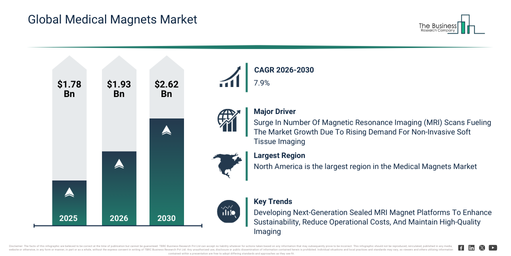
    The market for medical magnets has experienced significant growth over recent years. It is projected to grow from $1.78 billion in 2025 to $1.93 billion in 2026, exhibiting a compound annual growth rate (CAGR) of 8.2%. This historical growth can be attributed to several factors, including the increasing adoption of MRI systems, the growing prevalence of neurological disorders, rising investments in diagnostic infrastructure, the expansion of magnetic therapy usage, and the growing production of high-performance magnets.

    The medical magnets market size is projected to experience robust expansion over the coming years. By 2030, its valuation is anticipated to reach $2.62 billion, demonstrating a compound annual growth rate (CAGR) of 7.9%. This projected growth during the forecast period is primarily driven by an increasing demand for minimally invasive diagnostics, growing r&d in magnetic drug delivery, rising adoption of TMS devices, the expansion of hyperthermia cancer treatment applications, and growing dental applications using precision magnets. Key developments expected in this period include technological advancements in high-field MRI magnet systems, innovations in tms coil and magnet designs, the development of lightweight and high-strength magnets, research and development in magnetic hyperthermia therapy, and technological advancements in portable and compact magnetic devices.

    Access Your Free Sample Report For In-Depth Market Analysis:

    https://www.thebusinessresearchcompany.com/sample.aspx?id=30650&type=smp

    What Key Factors Are Shaping The Medical Magnets Market Landscape?

    The projected expansion of the medical magnets market is linked to the increasing frequency of magnetic resonance imaging (MRI) scans. MRI scans are non-invasive diagnostic procedures that utilize powerful magnets and radio waves to generate detailed images of the body’s internal organs and tissues. The rise in MRI scan usage is largely driven by a global increase in the geriatric population, which often presents with chronic conditions demanding thorough, non-invasive soft tissue imaging for accurate diagnosis and treatment strategies. Medical magnets are crucial for MRI scans, as they create the strong, consistent magnetic fields necessary for producing high-resolution images of internal structures. These magnets improve diagnostic precision and imaging quality, allowing for detailed visualization of soft tissues without reliance on ionizing radiation. An illustration of this trend is provided by NHS England, a UK-based publicly funded healthcare system, which reported in December 2024 that magnetic resonance imaging scans in England climbed from 361,705 in August 2023 to 365,270 in August 2024, with a cumulative 12-month total from September 2023 to August 2024 reaching 4,504,615 scans. Therefore, the expanding application of these devices in both therapeutic and diagnostic contexts is stimulating the growth of the medical magnets market. The rising occurrence of chronic illnesses is expected to further the expansion of the medical magnets market. Chronic diseases are long-term health issues, such as diabetes, heart disease, and arthritis, that typically progress gradually and often demand continuous medical oversight and lifestyle adjustments to control symptoms and avoid complications. The surge in chronic diseases is largely a consequence of unhealthy habits, including poor dietary choices, lack of physical activity, and smoking, which elevate the risk of conditions like diabetes, heart disease, and obesity. Medical magnets play a role in chronic disease management by backing targeted therapies and diagnostic imaging, thereby assisting in tracking and reducing symptoms over time. They contribute to improved patient care by offering non-invasive treatment options and enhancing the effectiveness of current medical interventions. For example, in June 2024, the National Health Service, a UK-based government department, indicated that 3,615,330 individuals registered with a general practitioner (GP) received a diagnosis of non-diabetic hyperglycemia or pre-diabetes in 2023, marking an 18% rise from 3,065,825 cases in 2022. This increasing prevalence of chronic diseases is consequently fostering the growth of the medical magnets market.

    How Is The Medical Magnets Market Categorized Across Its Segment Groups?

    The medical magnets market covered in this report is segmented –

    1) By Product Type: High-Performance Magnets, Lower-Performance Magnets, Superconducting Magnets, Electromagnets

    2) By Material Type: Neodymium Iron Boron, Ferrite, Samarium Cobalt, Other Materials

    3) By Technology: Permanent Magnet Technology, Electromagnetic Systems, Superconducting Magnet Technology, Hybrid Magnetic Systems

    4) By Application: Magnetic Resonance Imaging, Transcranial Magnetic Stimulation, Magnetic Therapy, Drug Delivery, Dentistry

    5) By End User: Hospitals, Diagnostic Imaging Centers, Specialty Neurology Centers, Research And Academic Institutions, Rehabilitation And Wellness Centers

    Subsegment:

    1) By High-Performance Magnets: Neodymium Iron Boron, Samarium Cobalt, Alnico

    2) By Lower-Performance Magnets: Ferrite, Ceramic

    3) By Superconducting Magnets: Niobium Titanium, Niobium Tin, Magnesium Diboride

    4) By Electromagnets: Solenoid, Toroidal, Helical

    What Market Trends Are Affecting The Medical Magnets Market?

    Leading companies within the medical magnets market are concentrating on developing advanced technologies, such as helium-efficient MRI magnet solutions, to minimize operational costs and boost sustainability without diminishing imaging performance. Helium-efficient MRI magnet technologies refer to next-generation superconducting magnet designs that use little or no liquid helium, achieved through sealed or cryogen-free cooling systems. This innovation aims to cut resource consumption, operating expenses, and environmental impact while upholding high-quality imaging capabilities. For instance, in February 2025, GE Healthcare Technologies Inc., a US-based medical technology company, launched the Freelium sealed magnet platform. This platform boasts a helium-free design, consuming less than 1% of the helium required by traditional MRI magnets. It also integrates intelligent sensor technology for remote monitoring and automated magnet recovery, alongside providing a permanent helium enclosure for enhanced sustainability. Additional features include compatibility with AI-enabled imaging solutions and a design optimized for installation in locations with limited helium access, thereby enabling broader deployment of high-performance MRI systems. This launch signifies a major leap forward in MRI technology, combining environmental efficiency, operational reliability, and superior diagnostic performance.

    Which Firms Are Influencing Competition In The Medical Magnets Market?

    Major companies operating in the medical magnets market are Hitachi Ltd., Siemens Healthineers AG, Koninklijke Philips N.V., GE HealthCare Technologies Inc., Shin-Etsu Chemical Co. Ltd., Canon Medical Systems Corporation, Neo Performance Materials Inc., Ningbo Tongchuang Magnetic Materials Co. Ltd., Stereotaxis Inc., MagnetsTek LLC, SM Magnetics Inc., Zhejiang Zhaobao Magnet Group Co. Ltd., Bunting-DuBois Magnetics, I.M.A. Industria Macchine Automatiche S.p.A., Magnetica Limited, VACUUMSCHMELZE GmbH & Co. KG, Newland Magnetics Europe Ltd., Noveon Magnetics Inc., Goudsmit Magnetics Group B.V., MainRich Magnetics Co. Ltd.

    Get The Full Medical Magnets Market Report:

    https://www.thebusinessresearchcompany.com/report/medical-magnets-market-report

    Which Region Accounts For The Largest Portion Of The Medical Magnets Market?

    North America was the largest region in the medical magnets market in 2025. Asia-Pacific is expected to be the fastest-growing region in the forecast period. The regions covered in the medical magnets market report are Asia-Pacific, South East Asia, Western Europe, Eastern Europe, North America, South America, Middle East, Africa.

    Request A Customized Medical Magnets Market Report For Competitive Insights:

    https://www.thebusinessresearchcompany.com/customise?id=30650&type=smp

    Browse Through More Reports Similar to the Global Medical Magnets Market 2026, By The Business Research Company

    Electronic Device Magnets Market Report 2026

    https://www.thebusinessresearchcompany.com/report/electronic-device-magnets-global-market-report

    Magnetic Materials Market Report 2026

    https://www.thebusinessresearchcompany.com/report/magnetic-materials-global-market-report

    magnetometer global market report

    https://www.thebusinessresearchcompany.com/report/magnetometer-global-market-report

    Get in touch with us:

    The Business Research Company: https://www.thebusinessresearchcompany.com/

    Americas +1 310-496-7795

    Asia +44 7882 955267 & +91 8897263534

    Europe +44 7882 955267

    Email us at info@tbrc.info

    Follow us on:

    LinkedIn: https://in.linkedin.com/company/the-business-research-company

    YouTube: https://www.youtube.com/channel/UC24_fI0rV8cR5DxlCpgmyFQ

    Global Market Model: https://www.thebusinessresearchcompany.com/global-market-model

  • Rising Demand For Digital Medical Imaging Fueling The Growth Of The Market Due To Need For High-Quality And Accurate Diagnostic Images Is Supporting Expansion In The Medical Imaging Reconstruction Artificial Intelligence (AI)  Market

    Rising Demand For Digital Medical Imaging Fueling The Growth Of The Market Due To Need For High-Quality And Accurate Diagnostic Images Is Supporting Expansion In The Medical Imaging Reconstruction Artificial Intelligence (AI) Market

    The Business Research Company’s 2026 market reports feature enhanced tools like market attractiveness analysis, TAM assessment, and company scoring matrices, along with interactive dashboards, deeper supply chain insights, and startup coverage strengthening the depth, usability, and strategic value of insights.

    How Much Growth In Market Value Is Expected For The Medical Imaging Reconstruction Artificial Intelligence (AI) Market Between 2026 And 2030?

    The size of the medical imaging reconstruction artificial intelligence (AI) market has experienced rapid growth in recent times. Projections indicate a growth from $1.80 billion in 2025 to $2.27 billion in 2026 for this market, with a compound annual growth rate (CAGR) of 26.0%. Historically, this growth stemmed from factors such as increasing medical imaging volumes, a rise in the adoption of digital radiology systems, a heightened requirement for faster image reconstruction, an increased focus on minimizing radiation doses, and the growing incorporation of deep learning techniques.

    The medical imaging reconstruction artificial intelligence (AI) market is projected to experience substantial growth in the coming years. It is expected to expand to $5.65 billion by 2030, demonstrating a compound annual growth rate (CAGR) of 25.7%. This expansion during the forecast period is propelled by factors such as the increasing demand for cloud-based imaging solutions, escalating investments in artificial intelligence healthcare innovation, the wider adoption of advanced reconstruction software, the broadening scope of hospital digital transformation initiatives, and the growing need for radiologist workflow automation. Prominent trends observed in this period include the increased acceptance of multimodal image reconstruction, the expanding application of real-time reconstruction algorithms, the rising incorporation of generative artificial intelligence models, the growth of hybrid cloud imaging platforms, and a notable transition towards fully automated imaging pipelines.

    Access Your Free Sample Report For In-Depth Market Analysis:

    https://www.thebusinessresearchcompany.com/sample.aspx?id=30649&type=smp

    Which Factors Are Influencing The Growth Of The Medical Imaging Reconstruction Artificial Intelligence (AI) Market?

    The anticipated expansion of the medical imaging reconstruction artificial intelligence (AI) market is significantly propelled by the rising need for digital medical imaging. Digital medical imaging involves employing digital technologies to acquire, save, process, and present medical images of the human body for purposes of diagnosis, monitoring, and treatment. This surge in demand stems from the increasing requirement for premium visual content and precise diagnostic images, given that digital technologies facilitate quicker processing, enhanced resolution, and streamlined data storage and sharing. Medical imaging reconstruction artificial intelligence (AI) plays a supportive role in digital medical imaging by improving image clarity, speeding up reconstruction processes, and allowing for more precise interpretation of diagnostic scans. It contributes to better patient care through enabling accurate diagnoses and more informed clinical decisions. As an illustration, NHS England, a government health authority located in the UK, reported in May 2025 that 48.9 million imaging tests were recorded throughout England from February 2024 to January 2025, with January 2025 alone accounting for 4.03 million imaging tests, which underscores the continuously high volume of diagnostic imaging procedures. Consequently, the escalating demand for digital medical imaging is fueling the growth of the medical imaging reconstruction artificial intelligence (AI) market.

    How Are Segments Identified Within The Medical Imaging Reconstruction Artificial Intelligence (AI) Market Segment Framework?

    The medical imaging reconstruction artificial intelligence (AI) market covered in this report is segmented –

    1) By Component: Software, Hardware, Services

    2) By Modality: Computed Tomography (CT), Magnetic Resonance Imaging (MRI), Positron Emission Tomography (PET), Ultrasound, X-Ray (X-Radiation), Other Modality

    3) By Deployment Mode: On-Premises, Cloud

    4) By Application: Oncology, Cardiology, Neurology, Orthopedics, Other Application

    5) By End-User: Hospitals, Diagnostic Imaging Centers, Research Institutes, Other End-User

    Subsegments:

    1) By Software: Image Reconstruction Software, Workflow Management Software, Cloud-Based Reconstruction Platforms, Artificial Intelligence Algorithm Software, Data Analytics And Visualization Software

    2) By Hardware: Imaging Processing Units, Medical Imaging Scanners, Storage And Server Systems, Graphics Processing Hardware, Edge Computing Devices

    3) By Services: Maintenance And Support Services, Training And Implementation Services, Consulting Services, Software As A Service, Research And Development Services

    Which Trends Are Influencing Demand In The Medical Imaging Reconstruction Artificial Intelligence (AI) Market?

    Leading enterprises within the medical imaging reconstruction artificial intelligence (AI) market are concentrating on creating technologically advanced solutions, including deep learning-based image processing software, with the aim of improving diagnostic accuracy, decreasing scan times, and boosting image quality across various modalities. Deep learning-based image processing software involves AI algorithms utilizing extensive data for training to produce clearer reconstructions of medical images, minimize image artifacts, and pinpoint anatomical structures with higher precision, thereby facilitating superior clinical judgments. As an illustration, in May 2023, GE HealthCare, a US-based medical technology company, was granted FDA 510(k) clearance for Precision DL, a deep learning image processing software designed for PET/CT scanners and integrated into the Omni Legend system. This solution utilizes deep learning-based image processing software to enhance image quality while preserving low radiation dosage, streamlining workflow, and providing clinicians with sharper diagnostic perspectives. It further seeks to advance small lesion detection, enhance measurement precision, and facilitate quicker imaging with reduced radiation, allowing practitioners to provide more precise and personalized patient care.

    Who Are The Companies Competing Within The Medical Imaging Reconstruction Artificial Intelligence (AI) Market?

    Major companies operating in the medical imaging reconstruction artificial intelligence (AI) market are NVIDIA Corporation, Siemens Healthineers AG, Fujifilm Holdings Corp., Philips International B.V., GE HealthCare Technologies Inc., United Imaging Healthcare Co. Ltd., Samsung Medison, Hitachi Medical Systems GmbH, Canon Medical Systems Corporation, Viz.ai Inc., Aidoc Medical Ltd., Lunit Inc., Infervision, Quibim SL, DeepHealth, Blackford Analysis Ltd., Airs Medical Inc., Subtle Medical Inc., Zebra Medical, Enlitic

    Get The Full Medical Imaging Reconstruction Artificial Intelligence (AI) Market Report:

    https://www.thebusinessresearchcompany.com/report/medical-imaging-reconstruction-artificial-intelligence-ai-market-report

    Which Region Holds The Highest Market Share In The Medical Imaging Reconstruction Artificial Intelligence (AI) Market?

    North America was the largest region in the medical imaging reconstruction artificial intelligence (AI) market in 2025. Asia-Pacific is expected to be the fastest-growing region in the forecast period. The regions covered in the medical imaging reconstruction artificial intelligence (AI) market report are Asia-Pacific, South East Asia, Western Europe, Eastern Europe, North America, South America, Middle East, Africa.

    Request A Customized Medical Imaging Reconstruction Artificial Intelligence (AI) Market Report For Competitive Insights:

    https://www.thebusinessresearchcompany.com/customise?id=30649&type=smp

    Browse Through More Reports Similar to the Global Medical Imaging Reconstruction Artificial Intelligence (AI) Market 2026, By The Business Research Company

    Artificial Intelligence In Medical Imaging Market Report 2026

    https://www.thebusinessresearchcompany.com/report/artificial-intelligence-in-medical-imaging-global-market-report

    Ai In Medical Imaging Market Report 2026

    https://www.thebusinessresearchcompany.com/report/ai-in-medical-imaging-global-market-report

    artificial intelligence in magnetic resonance imaging MRI global market report

    https://www.thebusinessresearchcompany.com/report/artificial-intelligence-in-magnetic-resonance-imaging-mri-global-market-report

    Get in touch with us:

    The Business Research Company: https://www.thebusinessresearchcompany.com/

    Americas +1 310-496-7795

    Asia +44 7882 955267 & +91 8897263534

    Europe +44 7882 955267

    Email us at info@tbrc.info

    Follow us on:

    LinkedIn: https://in.linkedin.com/company/the-business-research-company

    YouTube: https://www.youtube.com/channel/UC24_fI0rV8cR5DxlCpgmyFQ

    Global Market Model: https://www.thebusinessresearchcompany.com/global-market-model
  • Growing Demand For Efficient Ferrous Metal Separation Fueling Market Growth Due To Rising Mining And Recycling Activities Is Contributing To Changes In The Magnetic Overband Separator  Market

    Growing Demand For Efficient Ferrous Metal Separation Fueling Market Growth Due To Rising Mining And Recycling Activities Is Contributing To Changes In The Magnetic Overband Separator Market

    The Business Research Company’s 2026 market reports feature enhanced tools like market attractiveness analysis, TAM assessment, and company scoring matrices, along with interactive dashboards, deeper supply chain insights, and startup coverage strengthening the depth, usability, and strategic value of insights.

    What Is The Estimated Market Size Of The Magnetic Overband Separator Market In 2026, And How Will Its Value Evolve By 2030?

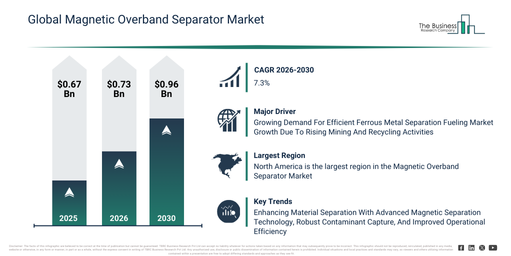
    The magnetic overband separator market has exhibited robust growth over recent years. It is forecast to increase from $0.67 billion in 2025 to $0.73 billion in 2026, registering a compound annual growth rate (CAGR) of 7.6%. This historical expansion can be attributed to an escalated demand within the mining industry, wider adoption in recycling processes, a greater necessity for equipment safeguarding, the proliferation of construction and manufacturing endeavors, and an increasing emphasis on product purity.

    The magnetic overband separator market size is anticipated to experience substantial growth in the upcoming years. It is projected to reach $0.96 billion by 2030, demonstrating a compound annual growth rate (CAGR) of 7.3%. This expansion during the forecast period is primarily driven by heightened automation in material handling processes, the increasing embrace of both permanent and electromagnets, a surge in investment towards smart separator technologies, the widening scope of applications in e-waste recycling, and an intensified regulatory focus on ensuring safety and controlling contamination. Significant trends expected during this period include improvements in magnetic separator design through technology, breakthroughs in self-cleaning and automated systems, the creation of separators that are both energy-efficient and durable, ongoing research into hybrid separation and sensor-based sorting techniques, and progress in integrating AI and IoT for enhanced predictive maintenance capabilities.

    Access Your Free Sample Report For In-Depth Market Analysis:

    https://www.thebusinessresearchcompany.com/sample.aspx?id=30644&type=smp

    What Leading Drivers Are Supporting The Magnetic Overband Separator Market Expansion?

    The magnetic overband separator market is anticipated to grow, driven by the increasing need for efficient ferrous metal separation. Efficient ferrous metal separation is a process that employs magnetic force to eliminate iron-based metallic contaminants from bulk materials and scrap streams, thus protecting equipment and maintaining material quality. The heightened demand for efficient ferrous metal separation stems from a global reliance on recycled ferrous scrap and increased mining throughput, which collectively boost the volume of metal-containing material requiring separation. Magnetic overband separators support efficient ferrous metal separation by enabling the continuous removal of ferrous contaminants, thereby improving process reliability and ensuring a cleaner material flow within mining and recycling facilities. For instance, in October 2024, the World Steel Association, a Belgium-based steel industry association, reported that global steel production in 2023 consumed approximately 630 million metric tons of recycled scrap, representing nearly 30% of the total crude steel output, a rise from about 28% in 2022. Therefore, the escalating demand for efficient ferrous metal separation is propelling the expansion of the magnetic overband separator market.

    What Are The Key Segment Divisions In The Magnetic Overband Separator Market Segment Structure?

    The magnetic overband separator market covered in this report is segmented –

    1) By Magnet Type: Permanent Magnet, Electromagnet

    2) By Separator Type: Cross-Belt Separator, Over-Belt Separator, Inline Separator

    3) By Cleaning Mechanism: Self-Cleaning, Manual Cleaning

    4) By Application: Mining, Recycling, Material Handling, Power Generation

    5) By End Use: Construction, Manufacturing, Waste Management

    Subsegments:

    1) By Permanent Magnet: Ceramic Magnet, Alnico Magnet, Neodymium Magnet, Ferrite Magnet

    2) By Electromagnet: Solenoid Electromagnet, Coil Wound Electromagnet, Electro Permanent Magnet, Laminated Core Electromagnet

    What Emerging Trends Are Seen In The Magnetic Overband Separator Market?

    Leading companies within the magnetic overband separator market are concentrating on the development of advanced solutions, such as magnetic separation technology, aimed at extracting tramp metal and ferrous contaminants from bulk materials and conveyor lines. This effort serves to protect downstream equipment and enhance product quality. Magnetic separation technology itself involves utilizing permanent magnets or electromagnets to attract and seize metallic particles from material streams, thereby ensuring continuous operation and minimizing wear on processing equipment. For example, in September 2023, Magnetic Products Inc., a US-based manufacturer specializing in industrial magnetic separation and material handling systems, introduced the Intell-I-Mag drawer magnet. This new product features two-inch-diameter magnetic tubes specifically engineered to boost magnetic field strength and the efficiency of contaminant extraction. The Intell-I-Mag cavity design facilitates the effective capture of fine ferrous particles, while also offering easy maintenance and removal, making it well-suited for high-throughput operations in sectors like recycling, quarrying, mining, and other bulk material processing. This introduction clearly emphasizes the industry’s increasing focus on magnetic overband separator systems that combine potent magnetic separation technology with user-friendly designs to improve material purity, reduce equipment downtime, and lower overall lifecycle costs.

    Which Organizations Are Engaged In The Magnetic Overband Separator Market?

    Major companies operating in the magnetic overband separator market are Metso Corporation, Multotec Group (Pty) Ltd, Eriez Manufacturing Co., Bunting Magnetics Co. Inc., Walker Magnetics Ltd., STEINERT GmbH, Saideep Magnetics Pvt. Ltd., Kumar Magnet Industries Pvt. Ltd., Jaykrishna Magnetics Pvt. Ltd., Vibromag Industries, Master Magnets Ltd., Goudsmit Magnetics Group B.V., Electro Flux Equipments Pvt. Ltd., IFE Aufbereitungstechnik GmbH, Excel Magnetics Pvt. Ltd., Dings Magnetics Group, Jaikar Magnet Equipments Pvt. Ltd., Shyam Magnet Pvt. Ltd., Magna Tronix Pvt. Ltd., Royal Magnetics Pvt. Ltd.

    Get The Full Magnetic Overband Separator Market Report:

    https://www.thebusinessresearchcompany.com/report/magnetic-overband-separator-market-report

    Where Is The Magnetic Overband Separator Market Most Concentrated Geographically?

    North America was the largest region in the magnetic overbend separator market in 2025. Asia-Pacific is expected to be the fastest-growing region in the forecast period. The regions covered in the magnetic overband separator market report are Asia-Pacific, South East Asia, Western Europe, Eastern Europe, North America, South America, Middle East, Africa.

    Request A Customized Magnetic Overband Separator Market Report For Competitive Insights:

    https://www.thebusinessresearchcompany.com/customise?id=30644&type=smp

    Browse Through More Reports Similar to the Global Magnetic Overband Separator Market 2026, By The Business Research Company

    Magnetic Beads Market 2026

    https://www.thebusinessresearchcompany.com/report/magnetic-beads-market

    Magnetic Sensor Market Report 2026

    https://www.thebusinessresearchcompany.com/report/magnetic-sensor-global-market-report

    ultra wideband global market report

    https://www.thebusinessresearchcompany.com/report/ultra-wideband-global-market-report

    Get in touch with us:

    The Business Research Company: https://www.thebusinessresearchcompany.com/

    Americas +1 310-496-7795

    Asia +44 7882 955267 & +91 8897263534

    Europe +44 7882 955267

    Email us at info@tbrc.info

    Follow us on:

    LinkedIn: https://in.linkedin.com/company/the-business-research-company

    YouTube: https://www.youtube.com/channel/UC24_fI0rV8cR5DxlCpgmyFQ

    Global Market Model: https://www.thebusinessresearchcompany.com/global-market-model

  • Intravenous (IV) Compounding Automation  Market Analysis With Focus On Growth Potential And Future Outlook

    Intravenous (IV) Compounding Automation Market Analysis With Focus On Growth Potential And Future Outlook

    The Business Research Company’s 2026 market reports feature enhanced tools like market attractiveness analysis, TAM assessment, and company scoring matrices, along with interactive dashboards, deeper supply chain insights, and startup coverage strengthening the depth, usability, and strategic value of insights.

    What Is The Anticipated Rise In Market Value Of The Intravenous (IV) Compounding Automation Market During The Forecast Period?

    The intravenous (IV) compounding automation market has seen swift expansion in recent years. Its value is expected to rise from $2.19 billion in 2025 to $2.45 billion by 2026, achieving a compound annual growth rate (CAGR) of 11.9%. Historically, this growth can be attributed to several factors such as the increasing embrace of robotic compounding systems, a surging need for chemotherapy automation, a heightened focus on ensuring medication safety, the broadening application of automation in hospitals and pharmacies, and a growing recognition of the benefits of workflow efficiency.

    The intravenous (IV) compounding automation market is set for substantial expansion in the upcoming years, with projections indicating it will reach $3.79 billion by 2030, growing at a compound annual growth rate (CAGR) of 11.6%. This projected growth throughout the forecast period stems from factors such as increasing investments in AI-enabled compounding solutions, the rising deployment of automated IV workstations, enhanced integration of software with hospital information systems, the expansion of remote monitoring and predictive maintenance capabilities, and the development of more modular and customizable compounding systems. Key trends anticipated during this period include breakthroughs in AI and machine learning for compounding, advancements in robotic and automated devices, the introduction of smart pump and monitoring technologies, innovations in sterile compounding isolators and safety cabinets, and the progress in compact and space-saving automation solutions.

    Access Your Free Sample Report For In-Depth Market Analysis:

    https://www.thebusinessresearchcompany.com/sample.aspx?id=30629&type=smp

    What Key Factors Are Affecting The Intravenous (IV) Compounding Automation Market Demand?

    The intravenous (IV) compounding automation market is expected to grow, propelled by the rising demand for pharmaceutical products. A pharmaceutical product refers to a substance or blend of substances created for diagnosing, treating, preventing, or relieving diseases and medical conditions in humans or animals. IV compounding automation enhances pharmaceutical product preparation by enabling the precise, safe, and efficient formulation of complex intravenous medications, ensuring exact dosing, reducing contamination risks, and allowing healthcare providers to fulfill the increasing need for high-quality therapies. For instance, in November 2023, according to the European Federation of Pharmaceutical Industries and Associations (EFPIA), a Belgium-based trade association, the total pharmaceutical production in Europe was €390,000 million ($422,803 million) in 2023, an increase from €363,300 million ($393,857 million) in 2022. Therefore, the escalating demand for pharmaceutical products is a primary force behind the growth of the intravenous (IV) compounding automation market.

    Which Segments Define The Intravenous (IV) Compounding Automation Market Segment Structure?

    The intravenous (iv) compounding automation market covered in this report is segmented –

    1) By Product Type: Robotic Compounding Systems, Automated Compounding Devices, Software Solutions, Other Product Types

    2) By Service: Installation, Maintenance, Training, Consulting, Support, System Integration, Validation, Software Updates, Calibration, Remote Monitoring

    3) By Application: Chemotherapy, Parenteral Nutrition, Antibiotics, Other Applications

    4) By End-User: Hospitals, Compounding Pharmacies, Oncology Centers, Other End-Users

    Subsegments:

    1) By Robotic Compounding Systems: Robotic Arm Based Systems, Closed System Robotic Compounding Units, Hazardous Drug Handling Robots, Sterile Preparation Robotic Platforms

    2) By Automated Compounding Devices: Volumetric Compounding Devices, Gravimetric Compounding Devices, Multi Chamber Compounding Units, Automated Parenteral Nutrition Compounding Devices

    3) By Software Solutions: Compounding Workflow Management Software, Dose Verification Software, Barcode Based Medication Safety Software, Compounding Data Analytics And Reporting Software

    4) By Other Product Types: Semi Automated Compounding Systems, Isolator Based Compounding Systems, Sterile Admixture Preparation Cabinets, Hybrid Compounding Assistance Devices

    Who Are The Established Players Within The Intravenous (IV) Compounding Automation Market?

    Major companies operating in the intravenous (iv) compounding automation market are Becton Dickinson and Company, Baxter International Inc., Grifols S.A., ICU Medical Inc., Omnicell Inc., Fresenius Kabi AG, Equashield Medical Ltd., Health Robotics S.r.l., Loccioni Group, Loccioni Group, OPTIMA pharma GmbH, Medimix Systems AG, ARxIUM Inc., General Healthy Co. Ltd., PharmaScope Onco Automation B.V., Comecer SpA, Syntegon Technology GmbH, Parata Pharmacy Automation, B. Braun SE, Aesynt Incorporated, Shenzhen Broadcare Robots Co. Ltd.

    Get The Full Intravenous (IV) Compounding Automation Market Report:

    https://www.thebusinessresearchcompany.com/report/intravenous-iv-compounding-automation-market-report

    Which Region Represents The Largest Share Of The Intravenous (IV) Compounding Automation Market?

    North America was the largest region in the intravenous (IV) compounding automation market in 2025. Asia-Pacific is expected to be the fastest-growing region in the forecast period. The regions covered in the intravenous (iv) compounding automation market report are Asia-Pacific, South East Asia, Western Europe, Eastern Europe, North America, South America, Middle East, Africa.

    Request A Customized Intravenous (IV) Compounding Automation Market Report For Competitive Insights:

    https://www.thebusinessresearchcompany.com/customise?id=30629&type=smp

    Browse Through More Reports Similar to the Global Intravenous (IV) Compounding Automation Market 2026, By The Business Research Company

    Automated Compounding Devices Market Report 2026

    https://www.thebusinessresearchcompany.com/report/automated-compounding-devices-global-market-report

    Intravenous Solutions Market Report 2026

    https://www.thebusinessresearchcompany.com/report/intravenous-solutions-global-market-report

    lab automation in drug discovery global market report

    https://www.thebusinessresearchcompany.com/report/lab-automation-in-drug-discovery-global-market-report

    Get in touch with us:

    The Business Research Company: https://www.thebusinessresearchcompany.com/

    Americas +1 310-496-7795

    Asia +44 7882 955267 & +91 8897263534

    Europe +44 7882 955267

    Email us at info@tbrc.info

    Follow us on:

    LinkedIn: https://in.linkedin.com/company/the-business-research-company

    YouTube: https://www.youtube.com/channel/UC24_fI0rV8cR5DxlCpgmyFQ

    Global Market Model: https://www.thebusinessresearchcompany.com/global-market-model

  • Intraoperative Neuromonitoring (IONM)  Market Forecast Showing Industry Progress And Growth Trends

    Intraoperative Neuromonitoring (IONM) Market Forecast Showing Industry Progress And Growth Trends

    The Business Research Company’s 2026 market reports feature enhanced tools like market attractiveness analysis, TAM assessment, and company scoring matrices, along with interactive dashboards, deeper supply chain insights, and startup coverage strengthening the depth, usability, and strategic value of insights.

    How Is The Market Size Of The Intraoperative Neuromonitoring (IONM) Market Expected To Scale Between 2026 And 2030?

    The intraoperative neuromonitoring market has shown significant growth in recent years. This market is expected to expand from $3.56 billion in 2025 to $3.84 billion in 2026, exhibiting a compound annual growth rate (CAGR) of 7.9%. This historical growth can be linked to factors such as an increasing need for safer surgical procedures, the greater implementation of intraoperative neuromonitoring in intricate surgeries, the rising occurrence of neurological and spinal disorders, the expansion of hospital facilities in developed areas, and a heightened commitment to patient safety during operations.

    The intraoperative neuromonitoring market is projected for significant expansion over the next few years, with its size expected to reach $5.14 billion by 2030, demonstrating a compound annual growth rate (CAGR) of 7.6%. This growth in the outlook period can be linked to the increasing uptake of multimodality neuromonitoring systems, the expanding application of artificial intelligence for signal interpretation, heightened investments in research and development for neuromonitoring technologies, the broader adoption of minimally invasive and robotic surgeries, and a greater availability of skilled neuromonitoring professionals. Prominent trends for the forecast period include enhancements in multimodality monitoring technologies, the deepening integration of artificial intelligence within neuromonitoring systems, the accelerating development of portable and cloud-connected devices, an expanding utilization of real-time data analytics in surgical procedures, and emerging innovations in wearable and intraoperative monitoring sensors.

    Access Your Free Sample Report For In-Depth Market Analysis:

    https://www.thebusinessresearchcompany.com/sample.aspx?id=30628&type=smp

    Which Primary Drivers Are Impacting The Intraoperative Neuromonitoring (IONM) Market Growth?

    An anticipated increase in complex surgical procedures is poised to drive expansion within the intraoperative neuromonitoring (IONM) market. These complex surgeries are defined as elaborate medical interventions characterized by significant risks, a demand for expert skills, and frequently targeting severe or systemic health issues. The frequency of complex surgeries is increasing because surgeons are more often operating on elderly individuals presenting with numerous chronic ailments such as diabetes, obesity, and heart disease, a trend supported by advancements in surgical methods that allow for the successful handling of high-risk scenarios. intraoperative neuromonitoring (IONM) assists complex surgical operations by delivering immediate information concerning neural activity, thereby reducing the likelihood of nerve injury throughout crucial interventions. As an illustration, information from January 2025 provided by the Organ Procurement and Transplantation Network (OPTN) – a US-based national network connecting American professionals in organ donation and transplantation – revealed that the total number of organ transplants performed in the United States reached 48,180 in 2024, marking a 3.3% rise from 46,632 in 2023. Consequently, the expanding number of complex surgical procedures is propelling the growth of the intraoperative neuromonitoring (IONM) market.

    How Is The Intraoperative Neuromonitoring (IONM) Market Segmented Across Different Segment Categories?

    The intraoperative neuromonitoring (ionm) market covered in this report is segmented –

    1) By Type: Systems, Accessories And Consumables, Services

    2) By Source Type: Insourced Monitoring, Outsourced Monitoring

    3) By Modality: Somatosensory Evoked Potentials, Motor Evoked Potentials, Electroencephalography, Electromyography, Brainstem Auditory Evoked Potentials, Visual Evoked Potentials, Other Modalities

    4) By Application: Neurosurgery, Spinal Surgery, Vascular Surgery, Cardiothoracic Surgery, Ear, Nose, Throat Surgery, Orthopedic Surgery

    5) By End-User: Hospitals, Ambulatory Surgical Centers, Specialty Clinics, Other End-Users

    Subsegments:

    1) By Systems: Electromyography Monitoring System, Electroencephalography Monitoring System, Somatosensory Evoked Potential Monitoring System, Motor Evoked Potential Monitoring System, Brainstem Auditory Evoked Potential Monitoring System

    2) By Accessories And Consumables: Electrodes And Probes, Cables And Connectors, Monitoring Software, Disposable Sensors, Stimulators And Pads

    3) By Services: Preoperative Assessment Services, Intraoperative Monitoring Services, Postoperative Analysis Services, Remote Neuromonitoring Services, Consulting And Training Services

    Which Trends Are Shaping Growth In The Intraoperative Neuromonitoring (IONM) Market?

    Key players in the intraoperative neuromonitoring (IONM) market are concentrating on creating product lines, specifically specialized disposable concentric needle families, to boost diagnostic accuracy and streamline workflow. These specialized disposable concentric needle families are designed as single-use needles that offer consistent signal quality and highly accurate recording, thereby removing the inconsistencies of reusable devices and ensuring high fidelity in electromyography (EMG) and nerve conduction velocity (NCV) studies. An example of this is Rhythmlink International LLC, a US-based firm specializing in intraoperative neuromonitoring medical devices, which introduced its Concentric Needle Family in October 2023. This product line features specialized disposable concentric needles available in four sizes, intended for use with a dedicated reusable cable tailored for the system. This solution equips clinicians with a high-quality, adaptable instrument for precise identification and recording from target muscle regions, consequently improving the dependability of both intraoperative and diagnostic neurological evaluations.

    Which Organizations Play A Role In The Intraoperative Neuromonitoring (IONM) Market Landscape?

    Major companies operating in the intraoperative neuromonitoring (ionm) market are Abbott Laboratories, Medtronic plc, Boston Scientific Corporation, Nihon Kohden Corporation, Nuvaise Inc., Natus Medical incorporated, Speciality care Inc., Brainlab AG, Neurosoft Ltd., Cadwell industries Inc., Neuromonitoring Associates LLC, Compummedics Ltd., Inomed medizintecknic Gmbh, Accurate Neuromonitoring Inc., Electrical Geodesics Inc., Blackrock NeuroTech LLC, Neuromonitoring Technologies Inc., Tucker Davis technologies Inc., Sentient Medical Systems Inc., Dr.Langer Medical Gmbh, Moller Wedel Gmbh, Ionm Solutions Inc., Axontronic GmbH & Co. KG, Alpha Omega Engineering Ltd.

    Get The Full Intraoperative Neuromonitoring (IONM) Market Report:

    https://www.thebusinessresearchcompany.com/report/intraoperative-neuromonitoring-ionm-market-report

    Which Geographic Region Dominates The Intraoperative Neuromonitoring (IONM) Market?

    North America was the largest region in the intraoperative neuromonitoring market in 2025. Asia-Pacific is expected to be the fastest-growing region in the forecast period. The regions covered in the intraoperative neuromonitoring (ionm) market report are Asia-Pacific, South East Asia, Western Europe, Eastern Europe, North America, South America, Middle East, Africa.

    Request A Customized Intraoperative Neuromonitoring (IONM) Market Report For Competitive Insights:

    https://www.thebusinessresearchcompany.com/customise?id=30628&type=smp

    Browse Through More Reports Similar to the Global Intraoperative Neuromonitoring (IONM) Market 2026, By The Business Research Company

    Intraoperative Neuromonitoring Market Report 2026

    https://www.thebusinessresearchcompany.com/report/intraoperative-neuromonitoring-global-market-report

    Home Health Monitoring Devices Market Report 2026

    https://www.thebusinessresearchcompany.com/report/home-health-monitoring-devices-global-market-report

    medical electrodes global market report

    https://www.thebusinessresearchcompany.com/report/medical-electrodes-global-market-report

    Get in touch with us:

    The Business Research Company: https://www.thebusinessresearchcompany.com/

    Americas +1 310-496-7795

    Asia +44 7882 955267 & +91 8897263534

    Europe +44 7882 955267

    Email us at info@tbrc.info

    Follow us on:

    LinkedIn: https://in.linkedin.com/company/the-business-research-company

    YouTube: https://www.youtube.com/channel/UC24_fI0rV8cR5DxlCpgmyFQ

    Global Market Model: https://www.thebusinessresearchcompany.com/global-market-model