Category: Medical Equipment

  • The Rise Of Innovative Recharge-Free Neuromodulation Systems Enhance Patient Convenience And Therapy Adherence Is Influencing The Sacral Nerve Stimulation Devices Market

    The Rise Of Innovative Recharge-Free Neuromodulation Systems Enhance Patient Convenience And Therapy Adherence Is Influencing The Sacral Nerve Stimulation Devices Market

    The Business Research Company’s 2026 market reports feature enhanced tools like market attractiveness analysis, TAM assessment, and company scoring matrices, along with interactive dashboards, deeper supply chain insights, and startup coverage strengthening the depth, usability, and strategic value of insights.

    From Its 2026 Market Size, What Value Is The Sacral Nerve Stimulation Devices Market Projected To Reach By 2030?

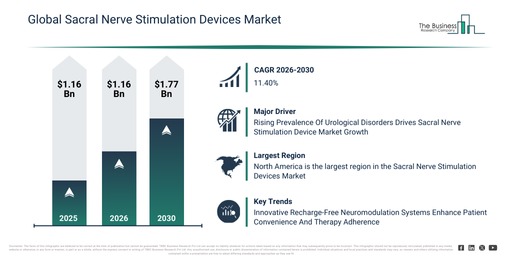
    The sacral nerve stimulation devices market has seen rapid expansion in recent years. It is projected to expand from $1.48 billion in 2025 to $1.65 billion in 2026, maintaining a compound annual growth rate (CAGR) of 11.5%. Historically, this growth has been fueled by factors such as the increasing prevalence of urinary incontinence, a growing geriatric population, advancements in neuromodulation technology, broader clinical acceptance of nerve stimulation therapies, and the expansion of urology specialty services.

    The sacral nerve stimulation devices market is poised for substantial growth in the upcoming years. It is projected to expand to $2.54 billion in 2030, demonstrating a compound annual growth rate (CAGR) of 11.4%. This anticipated growth is driven by the increasing embrace of smart implantable devices, the rising demand for sustained continence management, the proliferation of outpatient neuromodulation procedures, a growing emphasis on personalized neurological therapies, and increased financial contributions to bioelectronic medicine. Prominent trends throughout this period include the rising adoption of implantable neuromodulation devices, an increasing need for minimally invasive bladder control treatments, the expanding integration of programmable stimulation technologies, the broadening availability of long-term neurological therapy solutions, and an enhanced focus on tailoring therapies to individual patients.

    Access Your Free Sample Report For In-Depth Market Analysis:

    https://www.thebusinessresearchcompany.com/report/sacral-nerve-stimulation-devices-global-market-report

    What Leading Drivers Are Supporting The Sacral Nerve Stimulation Devices Market Expansion?

    The future expansion of the sacral nerve stimulation devices market is anticipated to be driven by the growing occurrence of urological disorders. These conditions encompass a broad spectrum of ailments impacting the urinary tract, kidneys, bladder, and prostate, varying in duration from acute to chronic. Urological disorders can originate from diverse causes, affecting both the urinary and reproductive organs. Additionally, lifestyle habits such as poor dietary choices, dehydration, and insufficient exercise, can contribute to the development of kidney stones, a painful ailment affecting the urinary tract. Sacral nerve stimulation devices provide a minimally invasive treatment option that can effectively manage urological disorders like urinary and fecal incontinence. For instance, data from April 2024, shared by the National Institute of Diabetes and Digestive and Kidney Diseases, a US-based healthcare company, revealed that on average each year, 651,446 individuals aged 65 and older (212,875 men and 438,572 women) received a new diagnosis of some form of urinary incontinence. Consequently, the increasing prevalence of urological disorders is expected to fuel the growth of the sacral nerve stimulation devices market.

    How Is The Sacral Nerve Stimulation Devices Market Segmented Across Different Segment Categories?

    The sacral nerve stimulation devices market covered in this report is segmented –

    1) By Technology Modality: Implantable Sacral Neuromodulation, External Sacral Neuromodulation

    2) By Product: External Sacral Nerve Stimulation Devices, Implantable Sacral Nerve Stimulation Devices

    3) By Age Group: Pediatrics, Adults, Geriatrics

    4) By Application: Urinary Incontinence, Fecal Incontinence, Bowel Dysfunction, Other Applications

    5) By End User: Hospitals, Ambulatory Surgical Centers, Specialty Clinics

    Subsegments:

    1) By Implantable Sacral Neuromodulation: Rechargeable Implantable SNS Systems, Non-Rechargeable Implantable SNS Systems

    2) By External Sacral Neuromodulation: Transcutaneous Sacral Neuromodulation Systems, Wearable External Neuromodulation Devices

    What Emerging Trends Are Seen In The Sacral Nerve Stimulation Devices Market?

    Leading companies active in the Sacral Nerve Stimulation (SNS) devices market are concentrating on developing sophisticated solutions, like sacral neuromodulation systems that eliminate the need for recharging, to enhance convenience for patients and encourage adherence to treatment. Recharge-free sacral neuromodulation systems function as implantable devices that stimulate the sacral nerves to treat bladder and bowel dysfunction without necessitating regular battery recharges. As an illustration, in January 2025, Medtronic PLC, an Ireland-based medical technology firm, obtained FDA approval in India for its InterStim X Sacral Neuromodulation (SNM) system, which addresses bladder and bowel control issues such as overactive bladder (OAB), chronic fecal incontinence (FI), and non-obstructive urinary retention. These systems are equipped with a proprietary fifth-generation battery that delivers over 10 years of therapy without recharging, potentially extending up to 15 years in low-energy configurations. It also incorporates a smart programmer, resembling a smartphone, allowing patients to independently adjust up to 11 therapy settings discreetly, whether at home or on the move. Furthermore, the system supports SureScan MRI technology, enabling patients to safely undergo full-body 1.5T and 3T MRI scans, with the MRI mode easily controlled by the patient under the guidance of a physician.

    Which Organizations Play A Role In The Sacral Nerve Stimulation Devices Market Landscape?

    Major companies operating in the sacral nerve stimulation devices market are Abbott, Medtronic plc, Boston Scientific Corporation, Axonics Modulation Technologies, Laborie Medical Technologies, Beijing PINS Medical Co. Ltd., Neuspera Medical, Coloplast Group, Medtronic Neurovascular, NeuroPace Inc., Aleva Neurotherapeutics, LivaNova Neuromodulation, Nalu Medical, SetPoint Medical, NeuroSigma Inc., Saluda Medical, Soterix Medical, Inspire Medical Systems Inc., Synapse Biomedical Inc., Bioinduction Ltd

    Get The Full Sacral Nerve Stimulation Devices Market Report:

    https://www.thebusinessresearchcompany.com/report/sacral-nerve-stimulation-devices-global-market-report

    Which Region Accounts For The Largest Portion Of The Sacral Nerve Stimulation Devices Market?

    North America was the largest region in the sacral nerve stimulation devices market in 2025. Asia-Pacific is expected to be the fastest-growing region in the forecast period. The regions covered in the sacral nerve stimulation devices market report are Asia-Pacific, South East Asia, Western Europe, Eastern Europe, North America, South America, Middle East, Africa.

    Request A Customized Sacral Nerve Stimulation Devices Market Report For Competitive Insights:

    https://www.thebusinessresearchcompany.com/report/sacral-nerve-stimulation-devices-global-market-report

    Browse Through More Reports Similar to the Global Sacral Nerve Stimulation Devices Market 2026, By The Business Research Company

    Electrical Stimulation Devices Market Report 2026

    https://www.thebusinessresearchcompany.com/report/electrical-stimulation-devices-global-market-report

    Spinal Cord Stimulation Market Report 2026

    https://www.thebusinessresearchcompany.com/report/spinal-cord-stimulation-global-market-report

    Neurostimulation Devices Market Report 2026

    https://www.thebusinessresearchcompany.com/report/neurostimulation-devices-global-market-report

    Get in touch with us:

    The Business Research Company: https://www.thebusinessresearchcompany.com/

    Americas +1 310-496-7795

    Asia +44 7882 955267 & +91 8897263534

    Europe +44 7882 955267

    Email us at info@tbrc.info

    Follow us on:

    LinkedIn: https://in.linkedin.com/company/the-business-research-company

    YouTube: https://www.youtube.com/channel/UC24_fI0rV8cR5DxlCpgmyFQ

    Global Market Model: https://www.thebusinessresearchcompany.com/global-market-model
  • Technological Advancements In Robotic-Assisted Phacoemulsification Platform Is Playing A Role In Shaping The Robotic-Assisted Eye Surgery Market

    Technological Advancements In Robotic-Assisted Phacoemulsification Platform Is Playing A Role In Shaping The Robotic-Assisted Eye Surgery Market

    The Business Research Company’s 2026 market reports feature enhanced tools like market attractiveness analysis, TAM assessment, and company scoring matrices, along with interactive dashboards, deeper supply chain insights, and startup coverage strengthening the depth, usability, and strategic value of insights.

    How Much Growth In Market Value Is Expected For The Robotic-Assisted Eye Surgery Market Between 2026 And 2030?

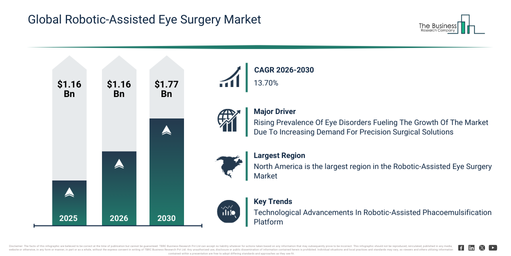
    The robotic-assisted eye surgery market has experienced rapid expansion in recent years. It is projected to increase from $1.39 billion in 2025 to $1.59 billion in 2026, at a compound annual growth rate (CAGR) of 14.4%. The historic growth in this sector is due to factors such as the limitations inherent in manual microsurgical techniques, the rising incidence of cataract and retinal disorders, the proliferation of specialized eye care centers, the increasing demand among surgeons for more precise instruments, and the progressive adoption of computer-assisted ophthalmic systems.

    The robotic-assisted eye surgery market is set for substantial expansion in the coming years. It is projected to achieve a value of $2.66 billion by 2030, exhibiting a compound annual growth rate (CAGR) of 13.7%. This projected growth is driven by various factors such as progress in AI-powered robotic systems, an expanding elderly demographic experiencing eye disorders, the proliferation of ambulatory surgical centers, increasing financial commitments to ophthalmic robotics research and development, and a broader acceptance of robot-assisted operations among surgeons. Significant trends anticipated during this period involve the increasing adoption of minimally invasive ophthalmic procedures, a rising demand for highly precise and stable surgical outcomes, the expanded application of robotic assistance in intricate retinal and corneal surgeries, the development of more training and skill enhancement programs for surgeons, and an elevated focus on patient safety alongside a reduction in surgical variability.

    Access Your Free Sample Report For In-Depth Market Analysis:

    https://www.thebusinessresearchcompany.com/report/robotic-assisted-eye-surgery-global-market-report

    Which Key Factors Are Driving The Robotic-Assisted Eye Surgery Market Growth?

    The escalating occurrence of eye disorders is projected to propel the expansion of the robotic-assisted eye surgery market in the coming years. Eye disorders refer to health conditions that impact the structure or function of the eye, potentially causing vision problems or blindness. The increasing incidence of eye disorders is primarily fueled by extended screen time, which contributes to digital eye strain, dry eyes, and blurred vision when screens are viewed for long durations without adequate breaks. Robot-assisted eye surgery offers solutions for diverse eye disorders by enhancing surgical precision, minimizing human error, and facilitating minimally invasive procedures, which leads to improved patient outcomes and faster recovery times. For instance, in May 2024, according to the Centers for Disease Control and Prevention, 20.5 million people aged 40 and older in the United States, representing 17.2% of that age group, were expected to have cataracts in at least one eye in 2024. This number is projected to grow to over 30 million by 2028. Therefore, the rising prevalence of eye disorders is a significant driver for the growth of the robotic-assisted eye surgery market.

    What Are The Main Segments Within The Robotic-Assisted Eye Surgery Market Segment Structure?

    The robotic-assisted eye surgery market covered in this report is segmented –

    1) By Type: Robotic Systems, Instruments And Accessories, Software And Services

    2) By Surgery Type: Cataract Surgery, Retinal Surgery, Corneal Surgery, Glaucoma Surgery, Refractive Surgery, Other Surgery Types

    3) By Technology: Telerobotics, Haptic Feedback Systems, Image-Guided Systems, Artificial Intelligent (AI)-Driven Robotic Systems, Other Technologies

    4) By Application: Anterior Segment Procedures, Posterior Segment Procedures, Corneal Procedures, Other Applications

    5) By End-User: Hospitals, Ambulatory Surgical Centers (ASCs), Specialized Eye Clinics, Research And Academic Institutes

    Subsegments:

    1) By Robotic Systems: Fully Automated Systems, Semi-Automated Systems

    2) By Instruments And Accessories: Surgical Instruments, Robotic Controllers, Visualization Systems

    3) By Software And Services: Robotic Surgery Software, Maintenance And Upgrades, Training And Support

    Which Trends Are Guiding The Direction Of The Robotic-Assisted Eye Surgery Market?

    Leading companies within the robotic-assisted eye surgery market are concentrating on developing sophisticated solutions, such as robotic-assisted phacoemulsification platforms, to heighten surgical accuracy, decrease complication rates, and enhance patient outcomes. A robotic-assisted phacoemulsification platform refers to a surgical system that employs robotic technology to assist physicians in performing cataract removal surgery with greater exactness. For instance, in May 2024, ForSight Robotics, an Israel-based provider of robotic surgery platforms, introduced the ORYOM surgical robotics platform for executing a complete, remote robotic cataract procedure. The ORYOM surgical robotics platform is fitted with a miniature robotic hand offering 14 degrees of freedom and hybrid kinematics, which allows for excellent maneuverability inside the eye. It combines artificial intelligence, advanced imaging, and compact mechanical components to facilitate precise and consistent surgical performance. The application of stereoscopic imaging improves depth perception and provides immediate visual feedback, aiding surgeons in achieving superior precision. The platform additionally leverages machine learning to adapt and refine its capabilities with each surgical procedure performed.

    Who Are The Companies Participating In The Robotic-Assisted Eye Surgery Market?

    Major companies operating in the robotic-assisted eye surgery market are Johnson & Johnson, ZEISS Group, Alcon Inc., Intuitive Surgical Operations Inc., Bausch + Lomb Corp., Leica Microsystems, Lumenis Ltd., Topcon Healthcare, IRIDEX Corp., ForSight Robotics Ltd., Prasad Netralaya, Haag-Streit Group, Nidek Co. Ltd., Ophthorobotics AG, Preceyes BV, Horizon Surgical Systems, AcuSurgical, LENSAR Inc., Ziemer Ophthalmic Systems AG, STAAR Surgical Company, Optovue, Glaukos Corporation, Eyenuk, AcuFocus, Avedro Inc., Aeon Astron Europe BV, Omega Ophthalmics

    Get The Full Robotic-Assisted Eye Surgery Market Report:

    https://www.thebusinessresearchcompany.com/report/robotic-assisted-eye-surgery-global-market-report

    Which Region Holds The Highest Market Share In The Robotic-Assisted Eye Surgery Market?

    North America was the largest region in the robotic-assisted eye surgery market in 2025. Asia-Pacific is expected to be the fastest-growing region in the forecast period. The regions covered in the robotic-assisted eye surgery market report are Asia-Pacific, South East Asia, Western Europe, Eastern Europe, North America, South America, Middle East, Africa.

    Request A Customized Robotic-Assisted Eye Surgery Market Report For Competitive Insights:

    https://www.thebusinessresearchcompany.com/report/robotic-assisted-eye-surgery-global-market-report

    Browse Through More Reports Similar to the Global Robotic-Assisted Eye Surgery Market 2026, By The Business Research Company

    Bearing Steel Market Report 2026

    https://www.thebusinessresearchcompany.com/report/bearing-steel-global-market-report

    Mounted Bearing Market Report 2026

    https://www.thebusinessresearchcompany.com/report/mounted-bearing-global-market-report

    Automotive Elastomers Market Report 2026

    https://www.thebusinessresearchcompany.com/report/automotive-elastomers-global-market-report

    Get in touch with us:

    The Business Research Company: https://www.thebusinessresearchcompany.com/

    Americas +1 310-496-7795

    Asia +44 7882 955267 & +91 8897263534

    Europe +44 7882 955267

    Email us at info@tbrc.info

    Follow us on:

    LinkedIn: https://in.linkedin.com/company/the-business-research-company

    YouTube: https://www.youtube.com/channel/UC24_fI0rV8cR5DxlCpgmyFQ

    Global Market Model: https://www.thebusinessresearchcompany.com/global-market-model
  • The Robotic Ultrasound Systems Market Is Witnessing Impact From Rising Patient Volumes Are Driving The Market Growth Due To Increasing Care Demand And The Need For Efficient Imaging

    The Robotic Ultrasound Systems Market Is Witnessing Impact From Rising Patient Volumes Are Driving The Market Growth Due To Increasing Care Demand And The Need For Efficient Imaging

    The Business Research Company’s 2026 market reports feature enhanced tools like market attractiveness analysis, TAM assessment, and company scoring matrices, along with interactive dashboards, deeper supply chain insights, and startup coverage strengthening the depth, usability, and strategic value of insights.

    What Is The Estimated Market Size Of The Robotic Ultrasound Systems Market In 2026, And How Will Its Value Evolve By 2030?

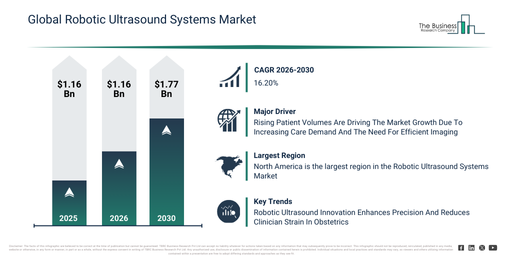
    The robotic ultrasound systems market has seen substantial expansion in recent years. This market is projected to expand from $1.78 billion in 2025 to $2.07 billion in 2026, reflecting a compound annual growth rate (CAGR) of 16.5%. Historically, this growth can be attributed to factors such as shortages of ultrasound operators, the increasing demand for diagnostic accuracy, the rise of telemedicine, the need for imaging standardization, and the introduction of early robotic imaging systems.

    The market size for robotic ultrasound systems is projected for quick expansion in the upcoming years. It is forecast to reach $3.77 billion by 2030, exhibiting a compound annual growth rate (CAGR) of 16.2%. This growth during the forecast period is attributable to the increasing reach of remote healthcare, AI-assisted diagnostics, the rise in chronic disease screening, the need for portable robotic imaging, and the automation of hospital workflows. Prominent trends for the forecast period encompass remote ultrasound examinations, imaging that does not require an operator, standardized diagnostic scanning, automated image acquisition, and improved imaging reproducibility.

    Access Your Free Sample Report For In-Depth Market Analysis:

    https://www.thebusinessresearchcompany.com/report/global-robotic-ultrasound-systems-market-report

    What Primary Drivers Are Shaping The Robotic Ultrasound Systems Market?

    The growth of the robotic ultrasound systems market is expected to be propelled by an increase in patient volumes moving forward. Patient volumes denote the total number of individuals seeking medical assessments, diagnostic procedures, or treatment within a healthcare establishment over a specified duration. The primary cause of rising patient volumes is the escalating pressure on emergency and inpatient services, as a higher demand for care frequently exceeds the available clinical capacity, leading to accumulated delays and an expansion in the number of patients awaiting timely evaluations. Robotic ultrasound systems help alleviate the impact of increasing patient volumes by improving scanning efficiency, enhancing workflow throughput, and enabling clinicians to manage a larger patient caseload with greater consistency and reduced operational strain. For instance, in October 2025, according to the British Medical Association (BMA), a UK-based professional association and trade union, the number of patients waiting over 12 hours for emergency admission surged from 35,900 in August 2025 to nearly 44,800 in September 2025. Therefore, the expanding patient volumes are a key driver for the robotic ultrasound systems market.

    How Is Segmentation Applied In The Robotic Ultrasound Systems Market Segment Analysis?

    The robotic ultrasound systems market covered in this report is segmented –

    1) By Product Type: Trolley-Based Robotic Ultrasound Systems, Compact Or Portable Robotic Ultrasound Systems

    2) By Technology: Automated, Semi-Automated

    3) By End-User: Hospitals, Diagnostic Centers, Ambulatory Surgical Centers, Research Institutes, Other End-Users

    Subsegments:

    1) By Trolley-Based Robotic Ultrasound Systems: High-Precision Robotic Scanning Units, Integrated Robotic Imaging Workstations

    2) By Compact Or Portable Robotic Ultrasound Systems: Handheld Robotic Assisted Ultrasound Devices, Mobile Autonomous Scanning Units

    What Trends Are Affecting The Growth Of The Robotic Ultrasound Systems Market?

    Major companies operating in the robotic ultrasound systems market are concentrating on developing sophisticated products, such as robotic ultrasound platforms, to boost scanning efficiency and alleviate operator strain. A robotic ultrasound platform functions as a computer-assisted mechanism that employs robotic actuation to precisely position and maneuver an ultrasound transducer, thereby enabling consistent imaging while decreasing physical exertion for clinicians. For instance, in May 2025, Life Science Robotics, a Denmark-based innovator of medical robotics solutions, introduced ARUS. This product features a robotic arm equipped with joystick-based control, haptic feedback, and adaptive pressure management to support accurate ultrasound scanning with reduced physical demands on sonographers. It is engineered to improve image uniformity, enhance the capacity to scan patients with a high body mass index, and mitigate work-related musculoskeletal risks, particularly in obstetric imaging environments.

    Who Are The Companies Participating In The Robotic Ultrasound Systems Market Environment?

    Major companies operating in the robotic ultrasound systems market are Siemens Healthineers AG, Koninklijke Philips N.V., GE HealthCare, Canon Medical Systems Corporation, Samsung Medison Co. Ltd., Fujifilm Holdings Corporation, Mindray Medical International Limited, Esaote S.p.A., BK Medical Holding Company Inc., Exact Imaging Inc., AdEchoTech Inc., EchoNous Inc., Butterfly Network Inc., Clarius Mobile Health Corp., ImFusion GmbH, Sonivate Medical Inc., TeleRobotic Ultrasound Systems Inc., Mecasonic Group, Medo.ai, Ultrasound Robotics Ltd.

    Get The Full Robotic Ultrasound Systems Market Report:

    https://www.thebusinessresearchcompany.com/report/global-robotic-ultrasound-systems-market-report

    Where Is The Robotic Ultrasound Systems Market Most Concentrated Geographically?

    North America was the largest region in the robotic ultrasound systems market in 2025. The regions covered in the robotic ultrasound systems market report are Asia-Pacific, South East Asia, Western Europe, Eastern Europe, North America, South America, Middle East, Africa.

    Request A Customized Robotic Ultrasound Systems Market Report For Competitive Insights:

    https://www.thebusinessresearchcompany.com/report/global-robotic-ultrasound-systems-market-report

    Browse Through More Reports Similar to the Global Robotic Ultrasound Systems Market 2026, By The Business Research Company

    Contrast Enhanced Ultrasound Market Report 2026

    https://www.thebusinessresearchcompany.com/report/contrast-enhanced-ultrasound-global-market-report

    Ultrasound Transducer Market Report 2026

    https://www.thebusinessresearchcompany.com/report/ultrasound-transducer-global-market-report

    Ultrasonic Technology Market Report 2026

    https://www.thebusinessresearchcompany.com/report/ultrasonic-technology-global-market-report

    Get in touch with us:

    The Business Research Company: https://www.thebusinessresearchcompany.com/

    Americas +1 310-496-7795

    Asia +44 7882 955267 & +91 8897263534

    Europe +44 7882 955267

    Email us at info@tbrc.info

    Follow us on:

    LinkedIn: https://in.linkedin.com/company/the-business-research-company

    YouTube: https://www.youtube.com/channel/UC24_fI0rV8cR5DxlCpgmyFQ

    Global Market Model: https://www.thebusinessresearchcompany.com/global-market-model
  • Growth In The Robotic Surgical Companion Market Is Being Driven By Rising Cancer Incidence Driving The Growth Of The Market Due To Increasing Need For Precise And Minimally Invasive Treatments

    Growth In The Robotic Surgical Companion Market Is Being Driven By Rising Cancer Incidence Driving The Growth Of The Market Due To Increasing Need For Precise And Minimally Invasive Treatments

    The Business Research Company’s 2026 market reports feature enhanced tools like market attractiveness analysis, TAM assessment, and company scoring matrices, along with interactive dashboards, deeper supply chain insights, and startup coverage strengthening the depth, usability, and strategic value of insights.

    How Does The Market Size Of The Robotic Surgical Companion Market Compare Between 2026 And 2030?

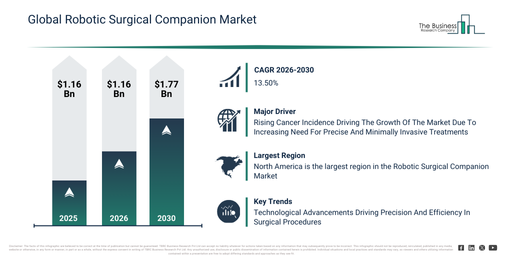
    The robotic surgical companion market has seen swift expansion in recent years. It is anticipated to expand from $6.9 billion in 2025 to $7.86 billion in 2026, demonstrating a compound annual growth rate (CAGR) of 13.8%. The historical growth of this market can be attributed to factors such as a shortage of skilled surgeons, increasing surgical complexity, the demand for minimally invasive procedures, technological advances in robotics, and hospital investment in advanced surgery.

    The robotic surgical companion market is anticipated to experience significant expansion in the coming years. This market is projected to reach $13.07 billion by 2030, exhibiting a compound annual growth rate (CAGR) of 13.5%. Key factors driving this growth during the forecast period include AI-powered surgical assistance, increased robotic surgery training, a rise in outpatient surgeries, the need for quicker patient recovery, and better integration with imaging systems. Prominent trends expected in the same period involve precision-guided surgical procedures, the adoption of minimally invasive robotic surgery, improved surgeon guidance and decision-making support, advanced surgical dexterity systems, and optimized operating room workflows.

    Access Your Free Sample Report For In-Depth Market Analysis:

    https://www.thebusinessresearchcompany.com/report/robotic-surgical-companion-global-market-report

    Which Major Drivers Are Influencing The Expansion Of The Robotic Surgical Companion Market?

    The rising incidence of cancer is anticipated to drive the expansion of the robotic surgical companion market in the coming years. Cancer is defined as a condition where the body’s cells multiply without control, harming adjacent tissues and potentially spreading to other parts of the body. The increase in cancer cases is largely attributable to unhealthy lifestyles, such as poor nutrition, lack of physical activity, and tobacco use, which heighten the risk of cell damage and uncontrolled cellular growth. Robotic surgical companions assist in cancer treatment by carrying out highly accurate, minimally invasive procedures that minimize harm to healthy tissues and contribute to quicker patient recovery. For instance, in February 2024, the World Health Organization, an intergovernmental organization based in Switzerland, indicated that the number of new cancer cases is projected to exceed 35 million by 2050, representing a 77% rise compared to the approximately 20 million cases recorded in 2022. Hence, the increasing prevalence of cancer is a key driver for the growth of the robotic surgical companion market.

    What Segment Categories Shape The Robotic Surgical Companion Market Segment Landscape?

    The robotic surgical companion market covered in this report is segmented –

    1) By Component: Hardware, Software, Services

    2) By Product Type: Surgical Robots, Robotic Surgical Assistants, Robotic Navigation Systems, Other Product Types

    3) By Application: General Surgery, Urology, Gynecology, Orthopedics, Cardiovascular, Neurosurgery, Other Applications

    4) By End-User: Hospitals, Ambulatory Surgical Centers, Specialty Clinics, Other End-Users

    Subsegments:

    1) By Hardware: Surgical Robots, Accessories And Consumables

    2) By Software: Surgical Planning Software Artificial Intelligence And Analytics Software, Imaging And Navigation Software

    3) By Services: Maintenance And Support, Remote Monitoring And Upgrades, Training And Consulting

    Which Trends Are Shaping The Robotic Surgical Companion Market?

    Leading firms in the robotic surgical companion market are concentrating on creating sophisticated offerings, including AI-driven robotic surgery systems, aimed at boosting surgical accuracy, shortening operation durations, and bettering patient results. An AI-powered robotic surgery system denotes a surgical platform integrating artificial intelligence algorithms with robotic tools to aid surgeons in the planning, guidance, and execution of procedures with heightened precision, accuracy, and efficiency. As an illustration, during July 2025, CARE Hospitals, an Indian healthcare service provider, introduced a Stryker Mako Robotic System specifically to improve accuracy in orthopedic operations. This represents a cutting-edge AI-enabled technology that facilitates exceptionally precise, customized joint replacement procedures through comprehensive 3D modeling and live robotic direction. Its primary advantages encompass enhanced surgical exactness, diminished tissue harm, decreased discomfort after surgery, quicker recuperation, and more foreseeable results. The system’s objective is to elevate the caliber and uniformity of orthopedic interventions, assisting patients in attaining superior long-term joint functionality with reduced hospital admissions and fewer issues when contrasted with conventional approaches.

    Who Are The Companies Operating Across The Robotic Surgical Companion Market Value Chain?

    Major companies operating in the robotic surgical companion market are Intuitive Surgical Inc., Medtronic plc, Stryker Corporation, Zimmer Biomet Holdings Inc., Asensus Surgical Inc., Globus Medical Inc., Distalmotion SA, Medicaroid Corporation, CMR Surgical Ltd., Johnson & Johnson, Smith & Nephew plc, eCential Robotics SAS, Renishaw plc, Meere Company Inc., avateramedical GmbH, Robocath SAS, Preceyes B.V., Neocis Inc., Microbot Medical Inc., NDR Medical Technology Pte. Ltd., Accuray Incorporated

    Get The Full Robotic Surgical Companion Market Report:

    https://www.thebusinessresearchcompany.com/report/robotic-surgical-companion-global-market-report

    Which Region Dominates The Robotic Surgical Companion Market By Market Share?

    North America was the largest region in the robotic surgical companion market in 2025. The regions covered in the robotic surgical companion market report are Asia-Pacific, South East Asia, Western Europe, Eastern Europe, North America, South America, Middle East, Africa.

    Request A Customized Robotic Surgical Companion Market Report For Competitive Insights:

    https://www.thebusinessresearchcompany.com/report/robotic-surgical-companion-global-market-report

    Browse Through More Reports Similar to the Global Robotic Surgical Companion Market 2026, By The Business Research Company

    Surgical Robot Accessories Market Report 2026

    https://www.thebusinessresearchcompany.com/report/surgical-robot-accessories-global-market-report

    Robotic Surgery Services Market Report 2026

    https://www.thebusinessresearchcompany.com/report/robotic-surgery-services-global-market-report

    Healthcare Companion Robots Market Report 2026

    https://www.thebusinessresearchcompany.com/report/healthcare-companion-robots-global-market-report

    Get in touch with us:

    The Business Research Company: https://www.thebusinessresearchcompany.com/

    Americas +1 310-496-7795

    Asia +44 7882 955267 & +91 8897263534

    Europe +44 7882 955267

    Email us at info@tbrc.info

    Follow us on:

    LinkedIn: https://in.linkedin.com/company/the-business-research-company

    YouTube: https://www.youtube.com/channel/UC24_fI0rV8cR5DxlCpgmyFQ

    Global Market Model: https://www.thebusinessresearchcompany.com/global-market-model
  • Robotic Surgery Devices Market Analysis With Focus On Growth Potential And Future Outlook

    Robotic Surgery Devices Market Analysis With Focus On Growth Potential And Future Outlook

    The Business Research Company’s 2026 market reports feature enhanced tools like market attractiveness analysis, TAM assessment, and company scoring matrices, along with interactive dashboards, deeper supply chain insights, and startup coverage strengthening the depth, usability, and strategic value of insights.

    What Is The Forecasted Market Size Trajectory Of The Robotic Surgery Devices Market From 2026 To 2030?

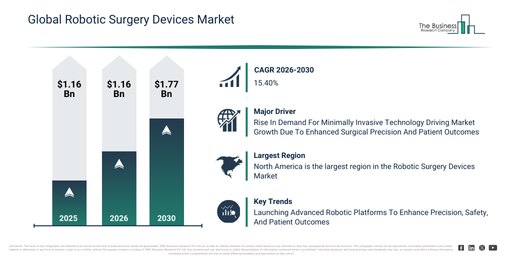
    The robotic surgery devices market size has seen rapid expansion in recent years. It is anticipated to grow from $8.81 billion in 2025 to $10.19 billion in 2026, registering a compound annual growth rate (CAGR) of 15.7%. The surge during the historic period can be attributed to the wider adoption of minimally invasive surgical procedures, a growing preference among surgeons for robotic assistance, increased hospital investments in advanced surgery systems, an uptick in complex surgical cases, and enhancements in robotic instrumentation.

    The robotic surgery devices market is poised for significant expansion in the next few years. It is anticipated to grow to $18.08 billion by 2030, achieving a compound annual growth rate (CAGR) of 15.4%. This projected growth during the forecast period is fueled by the increasing adoption of autonomous surgical functions, a rising demand for precision surgery, the expansion of robotic surgery training programs, the growing integration of AI-assisted decision support, and an increase in outpatient robotic procedures. Key trends expected over this period include the wider acceptance of robot-assisted minimally invasive surgeries, an escalating demand for multi-specialty robotic platforms, the growing use of advanced surgical visualization systems, the proliferation of remote and teleoperated surgery, and an enhanced focus on surgical precision and patient outcomes.

    Access Your Free Sample Report For In-Depth Market Analysis:

    https://www.thebusinessresearchcompany.com/report/robotic-surgery-devices-global-market-report

    What Key Drivers Are Fueling The Growth Of The Robotic Surgery Devices Market?

    The anticipated surge in demand for minimally invasive technology is set to advance the robotic surgery devices market. Minimally invasive technology involves surgical procedures conducted through small incisions with advanced instruments and robotic systems, leading to reduced tissue damage and quicker recovery times. This increased preference for minimally invasive technology stems from patients desiring faster recovery, fewer post-operative complications, and shorter hospital stays. Such a rise in demand bolsters the robotic surgery devices market by promoting the adoption of robotic-assisted platforms that enhance precision, enable complex operations, and improve overall surgical outcomes. For instance, in June 2024, the American Society of Plastic Surgeons, a US-based non-profit organization, reported a 7% increase in minimally invasive procedures in 2023, which surpassed the 2% growth rate of surgical procedures. Hand surgeries, including carpal tunnel, arthritis, and trigger finger, amounted to 207,887 procedures, showing a 2% rise from 2022. Therefore, the growing demand for minimally invasive technology is a primary driver for the expansion of the robotic surgery devices market.

    Which Segment Types Are Examined In The Robotic Surgery Devices Market Segment Study?

    The robotic surgery devices market covered in this report is segmented –

    1) By Product: Robotic systems, Instruments & Accessories, Services

    2) By Application: General Surgery, Urological Surgery, Gynecological Surgery, Orthopaedics Surgery, Neurosurgery, Other Applications.

    3) By End-Use: Hospitals, Ambulatory Surgery Centers (Ascs)

    Subsegments:

    1) By Robotic Systems: Surgical Robotic Systems, Teleoperated Robotic Systems, Autonomous Robotic Systems

    2) By Instruments And Accessories: Surgical Instruments, Endoscopes, Vision Systems, Energy Devices

    3) By Services: Maintenance And Repair Services, Training And Support Services, Consulting Services

    What Trends Are Influencing The Robotic Surgery Devices Market?

    Leading companies in the robotic surgery devices market are concentrating on technological advancements, such as robotic surgery platforms, to boost procedural efficiency, refine treatment precision, and increase overall profitability. These robotic surgery platforms are being developed to minimize radiation exposure, enhance ergonomics for surgeons, and improve patient recovery through minimally invasive procedures. R-One+ is a medical robot system for heart surgery. For instance, in May 2023, Robocath, a France-based medical technology company, released R-One+, a new robotic system for cardiac surgery. The R-One+ robotic platform is designed to improve treatment precision and safety, decrease radiation exposure, and generally enhance the patient experience. This robotic solution allows interventional cardiologists to perform coronary angioplasties utilizing a tablet and a joystick. The R-One+ robotic platform stands as a significant innovation in interventional cardiology, offering medical professionals a new instrument to better patient outcomes and reduce the risk of complications during treatments.

    Which Players Are Part Of The Competitive Landscape Of The Robotic Surgery Devices Market?

    Major companies operating in the robotic surgery devices market are Intuitive Surgical Inc., Stryker Corporation, Medtronic plc, Smith & Nephew plc, Johnson & Johnson, TransEnterix Inc., Zimmer Biomet Holdings Inc., Auris Health Inc., CMR Surgical Ltd., Verb Surgical Inc., Renishaw plc, Think Surgical Inc., Corindus Vascular Robotics Inc., Mazor Robotics Ltd., Titan Medical Inc., Virtual Incision Corporation, Medrobotics Corporation, Preceyes BV, Microbot Medical Inc., Asensus Surgical Inc., Avatera Medical GmbH, Medicaroid Corporation, Hansen Medical Inc., Edge Surgical Inc., Synaptive Medical, Aesculap Inc.

    Get The Full Robotic Surgery Devices Market Report:

    https://www.thebusinessresearchcompany.com/report/robotic-surgery-devices-global-market-report

    Which Region Is The Largest In The Robotic Surgery Devices Market?

    North America was the largest region in the robotic surgery devices market in 2025. Western Europe was the second largest market in global robotic surgery devices market. The regions covered in the robotic surgery devices market report are Asia-Pacific, South East Asia, Western Europe, Eastern Europe, North America, South America, Middle East, Africa.

    Request A Customized Robotic Surgery Devices Market Report For Competitive Insights:

    https://www.thebusinessresearchcompany.com/report/robotic-surgery-devices-global-market-report

    Browse Through More Reports Similar to the Global Robotic Surgery Devices Market 2026, By The Business Research Company

    Robotic Surgery Services Market Report 2026

    https://www.thebusinessresearchcompany.com/report/robotic-surgery-services-global-market-report

    Surgical Robot Accessories Market Report 2026

    https://www.thebusinessresearchcompany.com/report/surgical-robot-accessories-global-market-report

    Surgical Robots Market Report 2026

    https://www.thebusinessresearchcompany.com/report/surgical-robots-global-market-report

    Get in touch with us:

    The Business Research Company: https://www.thebusinessresearchcompany.com/

    Americas +1 310-496-7795

    Asia +44 7882 955267 & +91 8897263534

    Europe +44 7882 955267

    Email us at info@tbrc.info

    Follow us on:

    LinkedIn: https://in.linkedin.com/company/the-business-research-company

    YouTube: https://www.youtube.com/channel/UC24_fI0rV8cR5DxlCpgmyFQ

    Global Market Model: https://www.thebusinessresearchcompany.com/global-market-model
  • Robotic Surgery Consumables Market Forecast Showing Industry Progress And Growth Trends

    Robotic Surgery Consumables Market Forecast Showing Industry Progress And Growth Trends

    The Business Research Company’s 2026 market reports feature enhanced tools like market attractiveness analysis, TAM assessment, and company scoring matrices, along with interactive dashboards, deeper supply chain insights, and startup coverage strengthening the depth, usability, and strategic value of insights.

    How Much Will The Market Value Of The Robotic Surgery Consumables Market Grow Between 2026 And 2030?

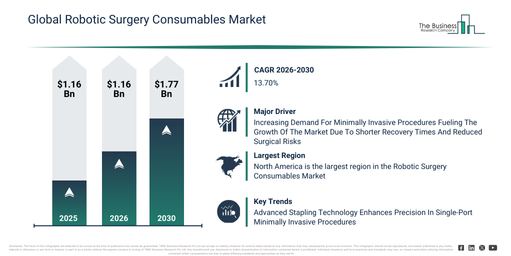
    The robotic surgery consumables market has shown significant expansion in recent years. It is anticipated to increase from $5.73 billion in 2025 to $6.53 billion in 2026, achieving a compound annual growth rate (CAGR) of 14.0%. The historical growth trajectory can be linked to factors such as the early integration of robotic surgical systems, a rising number of complex surgical interventions, the drive for enhanced surgical precision, increased hospital funding directed towards advanced surgery, and the utilization of reusable surgical instruments.

    The robotic surgery consumables market is anticipated to experience substantial expansion in the coming years. This market is projected to reach $10.9 billion by 2030, exhibiting a compound annual growth rate (CAGR) of 13.7%. Several factors contribute to this growth during the forecast period, including the increasing adoption of robotic-assisted surgeries, higher healthcare spending on sophisticated medical procedures, a rising demand for disposable and sterile consumables, ongoing technological improvements in robotic systems, and the proliferation of ambulatory surgical centers. Key trends anticipated over the forecast period encompass a growing uptake of single-use robotic surgery consumables, a heightened need for highly precise and sterile surgical items, an increase in both minimally invasive and robotic-assisted interventions, the broader application of robotic surgery across various medical fields, and an emphasis on minimizing surgical site infections and optimizing procedure duration.

    Access Your Free Sample Report For In-Depth Market Analysis:

    https://www.thebusinessresearchcompany.com/report/robotic-surgery-consumables-global-market-report

    Which Drivers Are Supporting The Robotic Surgery Consumables Market Growth?

    The growing need for minimally invasive procedures is anticipated to fuel the expansion of the robotic surgery consumables market. Minimally invasive procedures involve medical interventions performed through minor incisions or natural openings, which decreases patient trauma and accelerates recovery. The heightened preference for these procedures stems from their advantages such as shorter healing periods, reduced complication risks, less pain, and smaller scars, making them more attractive to patients seeking faster and safer treatment options. Robotic surgery consumables play a crucial role by enhancing the efficiency and precision of these procedures through specialized instruments and tools, ensuring accurate movements and consistent performance. This ultimately reduces surgical risks and procedure duration, thereby improving patient outcomes and overall operating room productivity. For example, in June 2024, the American Society of Plastic Surgeons, a US-based non-profit organization, reported that minimally invasive procedures grew by 7% in 2023, compared to 2022. Consequently, the increasing demand for minimally invasive procedures is a key driver for the growth of the robotic consumables market.

    How Are Different Segments Classified In The Robotic Surgery Consumables Market Segment Analysis?

    The robotic surgery consumables market covered in this report is segmented –

    1) By Product Type: Electrosurgical Devices, Robotic Surgical Instruments, Auxiliary Surgical Instruments, Imaging Systems, Consumable Supplies

    2) By Consumables: Surgical Sutures, Electrosurgical Devices, Needles, Catheters, Fluid Management Systems

    3) By Application: General Surgery, Gynecology Surgical Procedure, Urology Surgical Procedure, Orthopedic Surgical Procedure, Cardiology Surgical Procedure, Head And Neck Surgical Procedure, Other Surgical Procedure

    4) By Distribution Channel: Direct Sales, Distributors, Online Sales, Wholesale Suppliers, Third-party Logistics (3PL) Providers

    5) By End-User: Hospitals, Ambulatory Surgical Centers (ASCs), Research And Academic Institutions, Specialty Clinics, Other End-Users

    Subsegments:

    1) By Electrosurgical Devices: Monopolar Devices, Bipolar Devices, Electrosurgical Generators, Smoke Evacuation Systems

    2) By Robotic Surgical Instruments: Forceps And Graspers, Scissors, Needle Holders, Dissectors, Staplers

    3) By Auxiliary Surgical Instruments: Trocars And Cannulas, Insufflators, Suturing Devices, Suction Or Irrigation Systems

    4) By Imaging Systems: 3D Imaging Systems, Fluorescence Imaging Systems, Endoscopic Cameras, Navigation And Tracking Systems

    5) By Consumable Supplies: Surgical Drapes, Sutures And Staples, Surgical Blades, Sterile Barriers, Robotic Arm Covers

    Which Trends Are Expected To Impact The Robotic Surgery Consumables Market?

    Key companies operating within the robotic surgery consumables market are concentrating on developing advanced products, such as single-port wristed staplers, to improve surgical precision and enable access via smaller incisions in minimally invasive procedures. Single-port wristed staplers represent sophisticated surgical instruments engineered to pass through a singular incision while providing wrist-like articulation, empowering surgeons to perform accurate stapling in confined anatomical spaces. For example, in April 2025, Intuitive Surgical Inc., a US-based medical device company, obtained approval from the U.S. Food and Drug Administration (FDA) for SP SureForm 45, a surgical stapler specifically developed for use with its single-port (SP) robotic surgical system, the da Vinci SP. The stapler incorporates SmartFire technology, which continuously monitors and adjusts tissue compression both before and during firing to enhance staple line consistency and minimize tissue trauma. Additionally, its fully wristed design offers 120° of articulation, allowing surgeons to achieve precise control and maneuverability directly from the console during single-port robotic procedures.

    Who Are The Companies Driving Activity In The Robotic Surgery Consumables Market?

    Major companies operating in the robotic surgery consumables market are Medtronic plc, Johnson & Johnson, Stryker Corporation, Zimmer Biomet Holdings Inc., Intuitive Surgical Inc., Smith & Nephew Plc., Karl Storz SE And Co. KG, Globus Medical Inc., MicroPort Scientific Corporation, Accuray Incorporated, CMR Surgical Ltd., B. Braun SE, Meerecompany Inc., Procept BioRobotics., Beijing Tinavi Medical Technology Co. Ltd., Perlove Medical Equipment Co. Ltd., Titan Medical Inc., Asensus Surgical US Inc., Avatera Medical GmbH, Robocath SAS

    Get The Full Robotic Surgery Consumables Market Report:

    https://www.thebusinessresearchcompany.com/report/robotic-surgery-consumables-global-market-report

    Which Region Leads The Robotic Surgery Consumables Market In Terms Of Market Share?

    North America was the largest region in the robotic surgery consumables market in 2025. Asia-Pacific is expected to be the fastest-growing region in the forecast period. The regions covered in the robotic surgery consumables market report are Asia-Pacific, South East Asia, Western Europe, Eastern Europe, North America, South America, Middle East, Africa.

    Request A Customized Robotic Surgery Consumables Market Report For Competitive Insights:

    https://www.thebusinessresearchcompany.com/report/robotic-surgery-consumables-global-market-report

    Browse Through More Reports Similar to the Global Robotic Surgery Consumables Market 2026, By The Business Research Company

    Post Consumer Recycled Plastics Market Report 2026

    https://www.thebusinessresearchcompany.com/report/post-consumer-recycled-plastics-global-market-report

    Plastic Recycling Market Report 2026

    https://www.thebusinessresearchcompany.com/report/plastic-recycling-global-market-report

    Recycled Glass Market Report 2026

    https://www.thebusinessresearchcompany.com/report/recycled-glass-global-market-report

    Get in touch with us:

    The Business Research Company: https://www.thebusinessresearchcompany.com/

    Americas +1 310-496-7795

    Asia +44 7882 955267 & +91 8897263534

    Europe +44 7882 955267

    Email us at info@tbrc.info

    Follow us on:

    LinkedIn: https://in.linkedin.com/company/the-business-research-company

    YouTube: https://www.youtube.com/channel/UC24_fI0rV8cR5DxlCpgmyFQ

    Global Market Model: https://www.thebusinessresearchcompany.com/global-market-model
  • Robotic Orthodontic Systems Market Future Trends Influencing Growth Through 2030

    Robotic Orthodontic Systems Market Future Trends Influencing Growth Through 2030

    The Business Research Company’s 2026 market reports feature enhanced tools like market attractiveness analysis, TAM assessment, and company scoring matrices, along with interactive dashboards, deeper supply chain insights, and startup coverage strengthening the depth, usability, and strategic value of insights.

    What Changes In Market Value Are Expected For The Robotic Orthodontic Systems Market Over The 2026–2030 Period?

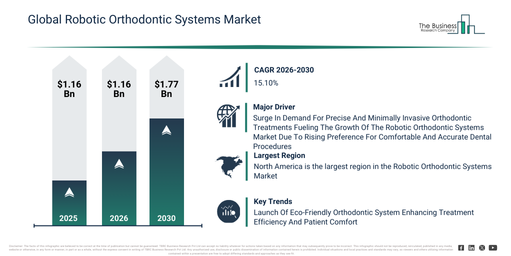
    The robotic orthodontic systems market size has experienced rapid growth in recent years. This market is projected to expand from $1.07 billion in 2025 to $1.23 billion in 2026, demonstrating a compound annual growth rate (CAGR) of 15.4%. Factors contributing to its historical growth include an increasing demand for orthodontic care, the expansion of cosmetic dentistry, the constraints of manual orthodontics, the initial adoption of digital orthodontics, and patients’ desire for quicker treatment.

    The market size for robotic orthodontic systems is projected to experience swift expansion over the coming years. This market is predicted to reach $2.16 billion by 2030, driven by a compound annual growth rate (CAGR) of 15.1%. Factors contributing to this growth during the forecast timeframe include an increase in clear aligner utilization, AI-powered dental planning, the proliferation of dental clinics, a rise in adult orthodontics, and investments in digital dentistry. Key trends anticipated during this period encompass automated precision tooth alignment, shorter orthodontic treatment durations, enhanced treatment predictability, the integration of digital treatment planning, and automated application of brackets and aligners.

    Access Your Free Sample Report For In-Depth Market Analysis:

    https://www.thebusinessresearchcompany.com/report/global-robotic-orthodontic-systems-market-report

    What Key Factors Are Affecting The Robotic Orthodontic Systems Market Demand?

    The future expansion of the robotic orthodontic systems market is anticipated to be fueled by the growing need for exact, minimally intrusive orthodontic procedures. These treatments represent advanced dental methods that accurately and gently reposition teeth, leading to minimal discomfort, less tissue harm, quicker recovery, and preservation of natural tooth structure. The uptake of precise and minimally invasive orthodontic treatments is increasing as patients show a growing preference for comfortable, quicker dental solutions offering accurate outcomes with reduced pain and shorter recovery periods. Robotic orthodontic systems facilitate these precise and minimally invasive treatments through automated, highly accurate technology, which plans and executes tooth movements with enhanced precision and less manual input. For example, data from July 2025 by the American Association of Orthodontists (AAO), a US-based professional body for orthodontists, indicated a rise in patients undergoing active orthodontic treatment per orthodontist member, from 574 in 2022 to 696 in 2024, representing a 21% increase within two years. Consequently, the escalating demand for precise, minimally invasive orthodontic interventions is a key factor propelling the expansion of the robotic orthodontic systems market.

    How Is The Robotic Orthodontic Systems Market Categorized Across Its Segment Groups?

    The robotic orthodontic systems market covered in this report is segmented –

    1) By Product Type: Fully Automated Systems, Semi-Automated Systems

    2) By Technology: Artificial Intelligence, Machine Learning, Other Technologys

    3) By Application: Clear Aligner Planning and Fabrication, Automated Bracket Placement and Bonding, Robotic Archwire Design and Bending, Digital Scanning and Treatment Simulation, Orthodontic Treatment Monitoring and Adjustment

    4) By End-User: Dental Clinics and Orthodontic Practices, Hospitals and Multi-Specialty Dental Centers, Academic and Research Institutes, Dental Service Organizations (DSOs) and Corporate Dental Chains, Orthodontic Laboratories and Digital Manufacturing Centers

    Subsegments:

    1) By Fully Automated Systems: Clear Aligner Robotics, Bracket Placement Robotics, Archwire Bending Robotics, Scanning And Imaging Robotics

    2) By Semi-Automated Systems: Assisted Bracket Positioning, Guided Tooth Movement, Hybrid Scanning Solutions

    What Trends Are Influencing Changes In The Robotic Orthodontic Systems Market?

    Leading companies active in the robotic orthodontic systems market are concentrating on developing advanced offerings, including pioneering and ecologically sound orthodontic systems, to bolster treatment effectiveness and patient comfort. An eco-friendly solution signifies a sustainable technology or method that reduces environmental impact by minimizing material waste, optimizing energy consumption, and promoting digital workflows. For example, in July 2024, Dror Ortho-Design Inc., a US-based orthodontic technology firm, introduced the ZSMILE product brand, an inventive solution that corrects smiles by straightening teeth using pulsating air delivered through a single custom-made smart aligner. This system replaces conventional multi-aligner treatments by employing advanced digital and robotic procedures to achieve precise tooth movement with a minimal environmental footprint. It offers real-time monitoring and treatment adjustments via a connected digital platform, empowering orthodontists to customize therapies efficiently while cutting down on material use and clinic visits. Integrated with Dror Ortho-Design’s intelligent orthodontic technologies, it delivers a seamless, environmentally conscious, and patient-focused orthodontic experience. The ZSMILE system improves treatment results, simplifies clinical processes, and supports the global transition towards sustainable and digital orthodontic care.

    Which Firms Are Influencing Competition In The Robotic Orthodontic Systems Market?

    Major companies operating in the robotic orthodontic systems market are Align Technology Inc., Dentsply Sirona Inc., Straumann Holding AG, Envista Holdings Corporation, Angelalign Technology Inc., Smartee Denti-Technology Co. Ltd., LightForce Orthodontics Inc., uLab Systems Inc., ArchForm Inc., Planmeca Oy, 3Shape A/S, Ormco Corporation, Henry Schein Orthodontics Inc., TP Orthodontics Inc., GC Orthodontics Inc., Great Lakes Dental Technologies, American Orthodontics Corporation, Forestadent Bernhard Förster GmbH, Dentaurum GmbH & Co. KG, Rocky Mountain Orthodontics Inc.

    Get The Full Robotic Orthodontic Systems Market Report:

    https://www.thebusinessresearchcompany.com/report/global-robotic-orthodontic-systems-market-report

    Which Region Leads The Robotic Orthodontic Systems Market In Overall Market Size?

    North America was the largest region in the robotic orthodontic systems market in 2025. Asia-Pacific is expected to be the fastest-growing region in the forecast period. The regions covered in the robotic orthodontic systems market report are Asia-Pacific, South East Asia, Western Europe, Eastern Europe, North America, South America, Middle East, Africa.

    Request A Customized Robotic Orthodontic Systems Market Report For Competitive Insights:

    https://www.thebusinessresearchcompany.com/report/global-robotic-orthodontic-systems-market-report

    Browse Through More Reports Similar to the Global Robotic Orthodontic Systems Market 2026, By The Business Research Company

    Orthopedic Surgical Robots Market Report 2026

    https://www.thebusinessresearchcompany.com/report/orthopedic-surgical-robots-global-market-report

    Prosthetics And Orthotics Market Report 2026

    https://www.thebusinessresearchcompany.com/report/prosthetics-and-orthotics-global-market-report

    Robotic Prosthetics Market Report 2026

    https://www.thebusinessresearchcompany.com/report/robotic-prosthetics-global-market-report

    Get in touch with us:

    The Business Research Company: https://www.thebusinessresearchcompany.com/

    Americas +1 310-496-7795

    Asia +44 7882 955267 & +91 8897263534

    Europe +44 7882 955267

    Email us at info@tbrc.info

    Follow us on:

    LinkedIn: https://in.linkedin.com/company/the-business-research-company

    YouTube: https://www.youtube.com/channel/UC24_fI0rV8cR5DxlCpgmyFQ

    Global Market Model: https://www.thebusinessresearchcompany.com/global-market-model
  • Robotic Endoscopy Devices Market Growth Patterns And Forecast Outlook Through 2030

    Robotic Endoscopy Devices Market Growth Patterns And Forecast Outlook Through 2030

    The Business Research Company’s 2026 market reports feature enhanced tools like market attractiveness analysis, TAM assessment, and company scoring matrices, along with interactive dashboards, deeper supply chain insights, and startup coverage strengthening the depth, usability, and strategic value of insights.

    By 2030, What Market Size Is The Robotic Endoscopy Devices Market Expected To Reach Based On Its 2026 Value?

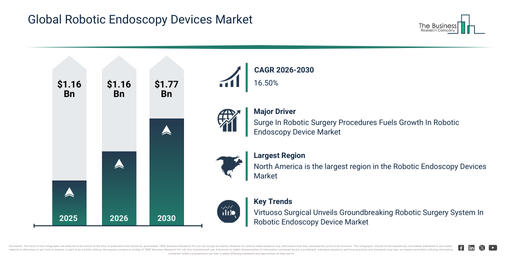
    The robotic endoscopy devices market has experienced significant expansion in recent years. This market is projected to grow from $2.96 billion in 2025 to $3.42 billion in 2026, at a compound annual growth rate (CAGR) of 15.8%. The historical growth can be attributed to several factors, including the increasing prevalence of gastrointestinal and pulmonary disorders, the rising adoption of minimally invasive diagnostic procedures, greater hospital investments in robotic platforms, the expanding clinical application of flexible endoscopy, and continuous improvements in imaging and visualization technologies.

    The robotic endoscopy devices market size is projected to experience substantial expansion over the next few years. It is predicted to reach $6.3 billion by 2030, exhibiting a compound annual growth rate (CAGR) of 16.5%. This growth throughout the forecast period can be attributed to several factors, including an escalating demand for precision diagnostics, the increasing implementation of robotic-assisted surgery platforms, the broadening availability of outpatient diagnostic procedures, a heightened focus on workflow automation within hospitals, and the growing integration of AI-based clinical decision support systems. Significant trends anticipated in the forecast period encompass a rising adoption of robot-assisted flexible endoscopy, the increasing integration of AI-guided navigation systems, an expanding demand for minimally invasive diagnostic tools, the wider application of automated imaging and biopsy capabilities, and an intensified focus on precision and operator control.

    Access Your Free Sample Report For In-Depth Market Analysis:

    https://www.thebusinessresearchcompany.com/report/robotic-endoscopy-devices-global-market-report

    Which Primary Drivers Are Impacting The Robotic Endoscopy Devices Market Growth?

    The expansion of the robotic endoscopy device market is anticipated to be fueled by the rising number of robotic surgery procedures. Robotic surgery is an advanced surgical technique employing robotic systems to assist surgeons during operations. These robotic devices are extensively utilized in endoscopy for superior maneuverability and efficiency, aiding in the simplification of complex processes by enhancing visualization, exposure, and tissue manipulation. For example, in November 2024, according to the Private Healthcare Information Network (PHIN), a UK-based government-mandated organization, increased adoption led to 22,700 robot-assisted procedures in Q1 2024. This figure indicates a 45 percent increase over the same period in 2023 and a 12 percent rise compared to the final quarter of 2023. Thus, the growing volume of robotic surgery procedures is a primary driver for the robotic endoscopy device market.

    How Are Segments Identified Within The Robotic Endoscopy Devices Market Segment Framework?

    The robotic endoscopy devices market covered in this report is segmented –

    1) By Product: Robotic Diagnostic Endoscopy Systems, Robotic-Assisted Therapeutic Endoscopy Systems

    2) By Application: Colonoscopy, Bronchoscopy, Gastrointestinal Endoscopy, Other Application

    3) By End User: Hospitals, Ambulatory Surgical Centers, Other End Users

    Subsegments:

    1) By Robotic Diagnostic Endoscopy Systems: Robotic Flexible Endoscopes, Robotic Capsule Endoscopy Systems, Robotic Imaging And Visualization Systems, Robotic Navigation And Control Platforms, Robotic Biopsy And Sampling Tools

    2) By Robotic-Assisted Therapeutic Endoscopy Systems: Robotic Endoscopic Resection Systems, Robotic Endoscopic Suturing And Closure Systems, Robotic Endoscopic Ablation Systems, Robotic Endoscopic Laser Therapy Systems, Robotic Endoscopic Stent Placement And Retrieval Systems

    Which Trends Are Shaping Growth In The Robotic Endoscopy Devices Market?

    Major companies operating in the robotic endoscopy devices market are concentrating on developing advanced technologies, such as robotic micro-manipulator endoscopic systems. These systems refer to ultra-miniaturized, robotically controlled instruments integrated at the tip of a rigid endoscope, which enable surgeons to perform highly dexterous, two-handed movements deep inside the body with millimeter-scale precision. For instance, in May 2023, Virtuoso Surgical, a US-based manufacturer of minimally invasive surgery devices, launched its new robotic surgery system. This new system employs revolutionary technology to assist surgeons in endoscopic procedures. The technology allows surgeons to utilize two hands for making dexterous movements at the end of an endoscope deep inside the body. The rigid endoscope tip of the Virtuoso Surgical system, equipped with two robotically operated, needle-sized manipulators, is less than half the diameter of a U.S. dime. The manipulators are 1mm in diameter, and the scope itself is significantly smaller than the equipment used by conventional robotic endoscopes.

    Who Are The Companies Competing Within The Robotic Endoscopy Devices Market?

    Major companies operating in the robotic endoscopy devices market are Olympus Corporation, FUJIFILM Holdings Corporation, Medtronic PLC, Boston Scientific Corporation, Karl Storz SE And Co KG, Richard Wolf GmbH, Medrobotics Corporation, EndoMaster Pte Ltd, Virtuoso Surgical Inc, ENDO Robotics Co Ltd, CapsoVision Inc, Asensus Surgical Inc, Renishaw plc, Medineering GmbH, ConMed Corporation, Ambu AS, Ovesco Endoscopy AG, Fortimedix Surgical BV, Smith And Nephew, Stryker Corporation

    Get The Full Robotic Endoscopy Devices Market Report:

    https://www.thebusinessresearchcompany.com/report/robotic-endoscopy-devices-global-market-report

    Which Region Is The Top Contributor To The Robotic Endoscopy Devices Market By Share?

    North America was the largest region in the robotic endoscopy devices market in 2025. The regions covered in the robotic endoscopy devices market report are Asia-Pacific, South East Asia, Western Europe, Eastern Europe, North America, South America, Middle East, Africa.

    Request A Customized Robotic Endoscopy Devices Market Report For Competitive Insights:

    https://www.thebusinessresearchcompany.com/report/robotic-endoscopy-devices-global-market-report

    Browse Through More Reports Similar to the Global Robotic Endoscopy Devices Market 2026, By The Business Research Company

    Endoscopy Devices And Equipment Market Report 2026

    https://www.thebusinessresearchcompany.com/report/endoscopy-devices-and-equipment-global-market-report

    Dermatology Endoscopy Devices Market Report 2026

    https://www.thebusinessresearchcompany.com/report/dermatology-endoscopy-devices-global-market-report

    Robot Assisted Endoscope Market Report 2026

    https://www.thebusinessresearchcompany.com/report/robot-assisted-endoscope-global-market-report

    Get in touch with us:

    The Business Research Company: https://www.thebusinessresearchcompany.com/

    Americas +1 310-496-7795

    Asia +44 7882 955267 & +91 8897263534

    Europe +44 7882 955267

    Email us at info@tbrc.info

    Follow us on:

    LinkedIn: https://in.linkedin.com/company/the-business-research-company

    YouTube: https://www.youtube.com/channel/UC24_fI0rV8cR5DxlCpgmyFQ

    Global Market Model: https://www.thebusinessresearchcompany.com/global-market-model
  • Robotic Biobanking Systems Market Insights On Growth Drivers, Trends, And Opportunities

    Robotic Biobanking Systems Market Insights On Growth Drivers, Trends, And Opportunities

    The Business Research Company’s 2026 market reports feature enhanced tools like market attractiveness analysis, TAM assessment, and company scoring matrices, along with interactive dashboards, deeper supply chain insights, and startup coverage strengthening the depth, usability, and strategic value of insights.

    What Is The Anticipated Rise In Market Value Of The Robotic Biobanking Systems Market During The Forecast Period?

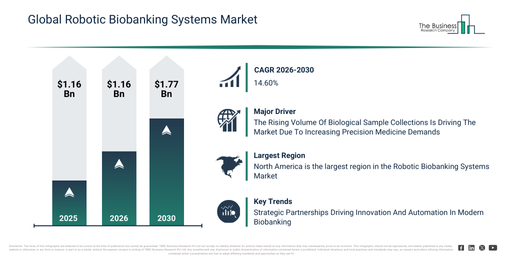
    The robotic biobanking systems market has seen rapid expansion in recent years. Its size is expected to increase from $2.3 billion in 2025 to $2.65 billion in 2026, achieving a compound annual growth rate (CAGR) of 14.9%. The historical growth in this sector was driven by an increase in clinical research samples, substantial biobank infrastructure investments, the growing demand for sample traceability, the inherent limitations of manual storage, and the initial adoption of automation.

    The market for robotic biobanking systems is projected to experience substantial expansion in the coming years. This market is set to reach $4.57 billion by 2030, exhibiting a compound annual growth rate (CAGR) of 14.6%. Key factors driving this projected growth include the advancement of precision medicine, the increasing scope of genomic studies, the proliferation of large-scale clinical trials, the adoption of digital biorepository management, and AI-powered sample analytics. Significant trends anticipated within this forecast timeframe encompass automated processes for sample storage and retrieval, improved sample traceability, efficient high-throughput biobank operations, a reduction in errors from human handling, and effective long-term sample integrity management.

    Access Your Free Sample Report For In-Depth Market Analysis:

    https://www.thebusinessresearchcompany.com/report/global-robotic-biobanking-systems-market-report

    What Significant Factors Are Influencing The Robotic Biobanking Systems Market Expansion?

    The expansion of the robotic biobanking systems market is anticipated due to the increasing volume of biological sample collections. These collections involve the systematic gathering and preservation of biological materials such as blood, tissue, saliva, or other biospecimens, along with their associated data, for use in biomedical research, diagnostics, and therapeutic development. The primary catalyst for this increased volume is the rising focus on precision medicine, as modern healthcare increasingly relies on extensive, well-characterized biospecimen repositories to support genomic research, biomarker discovery, and the creation of personalized treatment plans. Robotic biobanking systems facilitate this growth by automating the handling, storage, and retrieval of samples, thereby guaranteeing scalability, accuracy, and efficiency in managing rapidly expanding sample inventories. For instance, in July 2025, the UK Biobank Limited, a UK-based large-scale biomedical database, announced plans to relocate over 11 million samples to its new Manchester headquarters in 2026, where four next-generation automated freezers will accommodate up to 20 million samples and robotic systems will retrieve approximately 1 million samples annually, which is four times faster than current capacity. Consequently, the escalating volume of biological sample collections is propelling the growth of the robotic biobanking systems market.

    What Are The Key Segment Divisions In The Robotic Biobanking Systems Market Segment Structure?

    The robotic biobanking systems market covered in this report is segmented –

    1) By Product Type: Automated Sample Storage Systems, Automated Sample Retrieval Systems, Automated Sample Processing Systems

    2) By Sample Type: Blood, Tissue, Cells, Deoxyribonucleic Acid (DNA) Or Ribonucleic Acid (RNA)

    3) By Storage Type: Cryogenic, Ambient, Refrigerated

    4) By Application: Clinical Research, Pharmaceutical And Biotech Research, Academic And Research Institutes, Biobank Management

    5) By End-User: Hospitals, Research Institutes, Pharma And Biotech, Contract Research Organizations (CROs)

    Subsegments:

    1) By Automated Sample Storage Systems: Modular Storage Units, High-Throughput Storage Systems, Compact Storage Systems, Integrated Storage And Tracking Platforms

    2) By Automated Sample Retrieval Systems: Barcode-Based Retrieval Systems, Robotic Arm Retrieval Systems, Automated Carousel Retrieval Systems, Vertical Lift Retrieval Systems

    3) By Automated Sample Processing Systems: Automated Sample Aliquoting Systems, Automated Sample Sorting Systems, Automated Sample Labeling Systems, Automated Sample Tracking Systems

    What Trends Are Affecting The Direction Of The Robotic Biobanking Systems Market?

    Leading companies within the robotic biobanking systems market are prioritizing strategic alliances to broaden their technological scope, improve service availability, and quicken the pace of automation adoption in advanced biobanking workflows. These strategic collaborations represent advantageous partnerships forged between technology suppliers, medical establishments, and research bodies, designed to harness complementary strengths to propel innovation, refine operational effectiveness, and enlarge market footprint. For example, in October 2025, Abu Dhabi Biobank, a UAE-based hybrid cord blood bank, partnered with NMC Healthcare, a UAE-based healthcare provider, with the objective of widening access to both private and public cord blood banking services throughout key hospitals in the region. This initiative supports personalized healthcare and advances stem cell research through the integration of robotic and automated biobanking systems. The alliance aims to establish one of the largest regional repositories for cord blood samples, underpinned by sophisticated robotic handling and long-term automated storage technologies. Furthermore, it seeks to raise awareness and educate the public about the advantages of cord blood preservation, empowering families to contribute to future-ready biomedical research and regenerative medicine endeavors.

    Which Organizations Are Engaged In The Robotic Biobanking Systems Market?

    Major companies operating in the robotic biobanking systems market are Thermo Fisher Scientific Inc., Beckman Coulter Inc., Tecan Group Ltd., Hamilton Company, Azenta Life Sciences, Haier Biomedical Co., BICO, SPT Labtech Ltd., HighRes Biosolutions Inc., LiCONiC AG, ASKION GmbH, Angelantoni Life Science Srl, SciRobotics Ltd., MGI Tech Co. Ltd., B Medical Systems S.a.r.l, Sakura Finetek Japan Co. Ltd., Panasonic Healthcare Co. Ltd., Brooks Automation Inc., Labcyte Inc., RTS Life Science Ltd., Kriosystem Life Sciences S.r.l.

    Get The Full Robotic Biobanking Systems Market Report:

    https://www.thebusinessresearchcompany.com/report/global-robotic-biobanking-systems-market-report

    Which Region Represents The Largest Share Of The Robotic Biobanking Systems Market?

    North America was the largest region in the robotic biobanking systems market in 2025. Asia-Pacific is expected to be the fastest-growing region in the forecast period. The regions covered in the robotic biobanking systems market report are Asia-Pacific, South East Asia, Western Europe, Eastern Europe, North America, South America, Middle East, Africa.

    Request A Customized Robotic Biobanking Systems Market Report For Competitive Insights:

    https://www.thebusinessresearchcompany.com/report/global-robotic-biobanking-systems-market-report

    Browse Through More Reports Similar to the Global Robotic Biobanking Systems Market 2026, By The Business Research Company

    Medical Robots Market Report 2026

    https://www.thebusinessresearchcompany.com/report/medical-robots-global-market-report

    Robotic Process Automation In Healthcare Market Report 2026

    https://www.thebusinessresearchcompany.com/report/robotic-process-automation-in-healthcare-global-market-report

    Artificial Intelligence Ai In Biopharmaceuticals Market Report 2026

    https://www.thebusinessresearchcompany.com/report/artificial-intelligence-ai-in-biopharmaceuticals-global-market-report

    Get in touch with us:

    The Business Research Company: https://www.thebusinessresearchcompany.com/

    Americas +1 310-496-7795

    Asia +44 7882 955267 & +91 8897263534

    Europe +44 7882 955267

    Email us at info@tbrc.info

    Follow us on:

    LinkedIn: https://in.linkedin.com/company/the-business-research-company

    YouTube: https://www.youtube.com/channel/UC24_fI0rV8cR5DxlCpgmyFQ

    Global Market Model: https://www.thebusinessresearchcompany.com/global-market-model
  • Robot-Assisted Percutaneous Coronary Intervention (PCI) Market Developments Shaping Growth Across The Forecast Period

    Robot-Assisted Percutaneous Coronary Intervention (PCI) Market Developments Shaping Growth Across The Forecast Period

    The Business Research Company’s 2026 market reports feature enhanced tools like market attractiveness analysis, TAM assessment, and company scoring matrices, along with interactive dashboards, deeper supply chain insights, and startup coverage strengthening the depth, usability, and strategic value of insights.

    How Is The Market Size Of The Robot-Assisted Percutaneous Coronary Intervention (PCI) Market Expected To Scale Between 2026 And 2030?

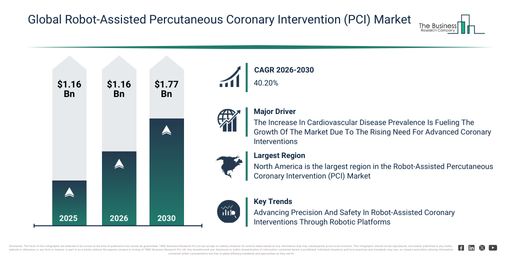
    The robot-assisted percutaneous coronary intervention (pci) market has experienced substantial expansion in recent years. This market is set to increase from $27.56 billion in 2025 to $38.73 billion in 2026, achieving a compound annual growth rate (CAGR) of 40.5%. The historical growth of this market can be attributed to the rising prevalence of coronary artery disease, the inherent limitations of manual pci precision, the increasing adoption of catheter-based interventions, heightened awareness regarding radiation risks, and the proliferation of cardiac catheterization labs.

    The market size for robot-assisted percutaneous coronary intervention (PCI) is anticipated to experience considerable growth in the upcoming years. It is projected to expand to $149.68 billion by 2030, exhibiting a compound annual growth rate (CAGR) of 40.2%. This growth during the forecast period can be attributed to advancements in robotic-assisted intervention technologies, a rising adoption of automation within cardiology, increasing investments in digital healthcare infrastructure, growing demand for complex and high-risk PCI procedures, and supportive regulatory approvals for robotic systems. Significant trends in the forecast period include a rising uptake of minimally invasive cardiac procedures, an increasing focus on reducing radiation exposure for clinicians, a growing demand for precision and procedural accuracy, the expansion of complex coronary intervention capabilities, and improved patient safety and clinical outcomes.

    Access Your Free Sample Report For In-Depth Market Analysis:

    https://www.thebusinessresearchcompany.com/report/robot-assisted-percutaneous-coronary-intervention-pci-global-market-report

    Which Important Drivers Are Guiding The Robot-Assisted Percutaneous Coronary Intervention (PCI) Market Growth?

    The future expansion of the robot-assisted percutaneous coronary intervention (PCI) market is anticipated to be driven by the rising occurrence of cardiovascular diseases. These conditions involve the heart and blood vessels, encompassing ailments such as coronary artery disease, heart attacks, and stroke. The surge in cardiovascular diseases is largely attributed to inactive lifestyles, which contribute to obesity, hypertension, and poorer heart health. Robot-assisted percutaneous coronary intervention (PCI) addresses cardiovascular diseases by precisely reopening blocked or narrowed coronary arteries to restore blood flow to the heart, while also minimizing procedural risks and radiation exposure, thereby improving patient outcomes. For instance, in December 2024, GOV.UK, a UK-based government agency, reported that in March 2024, nearly 2.24 million adults in England—about 4.4% of those aged 18 and over—had a GP-recorded diagnosis of CKD. This marked an increase from 2.09 million cases the previous year. Consequently, the increasing prevalence of cardiovascular diseases is stimulating the growth of the robot-assisted percutaneous coronary intervention (PCI) market.

    Which Segment Categories Are Included In The Robot-Assisted Percutaneous Coronary Intervention (PCI) Market Segment Analysis?

    The robot-assisted percutaneous coronary intervention (pci) market covered in this report is segmented –

    1) By Component: Robotic Systems, Catheters And Guidewires, Control Consoles

    2) By Application: Coronary Angioplasty, Stent Placement, Thrombectomy

    3) By End-User: Hospitals, Cardiac Catheterization Laboratories, Ambulatory Surgical Centers, Other End-Users

    Subsegments:

    1) By Robotic Systems: Electromechanical Robotic Arms, Imaging Integration Units, Robotic Drive Systems

    2) By Catheters And Guidewires: Coronary Guidewires, Balloon Catheters, Drug-Eluting Catheters

    3) By Control Consoles: Touchscreen Interfaces, Joystick Controllers, Imaging Display Panels

    What Trends Are Influencing The Evolution Of The Robot-Assisted Percutaneous Coronary Intervention (PCI) Market?

    Leading companies in the robot-assisted percutaneous coronary intervention (PCI) market are concentrating on developing sophisticated robotic cardiologist platforms to improve patient safety and streamline complex coronary interventions. A robotic cardiology platform is a high-tech system that assists cardiologists in performing precise and controlled coronary procedures, enhancing accuracy, minimizing human error, and reducing radiation exposure for both patients and medical personnel. For example, in May 2023, Robocath SAS, a France-based company specializing in robotic solutions for vascular interventions, introduced the R-One+. This advanced robotic solution enables interventional cardiologists to perform coronary angioplasties (percutaneous coronary intervention, or PCI) by manipulating devices through an integrated command unit located either in the catheterization lab or a control room. The R-One+ improves precision in device handling, enhances safety for both patients and medical staff by lowering radiation exposure, and offers more comfortable working conditions for operators. The launch took place at the EuroPCR conference in Paris, where the platform showcased new features designed to make PCI procedures simpler and safer, while also protecting the cardiology team from radiation-induced injuries. This innovation highlights Robocath’s commitment to enhancing cardiovascular disease treatments with intelligent robotic assistance.

    Who Are The Active Companies Shaping The Robot-Assisted Percutaneous Coronary Intervention (PCI) Market?

    Major companies operating in the robot-assisted percutaneous coronary intervention (pci) market are Medtronic plc, Siemens Healthineers AG, Boston Scientific Corporation, Intuitive Surgical, BIOTRONIK SE & Co. KG, MicroPort Scientific Corporation, Biosensors International Group Ltd., OrbusNeich Medical Group Holdings Limited, Stereotaxis Inc., Perfint Healthcare, Robocath Inc., Meril Life Sciences Pvt. Ltd., Abbott Laboratories, Philips Healthcare, Terumo Corporation, Asahi Intecc, Catheter Precision, Cardiobot, Remedics, meerecompany Inc., AngioDynamics, Clear Surgical Inc., GE Healthcare, Canon Medical Systems, Asensus Surgical, Endovascular Robotics

    Get The Full Robot-Assisted Percutaneous Coronary Intervention (PCI) Market Report:

    https://www.thebusinessresearchcompany.com/report/robot-assisted-percutaneous-coronary-intervention-pci-global-market-report

    Which Geographic Region Dominates The Robot-Assisted Percutaneous Coronary Intervention (PCI) Market?

    North America was the largest region in the robot-assisted percutaneous coronary intervention (PCI) market in 2025. Asia-Pacific is expected to be the fastest-growing region in the forecast period. The regions covered in the robot-assisted percutaneous coronary intervention (pci) market report are Asia-Pacific, South East Asia, Western Europe, Eastern Europe, North America, South America, Middle East, Africa.

    Request A Customized Robot-Assisted Percutaneous Coronary Intervention (PCI) Market Report For Competitive Insights:

    https://www.thebusinessresearchcompany.com/report/robot-assisted-percutaneous-coronary-intervention-pci-global-market-report

    Browse Through More Reports Similar to the Global Robot-Assisted Percutaneous Coronary Intervention (PCI) Market 2026, By The Business Research Company

    Post Consumer Recycled Plastics Market Report 2026

    https://www.thebusinessresearchcompany.com/report/post-consumer-recycled-plastics-global-market-report

    Plastic Recycling Market Report 2026

    https://www.thebusinessresearchcompany.com/report/plastic-recycling-global-market-report

    Asphalt Shingles Market Report 2026

    https://www.thebusinessresearchcompany.com/report/asphalt-shingles-global-market-report

    Get in touch with us:

    The Business Research Company: https://www.thebusinessresearchcompany.com/

    Americas +1 310-496-7795

    Asia +44 7882 955267 & +91 8897263534

    Europe +44 7882 955267

    Email us at info@tbrc.info

    Follow us on:

    LinkedIn: https://in.linkedin.com/company/the-business-research-company

    YouTube: https://www.youtube.com/channel/UC24_fI0rV8cR5DxlCpgmyFQ

    Global Market Model: https://www.thebusinessresearchcompany.com/global-market-model