Category: Medical Equipment

  • Lung Cancer Surgery Equipment Market Growth Expected To Reach $5.09 Billion By 2030 At 6.4% CAGR

    Lung Cancer Surgery Equipment Market Growth Expected To Reach $5.09 Billion By 2030 At 6.4% CAGR

    The Business Research Company’s 2026 market reports feature enhanced tools like market attractiveness analysis, TAM assessment, and company scoring matrices, along with interactive dashboards, deeper supply chain insights, and startup coverage strengthening the depth, usability, and strategic value of insights.

    What Is The Estimated Market Size Of The Lung Cancer Surgery Equipment Market In 2026, And How Will Its Value Evolve By 2030?

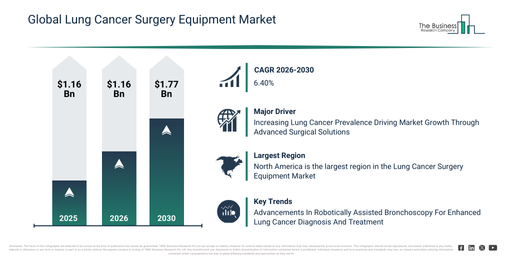
    The lung cancer surgery equipment market size has experienced significant expansion in recent years. It is anticipated to increase from $3.73 billion in 2025 to $3.98 billion in 2026, at a compound annual growth rate (CAGR) of 6.7%. The market’s historical development can be linked to factors such as the limited availability of advanced thoracic surgery equipment, the reliance on traditional open surgeries, the increasing prevalence of lung cancer, a rising number of hospital and surgical clinics, and the adoption of standard biopsy and imaging procedures.

    Significant expansion is anticipated for the lung cancer surgery equipment market over the coming years. Projections indicate its value will reach $5.1 billion by 2030, demonstrating a compound annual growth rate (CAGR) of 6.4%. This projected increase is linked to several factors, including advancements in robotic-assisted and minimally invasive surgical instruments, the incorporation of AI-powered imaging and monitoring systems, increased funding in research and academic institutions, the wider acceptance of enhanced recovery after surgery (ERAS) guidelines, and the establishment of more specialized lung cancer treatment facilities. Key developments expected during this period involve a greater embrace of minimally invasive lung procedures, an escalating need for sophisticated imaging and diagnostic apparatus, the merging of patient monitoring technologies with surgical tools, an intensified emphasis on post-operative recovery and subsequent care, and the broadening application of robotic-assisted thoracic surgeries.

    Access Your Free Sample Report For In-Depth Market Analysis:

    https://www.thebusinessresearchcompany.com/report/lung-cancer-surgery-equipment-global-market-report

    What Key Factors Are Shaping The Lung Cancer Surgery Equipment Market Landscape?

    The escalating prevalence of lung cancer is anticipated to propel the expansion of the lung cancer surgery equipment market. This condition involves the unchecked proliferation of abnormal cells within the lungs, often stemming from smoking or detrimental environmental contact. The increase in lung cancer diagnoses is primarily attributed to heightened exposure to risk factors including tobacco smoke, air pollution, and occupational carcinogens, alongside an aging demographic. Such equipment serves to diagnose the disease, remove cancerous tissue, and assist in post-operative care by means of precise surgical procedures and patient surveillance. As an illustration, the Cancer Council, an Australia-based non-profit organization, reported in February 2025 that approximately 15,122 individuals were diagnosed with lung cancer in Australia during 2024, with the average age at diagnosis recorded as 72. In the country, lung cancer stands as the fifth most frequently diagnosed cancer, and it is estimated that one in 20 Australians will receive such a diagnosis by the age of 85. Consequently, the increasing prevalence of lung cancer is fueling the expansion of the lung cancer surgery equipment market.

    How Is The Lung Cancer Surgery Equipment Market Organized By Segment Classification?

    The lung cancer surgery equipment market covered in this report is segmented –

    1) By Product Type: Surgical Instruments, Access Devices, Imaging Equipment, Electrosurgical Devices, Biopsy Devices, Patient Monitoring Equipment

    2) By Surgery Type: Lobectomy Surgery, Pneumonectomy Surgery, Wedge Resection, Video-Assisted Thoracoscopic Surgery (VATS), Robotic-Assisted Surgery

    3) By Application: Diagnosis, Treatment, Aftercare And Rehabilitation

    4) By End User: Hospitals, Surgical Clinics, Ambulatory Surgical Centers, Research And Academic Institutes

    Subsegments:

    1) By Surgical Instruments: Scalpels, Forceps, Retractors, Scissors, Sutures

    2) By Access Devices: Trocars, Catheters, Guidewires, Introducers

    3) By Imaging Equipment: CT Scanners, MRI Machines, PET Scanners, X-Ray Systems, Ultrasound Devices

    4) By Electrosurgical Devices: Electrosurgical Generators, Electrosurgical Probes, Electrosurgical Electrodes, Smoke Evacuation Systems

    5) By Biopsy Devices: Needle Biopsy Devices, Core Biopsy Devices, Vacuum-Assisted Biopsy Devices, Endoscopic Biopsy Devices

    6) By Patient Monitoring Equipment: Pulse Oximeters, ECG Monitors, Respiratory Monitors, Blood Pressure Monitors, Temperature Monitors

    What Market Trends Are Affecting The Lung Cancer Surgery Equipment Market?

    Leading companies operating in the lung cancer surgery equipment market are directing their efforts toward creating devices for robotically assisted bronchoscopy. This initiative seeks to improve the precision and safety of tumor localization and biopsy, enhance access to hard-to-reach lung nodules, and aid in the early and accurate diagnosis of lung cancer. Robotically assisted bronchoscopy is an advanced medical procedure that employs robotic technology to guide a bronchoscope, a thin, flexible tube, into the lungs with greater exactness and oversight compared to conventional manual methods. For instance, in March 2025, Johnson and Johnson, a US-based pharmaceutical company, announced that its MONARCH QUEST system, an advanced robotic-assisted bronchoscopy technology, had been granted U.S. FDA 510(k) clearance. This system represents the newest iteration of the MONARCH Platform, which is designed to improve the diagnosis of lung cancer using minimally invasive procedures. The system connects with the GE HealthCare OEC 3D mobile CBCT Imaging System, enabling real-time, intraprocedural 3D imaging. This integration enhances the precision of targeting lung nodules, especially those located in hard-to-reach areas of the lung.

    Who Are The Industry Participants Involved In The Lung Cancer Surgery Equipment Market?

    Major companies operating in the lung cancer surgery equipment market are Johnson & Johnson, Medtronic plc, Siemens Healthcare AG, Fujifilm Limited, GE Healthcare Technologies Inc, Boston Scientific Corporation, Olympus Corporation, Intuitive Surgical Inc, Teleflex Incorporated, KARL STORZ GmbH & Co KG, Integra LifeSciences Corporation, Richard Wolf GmbH, Angiodynamics Inc, B Braun Melsungen AG, Sontec Instruments Inc, Novadaq Technologies Inc, Stryker Corporation, CONMED Corporation, Smith & Nephew plc, Ambu A S

    Get The Full Lung Cancer Surgery Equipment Market Report:

    https://www.thebusinessresearchcompany.com/report/lung-cancer-surgery-equipment-global-market-report

    Which Region Is The Leading Market For The Lung Cancer Surgery Equipment Market?

    North America was the largest region in the lung cancer surgery equipment market in 2025. Asia-Pacific is expected to be the fastest-growing region in the forecast period. The regions covered in the lung cancer surgery equipment market report are Asia-Pacific, South East Asia, Western Europe, Eastern Europe, North America, South America, Middle East, Africa.

    Request A Customized Lung Cancer Surgery Equipment Market Report For Competitive Insights:

    https://www.thebusinessresearchcompany.com/report/lung-cancer-surgery-equipment-global-market-report

    Browse Through More Reports Similar to the Global Lung Cancer Surgery Equipment Market 2026, By The Business Research Company

    Lung Cancer Drugs Market Report 2026

    https://www.thebusinessresearchcompany.com/report/lung-cancer-drugs-global-market-report

    Thoracic Surgery Devices Market Report 2026

    https://www.thebusinessresearchcompany.com/report/thoracic-surgery-devices-global-market-report

    Surgical Equipment Market Report 2026

    https://www.thebusinessresearchcompany.com/report/surgical-equipment-global-market-report

    Get in touch with us:

    The Business Research Company: https://www.thebusinessresearchcompany.com/

    Americas +1 310-496-7795

    Asia +44 7882 955267 & +91 8897263534

    Europe +44 7882 955267

    Email us at info@tbrc.info

    Follow us on:

    LinkedIn: https://in.linkedin.com/company/the-business-research-company

    YouTube: https://www.youtube.com/channel/UC24_fI0rV8cR5DxlCpgmyFQ

    Global Market Model: https://www.thebusinessresearchcompany.com/global-market-model

  • Lumbar Disc Replacement Devices Market Forecast 2026–2030 Highlighting Expansion Across Industries

    Lumbar Disc Replacement Devices Market Forecast 2026–2030 Highlighting Expansion Across Industries

    The Business Research Company’s 2026 market reports feature enhanced tools like market attractiveness analysis, TAM assessment, and company scoring matrices, along with interactive dashboards, deeper supply chain insights, and startup coverage strengthening the depth, usability, and strategic value of insights.

    How Does The Market Size Of The Lumbar Disc Replacement Devices Market Compare Between 2026 And 2030?

    Recently, the lumbar disc replacement devices market size has experienced significant expansion. It is anticipated to increase from $1.3 billion in 2025 to $1.47 billion in 2026, at a compound annual growth rate (CAGR) of 13.1%. The growth observed in prior periods stemmed from factors such as the rising prevalence of degenerative disc disease, an uptick in spinal injury incidents, the proliferation of orthopedic surgical centers, increased adoption of disc replacement procedures, and the accessibility of advanced implant materials.

    The lumbar disc replacement devices market is anticipated to undergo substantial growth in the next few years, with projections indicating it will reach $2.39 billion in 2030, at a compound annual growth rate (CAGR) of 12.9%. This expansion over the forecast period is fueled by an increasing demand for motion-preserving surgical solutions, rising adoption of personalized implants, the expanding aging population base, growing investments in spinal biomechanics research, and an increasing preference for alternatives to spinal fusion. Key developments during this period are expected to include the increasing adoption of motion-preserving spine implants, rising demand for minimally invasive spine procedures, growing use of advanced biocompatible materials, expansion of personalized spinal implant designs, and an enhanced focus on long-term mobility outcomes.

    Access Your Free Sample Report For In-Depth Market Analysis:

    https://www.thebusinessresearchcompany.com/report/lumbar-disc-replacement-devices-global-market-report

    Which Factors Are Influencing The Growth Of The Lumbar Disc Replacement Devices Market?

    The escalating occurrence of spinal disorders is projected to fuel the expansion of the lumbar disc replacement devices market in the coming years. These conditions encompass various affections of the spine, such as abnormalities, injuries, or diseases that affect vertebrae, discs, nerves, and adjacent tissues, frequently resulting in discomfort, restricted movement, or other health issues. The heightened incidence of spinal disorders stems from factors including aging demographics, inactive lifestyles, excess weight, and a greater frequency of degenerative conditions like osteoarthritis and herniated discs. Lumbar disc replacement devices assist in managing spinal disorders by restoring flexibility and reducing pain for individuals with degenerative disc disease, serving as a viable substitute for conventional spinal fusion procedures. For example, in April 2024, the World Health Organization, an intergovernmental body based in Switzerland, reported that over 15 million people globally are affected by spinal cord injuries (SCI). Consequently, the growing prevalence of spinal disorders is boosting the growth of the lumbar disc replacement devices market.

    lumbar disc replacement devices Market Driver: Expansion of Healthcare Infrastructure Boosting Adoption of Advanced Medical Procedures due to Increased Investments and Spending

    The growth in healthcare infrastructure is anticipated to drive the expansion of the lumbar disc replacement devices market moving ahead. This refers to the system of hospitals, clinics, diagnostic facilities, and other medical support centers that ensure the population has access to high-quality healthcare services. The expansion of healthcare infrastructure is fueled by increasing investments from both government and private sectors, a rising population, and a greater need for sophisticated medical care. Enhanced infrastructure facilitates the integration of new medical technologies, improves patient access to care, and boosts the effectiveness of healthcare provision. For instance, in May 2023, a report from the UK-based government department, the Office for National Statistics, indicated that healthcare spending in the UK grew by 5.6% between 2022 and 2023, a notable increase compared to the 0.9% growth seen in 2022. Hence, the expansion of healthcare infrastructure is propelling the growth in the lumbar disc replacement devices market.

    Which Segments Define The Lumbar Disc Replacement Devices Market Segment Structure?

    The lumbar disc replacement devices market covered in this report is segmented –

    1) By Product: Metal-On-Metal, Metal-On-Biopolymer

    2) By Pain Type: Chronic, Acute, Radicular, Other Pain Types

    3) By End-User: Hospitals, Ambulatory Surgical Center, Other End Users

    Subsegments:

    1) By Metal-On-Metal: Cobalt-Chromium Alloy, Titanium Alloy

    2) By Metal-On-Biopolymer: Metal-On-PEEK (Polyether Ether Ketone), Metal-On-Polymer Composite

    Which Trends Are Influencing Demand In The Lumbar Disc Replacement Devices Market?

    Leading companies within the lumbar disc replacement devices market are concentrating on integrating sophisticated technologies, such as numerical code technology, to advance lumbar total disc replacement procedures. Numerical code technology involves utilizing specialized algorithms and computational models to simulate and optimize the design, performance, and implantation processes of medical devices, including lumbar disc replacement devices, thereby enhancing their precision and effectiveness in clinical applications. For example, in January 2023, the American Medical Association, a professional organization located in the US, issued a Current Procedural Terminology (CPT) code for the second level of lumbar total disc replacement (TDR) procedures. Centinel Spine LLC, a US-based medical equipment manufacturing firm, adopted this code to improve access to two-level lumbar TDR procedures. This initiative is vital for broadening the treatment alternatives available to patients, ultimately fostering superior clinical outcomes and more efficient healthcare delivery.

    Who Are The Established Players Within The Lumbar Disc Replacement Devices Market?

    Major companies operating in the lumbar disc replacement devices market are Medtronic Inc., Stryker Corporation, Zimmer Biomet Holdings Inc., NuVasive Inc., Globus Medical Inc., Orthofix International NV, Medacta International, Aesculap Inc., Alphatec Spine Inc., Paradigm Spine GmbH, B. Braun Melsungen AG, Neoflex Spine Inc., Centinel Spine Inc., Spineart SA, DePuy Synthes, AxioMed LLC, Spinal Stabilization Technologies LLC, NEURO FRANCE Implants SARL, SINTX Technologies Inc., SIGNUS Medizintechnik GmbH

    Get The Full Lumbar Disc Replacement Devices Market Report:

    https://www.thebusinessresearchcompany.com/report/lumbar-disc-replacement-devices-global-market-report

    Where Is The Lumbar Disc Replacement Devices Market Primarily Concentrated By Region?

    North America was the largest region in the lumbar disc replacement devices market in 2025. The regions covered in the lumbar disc replacement devices market report are Asia-Pacific, South East Asia, Western Europe, Eastern Europe, North America, South America, Middle East, Africa.

    Request A Customized Lumbar Disc Replacement Devices Market Report For Competitive Insights:

    https://www.thebusinessresearchcompany.com/report/lumbar-disc-replacement-devices-global-market-report

    Browse Through More Reports Similar to the Global Lumbar Disc Replacement Devices Market 2026, By The Business Research Company

    Spinal Surgery Devices And Equipment Market Report 2026

    https://www.thebusinessresearchcompany.com/report/spinal-surgery-devices-and-equipment-global-market-report

    Degenerative Disc Disease Treatment Market Report 2026

    https://www.thebusinessresearchcompany.com/report/degenerative-disc-disease-treatment-global-market-report

    Spine Implants Market Report 2026

    https://www.thebusinessresearchcompany.com/report/spine-implants-global-market-report

    Get in touch with us:

    The Business Research Company: https://www.thebusinessresearchcompany.com/

    Americas +1 310-496-7795

    Asia +44 7882 955267 & +91 8897263534

    Europe +44 7882 955267

    Email us at info@tbrc.info

    Follow us on:

    LinkedIn: https://in.linkedin.com/company/the-business-research-company

    YouTube: https://www.youtube.com/channel/UC24_fI0rV8cR5DxlCpgmyFQ

    Global Market Model: https://www.thebusinessresearchcompany.com/global-market-model
  • Global Low Vision Electronic Visual Aids Market Analysis For 2026–2030 With Strategic Insights

    Global Low Vision Electronic Visual Aids Market Analysis For 2026–2030 With Strategic Insights

    The Business Research Company’s 2026 market reports feature enhanced tools like market attractiveness analysis, TAM assessment, and company scoring matrices, along with interactive dashboards, deeper supply chain insights, and startup coverage strengthening the depth, usability, and strategic value of insights.

    What Is The Forecasted Market Size Trajectory Of The Low Vision Electronic Visual Aids Market From 2026 To 2030?

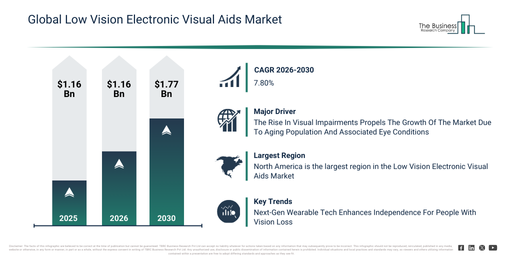
    The market size for low vision electronic visual aids has seen robust expansion in recent years. It is projected to expand from $1.25 billion in 2025 to $1.35 billion in 2026, achieving a compound annual growth rate (CAGR) of 8.0%. This historical market growth can be ascribed to factors such as the rising prevalence of visual impairments, the limited availability of affordable visual aids, increasing awareness regarding low vision aids, advancements in optical magnification technologies, and an expanding geriatric population.

    The low vision electronic visual aids market is projected to experience robust expansion in the coming years. This market is set to reach $1.82 billion by 2030, driven by a compound annual growth rate (CAGR) of 7.8%. The anticipated growth during this period stems from factors such as technological integration with AI and IoT, a rising demand for portable and wearable devices, supportive government programs, increased use in educational settings, and the expansion of e-commerce channels for distribution. Key trends expected throughout the forecast period involve the uptake of wearable low vision devices, the miniaturization of electronic magnifiers, visual assistance controlled by voice, seamless integration with smart home systems, and the development of personalized vision enhancement solutions.

    Access Your Free Sample Report For In-Depth Market Analysis:

    https://www.thebusinessresearchcompany.com/report/low-vision-electronic-visual-aids-global-market-report

    What Leading Drivers Are Supporting The Low Vision Electronic Visual Aids Market Expansion?

    The expansion of the low vision electronic visual aids market is anticipated to be driven by the increasing incidence of visual impairments. Visual impairments encompass various conditions of vision loss that standard corrective measures like glasses, contact lenses, medicine, or surgery cannot completely rectify, impacting an individual’s visual clarity. This rise in visual impairments is largely attributed to the aging global demographic, given that age-related ocular conditions such as macular degeneration, cataracts, and glaucoma become more prevalent with advancing age. Low-vision electronic visual aids assist those with visual impairments by improving their residual vision through features like magnification, contrast adjustments, and digital image processing, thereby fostering greater autonomy in their daily routines. For example, as reported by the World Health Organization, a specialized United Nations agency based in Switzerland, in August 2023, a staggering 2.2 billion individuals worldwide experience a near or distance vision impairment. Despite this, estimates indicate that only 36% of people with distance vision impairment stemming from refractive errors and merely 17% of those with vision impairment caused by cataracts have accessed suitable treatment. Consequently, the growing occurrence of visual impairments is acting as a significant catalyst for the expansion of the low vision electronic visual aids market.

    How Is The Low Vision Electronic Visual Aids Market Segmented Across Different Segment Categories?

    The low vision electronic visual aids market covered in this report is segmented –

    1) By Type: Portable Electronic Magnifiers, Closed Circuit Television, Voice Readers, Other Types

    2) By Technology: Optical Devices, Electronic Magnifiers, Text-to-Speech Devices, Speech Recognition Systems

    3) By Application: Reading Assistance, Navigation Assistance, Social Interaction And Communication, Entertainment

    4) By Distribution Channel: Online Retail, Specialty Stores, Optical Stores, Other Distribution Channels

    5) By End-User: Individuals, Hospitals And Clinics, Rehabilitation Centers, Educational Institutions

    Subsegments:

    1) By Portable Electronic Magnifiers: Handheld Magnifiers, Stand Magnifiers, Wearable Magnifiers, Digital Magnifier Tablets

    2) By Closed Circuit Television: Desktop Closed Circuit Television Systems, Transportable Closed Circuit Television Systems, Wearable Closed Circuit Television Devices, Closed Circuit Television With Text-To-Speech Integration

    3) By Voice Readers: Screen Readers, Book Readers, Optical Character Recognition-Based Readers, Smart Audio Assistants For Reading

    4) By Other Types: Braille Notetakers, Smart Glasses, Screen Magnification Software, Navigation Aids

    What Emerging Trends Are Seen In The Low Vision Electronic Visual Aids Market?

    Leading companies in the low vision electronic visual aids market are concentrating on developing innovative solutions, such as artificial intelligence-powered wearable smart glasses, to enhance real-time visual interpretation and user independence. Artificial intelligence-powered wearable smart glasses are sophisticated electronic visual aids that utilize AI-driven image processing, object recognition, and voice output to help individuals with low vision perceive and interact with their surroundings more effectively. For instance, in August 2024, Eyedaptic Inc., a US-based medical technology company, introduced EYE6 with Ivy, a next-generation wearable visual assistant tailored for individuals with age-related macular degeneration and other retinal disorders. These lightweight smart glasses integrate advanced vision enhancement with an AI-powered assistant named Ivy. It can read text, identify objects, describe surroundings, and support users in 99 languages to promote greater independence. Featuring full HD 1080p displays, hands-free voice control, and remote upgrade capabilities, the EYE6 offers a seamless, customizable user experience for people with low vision conditions.

    Which Organizations Play A Role In The Low Vision Electronic Visual Aids Market Landscape?

    Major companies operating in the low vision electronic visual aids market are Eschenbach Optik GmbH, Vispero, HumanWare Group, Freedom Scientific Inc., IrisVision Global Inc., VisionAid International Ltd., Zoomax Technology Co. Ltd., HIMS Inc., LS And S Products Inc., CTECH Low Vision And Blindness Solutions, Low Vision International AB, NuEyes Technologies Inc., Optelec U.S. Inc., Reinecker Vision GmbH, OrCam Technologies Ltd., Enhanced Vision, Dolphin Computer Access, Acesight, Eyedaptic Inc., eSight Corporation, Eurobraille, Help Tech GmbH & Co. KG

    Get The Full Low Vision Electronic Visual Aids Market Report:

    https://www.thebusinessresearchcompany.com/report/low-vision-electronic-visual-aids-global-market-report

    Which Region Has The Greatest Market Share In The Low Vision Electronic Visual Aids Market?

    North America was the largest region in the low vision electronic visual aids market in 2025. Asia-Pacific is expected to be the fastest-growing region in the forecast period. The regions covered in the low vision electronic visual aids market report are Asia-Pacific, South East Asia, Western Europe, Eastern Europe, North America, South America, Middle East, Africa.

    Request A Customized Low Vision Electronic Visual Aids Market Report For Competitive Insights:

    https://www.thebusinessresearchcompany.com/report/low-vision-electronic-visual-aids-global-market-report

    Browse Through More Reports Similar to the Global Low Vision Electronic Visual Aids Market 2026, By The Business Research Company

    Night Vision Devices Market Report 2026

    https://www.thebusinessresearchcompany.com/report/night-vision-devices-global-market-report

    Assistive Technologies For Visually Impaired Market Report 2026

    https://www.thebusinessresearchcompany.com/report/assistive-technologies-for-visually-impaired-global-market-report

    Computer Vision Market Report 2026

    https://www.thebusinessresearchcompany.com/report/computer-vision-global-market-report

    Get in touch with us:

    The Business Research Company: https://www.thebusinessresearchcompany.com/

    Americas +1 310-496-7795

    Asia +44 7882 955267 & +91 8897263534

    Europe +44 7882 955267

    Email us at info@tbrc.info

    Follow us on:

    LinkedIn: https://in.linkedin.com/company/the-business-research-company

    YouTube: https://www.youtube.com/channel/UC24_fI0rV8cR5DxlCpgmyFQ

    Global Market Model: https://www.thebusinessresearchcompany.com/global-market-model
  • Low Vision Electronic Glasses Market Outlook 2026–2030 Driven By Growth Factors And Projections

    Low Vision Electronic Glasses Market Outlook 2026–2030 Driven By Growth Factors And Projections

    The Business Research Company’s 2026 market reports feature enhanced tools like market attractiveness analysis, TAM assessment, and company scoring matrices, along with interactive dashboards, deeper supply chain insights, and startup coverage strengthening the depth, usability, and strategic value of insights.

    How Much Will The Market Value Of The Low Vision Electronic Glasses Market Grow Between 2026 And 2030?

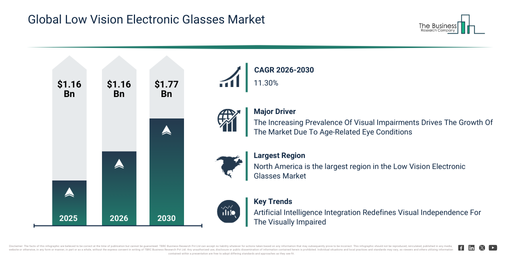
    The low vision electronic glasses market size has experienced swift expansion in recent years. It is projected to grow from $0.97 billion in 2025 to $1.08 billion in 2026, achieving a compound annual growth rate (CAGR) of 11.6%. The expansion during the historic period is attributable to an increasing prevalence of visual impairments, technological limitations in traditional optical aids, the elevated cost of initial devices, limited awareness of low vision aids, and a shortage of trained professionals.

    The low vision electronic glasses market is projected to experience substantial expansion in the coming years. This market is anticipated to reach $1.66 billion by 2030, exhibiting a compound annual growth rate (CAGR) of 11.3%. This projected growth is driven by several factors, including developments in AI-powered vision enhancement, the incorporation of AR/VR for more immersive experiences, decreased device expenses due to large-scale manufacturing, rising usage among the elderly, and an increased emphasis on fostering independent living for those with visual impairments. Key trends anticipated during this period involve the miniaturization of these devices, improved real-time image enhancement capabilities, enhanced wearable comfort and ergonomic designs, the integration of voice and gesture controls, and tailored vision assistance features.

    Access Your Free Sample Report For In-Depth Market Analysis:

    https://www.thebusinessresearchcompany.com/report/low-vision-electronic-glasses-global-market-report

    Which Key Factors Are Driving The Low Vision Electronic Glasses Market Growth?

    The rising occurrence of visual impairments is projected to boost the expansion of the low vision electronic glasses market in the future. Visual impairments denote a substantial decline in eyesight that remains uncorrectable by standard methods such as glasses, contact lenses, drugs, or operations, thereby impacting an individual’s capacity to carry out daily activities. This increase in visual impairments is largely attributed to aging populations, given that the likelihood of developing eye conditions like cataracts, glaucoma, and macular degeneration considerably increases with age. Low-vision electronic glasses assist those with visual impairments by improving their residual vision via magnification, contrast modification, and real-time image processing, thereby fostering increased autonomy in everyday routines. For example, in August 2023, data from the World Health Organization, a Switzerland-based specialized health agency of the United Nations, indicated that worldwide, a minimum of 2.2 billion individuals suffer from near or distance vision impairment. Nevertheless, estimations reveal that only 36% of individuals with distance vision impairment stemming from refractive errors and merely 17% of those experiencing vision impairment due to cataracts have received suitable treatment. Consequently, the growing occurrence of visual impairments is fueling the expansion of the low vision electronic glasses market.

    What Are The Main Segments Within The Low Vision Electronic Glasses Market Segment Structure?

    The low vision electronic glasses market covered in this report is segmented –

    1) By Product Type: Wearable Glasses, Smart Glasses, Augmented Reality Glasses, Night Vision Glasses

    2) By Technology: Optical Technology, Digital Technology, Adaptive Technology, Artificial Intelligence Integrated Technology

    3) By Application: Personal Use, Professional Use

    4) By Distribution Channel: Online Retail, Offline Retail, Direct Sales, Healthcare Providers

    5) By End-User: Individuals With Visual Impairments, Healthcare Institutions, Educational Institutions, Occupational Rehabilitation Centers

    Subsegments:

    1) By Wearable Glasses: Head-Mounted Low Vision Glasses, Clip-on Assistive Glasses, Full-Frame Digital Glasses

    2) By Smart Glasses: Voice-Controlled Smart Glasses, Bluetooth-Enabled Visual Aid Glasses, Integrated Camera Smart Glasses

    3) By Augmented Reality Glasses: Augmented Reality Glasses For Object Recognition, Augmented Reality Navigation Assistance Glasses, Augmented Reality Text-to-Speech Glasses

    4) By Night Vision Glasses: Infrared-Based Vision Glasses, Thermal Imaging Glasses for Low Vision, Low-Light Enhancement Glasses

    Which Trends Are Guiding The Direction Of The Low Vision Electronic Glasses Market?

    Companies operating within the low vision electronic glasses market are increasingly prioritizing the development of cutting-edge solutions, such as smart glasses integrated with artificial intelligence, to enhance visual clarity and promote independence for individuals facing visual impairments. Artificial intelligence-powered smart glasses are wearable devices that leverage AI technology to augment vision through object recognition, aloud text reading, and real-time image adjustments to assist people with visual challenges. For instance, in August 2024, Eyedaptic Inc., a vision technology company based in the US, unveiled EYE6 smart glasses, an advanced wearable device specifically designed to aid individuals experiencing central vision loss. These smart glasses integrate augmented reality and AI-driven vision enhancement to provide real-time image optimization, thereby improving visual clarity and contrast for users. The features of these glasses encompass a lightweight and discreet build, hands-free functionality, a multilingual visual assistant supporting 99 languages, and capabilities like text reading, environmental descriptions, and assistance with various everyday activities.

    Who Are The Companies Participating In The Low Vision Electronic Glasses Market?

    Major companies operating in the low vision electronic glasses market are OrCam Technologies Ltd., Enhanced Vision Systems Inc., Vuzix Corporation, Zoomax Technology Co. Ltd., IrisVision Global Inc., Acesight, Ceciaa SAS, Envision Technologies BV, Eyedaptic Inc., GiveVision Ltd., NuEyes Technologies Inc., OXSIGHT Ltd., Vision Buddy Inc., eSight Corporation, Everysight Labs Ltd., Nreal Technology Ltd., Rokid Corporation, Avegant Corporation, Magic Leap Inc., Lenovo Smart Glasses Division, Sony Smart Vision Systems, Epson Smart Glasses Division

    Get The Full Low Vision Electronic Glasses Market Report:

    https://www.thebusinessresearchcompany.com/report/low-vision-electronic-glasses-global-market-report

    Which Region Accounts For The Largest Portion Of The Low Vision Electronic Glasses Market?

    North America was the largest region in the low vision electronic glasses market in 2025. Asia-Pacific is expected to be the fastest-growing region in the forecast period. The regions covered in the low vision electronic glasses market report are Asia-Pacific, South East Asia, Western Europe, Eastern Europe, North America, South America, Middle East, Africa.

    Request A Customized Low Vision Electronic Glasses Market Report For Competitive Insights:

    https://www.thebusinessresearchcompany.com/report/low-vision-electronic-glasses-global-market-report

    Browse Through More Reports Similar to the Global Low Vision Electronic Glasses Market 2026, By The Business Research Company

    Advanced Glass Market Report 2026

    https://www.thebusinessresearchcompany.com/report/advanced-glass-global-market-report

    Smart Glass Market Report 2026

    https://www.thebusinessresearchcompany.com/report/smart-glass-global-market-report

    Glasses Case Market Report 2026

    https://www.thebusinessresearchcompany.com/report/glasses-case-global-market-report

    Get in touch with us:

    The Business Research Company: https://www.thebusinessresearchcompany.com/

    Americas +1 310-496-7795

    Asia +44 7882 955267 & +91 8897263534

    Europe +44 7882 955267

    Email us at info@tbrc.info

    Follow us on:

    LinkedIn: https://in.linkedin.com/company/the-business-research-company

    YouTube: https://www.youtube.com/channel/UC24_fI0rV8cR5DxlCpgmyFQ

    Global Market Model: https://www.thebusinessresearchcompany.com/global-market-model

  • Low Vision Assistive Devices Market Developments And Opportunities Across 2026–2030

    Low Vision Assistive Devices Market Developments And Opportunities Across 2026–2030

    The Business Research Company’s 2026 market reports feature enhanced tools like market attractiveness analysis, TAM assessment, and company scoring matrices, along with interactive dashboards, deeper supply chain insights, and startup coverage strengthening the depth, usability, and strategic value of insights.

    What Changes In Market Value Are Expected For The Low Vision Assistive Devices Market Over The 2026–2030 Period?

    The low vision assistive devices market size has seen strong expansion in recent years. It is projected to increase from $1.23 billion in 2025 to $1.34 billion in 2026, at a compound annual growth rate (CAGR) of 8.9%. The growth observed in the past can be attributed to heightened awareness about visual impairments, an expanding elderly demographic, advancements in optical device technology, governmental programs for individuals with disabilities, and the increasing use of screen readers in education.

    The low vision assistive devices market is anticipated to experience substantial expansion over the coming years. This market is projected to reach $1.89 billion by 2030, exhibiting a compound annual growth rate (CAGR) of 9.0%. This expansion during the forecast period is primarily driven by progress in AI-powered assistive technologies, the incorporation of AR/VR solutions for individuals with low vision, a rise in healthcare accessibility investments, the growing need for wearable low vision aids, and the expansion of online sales platforms. Key developments expected within this period encompass the adoption of portable and wearable devices, a heightened demand for electronic magnifiers, the seamless integration of assistive software into everyday devices, improved accessibility in educational and professional environments, and the development of customized low vision solutions.

    Access Your Free Sample Report For In-Depth Market Analysis:

    https://www.thebusinessresearchcompany.com/report/low-vision-assistive-devices-global-market-report

    What Primary Drivers Are Shaping The Low Vision Assistive Devices Market?

    The anticipated expansion of the low vision assistive devices market is largely driven by the growing occurrence of visual impairments. These impairments encompass various forms of sight loss, from partial vision to total blindness, which are not amenable to full correction with conventional eyeglasses or contact lenses. This surge in visual impairment cases stems from an increasing incidence of diabetes, a condition frequently causing retinal damage and progressive vision deterioration. Low vision assistive devices play a crucial role in managing visual impairments by amplifying residual vision, facilitating everyday tasks, and boosting the autonomy and well-being of those affected. A notable example illustrates this trend: in February 2025, Vision Australia, as cited by Developing Australia Communities – an Australia-based entity dedicated to empowering the disability sector – disclosed that 453,000 Australians live with blindness or low vision, with projections indicating this number will climb to 564,000 by 2030. Consequently, the expanding occurrence of visual impairments acts as a primary catalyst for the growth within the low vision assistive devices market.

    How Is Segmentation Applied In The Low Vision Assistive Devices Market Segment Analysis?

    The low vision assistive devices market covered in this report is segmented –

    1) By Product Type: Magnifiers, Reading Devices, Wearable Devices, Screen Readers, Other Product Types

    2) By Application: Education, Healthcare, Personal Use

    3) By Distribution Channel: Online Stores, Specialty Stores, Optical Stores, Other Distribution Channels

    4) By End-User: Children, Adults, Elderly

    Subsegments:

    1) By Magnifiers: Handheld Magnifiers, Stand Magnifiers, Electronic Magnifiers, Pocket Magnifiers

    2) By Reading Devices: Optical Character Recognition (OCR) Devices, Text-To-Speech Devices, Desktop Video Magnifiers, Portable Reading Machines

    3) By Wearable Devices: Smart Glasses, Head-Mounted Displays (HMDs), Augmented Reality (AR)-Based Devices, Camera-Based Wearable Systems

    4) By Screen Readers: Software-Based Screen Readers, Web-Based Screen Readers, Mobile Screen Readers, Braille Display Integrated Readers

    5) By Other Product Types: Braille Embossers, Tactile Graphics Devices, Speech-To-Text Converters, Audio Books And E-Readers

    What Trends Are Affecting The Growth Of The Low Vision Assistive Devices Market?

    Major companies operating in the low vision assistive devices market are prioritizing advanced technologies, such as the latest generation of blind assistive devices, to enhance visual clarity, independence, and mobility for individuals with central vision loss. These cutting-edge blind assistive devices integrate high-resolution imaging, real-time image processing, and wearable organic light-emitting diode (OLED) display systems to project improved visuals that merge smoothly with the user’s remaining vision while preserving peripheral awareness. For instance, in July 2025, eSight, a Canada-based assistive technology company, launched its eSight Go wearable device. It features a 12-megapixel camera with 4K capability, dual full high definition (HD) organic light emitting diode (OLED) screens, and a broad 45-degree field of view, offering a natural and immersive visual experience. Additional attributes include advanced image stabilization, a simplified user interface, and a neck-distributed battery pack that improves comfort for daily usage. These next-generation assistive technologies are designed to enable users to maintain full mobility and participate more actively in daily life, whether at school, work, home, or in social environments, supporting over 20 different vision impairments worldwide.

    Who Are The Companies Participating In The Low Vision Assistive Devices Market Environment?

    Major companies operating in the low vision assistive devices market are HIMS Inc., OrCam Technologies Ltd., HumanWare Group, Freedom Scientific Inc., eSight Corporation, IrisVision Global Inc., Zoomax Technology Co. Limited, Optelec U.S. Inc., Cobolt Systems Ltd., NuEyes Technologies Inc., Vision Buddy Inc., Acesight, Eyedaptic Inc., LVI Low Vision International AB, Reinecker Vision GmbH, Ash Technologies Ltd., RevoSight Inc., Enhanced Vision, Dolphin Computer Access, Vispero, Eurobraille, Help Tech GmbH & Co. KG

    Get The Full Low Vision Assistive Devices Market Report:

    https://www.thebusinessresearchcompany.com/report/low-vision-assistive-devices-global-market-report

    Which Region Holds The Highest Market Share In The Low Vision Assistive Devices Market?

    North America was the largest region in the low vision assistive devices market in 2025. The regions covered in the low vision assistive devices market report are Asia-Pacific, South East Asia, Western Europe, Eastern Europe, North America, South America, Middle East, Africa.

    Request A Customized Low Vision Assistive Devices Market Report For Competitive Insights:

    https://www.thebusinessresearchcompany.com/report/low-vision-assistive-devices-global-market-report

    Browse Through More Reports Similar to the Global Low Vision Assistive Devices Market 2026, By The Business Research Company

    Assistive Technologies For Visually Impaired Market Report 2026

    https://www.thebusinessresearchcompany.com/report/assistive-technologies-for-visually-impaired-global-market-report

    Night Vision Devices Market Report 2026

    https://www.thebusinessresearchcompany.com/report/night-vision-devices-global-market-report

    Robotic Vision Market Report 2026

    https://www.thebusinessresearchcompany.com/report/robotic-vision-global-market-report

    Get in touch with us:

    The Business Research Company: https://www.thebusinessresearchcompany.com/

    Americas +1 310-496-7795

    Asia +44 7882 955267 & +91 8897263534

    Europe +44 7882 955267

    Email us at info@tbrc.info

    Follow us on:

    LinkedIn: https://in.linkedin.com/company/the-business-research-company

    YouTube: https://www.youtube.com/channel/UC24_fI0rV8cR5DxlCpgmyFQ

    Global Market Model: https://www.thebusinessresearchcompany.com/global-market-model

  • Low Vision And Blind Aids Products Market Forecast 2026–2030 Presenting Long-Term Industry Insights

    Low Vision And Blind Aids Products Market Forecast 2026–2030 Presenting Long-Term Industry Insights

    The Business Research Company’s 2026 market reports feature enhanced tools like market attractiveness analysis, TAM assessment, and company scoring matrices, along with interactive dashboards, deeper supply chain insights, and startup coverage strengthening the depth, usability, and strategic value of insights.

    By 2030, What Market Size Is The Low Vision And Blind Aids Products Market Expected To Reach Based On Its 2026 Value?

    The low vision and blind aids products market has seen rapid expansion in recent years. Its valuation is set to rise from $3.32 billion in 2025 to $3.68 billion in 2026, achieving a compound annual growth rate (CAGR) of 10.8%. The historic growth can be attributed to several factors, including the increasing occurrence of visual impairments, greater public awareness of low vision aids, a rise in government-led initiatives for disabled individuals, advancements in optical device technology, and early integration by educational institutions.

    The market for low vision and blind aids products is projected to experience substantial expansion in the coming years. This market is forecast to reach $5.46 billion by 2030, exhibiting a compound annual growth rate (CAGR) of 10.4%. This anticipated growth during the projection period stems from factors such as the incorporation of AI into vision assistance devices, the proliferation of wearable technology, an escalating need for portable electronic support tools, the development of internet-based sales platforms, and an increased emphasis on educational and professional inclusion. Key developments anticipated in this period encompass tailored vision improvement tools, voice-controlled assistance systems, seamless mobile accessibility, intelligent navigation aids for both indoor & outdoor mobility, and cost-effective, widely available low-vision technologies.

    Access Your Free Sample Report For In-Depth Market Analysis:

    https://www.thebusinessresearchcompany.com/report/low-vision-and-blind-aids-products-global-market-report

    Which Major Drivers Are Influencing The Expansion Of The Low Vision And Blind Aids Products Market?

    The expanding occurrence of eye conditions is anticipated to fuel the expansion of the low vision and blind aids products market moving forward. Eye conditions are afflictions impacting the eyes’ structure or capabilities, potentially leading to compromised sight or complete blindness. The surge in these eye problems stems from prolonged screen usage, resulting in eye fatigue and an earlier onset of visual difficulties. Low vision and blind aids products aid individuals with eye conditions by optimizing their remaining vision or providing non-visual methods for information access. These devices improve daily activities, movement, and autonomy for people with lasting vision loss. For example, in May 2024, as reported by the Centers for Disease Control and Prevention (CDC), a US-based federal agency, more than 90 million Americans aged over 40 presently suffer from vision issues. By 2050, it is projected that vision impairment and blindness in the U.S. will rise by 150%, with instances of diabetic retinopathy climbing by 72%, cataracts by 87%, and both glaucoma and macular degeneration predicted to double. Consequently, the growing incidence of eye diseases propels the development of the low vision and blind aids products market.

    What Segment Categories Shape The Low Vision And Blind Aids Products Market Segment Landscape?

    The low vision and blind aids products market covered in this report is segmented –

    1) By Product Type: Optical Aids, Non-Optical Aids, Electronic Aids, Assistive Software, Wearable Technology

    2) By Age Group: Children, Adults, Seniors, Teenagers, Middle-Aged

    3) By Distribution Channel: Online Stores, Retail Pharmacies, Specialized Medical And Assistive Device Retailers, Specialty Stores, Direct Sales

    4) By Application: Blind School, Disabled Persons Federation And Hospital, Enterprises And Social Organizations

    5) By End-User: Individuals, Healthcare Professionals, Educational Institutions, Community Organizations, Government Agencies

    Subsegments:

    1) By Optical Aids: Magnifying Glasses, Telescopic Glasses, Spectacle-Mounted Magnifiers, Handheld Magnifiers, Stand Magnifiers

    2) By Non-Optical Aids: Braille Books, Large Print Materials, Tactile Graphics, Signature Guides, Writing Templates

    3) By Electronic Aids: Video Magnifiers, Digital Readers, Screen Enlargers, Electronic Braille Displays, Talking Devices

    4) By Assistive Software: Screen Readers, Screen Magnification Software, Text-To-Speech Software, Optical Character Recognition (OCR) Tools, Navigation And Mapping Software

    5) By Wearable Technology: Smart Glasses, Artificial Intelligence (AI)-Powered Vision Aids, Wearable Cameras, Voice-Enabled Smart Devices, Haptic Feedback Wearables

    Which Trends Are Shaping The Low Vision And Blind Aids Products Market?

    Major companies operating in the low vision and blind aids products market are channeling their efforts into developing sophisticated solutions, particularly AI-powered wearable vision aids, with the aim of boosting functional independence and enhancing the quality of life for individuals grappling with retinal disorders and vision loss. These intelligent, head-mounted devices integrate artificial intelligence with vision-enhancement technologies, empowering visually impaired persons to interpret visual information, carry out daily tasks, and navigate their surroundings more autonomously. For example, in August 2024, Eyedaptic, a US-based supplier of vision-enhancement solutions, unveiled EYE6 with Ivy, a novel AI-powered visual assistant. This system is tailored for individuals with age-related macular degeneration and other retinal disorders. The EYE6 incorporates advanced multimodal generative artificial intelligence and large language model capabilities, assisting users by reading text, identifying objects, and interpreting environments across various settings in 99 languages. These lightweight smart glasses blend high-definition visual augmentation with an interactive AI assistant, specifically designed to foster greater independence and streamline everyday task management for those with age-related macular degeneration and other retinal disorders.

    Who Are The Companies Operating Across The Low Vision And Blind Aids Products Market Value Chain?

    Major companies operating in the low vision and blind aids products market are Eschenbach Optik GmbH, Tobii Dynavox, OrCam Inc., Vispero, HumanWare, Freedom Scientific, MaxiAids, Enhanced Vision, Dolphin Computer Access, Zoomax, IRIS Vision, SELVAS Healthcare Inc., LS&S LLC, LVI Low Vision International, VisionAid, Eurobraille, HHW Care Products India Private Limited, Nippon Telesoft Co. Ltd., Help Tech GmbH & Co. KG, eSight Corporation, Vuzix Corporation, Aira Tech Corp.

    Get The Full Low Vision And Blind Aids Products Market Report:

    https://www.thebusinessresearchcompany.com/report/low-vision-and-blind-aids-products-global-market-report

    Where Is The Low Vision And Blind Aids Products Market Most Concentrated Geographically?

    North America was the largest region in the low vision and blind aids products market in 2025. Asia-Pacific is expected to be the fastest-growing region in the forecast period. The regions covered in the low vision and blind aids products market report are Asia-Pacific, South East Asia, Western Europe, Eastern Europe, North America, South America, Middle East, Africa.

    Request A Customized Low Vision And Blind Aids Products Market Report For Competitive Insights:

    https://www.thebusinessresearchcompany.com/report/low-vision-and-blind-aids-products-global-market-report

    Browse Through More Reports Similar to the Global Low Vision And Blind Aids Products Market 2026, By The Business Research Company

    Blind Spot Monitor Market Report 2026

    https://www.thebusinessresearchcompany.com/report/blind-spot-monitor-global-market-report

    Assistive Technologies For Visually Impaired Market Report 2026

    https://www.thebusinessresearchcompany.com/report/assistive-technologies-for-visually-impaired-global-market-report

    Night Blindness Treatment Market Report 2026

    https://www.thebusinessresearchcompany.com/report/night-blindness-treatment-global-market-report

    Get in touch with us:

    The Business Research Company: https://www.thebusinessresearchcompany.com/

    Americas +1 310-496-7795

    Asia +44 7882 955267 & +91 8897263534

    Europe +44 7882 955267

    Email us at info@tbrc.info

    Follow us on:

    LinkedIn: https://in.linkedin.com/company/the-business-research-company

    YouTube: https://www.youtube.com/channel/UC24_fI0rV8cR5DxlCpgmyFQ

    Global Market Model: https://www.thebusinessresearchcompany.com/global-market-model

  • Low Temperature Plasma Sterilizer Market Growth Analysis 2026–2030 Highlighting Innovation And Competitive Landscape

    Low Temperature Plasma Sterilizer Market Growth Analysis 2026–2030 Highlighting Innovation And Competitive Landscape

    The Business Research Company’s 2026 market reports feature enhanced tools like market attractiveness analysis, TAM assessment, and company scoring matrices, along with interactive dashboards, deeper supply chain insights, and startup coverage strengthening the depth, usability, and strategic value of insights.

    What Is The Anticipated Rise In Market Value Of The Low Temperature Plasma Sterilizer Market During The Forecast Period?

    The low temperature plasma sterilizer market size has seen rapid expansion in recent years. It is projected to expand from $1.49 billion in 2025 to $1.65 billion in 2026, achieving a compound annual growth rate (CAGR) of 10.7%. This historical growth can be attributed to several factors, including a reliance on conventional steam sterilizers, a growing awareness of the benefits of low-temperature sterilization, expanding hospital and clinic infrastructure, an increase in surgical and dental procedures, and a heightened demand for equipment sterilization compliance.

    The low temperature plasma sterilizer market is anticipated to experience substantial growth in the upcoming years. It is projected to expand to $2.48 billion by 2030, achieving a compound annual growth rate (CAGR) of 10.7%. This expansion during the forecast period is fueled by advancements in cold plasma and hydrogen peroxide sterilization technologies, increased demand in homecare and mobile healthcare settings, the broadening scope of pharmaceutical packaging sterilization, integration with smart hospital systems, and a heightened focus on patient safety and infection control. Significant trends foreseen for this period include the increasing use of low-temperature sterilization approaches, a growing need for sterilizing heat- and moisture-sensitive instruments, the widening application of sterilization solutions in outpatient and mobile healthcare, greater utilization of plasma sterilizers in pharmaceutical and laboratory environments, and an emphasis on sterilization processes that are both residue-free and rapid.

    Access Your Free Sample Report For In-Depth Market Analysis:

    https://www.thebusinessresearchcompany.com/report/low-temperature-plasma-sterilizer-global-market-report

    What Key Drivers Are Fueling The Growth Of The Low Temperature Plasma Sterilizer Market?

    The future expansion of the low temperature plasma sterilizer market is anticipated to be driven by the rising incidence of healthcare-associated infections. Healthcare-associated infections (HAIs) refer to infections contracted by patients during their medical care in a healthcare environment. The uptick in HAIs largely stems from the greater adoption of invasive medical procedures and equipment, increasing the likelihood of pathogen spread in healthcare environments. Low-temperature plasma sterilizers play a role in diminishing healthcare-associated infections by efficiently sterilizing medical tools sensitive to heat, leaving no toxic byproducts, which facilitates safer equipment reuse and improves infection control measures in healthcare environments. For instance, in July 2025, according to the UK Health Security Agency (UKHSA), a UK-based government agency, the incidence rate of methicillin-resistant Staphylococcus aureus (MRSA) bacteraemia was 1.8 cases per 100,000 population between January and March 2025, an increase from 1.7 cases per 100,000 population during the same period in 2024. Consequently, the rising prevalence of healthcare-associated infections is fueling the expansion of the low temperature plasma sterilizer market.

    Which Segment Types Are Examined In The Low Temperature Plasma Sterilizer Market Segment Study?

    The low temperature plasma sterilizer market covered in this report is segmented –

    1) By Product Type: Tabletop Sterilizers, Large-Automated Sterilizers, Portable Sterilizers, Accessories And Consumables

    2) By Technology: Cold Plasma Technology, Atmospheric Pressure Plasma Technology, Low-Temperature Hydrogen Peroxide Plasma Technology, Radiofrequency Plasma Technology

    3) By Material Compatibility: Metal Instruments, Plastic Instruments, Glass Instruments, Textiles And Porous Materials

    4) By Application: Surgical Instrument Sterilization, Hospital Environment Sterilization, Pharmaceutical Packaging Sterilization, Dental Product Sterilization

    5) By End-User: Healthcare Facilities, Pharmaceutical Companies, Research Laboratories, Homecare Settings

    Subsegments:

    1) By Tabletop Sterilizers: Dental Clinics Use, Small Laboratory Use, Outpatient Facilities, Home Healthcare Settings

    2) By Large-Automated Sterilizers: Hospital Central Sterile Supply Department (CSSD), Pharmaceutical Manufacturing Units, Research Institutes, Industrial Sterilization Facilities

    3) By Portable Sterilizers: Field Medical Units, Emergency Response Teams, Mobile Clinics, Military Applications

    4) By Accessories And Consumables: Sterilization Trays, Indicator Strips And Tapes, Sterilant Cartridges, Filters And Replacement Parts

    What Trends Are Influencing The Low Temperature Plasma Sterilizer Market?

    Companies operating within the low-temperature plasma sterilizer market are concentrating on developing technologically advanced products, such as automatic medical-grade sterilization devices. This initiative aims to boost efficiency, decrease manual effort, and ensure the safe sterilization of heat-sensitive medical devices. An automatic medical-grade sterilization device is a fully automated system designed to disinfect medical instruments to high clinical standards, utilizing advanced technologies like plasma or hydrogen peroxide without requiring manual intervention. For instance, in April 2025, Zhejiang Sada Medical Technology Co. Ltd., a China-based medical equipment company, launched the SD-D 100L Low-Temperature Hydrogen Peroxide Plasma Sterilizer. This product is a fully automatic, medical-grade sterilizer that performs low-temperature operation at 50°C ± 5°C, making it ideal for heat-sensitive instruments such as endoscopes and precision surgical tools. The SD-D 100L offers rapid sterilization cycles (40–60 minutes), integrated HEPA filtration, and advanced safety features including overpressure and overheating protection, thereby ensuring regulatory compliance and streamlined workflow efficiency.

    Which Players Are Part Of The Competitive Landscape Of The Low Temperature Plasma Sterilizer Market?

    Major companies operating in the low temperature plasma sterilizer market are Getinge AB, Shinva Medical Instrument Co. Ltd., Belimed AG, Advanced Sterilization Products, Tuttnauer Ltd., Matachana S.A., Cisa Production S.r.l., Steelco S.p.A., Aurora Sterilisation, STERIS plc, 3M Company, Noxilizer Inc., MMM Group, Andersen Products Inc., Cantel Medical Corp., Laoken Medical Technology Co. Ltd., Mudanjiang Plasma Physical Application Technology Co. Ltd., TEKNOMAR, BeyondMedi, Zeronitec, MEDFUTURE, Heal Force Bio-Meditech Holdings Co. Ltd., BIOBASE Group Co. Ltd., Sada Medical Co. Ltd.

    Get The Full Low Temperature Plasma Sterilizer Market Report:

    https://www.thebusinessresearchcompany.com/report/low-temperature-plasma-sterilizer-global-market-report

    Which Region Dominates The Low Temperature Plasma Sterilizer Market By Market Share?

    North America was the largest region in the low temperature plasma sterilizer market in 2025. Asia-Pacific is expected to be the fastest-growing region in the forecast period. The regions covered in the low temperature plasma sterilizer market report are Asia-Pacific, South East Asia, Western Europe, Eastern Europe, North America, South America, Middle East, Africa.

    Request A Customized Low Temperature Plasma Sterilizer Market Report For Competitive Insights:

    https://www.thebusinessresearchcompany.com/report/low-temperature-plasma-sterilizer-global-market-report

    Browse Through More Reports Similar to the Global Low Temperature Plasma Sterilizer Market 2026, By The Business Research Company

    Forex Brokers Market Report 2026

    https://www.thebusinessresearchcompany.com/report/forex-brokers-global-market-report

    Cryptocurrency Exchange Platform Market Report 2026

    https://www.thebusinessresearchcompany.com/report/cryptocurrency-exchange-platform-global-market-report

    Algorithmic Trading Software Market Report 2026

    https://www.thebusinessresearchcompany.com/report/algorithmic-trading-software-global-market-report

    Get in touch with us:

    The Business Research Company: https://www.thebusinessresearchcompany.com/

    Americas +1 310-496-7795

    Asia +44 7882 955267 & +91 8897263534

    Europe +44 7882 955267

    Email us at info@tbrc.info

    Follow us on:

    LinkedIn: https://in.linkedin.com/company/the-business-research-company

    YouTube: https://www.youtube.com/channel/UC24_fI0rV8cR5DxlCpgmyFQ

    Global Market Model: https://www.thebusinessresearchcompany.com/global-market-model

  • Low Endotoxin Gelatin Market Forecast Through 2030 With Insights On Market Patterns And Developments

    Low Endotoxin Gelatin Market Forecast Through 2030 With Insights On Market Patterns And Developments

    The Business Research Company’s 2026 market reports feature enhanced tools like market attractiveness analysis, TAM assessment, and company scoring matrices, along with interactive dashboards, deeper supply chain insights, and startup coverage strengthening the depth, usability, and strategic value of insights.

    How Is The Market Size Of The Low Endotoxin Gelatin Market Expected To Scale Between 2026 And 2030?

    The market size for low endotoxin gelatin has demonstrated strong expansion in recent years. It is anticipated to increase from $1.84 billion in 2025 to $1.96 billion in 2026, achieving a compound annual growth rate (CAGR) of 6.5%. Historically, this growth can be attributed to several factors including an uptick in pharmaceutical research endeavors, an increase in tissue engineering projects, the enlargement of biotech laboratories, the prompt adoption of drug delivery innovations, and a rising awareness regarding endotoxin safety.

    The low endotoxin gelatin market is projected to experience robust expansion over the coming years. By 2030, this market is anticipated to reach a valuation of $2.54 billion, demonstrating a compound annual growth rate (CAGR) of 6.7%. This anticipated growth during the forecast period is driven by several factors, including a significant increase in regenerative medicine applications, greater investment in biopharmaceutical manufacturing, escalating demand for injectable gelatin products, the creation of innovative biotech-grade gelatin formulations, and the implementation of sustainable production methods. Key trends expected during the forecast period encompass a growing need for biocompatible materials, the broadening scope of regenerative medicine applications, increased utilization in drug delivery systems, a heightened emphasis on cell culture safety and purity, and the integration of advanced formulation techniques.

    Access Your Free Sample Report For In-Depth Market Analysis:

    https://www.thebusinessresearchcompany.com/report/low-endotoxin-gelatin-global-market-report

    Which Drivers Are Supporting The Low Endotoxin Gelatin Market Growth?

    The expanding need for regenerative medicine is anticipated to fuel the future expansion of the low endotoxin gelatin market. Regenerative medicine encompasses treatments aimed at mending, substituting, or regrowing human cells, tissues, or organs to reinstate their normal functionality. This rising demand for regenerative medicine stems from an increase in chronic diseases, compelling a greater number of patients to seek advanced therapies capable of regenerating impaired tissues and enhancing long-term results. Low-endotoxin gelatin supports regenerative medicine through its provision of a secure, biocompatible scaffold, fostering cell proliferation and tissue regrowth while minimizing immune responses. Its superior purity renders it particularly suitable for delicate cell therapies and tissue engineering applications. As an illustration, data from July 2023, jointly reported by the American Society of Gene & Cell Therapy (ASGCT), a professional membership organization based in the US, and Citeline, a US-based provider of drugs and devices, indicated that at the close of quarter 1, 2023, there were 247 gene therapies in Phase II. This count subsequently rose by 5%, reaching a total of 260 by the conclusion of quarter 2. Consequently, the expanding need for regenerative medicine is propelling the growth of the low endotoxin gelatin market.

    How Are Different Segments Classified In The Low Endotoxin Gelatin Market Segment Analysis?

    The low endotoxin gelatin market covered in this report is segmented –

    1) By Processing Method: Type A (Acid Process Gelatin), Type B (Alkaline Process Gelatin)

    2) By Product Type: Porcine Gelatin, Bovine Gelatin, Fish Gelatin, Other Product Types

    3) By Formulation: Powder, Granules, Liquid, Sheet, Other Formulations

    4) By Application: Drug Delivery Systems, Tissue Engineering, Cell Culture, Stabilizing Agents, Biomedical Scaffolding And Encapsulation Uses

    5) By End-User: Pharmaceuticals, Biotechnology, Medical Device Manufacturers, Regenerative Medicine Developers, Research Laboratories

    Subsegments:

    1) By Type A (Acid Process Gelatin): Porcine Skin Gelatin, Fast Setting Gelatin, Low Bloom Gelatin, Pharmaceutical Grade Type A, Biotech Application Grade

    2) By Type B (Alkaline Process Gelatin): Bovine Hide Gelatin, High Bloom Gelatin, Slow Dissolving Gelatin, Injectable Grade Type B, Regenerative Medicine Grade

    Which Trends Are Expected To Impact The Low Endotoxin Gelatin Market?

    Leading companies within the low endotoxin gelatin market are prioritizing the creation of sophisticated products, specifically endotoxin-controlled excipients, to boost the safety and effectiveness of pharmaceutical preparations. These excipients consist of highly refined ingredients crafted to minimize the presence of endotoxins in drug formulations. They contribute to ensuring the safety and dependable performance of delicate products, including injectables, biologics, and cell-based therapies. An example is the January 2025 introduction by GELITA, a German manufacturer specializing in gelatin and collagen peptides, of VACCIPRO and MEDELLAPRO. These offerings are highly purified, medical-grade gelatins and collagen peptides developed for cutting-edge bioscience uses like vaccine stabilization, medical devices, and 3D bioprinting. They adhere to strict endotoxin control standards to guarantee product safety and patient well-being across pharmaceutical and healthcare environments.

    Who Are The Companies Driving Activity In The Low Endotoxin Gelatin Market?

    Major companies operating in the low endotoxin gelatin market are Nagase & Co. Ltd., Darling Ingredients, GELITA AG, PB Leiner, Nippi Inc., Nitta Gelatin Inc., Weishardt Group, Sterling Biotech Limited, Narmada Gelatines Ltd., Great Lakes Gelatin Company, Junca Gelatines SL, Trobas Gelatine BV, Lapi Gelatine S.p.A., Ewald-Gelatine GmbH, India Gelatine & Chemicals Ltd., Reinert Gruppe Ingredients GmbH, Jilin Tianzheng Biotechnology Co. Ltd., Yasin gelatin, Rousselot Biomedical, Advanced BioMatrix Inc., Gelomics Pty Ltd., BDF Natural Ingredients

    Get The Full Low Endotoxin Gelatin Market Report:

    https://www.thebusinessresearchcompany.com/report/low-endotoxin-gelatin-global-market-report

    Which Region Is The Largest In The Low Endotoxin Gelatin Market?

    North America was the largest region in the low endotoxin gelatin market in 2025. Asia-Pacific is expected to be the fastest-growing region in the forecast period. The regions covered in the low endotoxin gelatin market report are Asia-Pacific, South East Asia, Western Europe, Eastern Europe, North America, South America, Middle East, Africa.

    Request A Customized Low Endotoxin Gelatin Market Report For Competitive Insights:

    https://www.thebusinessresearchcompany.com/report/low-endotoxin-gelatin-global-market-report

    Browse Through More Reports Similar to the Global Low Endotoxin Gelatin Market 2026, By The Business Research Company

    Gelatin Market Report 2026

    https://www.thebusinessresearchcompany.com/report/gelatin-global-market-report

    Immunotoxin Market Report 2026

    https://www.thebusinessresearchcompany.com/report/immunotoxin-global-market-report

    Bovine Gelatin Market Report 2026

    https://www.thebusinessresearchcompany.com/report/bovine-gelatin-global-market-report

    Get in touch with us:

    The Business Research Company: https://www.thebusinessresearchcompany.com/

    Americas +1 310-496-7795

    Asia +44 7882 955267 & +91 8897263534

    Europe +44 7882 955267

    Email us at info@tbrc.info

    Follow us on:

    LinkedIn: https://in.linkedin.com/company/the-business-research-company

    YouTube: https://www.youtube.com/channel/UC24_fI0rV8cR5DxlCpgmyFQ

    Global Market Model: https://www.thebusinessresearchcompany.com/global-market-model

  • Long-Read Sequencing Market Outlook For 2026–2030 Covering Growth Drivers And Industry Trends

    Long-Read Sequencing Market Outlook For 2026–2030 Covering Growth Drivers And Industry Trends

    The Business Research Company’s 2026 market reports feature enhanced tools like market attractiveness analysis, TAM assessment, and company scoring matrices, along with interactive dashboards, deeper supply chain insights, and startup coverage strengthening the depth, usability, and strategic value of insights.

    What Level Of Market Value Growth Is Predicted For The Long-Read Sequencing Market From 2026 To 2030?

    The long-read sequencing market has seen substantial growth in recent years. Its value is expected to rise from $1.15 billion in 2025 to $1.46 billion in 2026, achieving a compound annual growth rate (CAGR) of 26.8%. This historical growth can be attributed to factors like the drawbacks of short-read sequencing, an increase in genomics research, innovations in nanopore sequencing technology, the need for accurate genome assembly, and augmented funding in the life sciences sector.

    The long-read sequencing market is projected to experience substantial expansion in the coming years. Its valuation is anticipated to reach $3.74 billion by 2030, exhibiting a compound annual growth rate (CAGR) of 26.5%. This anticipated growth during the forecast timeframe is attributable to factors such as increased clinical adoption of long-read sequencing, a reduction in sequencing expenses, the incorporation of AI-based analytical methods, broadened applications in oncology diagnostics, and the rise of population genomics initiatives. Key trends foreseen for this period encompass a greater embrace of long-read technologies, advancements in detecting structural variants, the development of hybrid sequencing methodologies, a wider focus on rare disease genomics, and an increasing application in assembling complex genomes.

    Access Your Free Sample Report For In-Depth Market Analysis:

    https://www.thebusinessresearchcompany.com/report/long-read-sequencing-global-market-report

    What Key Factors Are Affecting The Long-Read Sequencing Market Demand?

    The expanding occurrence of genetic diseases is projected to drive the growth of the long-read sequencing market in the coming years. Genetic diseases are disorders resulting from changes or mutations in DNA, which can be either inherited or occur spontaneously, thereby impacting health, development, or various bodily functions. The rising frequency of genetic diseases is attributable to enhanced awareness and advancements in diagnostic technologies, enabling earlier and more accurate detection of conditions that were previously undiagnosed. Long-read sequencing improves the management of genetic disorders by offering highly accurate and comprehensive genomic insights, making it an ideal tool for diagnosing complex and rare conditions. It reduces diagnostic uncertainty through the detection of structural variations and intricate mutations, thus enhancing personalized treatment and clinical decision-making. For instance, in October 2024, according to the Cystic Fibrosis Trust, a UK-based national charity, there were 11,148 people living with cystic fibrosis (CF) in the UK in 2022, increasing to 11,318 in 2023. Therefore, the growing prevalence of genetic diseases is a significant impetus for the long-read sequencing market’s expansion.

    How Is The Long-Read Sequencing Market Categorized Across Its Segment Groups?

    The long-read sequencing market covered in this report is segmented –

    1) By Product And Service: Instruments Or Platforms, Consumables And Reagents, Services And Software

    2) By Workflow: Pre-Sequencing, Sequencing, Data Analysis

    3) By Technology Platform: Single Molecule Real-Time (SMRT) High-Fidelity (HiFi) Sequencing, Synthetic Long-Read Or Linked-Read, Hybrid And Other Emerging

    4) By Application: Human Genomics And Rare-Disease Diagnostics, Oncology And Liquid Biopsy, Metagenomics And Microbiome, Transcriptomics, Agri Genomics And Plant Or Animal Breeding, Other Applications

    5) By End User: Academic And Research Institutes, Hospitals And Clinics, Pharmaceutical And Biotechnology Companies, Other End-Uses

    Subsegments:

    1) By Instruments Or Platforms: Single-Molecule Real-Time (SMRT) Sequencers, Nanopore Sequencers

    2) By Consumables And Reagents: Library Preparation Kits, Sample Preparation Kits, Sequencing Kits

    3) By Services And Software: Sequencing Services, Data Analysis Services, Bioinformatics Software

    What Trends Are Influencing Changes In The Long-Read Sequencing Market?

    Leading companies in the long-read sequencing market are dedicated to developing advanced solutions, including HiFi reads, to boost sequencing precision, detect intricate genetic variations, and accelerate genomic research. High-fidelity (HiFi) reads are long DNA sequences produced by certain long-read sequencing technologies, which offer both extensive read lengths and extremely low error rates, enabling the precise identification of complex genetic variants and structural variations. For example, in November 2024, Pacific Biosciences of California Inc., a US-based biotechnology company, launched its Vega system, representing its initial benchtop long-read sequencing platform engineered for quicker and more accessible genomic analysis. This device is a compact, affordable benchtop long-read sequencer that delivers highly accurate HiFi data with 99.9% read accuracy. It facilitates fast, versatile sequencing for applications such as RNA, targeted, and small genome sequencing, thereby extending advanced genomics capabilities to a greater number of laboratories. Vega simplifies workflows with integrated computing and user-friendly operation, empowering researchers to efficiently uncover complex genetic insights.

    Which Firms Are Influencing Competition In The Long-Read Sequencing Market?

    Major companies operating in the long-read sequencing market are Thermo Fisher Scientific Inc., Agilent Technologies Inc., Revvity Inc., Bio-Rad Laboratories Inc., BGI Genomics Co. Ltd., Novogene Co. Ltd., Takara Bio Inc., Oxford Nanopore Technologies plc, Pacific Biosciences of California Inc., New England Biolabs Inc., Roche Sequencing Solutions Inc., The Garvan Institute, Element Biosciences Inc., Eurofins Genomics, CD Genomics, BaseClear B.V, France Génomique, GrandOmics Biosciences Co. Ltd., Future Genomics Technologies B.V., MicrobesNG

    Get The Full Long-Read Sequencing Market Report:

    https://www.thebusinessresearchcompany.com/report/long-read-sequencing-global-market-report

    Which Region Leads The Long-Read Sequencing Market In Terms Of Market Share?

    North America was the largest region in the long-read sequencing market in 2025. Asia-Pacific is expected to be the fastest-growing region in the forecast period. The regions covered in the long-read sequencing market report are Asia-Pacific, South East Asia, Western Europe, Eastern Europe, North America, South America, Middle East, Africa.

    Request A Customized Long-Read Sequencing Market Report For Competitive Insights:

    https://www.thebusinessresearchcompany.com/report/long-read-sequencing-global-market-report

    Browse Through More Reports Similar to the Global Long-Read Sequencing Market 2026, By The Business Research Company

    Next Generation Sequencing Market 2026

    https://www.thebusinessresearchcompany.com/report/next-generation-sequencing-market

    Dna Sequencing Market Report 2026

    https://www.thebusinessresearchcompany.com/report/dna-sequencing-global-market-report

    Protein Sequencing Market Report 2026

    https://www.thebusinessresearchcompany.com/report/protein-sequencing-global-market-report

    Get in touch with us:

    The Business Research Company: https://www.thebusinessresearchcompany.com/

    Americas +1 310-496-7795

    Asia +44 7882 955267 & +91 8897263534

    Europe +44 7882 955267

    Email us at info@tbrc.info

    Follow us on:

    LinkedIn: https://in.linkedin.com/company/the-business-research-company

    YouTube: https://www.youtube.com/channel/UC24_fI0rV8cR5DxlCpgmyFQ

    Global Market Model: https://www.thebusinessresearchcompany.com/global-market-model

  • Rising Research And Development Investment Fueling The Growth Of The Market Due To Demand For Innovative And Targeted Therapies Is Supporting Expansion In The Liver Cancer Drug Market

    Rising Research And Development Investment Fueling The Growth Of The Market Due To Demand For Innovative And Targeted Therapies Is Supporting Expansion In The Liver Cancer Drug Market

    The Business Research Company’s 2026 market reports feature enhanced tools like market attractiveness analysis, TAM assessment, and company scoring matrices, along with interactive dashboards, deeper supply chain insights, and startup coverage strengthening the depth, usability, and strategic value of insights.

    How Will The Market Value Of The Liver Cancer Drug Market Progress Between 2026 And 2030?

    The liver cancer drug market size has seen rapid growth in recent years. It is forecast to increase from $2.62 billion in 2025 to $2.93 billion in 2026, exhibiting a compound annual growth rate (CAGR) of 12.1%. This historical growth can be attributed to the rising incidence of hepatocellular carcinoma, a growing prevalence of chronic liver diseases, an expansion in oncology clinical trials, improved cancer diagnosis rates, and the availability of advanced chemotherapy regimens.

    The liver cancer drug market size is anticipated to experience substantial expansion in the coming years, projected to reach $4.62 billion by 2030, demonstrating a compound annual growth rate (CAGR) of 12.1%. This growth during the forecast period is driven by various factors, including the increasing approvals of new immunotherapies, rising investments in oncology research and development, the broadening of personalized cancer treatment strategies, a growing demand for combination therapies, and a heightened emphasis on early-stage liver cancer treatment. Major trends expected in this period encompass the wider adoption of targeted liver cancer therapies, an increasing use of immunotherapy combinations, the advancement of precision oncology drug development, a greater focus on biomarker-based treatment selection, and improved integration of companion diagnostics.

    Access Your Free Sample Report For In-Depth Market Analysis:

    https://www.thebusinessresearchcompany.com/report/liver-cancer-drug-global-market-report

    Which Primary Drivers Are Impacting The Liver Cancer Drug Market Growth?

    The expanding focus on research and development is projected to stimulate growth within the liver cancer drug market. This field involves a systematic method for exploring, creating, and assessing new products, technologies, or methodologies to broaden knowledge and introduce innovative market solutions. The increase in research and development is driven by a rising demand for innovation and technological advancements across various industries, compelling companies to invest in new products and improvements to maintain a competitive edge. For liver cancer drugs, research and development is crucial for discovering targeted therapies that enhance treatment effectiveness and lessen harm to healthy liver tissue. For example, in September 2024, Cancer Research UK, a UK-based cancer research organization, indicated that $533 million (£399 million) was invested in cancer research during the 2023-24 financial year, with $124 million (£93 million) allocated to research applicable to all cancer types and $112 million (£84 million) directed toward fundamental studies aimed at understanding cancer’s core biology. Thus, the growing investment in research and development is a key factor driving the expansion of the liver cancer drug market.

    How Are Segments Identified Within The Liver Cancer Drug Market Segment Framework?

    The liver cancer drug market covered in this report is segmented –

    1) By Type: Hepatocellular Carcinoma, Cholangio Carcinoma, Hepatoblastoma, Other Types

    2) By Therapy: Targeted Therapy, Immunotherapy, Chemotherapy, Other Therapies

    3) By Route Of Administration: Oral, Injectable

    4) By Distribution Channel: Hospital Pharmacies, Retail Pharmacies, Online Pharmacies

    Subsegments:

    1) By Hepatocellular Carcinoma: Targeted Therapy, Immunotherapy, Chemotherapy, Combination Therapy

    2) By Cholangio Carcinoma: Targeted Therapy, Chemotherapy, Immunotherapy

    3) By Hepatoblastoma: Chemotherapy, Targeted Therapy, Immunotherapy, Surgical Adjuvants

    4) By Other Types: Chemotherapy, Targeted Therapy, Experimental Or Off-label Therapies, Supportive Care Medications

    Which Trends Are Shaping Growth In The Liver Cancer Drug Market?

    Leading companies in the liver cancer drug market are concentrating on developing innovative solutions, such as advanced treatments for liver cancer, to enhance the precision of therapy and patient outcomes. Advanced therapy for liver cancer encompasses novel approaches like immunotherapy, targeted therapy, gene therapy, CAR-T cell therapy, and minimally invasive procedures such as TACE and ablation, all aimed at improving effectiveness and accuracy in managing liver cancer. For example, in November 2023, Terumo India, an India-based medical device manufacturer, launched advanced Balloon-TACE therapy for liver cancer treatment in India. This therapy features two innovative devices, Occlusafe and LifePearl, which are designed to improve the precision and efficacy of transcatheter arterial chemoembolization (TACE). This treatment specifically targets hepatocellular carcinoma, the most common type of liver cancer in India, by directly delivering chemotherapy to tumors while minimizing damage to healthy tissue and preserving liver function.

    Who Are The Companies Competing Within The Liver Cancer Drug Market?

    Major companies operating in the liver cancer drug market are Pfizer Inc., F. Hoffmann-La Roche Ltd, Merck & Co. Inc., AstraZeneca plc, Bayer AG, Bristol-Myers Squibb Company, Eli Lilly and Company, Novartis AG, Takeda Pharmaceutical Company Limited, Hetero Drugs Limited, Sun pharma, Eisai Company Limited, Genentech Incorporated, Ipsen Société Anonyme, Cipla Limited, Dr. Reddy’s Laboratories Limited, BeiGene Ltd., Exelixis Incorporated, Natco Pharma Limited, MacroGenics Inc.

    Get The Full Liver Cancer Drug Market Report:

    https://www.thebusinessresearchcompany.com/report/liver-cancer-drug-global-market-report

    Which Region Leads The Liver Cancer Drug Market In Overall Market Size?

    North America was the largest region in the liver cancer drug market in 2025. Asia-Pacific is expected to be the fastest-growing region in the forecast period. The regions covered in the liver cancer drug market report are Asia-Pacific, South East Asia, Western Europe, Eastern Europe, North America, South America, Middle East, Africa.

    Request A Customized Liver Cancer Drug Market Report For Competitive Insights:

    https://www.thebusinessresearchcompany.com/report/liver-cancer-drug-global-market-report

    Browse Through More Reports Similar to the Global Liver Cancer Drug Market 2026, By The Business Research Company

    Liver Diseases Therapeutics Market Report 2026

    https://www.thebusinessresearchcompany.com/report/liver-diseases-therapeutics-global-market-report

    Liver Health Supplements Market Report 2026

    https://www.thebusinessresearchcompany.com/report/liver-health-supplements-global-market-report

    Kidney Cancer Drugs Market Report 2026

    https://www.thebusinessresearchcompany.com/report/kidney-cancer-drugs-global-market-report

    Get in touch with us:

    The Business Research Company: https://www.thebusinessresearchcompany.com/

    Americas +1 310-496-7795

    Asia +44 7882 955267 & +91 8897263534

    Europe +44 7882 955267

    Email us at info@tbrc.info

    Follow us on:

    LinkedIn: https://in.linkedin.com/company/the-business-research-company

    YouTube: https://www.youtube.com/channel/UC24_fI0rV8cR5DxlCpgmyFQ

    Global Market Model: https://www.thebusinessresearchcompany.com/global-market-model