Category: Medical Equipment

  • Cosmetic Implants Market Forecast 2026–2035 Highlighting Market Data Patterns and Industry Insights

    Cosmetic Implants Market Forecast 2026–2035 Highlighting Market Data Patterns and Industry Insights

    The Business Research Company’s 2026 market reports include new capabilities such as market attractiveness scoring and analysis, total addressable market analysis, company scoring matrix, interactive excel data dashboard, improved supply chain analysis, upcoming startups in the market, and overview of key products, aimed at improving the depth, usability, and strategic value of the insights delivered.

    What Market Value Is Anticipated For The Cosmetic Implants Market Over The Period 2026–2030?

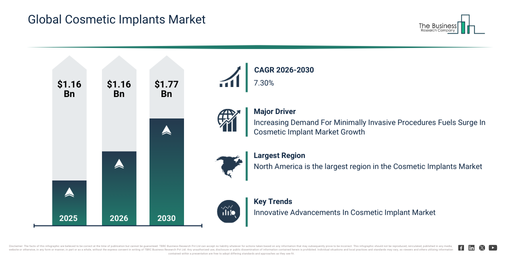
    The cosmetic implants market has shown robust growth in recent years. Its projected expansion is from $12.36 billion in 2025 to $13.27 billion in 2026, exhibiting a compound annual growth rate (CAGR) of 7.4%. This historical growth can be linked to an increase in cosmetic surgery procedures, growing acceptance of aesthetic enhancements, advancements in implant material science, the expansion of dental implant applications, and the availability of certified cosmetic surgeons.

    The cosmetic implants market is projected to experience substantial expansion in the upcoming years. By 2030, this market is anticipated to reach a valuation of $17.56 billion, exhibiting a compound annual growth rate (CAGR) of 7.3%. This anticipated expansion during the forecast period stems from several factors, including a heightened demand for tailored cosmetic solutions, a greater emphasis on facial aesthetics and reconstructive procedures, the broadening scope of medical tourism for cosmetic treatments, advancements in bioengineered implants, and more frequent regulatory endorsements for sophisticated implant substances. Key trends expected within this period encompass a surging need for advanced aesthetic improvements, the wider acceptance of biocompatible implant components, the increasing utilization of personalized cosmetic implants, the proliferation of minimally invasive cosmetic operations, and a heightened commitment to ensuring the long-term safety of implants.

    Download the Free Sample Report to Explore Key Market Insights:

    https://www.thebusinessresearchcompany.com/sample.aspx?id=13409&type=smp

    Which Economic Or Industry Drivers Are Impacting The Cosmetic Implants Market?

    The rising need for minimally invasive procedures is anticipated to fuel the expansion of the cosmetic implants market in the future. Minimally invasive procedures are defined as medical treatments conducted via small cuts or openings, which lessens patient injury and shortens recuperation periods. The growing popularity of minimally invasive surgical procedures stems from their advantages such as quicker healing, lower complication risks, reduced discomfort, and smaller scarring, thereby appealing to patients looking for faster and safer treatment alternatives. Cosmetic implants improve minimally invasive techniques by incorporating advanced, biocompatible substances, which enable tinier incisions and more accurate positioning. These implants decrease the difficulty of surgery by facilitating faster recovery and fewer adverse events, thus enhancing patient comfort and the overall effectiveness of the procedure. As an illustration, in June 2024, the American Society of Plastic Surgeons, a US-based non-profit organization, reported that minimally invasive procedures saw a 7% growth in 2023, surpassing the growth of conventional surgical procedures by 2%. Consequently, the escalating demand for minimally invasive procedures is fueling the expansion of the cosmetic implants market.

    How Is The Cosmetic Implants Market Divided Into Its Major Segments?

    The cosmetic implants market covered in this report is segmented –

    1) By Raw Material: Polymer, Ceramic, Metal, Biological

    2) By Application: Dental Implants, Breast Implants, Facial Implants, Other Applications

    3) By End User: Hospitals, Ambulatory Surgical Centers, Specialty Clinics, Other End Users

    Subsegments:

    1) By Polymer: Silicone-Based Implants, Polyurethane-Based Implants, Polymethylmethacrylate (PMMA) Implants

    2) By Ceramic: Alumina Ceramic Implants, Zirconia Ceramic Implants

    3) By Metal: Titanium Implants, Stainless Steel Implants, Cobalt-chromium Implants

    4) By Biological: Collagen Implants, Hyaluronic Acid Implants, Growth Factor-Based Implants

    How Are Trends Transforming The Cosmetic Implants Market Landscape?

    Leading companies in the cosmetic implant market are developing innovative products such as breast tissue dynamic gel to reach wider customer bases, increase sales, and boost revenue. Breast tissue dynamic gel is a colorless gel breast augmentation filler composed of hyaluronic acid and water, injected into the breast to enhance its size or fullness. For instance, in July 2024, GC Aesthetics (GCA), a France-based leading designer, manufacturer, and distributor of breast implants and medical devices for the global aesthetics industry, introduced Luna XT and PERLE in Hainan, China. Luna XT offers “industry-leading” support for women undergoing both immediate and delayed breast reconstruction surgery, featuring a unique microtextured surface, highly cohesive silicone gel, and a high-performance shell. Meanwhile, PERLE provides an innovative solution that integrates a revolutionary BioQ-Surface and Emunomic Breast Tissue Dynamic Gel, thereby improving patient safety and aesthetic outcomes.

    Who Are The Prominent Organizations Shaping The Cosmetic Implants Market?

    Major companies operating in the cosmetic implants market are Johnson & Johnson Services Inc., Allergan Inc., Zimmer Biomet Holdings Inc., Dentsply Sirona Inc., Institut Straumann AG, KLS Martin Group, Sientra Inc., Mentor Worldwide LLC, GC Aesthetics plc, Nobel Biocare Holding AG, Megagen Implant Co. Ltd., Groupe Sebbin SAS, Polytech Health & Aesthetics GmbH, Silimed, Spectrum Designs Medical, Alpha Aesthetics Implants, Nagor, Implantech Associations Inc., Surgiform Technology Ltd., Aesthetic And Reconstructive Technologies (AART) Inc.

    Read the full cosmetic implants market report here:

    https://www.thebusinessresearchcompany.com/report/cosmetic-implants-global-market-report

    What Are The Top-Performing Regions Within The Cosmetic Implants Market?

    North America was the largest region in the cosmetic implants market in 2025. Asia-Pacific is expected to be the fastest-growing region in the forecast period. The regions covered in the cosmetic implants market report are Asia-Pacific, South East Asia, Western Europe, Eastern Europe, North America, South America, Middle East, Africa.

    Request A Tailored Cosmetic Implants Market Research Report For Competitive Advantage:

    https://www.thebusinessresearchcompany.com/customise?id=13409&type=smp

    Browse Through More Reports Similar to the Global Cosmetic Implants Market 2026, By The Business Research Company

    Virtual Reality Devices Market Report 2026

    https://www.thebusinessresearchcompany.com/report/virtual-reality-devices-global-market-report

    Surface Haptics Technology Market Report 2026

    https://www.thebusinessresearchcompany.com/report/surface-haptics-technology-global-market-report

    Virtual Reality Vr In Medical Simulation Market Report 2026

    https://www.thebusinessresearchcompany.com/report/virtual-reality-vr-in-medical-simulation-global-market-report

    Get in touch with us:

    The Business Research Company: https://www.thebusinessresearchcompany.com/

    Americas +1 310-496-7795

    Asia +44 7882 955267 & +91 8897263534

    Europe +44 7882 955267

    Email us at info@tbrc.info

    Follow us on:

    LinkedIn: https://in.linkedin.com/company/the-business-research-company

    YouTube: https://www.youtube.com/channel/UC24_fI0rV8cR5DxlCpgmyFQ

    Global Market Model: https://www.thebusinessresearchcompany.com/global-market-model

  • Cortical Haptic Virtual Reality Glove Market Outlook 2026–2030 with Major Growth Drivers and Emerging Industry Trends

    Cortical Haptic Virtual Reality Glove Market Outlook 2026–2030 with Major Growth Drivers and Emerging Industry Trends

    The Business Research Company’s 2026 market reports include new capabilities such as market attractiveness scoring and analysis, total addressable market analysis, company scoring matrix, interactive excel data dashboard, improved supply chain analysis, upcoming startups in the market, and overview of key products, aimed at improving the depth, usability, and strategic value of the insights delivered.

    What Is The Expected Market Size Of The Cortical Haptic Virtual Reality Glove Market From 2026 To 2030?

    The cortical haptic virtual reality glove market size has experienced rapid growth recently. Forecasts indicate it will expand from $1.84 billion in 2025 to $2.23 billion in 2026, achieving a compound annual growth rate (CAGR) of 21.3%. Several factors contributed to this historic growth, including the rising acceptance of VR gaming and entertainment, the foundational development of haptic glove technologies, the expansion of industrial simulation and training, investments targeting rehabilitation and healthcare uses, and breakthroughs in sensor and exoskeleton technologies.

    The cortical haptic virtual reality glove market is anticipated to experience substantial growth over the next few years. It is projected to expand to $4.79 billion by 2030, demonstrating a compound annual growth rate (CAGR) of 21.0%. This growth during the forecast period can be attributed to the integration of AI for adaptive haptic responses, the expansion of industrial and engineering training applications, the growth of immersive education platforms, the emergence of wireless and soft robotic glove technologies, and an increasing demand for realistic remote and metaverse interactions. Major trends expected in this period include neural-interface enabled tactile feedback, advanced force and vibrotactile feedback, innovations in wireless haptic gloves, integration into rehabilitation and healthcare, and high-fidelity gaming and simulation experiences.

    Download the Free Sample Report to Explore Key Market Insights:

    https://www.thebusinessresearchcompany.com/sample.aspx?id=28185&type=smp

    What Major Drivers Are Influencing Demand In The Cortical Haptic Virtual Reality Glove Market?

    The increasing availability of wearable devices is anticipated to drive the expansion of the cortical haptic virtual reality glove market in the future. Wearable devices are electronic gadgets intended to be worn on the body, frequently designed for monitoring health, tracking fitness, or offering intelligent functionalities. The escalating demand for these devices stems from greater consumer awareness regarding health, as individuals increasingly aim to monitor and enhance their physical condition, observe vital statistics, and oversee their general well-being. These devices augment cortical haptic virtual reality (VR) gloves by delivering accurate, instantaneous feedback, thereby making them highly suitable for engaging virtual experiences and training scenarios. They boost interaction precision through the simulation of lifelike touch, pressure, and texture sensations, which in turn elevates user involvement and the overall efficacy of VR environments. As an illustration, in April 2025, the Parliamentary Office of Science and Technology, a UK-based parliamentary research and advisory body, reported that from 2023 to 2024, the National Institute for Health and Care Research (NIHR) and UK Research and Innovation (UKRI) allocated £11.5 million ($15.52 million) across 10 research projects. These projects were centered on advancing wearable technologies designed to foster greater autonomy for individuals experiencing frailty or prolonged physical disabilities. Consequently, the widespread availability of wearable devices is stimulating expansion within the cortical haptic virtual reality glove market.

    Which Segments Are Included In The Analysis Of The Cortical Haptic Virtual Reality Glove Market?

    The cortical haptic virtual reality glove market covered in this report is segmented –

    1) By Product Type: Wired Gloves, Wireless Gloves

    2) By Technology: Force Feedback, Vibrotactile Feedback, Electroactive Polymer Or Soft Actuators

    3) By Distribution Channel: Online, Offline

    4) By Application: Gaming And Entertainment, Healthcare And Rehabilitation, Industrial And Training

    5) By End-User: Consumer, Enterprise Or Commercial, Research And Education

    Subsegments:

    1) By Wired Gloves: Exoskeleton Gloves, Rigid Frame Gloves, Cable-Driven Gloves

    2) By Wireless Gloves: Soft Robotic Gloves, Finger Tracking Gloves, Wearable Sensor Gloves

    Which Trends Are Impacting The Growth Of The Cortical Haptic Virtual Reality Glove Market?

    Major companies within the cortical haptic virtual reality glove market are concentrating on developing innovative advancements like pneumatic haptic gloves to improve realism and user engagement in immersive environments. A pneumatic haptic glove functions as a wearable interface, utilizing air-pressure-based actuation to provide precise tactile cues, which enables more natural interaction with digital content. For example, in January 2024, Microtube Technologies, a Singapore-based provider of immersive haptic hardware, launched the HEXR Glove. This device delivers high-fidelity tactile feedback through pneumatic actuation while remaining wireless and free of external pumps or bulky accessories, thereby enhancing comfort and portability. It is compatible with major virtual, augmented, and extended-reality headsets, allowing for applications in sectors such as healthcare, education, entertainment, and training.

    Which Key Industry Participants Are Active In The Cortical Haptic Virtual Reality Glove Market?

    Major companies operating in the cortical haptic virtual reality glove market are HaptX Inc, Manus VR, SenseGlove, CyberGlove Systems, VRgluv, Dexta Robotics, BeBop Sensors, Contact CI, NeuroDigital Technologies, Noitom Ltd, Teslasuit, Meta Platforms Inc, Apple Inc, Sony Interactive Entertainment, Razer Inc, bHaptics, Virtuix, Quantanx, Ultraleap, Straythink, ExoGeniX, GestureTek, Tactai, VRGluv, AxonVR

    Read the full cortical haptic virtual reality glove market report here:

    https://www.thebusinessresearchcompany.com/report/cortical-haptic-virtual-reality-glove-global-market-report

    Which Region Shows The Strongest Potential For Future Growth In The Cortical Haptic Virtual Reality Glove Market?

    North America was the largest region in the cortical haptic virtual reality glove market in 2025. Asia-Pacific is expected to be the fastest-growing region in the forecast period. The regions covered in the cortical haptic virtual reality glove market report are Asia-Pacific, South East Asia, Western Europe, Eastern Europe, North America, South America, Middle East, Africa.

    Request A Tailored Cortical Haptic Virtual Reality Glove Market Research Report For Competitive Advantage:

    https://www.thebusinessresearchcompany.com/customise?id=28185&type=smp

    Browse Through More Reports Similar to the Global Cortical Haptic Virtual Reality Glove Market 2026, By The Business Research Company

    Vascular Stent Market Report 2026

    https://www.thebusinessresearchcompany.com/report/vascular-stent-global-market-report

    Drug Eluting Stent Market Report 2026

    https://www.thebusinessresearchcompany.com/report/drug-eluting-stent-global-market-report

    Self Expanding Stents Market Report 2026

    https://www.thebusinessresearchcompany.com/report/self-expanding-stents-global-market-report

    Get in touch with us:

    The Business Research Company: https://www.thebusinessresearchcompany.com/

    Americas +1 310-496-7795

    Asia +44 7882 955267 & +91 8897263534

    Europe +44 7882 955267

    Email us at info@tbrc.info

    Follow us on:

    LinkedIn: https://in.linkedin.com/company/the-business-research-company

    YouTube: https://www.youtube.com/channel/UC24_fI0rV8cR5DxlCpgmyFQ

    Global Market Model: https://www.thebusinessresearchcompany.com/global-market-model

  • One of the Major Drivers of the Coronary Stents Market Is the Rising Prevalence Of Cardiovascular Diseases To Drive Growth In Coronary Stent Market

    One of the Major Drivers of the Coronary Stents Market Is the Rising Prevalence Of Cardiovascular Diseases To Drive Growth In Coronary Stent Market

    The Business Research Company’s 2026 market reports include new capabilities such as market attractiveness scoring and analysis, total addressable market analysis, company scoring matrix, interactive excel data dashboard, improved supply chain analysis, upcoming startups in the market, and overview of key products, aimed at improving the depth, usability, and strategic value of the insights delivered.

    What Market Valuation Is Forecasted For The Coronary Stents Market By 2030 Starting From Its 2026 Size?

    The coronary stents market has seen substantial expansion over recent years. It is projected to increase from $11.9 billion in 2025 to $12.9 billion in 2026, demonstrating a compound annual growth rate (CAGR) of 8.3%. The growth witnessed historically can be linked to the increasing incidence of coronary artery disease, a rising number of percutaneous coronary intervention procedures, advancements in stent coating technologies, the expansion of interventional cardiology services, and improved clinical outcomes associated with coronary stenting.

    The coronary stents market size is projected to experience substantial expansion over the upcoming years. Its valuation is anticipated to reach $17.76 billion by 2030, exhibiting a compound annual growth rate (CAGR) of 8.3%. This projected expansion during the forecast period stems from factors such as an aging demographic prone to increased cardiovascular risks, a rising need for less invasive cardiac interventions, the wider embrace of advanced stent technologies, a heightened emphasis on durable vessel healing and improved patient results, and broader availability of cardiac care in developing regions. Key developments expected during this period involve a greater uptake of drug-eluting and dual therapy stents, a stronger inclination towards minimally invasive coronary procedures, an intensified drive to mitigate restenosis and thrombosis hazards, the broader utilization of bioresorbable and biodegradable stents, and an escalating requirement for innovative stent materials and designs.

    Download the Free Sample Report to Explore Key Market Insights:

    https://www.thebusinessresearchcompany.com/sample.aspx?id=18325&type=smp

    Which Market Drivers Are Supporting The Expansion Of The Coronary Stents Market?

    The growing occurrence of cardiovascular diseases (CVDs) is anticipated to fuel the expansion of the coronary stent market going forward. These diseases encompass various heart and blood vessel conditions, such as coronary artery disease, heart failure, stroke, and high blood pressure. The increase in CVDs is linked to an aging global population and a higher incidence of risk factors including obesity, diabetes, inactive routines, unhealthy eating habits, and stress. Coronary stents become necessary in such cases to unblock or widen constricted coronary arteries, thereby enhancing blood circulation to the heart and lowering the likelihood of heart attacks. For example, data from October 2024, provided by the US government agency, the Centers for Disease Control and Prevention, revealed that in 2023, cardiovascular disease was responsible for 919,032 fatalities, representing approximately one in every three deaths. Consequently, the escalating incidence of cardiovascular diseases (CVDs) is significantly contributing to the growth of the coronary stent market.

    Which Segment Categories Define The Coronary Stents Market?

    The coronary stents market covered in this report is segmented –

    1) By Product Type: Dual Therapy Stents, Radioactive Stents, Thrombectomy Stents, Covered Stents, Bioresorbable Stents, Biodegradable Stents, Hybrid Stents, Drug-Eluting Stents, Bare Metal Stents

    2) By Technology: Laser Cutting, 3D-Printed Stents, Microfabrication, Nanotechnology-Based Stents, Electropolishing, Others Technologies

    3) By Raw Material: Cobalt-Chromium, Stainless Steel, Platinum–Chromium, Nickel–Titanium, Polymer

    4) By Deployment: Self-Expandable Stents, Balloon-Expandable Stents

    5) By End Uses: Hospitals And Ambulatory Surgical Centers, Specialty Clinics, Other End Uses

    Subsegments:

    1) By Dual Therapy Stents: Sirolimus-Eluting Dual Therapy Stents, Paclitaxel-Eluting Dual Therapy Stents, Everolimus-Eluting Dual Therapy Stents

    2) By Radioactive Stents: Beta Radiation Stents, Gamma Radiation Stents, Other Radiation Stents

    3) By Thrombectomy Stents: Manual Thrombectomy Stents, Mechanical Thrombectomy Stents, Hydrodynamic Thrombectomy Stents

    4) By Covered Stents: PTFE-Covered Stents, ePTFE-Covered Stents, Polyurethane-Covered Stents, Other Covered Stents

    5) By Bioresorbable Stents: Polymer-Based Bioresorbable Stents, Metal-Based Bioresorbable Stents, Ceramic-Based Bioresorbable Stents

    6) By Biodegradable Stents: Polymeric Biodegradable Stents, Magnesium-Based Biodegradable Stents, Other Biodegradable Stents

    7) By Hybrid Stents: Hybrid Drug-Eluting Stents, Hybrid Biodegradable Or Metal Stents, Other Hybrid Stents

    8) By Drug-Eluting Stents: Sirolimus-Eluting Stents, Paclitaxel-Eluting Stents, Everolimus-Eluting Stents, Zotarolimus-Eluting Stents, Other Drug-Eluting Stents

    9) By Bare Metal Stents: Stainless Steel Bare Metal Stents, Cobalt Chromium Bare Metal Stents, Other Bare Metal Stents

    What Major Market Trends Are Driving Changes In The Coronary Stents Market?

    Leading companies in the coronary stent market are introducing advanced products, such as drug-eluting stents, aimed at decreasing the necessity for recurrent interventions when contrasted with bare-metal stents. These drug-eluting stents are specialized devices for coronary arteries, featuring a medicinal coating that steadily releases drugs to prevent the arteries from narrowing again. For instance, in May 2024, Abbott, a US-based healthcare company, rolled out the XIENCE Sierra Everolimus (drug) Eluting Coronary Stent System in India. The XIENCE Sierra stent is distinguished by its improved design, a novel delivery system, and distinct size options, specifically engineered to manage complex cases. It maintains the specialized coating that diminishes the risk of artery re-blockage, consistent with other XIENCE stents. This particular stent boasts an outstanding safety profile, substantiated by more than 120 clinical trials involving over 120,000 patients.

    Who Are The Top Companies Competing In The Coronary Stents Market?

    Major companies operating in the coronary stents market are Abbott Laboratories, Medtronic plc, Boston Scientific Corporation, Terumo Corporation, BIOTRONIK SE & Co KG, B Braun Melsungen AG, Biosensors International Group Ltd, MicroPort Scientific Corporation, Lepu Medical Technology Beijing Co Ltd, Meril Life Sciences Pvt Ltd, Stentys SA, Alvimedica, Vascular Concepts, Balton Medical, Cardionovum, HEXACATH, Elixir Medical Corporation, Translumina GmbH, Relisys Medical Devices Ltd, REVA Medical Inc, Sahajanand Medical Technologies Pvt Ltd, Endocor GmbH, Eurocor Tech, Medinol, Q3 Medical Devices, S3V Vascular Technologies, InSitu Technologies, Minvasys

    Read the full coronary stents market report here:

    https://www.thebusinessresearchcompany.com/report/coronary-stents-global-market-report

    How Is The Coronary Stents Market Distributed Across Key Geographic Regions?

    North America was the largest region in the coronary stents market in 2025. Asia-Pacific is expected to be the fastest-growing region in the forecast period. The regions covered in the coronary stents market report are Asia-Pacific, South East Asia, Western Europe, Eastern Europe, North America, South America, Middle East, Africa.

    Request A Tailored Coronary Stents Market Research Report For Competitive Advantage:

    https://www.thebusinessresearchcompany.com/customise?id=18325&type=smp

    Browse Through More Reports Similar to the Global Coronary Stents Market 2026, By The Business Research Company

    Atherectomy Devices Market Report 2026

    https://www.thebusinessresearchcompany.com/report/atherectomy-devices-global-market-report

    Coronary Angiography Devices Market Report 2026

    https://www.thebusinessresearchcompany.com/report/coronary-angiography-devices-global-market-report

    Biopsy Devices Market Report 2026

    https://www.thebusinessresearchcompany.com/report/biopsy-devices-global-market-report

    Get in touch with us:

    The Business Research Company: https://www.thebusinessresearchcompany.com/

    Americas +1 310-496-7795

    Asia +44 7882 955267 & +91 8897263534

    Europe +44 7882 955267

    Email us at info@tbrc.info

    Follow us on:

    LinkedIn: https://in.linkedin.com/company/the-business-research-company

    YouTube: https://www.youtube.com/channel/UC24_fI0rV8cR5DxlCpgmyFQ

    Global Market Model: https://www.thebusinessresearchcompany.com/global-market-model

  • A key trend shaping the Coronary Atherectomy Devices Market involves the AngioDynamics Receives FDA Clearance for Auryon XL Radial Access Catheter to Enhance Treatment of Peripheral Arterial Disease

    A key trend shaping the Coronary Atherectomy Devices Market involves the AngioDynamics Receives FDA Clearance for Auryon XL Radial Access Catheter to Enhance Treatment of Peripheral Arterial Disease

    The Business Research Company’s 2026 market reports include new capabilities such as market attractiveness scoring and analysis, total addressable market analysis, company scoring matrix, interactive excel data dashboard, improved supply chain analysis, upcoming startups in the market, and overview of key products, aimed at improving the depth, usability, and strategic value of the insights delivered.

    How Is The Market Size Of The Coronary Atherectomy Devices Market Expected To Change Between 2026 And 2030?

    The market size for coronary atherectomy devices has expanded rapidly in recent years. It is projected to increase from $0.23 billion in 2025 to $0.26 billion in 2026, achieving a compound annual growth rate (CAGR) of 10.1%. The growth observed in prior periods can be ascribed to the increasing incidence of coronary artery disease, a rise in the use of interventional cardiology procedures, the proliferation of catheterization laboratories, an expanding aging population, and the clinical substantiation of atherectomy techniques.

    The coronary atherectomy devices market is anticipated to experience substantial growth in the coming years. This market is projected to reach a value of **$0.37 billion in 2030, exhibiting a compound annual growth rate (CAGR) of 9.4%.** This growth during the forecast period is driven by factors such as an escalating demand for complex coronary interventions, increased adoption of image-guided cardiovascular procedures, expanding investments in cardiac care infrastructure, technological advancements enhancing device precision, and a wider application of minimally invasive treatment protocols. Significant trends expected during this period include the greater utilization of sophisticated rotational atherectomy devices, a rise in the adoption of minimally invasive coronary procedures, a heightened focus on treating calcified lesions, the proliferation of precision-controlled atherectomy systems, and improved integration with imaging-guided interventions.

    Download the Free Sample Report to Explore Key Market Insights:

    https://www.thebusinessresearchcompany.com/sample.aspx?id=3345&type=smp

    What Underlying Factors Are Accelerating The Growth Of The Coronary Atherectomy Devices Market?

    The increasing occurrence of cardiovascular diseases (CVDs) is propelling the expansion of the coronary atherectomy devices market. These conditions encompass various heart and blood vessel disorders, frequently resulting from plaque accumulation, diminished blood flow, and gradual arterial narrowing. The escalating incidence of CVDs stems from the rising prevalence of changeable risk factors such as hypertension, obesity, diabetes, poor dietary habits, sedentary lifestyles, and tobacco consumption. This growing disease burden fosters the use of coronary atherectomy devices by generating a demand for minimally invasive instruments capable of efficiently removing calcified or intricate plaque, re-establishing optimal blood flow, and enhancing success rates in percutaneous coronary interventions (PCI). For instance, in October 2024, according to the Centers for Disease Control and Prevention, a US-based public health institute, in 2023, about 1 out of every 6 deaths from cardiovascular diseases was among adults younger than 65 years old, and a total of 919,032 people died from cardiovascular disease, representing 1 in every 3 deaths. Consequently, the rising prevalence of cardiovascular diseases is a major force behind the growth of the global coronary atherectomy devices market.

    How Is The Coronary Atherectomy Devices Market Structured Across Different Segments?

    The coronary atherectomy devices market covered in this report is segmented –

    1) By Product: Directional Atherectomy Devices, Orbital Atherectomy Devices, Photo-Ablative Atherectomy Devices, Rotational Atherectomy Devices, Other Products

    2) By Application: Peripheral Vascular, Cardiovascular, Coronary Artery Disease

    3) By End User: Hospitals And Surgical Centers, Ambulatory Care Centers, Cardiac Specialty Centers

    Subsegments:

    1) By Directional Atherectomy Devices: Traditional Directional Atherectomy Devices, Advanced Directional Atherectomy Devices

    2) By Orbital Atherectomy Devices: Single-Wire Orbital Atherectomy Devices, Multi-Wire Orbital Atherectomy Devices

    3) By Photo-Ablative Atherectomy Devices: Laser-Based Photo-Ablative Devices, Other Photo-Ablative Atherectomy Devices

    4) By Rotational Atherectomy Devices: Manual Rotational Atherectomy Devices, Motorized Rotational Atherectomy Devices

    5) By Other Products: Combination Atherectomy Devices, Custom Atherectomy Solutions, Other Coronary Atherectomy Devices

    Which Trends Are Shaping The Future Of The Coronary Atherectomy Devices Market?

    Companies active in the coronary atherectomy equipment market are concentrating on inventive solutions like radial access catheters to improve patient outcomes by enabling safer and less invasive procedures for managing coronary artery disease. Radial Access Catheters are specialized medical instruments used in interventional cardiology to gain access to the coronary arteries through the radial artery in the wrist, in contrast to the conventional femoral artery in the groin. For instance, in January 2024, AngioDynamics, a US-based provider of products and solutions to healthcare professionals, declared FDA 510(k) clearance for its Auryon XL Radial Access Catheter, engineered to address peripheral arterial disease (PAD). This 225-cm catheter, which is compatible with the Auryon Atherectomy System, provides two diameter options (0.9 mm and 1.5 mm) and incorporates advanced laser technology for the effective treatment of arterial occlusions. Significantly, radial access considerably diminishes major bleeding risks compared to traditional femoral access and permits bilateral disease treatment within a single session, thereby encouraging swifter recovery.

    Which Major Players Dominate The Coronary Atherectomy Devices Market?

    Major companies operating in the coronary atherectomy devices market are Boston Scientific Corporation, Cardiovascular Systems Inc., The Spectranetics Corporation, Medtronic Inc., Avinger Inc., Biotronik SE & Co. KG, Arterial Remodeling Technologies, Straub Medical AG, RA Medical Systems Inc., Shockwave Medical Inc., Terumo Corporation, Abbott Laboratories Inc., Asahi Intecc Co. Ltd., Baylis Medical Company Inc., Cook Medical LLC, Cordis Corporation, Infraredx Inc., Intact Vascular Inc., TriReme Medical LLC, Volcano Corporation

    Read the full coronary atherectomy devices market report here:

    https://www.thebusinessresearchcompany.com/report/coronary-atherectomy-devices-global-market-report

    Which Region Is Projected To Dominate The Coronary Atherectomy Devices Market During The Forecast Period?

    North America was the largest region in the coronary atherectomy devices market in 2025. Western Europe was the second-largest region in the global coronary atherectomy devices market share. Africa, was the smallest region in the coronary atherectomy devices industry. The regions covered in the coronary atherectomy devices market report are Asia-Pacific, South East Asia, Western Europe, Eastern Europe, North America, South America, Middle East, Africa.

    Request A Tailored Coronary Atherectomy Devices Market Research Report For Competitive Advantage:

    https://www.thebusinessresearchcompany.com/customise?id=3345&type=smp

    Browse Through More Reports Similar to the Global Coronary Atherectomy Devices Market 2026, By The Business Research Company

    Coronary Atherectomy Devices Market Report 2026

    https://www.thebusinessresearchcompany.com/report/coronary-atherectomy-devices-global-market-report

    Angiography Equipment Market Report 2026

    https://www.thebusinessresearchcompany.com/report/angiography-equipment-global-market-report

    Biopsy Devices Market Report 2026

    https://www.thebusinessresearchcompany.com/report/biopsy-devices-global-market-report

    Get in touch with us:

    The Business Research Company: https://www.thebusinessresearchcompany.com/

    Americas +1 310-496-7795

    Asia +44 7882 955267 & +91 8897263534

    Europe +44 7882 955267

    Email us at info@tbrc.info

    Follow us on:

    LinkedIn: https://in.linkedin.com/company/the-business-research-company

    YouTube: https://www.youtube.com/channel/UC24_fI0rV8cR5DxlCpgmyFQ

    Global Market Model: https://www.thebusinessresearchcompany.com/global-market-model

  • A significant industry trend in the Coronary Angiography Devices Market includes the Technological Innovations Driving Precision And Patient Outcomes In Interventional Cardiology

    A significant industry trend in the Coronary Angiography Devices Market includes the Technological Innovations Driving Precision And Patient Outcomes In Interventional Cardiology

    The Business Research Company’s 2026 market reports include new capabilities such as market attractiveness scoring and analysis, total addressable market analysis, company scoring matrix, interactive excel data dashboard, improved supply chain analysis, upcoming startups in the market, and overview of key products, aimed at improving the depth, usability, and strategic value of the insights delivered.

    What Is The Market Size Of The Coronary Angiography Devices Market In 2026 And What Value Is Projected For 2030?

    The coronary angiography devices market has experienced significant expansion in recent years. This market is expected to increase from $10.03 billion in 2025 to $10.7 billion in 2026, achieving a compound annual growth rate (CAGR) of 6.7%. The historical growth trajectory can be attributed to factors such as the rising incidence of coronary artery disease, an increase in cardiac catheterization procedures, the expansion of hospital infrastructure for cardiac care, the growing adoption of x-ray based angiography systems, and enhanced awareness regarding the early diagnosis of heart conditions.

    The coronary angiography devices market size is projected to experience substantial expansion in the coming years. It is anticipated to grow to $13.83 billion in 2030, demonstrating a compound annual growth rate (CAGR) of 6.6%. This projected growth during the forecast period is driven by an aging population with elevated cardiovascular risk, an increasing need for early and accurate coronary diagnostics, the expansion of interventional cardiology centers, the rising adoption of image-guided cardiac procedures, and a growing focus on preventive cardiology care. Prominent trends expected in the forecast period include the increasing embrace of minimally invasive coronary diagnostic procedures, the expanded use of advanced imaging systems in cardiac diagnostics, a heightened demand for high-precision coronary visualization, the broadened application of angiography in early cardiac disease detection, and the increasing integration of diagnostic and therapeutic angiography workflows.

    Download the Free Sample Report to Explore Key Market Insights:

    https://www.thebusinessresearchcompany.com/sample.aspx?id=18800&type=smp

    Which Growth Drivers Are Contributing To The Progress Of The Coronary Angiography Devices Market?

    The increasing occurrence of vascular heart diseases is projected to stimulate expansion in the coronary angiography devices market. Vascular heart diseases refer to various conditions impacting the blood vessels that supply the heart or are located within it. The rising incidence of these diseases is attributed to shifts in lifestyle choices, including diet and physical activity, an aging population, and the growing rates of conditions such as diabetes and hypertension. Coronary angiography devices are instrumental in diagnosing and evaluating vascular heart diseases by providing high-resolution images of the coronary arteries, which allows for precise identification of obstructions, constrictions, and other anomalies that guide therapeutic decisions. For instance, in October 2024, the Centers for Disease Control and Prevention, a US-based, government agency, reported that in 2023, cardiovascular disease led to 919,032 lives lost, accounting for approximately one in every three deaths. Consequently, the increasing prevalence of vascular heart diseases is a primary driver for the coronary angiography devices market.

    What Are The Key Segments Of The Coronary Angiography Devices Market?

    The coronary angiography devices market covered in this report is segmented –

    1) By Product Type: Angiography Systems, Angiography Catheters, Angiography Contrast Media, Vascular Closure Devices (VCDs), Angiography Balloons, Angiography Guidewires, Angiography Accessories

    2) By Technology: X-Ray Angiography, Computed Tomography Angiography (CTA), Magnetic Resonance Angiography, Other Technologies

    3) By Indication: Coronary Artery Disease, Valvular Heart Disease, Congenital Heart Disease, Congestive Heart Failure, Other Indications

    4) By Application: Diagnostics, Therapeutics

    5) By End-User: Hospital And Clinics, Diagnostic And Imaging Centers, Research Institutes

    Subsegments:

    1) By Angiography Systems: X-Ray Angiography Systems, 3D Or 4D Angiography Systems, Digital Subtraction Angiography (DSA) Systems

    2) By Angiography Catheters: Diagnostic Catheters, Therapeutic Catheters, Over-The-Wire (OTW) Catheters, Rapid Exchange (RX) Catheters

    3) By Angiography Contrast Media: Iodinated Contrast Media, Non-Iodinated Contrast Media

    4) By Vascular Closure Devices (VCDs): Mechanical VCDs, Passive Hemostasis VCDs, Active Hemostasis VCDs

    5) By Angiography Balloons: High-Pressure Balloons, Low-Pressure Balloons, Drug-Eluting Balloons

    6) By Angiography Guidewires: Standard Guidewires, Supportive Guidewires, Steerable Guidewires

    7) By Angiography Accessories: Introducer Sheaths, Inflation Devices, Syringes And Needles, Guidewire Support Systems

    What Key Trends Are Influencing The Development Of The Coronary Angiography Devices Market?

    Prominent companies within the coronary angiography devices market are concentrating on developing technological innovations, such as next-generation drug-eluting stents, to enhance the accuracy of procedures, improve patient health outcomes, and provide long-term cardiovascular support. These advanced drug-eluting stents are specifically engineered with superior scaffolding, sophisticated drug coatings, and improved deliverability to minimize restenosis and optimize arterial healing. For instance, in May 2024, Abbott Laboratories, a US-based medical devices firm, introduced its XIENCE Sierra stent in India. This stent provides cardiologists with heightened flexibility, precise deployment capabilities, and increased safety, aiming to broaden available treatment options and elevate the standard of care in managing coronary artery disease. By integrating cutting-edge design and clinical insights, this product launch contributes to enhanced procedural efficiency and patient-centric outcomes in interventional cardiology, simultaneously affirming Abbott’s dedication to innovation and global advancements in cardiovascular health.

    Who Are The Leading Companies Operating In The Coronary Angiography Devices Market?

    Major companies operating in the coronary angiography devices market are Cardinal Health Inc., Johnson & Johnson Services Inc., Abbott Laboratories, Medtronic plc, Siemens Healthineers AG, Koninklijke Philips N.V., GE HealthCare Technologies Inc., Boston Scientific Corporation, B. Braun Holding GmbH & Co. KG, Terumo Corporation, Nipro Corporation, Shimadzu Corporation, Cook Group Incorporated, ICU Medical Inc., Biotronik SE Co. KG, Merit Medical Systems Inc., Cordis Corporation, Guerbet N.V., AngioDynamics Inc., Canon Medical Systems Corporation, Acist Medical Systems, Medinol Ltd., Alvimedica

    Read the full coronary angiography devices market report here:

    https://www.thebusinessresearchcompany.com/report/coronary-angiography-devices-global-market-report

    What Are The Leading Geographic Regions In The Coronary Angiography Devices Market?

    North America was the largest region in the coronary angiography devices market in 2025. Asia-Pacific is expected to be the fastest-growing region in the forecast period. The regions covered in the coronary angiography devices market report are Asia-Pacific, South East Asia, Western Europe, Eastern Europe, North America, South America, Middle East, Africa.

    Request A Tailored Coronary Angiography Devices Market Research Report For Competitive Advantage:

    https://www.thebusinessresearchcompany.com/customise?id=18800&type=smp

    Browse Through More Reports Similar to the Global Coronary Angiography Devices Market 2026, By The Business Research Company

    Corneal Implants Market Report 2026

    https://www.thebusinessresearchcompany.com/report/corneal-implants-global-market-report

    Newborn Eye Imaging Systems Market Report 2026

    https://www.thebusinessresearchcompany.com/report/newborn-eye-imaging-systems-global-market-report

    Ophthalmic Devices Market Report 2026

    https://www.thebusinessresearchcompany.com/report/ophthalmic-devices-global-market-report

    Get in touch with us:

    The Business Research Company: https://www.thebusinessresearchcompany.com/

    Americas +1 310-496-7795

    Asia +44 7882 955267 & +91 8897263534

    Europe +44 7882 955267

    Email us at info@tbrc.info

    Follow us on:

    LinkedIn: https://in.linkedin.com/company/the-business-research-company

    YouTube: https://www.youtube.com/channel/UC24_fI0rV8cR5DxlCpgmyFQ

    Global Market Model: https://www.thebusinessresearchcompany.com/global-market-model
  • A key trend shaping the Corneal Topography Systems Market involves the Use Of Oct-Based Corneal Topography Systems To Enhance Early Detection And Diagnostic Accuracy

    A key trend shaping the Corneal Topography Systems Market involves the Use Of Oct-Based Corneal Topography Systems To Enhance Early Detection And Diagnostic Accuracy

    The Business Research Company’s 2026 market reports include new capabilities such as market attractiveness scoring and analysis, total addressable market analysis, company scoring matrix, interactive excel data dashboard, improved supply chain analysis, upcoming startups in the market, and overview of key products, aimed at improving the depth, usability, and strategic value of the insights delivered.

    What Will Be The Estimated Market Valuation Of The Corneal Topography Systems Market By The End Of 2030?

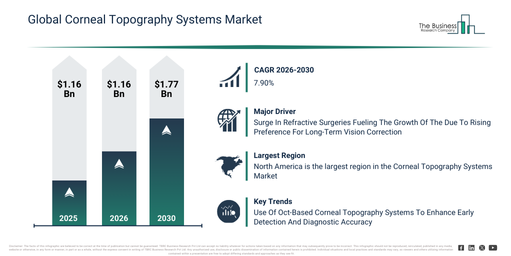
    Recent years have seen substantial growth in the corneal topography systems market. This market is anticipated to expand from $1.17 billion in 2025 to $1.27 billion in 2026, achieving a compound annual growth rate (CAGR) of 8.2%. The historical growth is attributable to an increase in refractive surgeries, the rising prevalence of vision disorders, the adoption of ophthalmic diagnostic technologies, the expansion of eye care clinics, and advancements in optical imaging.

    The market for corneal topography systems is anticipated to experience substantial expansion over the upcoming years. This market is projected to reach $1.72 billion by 2030, exhibiting a compound annual growth rate (CAGR) of 7.9%. This predicted growth is driven by factors such as AI-assisted corneal analysis, a rising demand for personalized vision correction, an increase in cataract surgeries, the expansion of outpatient ophthalmology services, and the emergence of digital eye health platforms. Key trends during this period are expected to encompass high-resolution corneal mapping, improved early detection of keratoconus, sophisticated refractive surgery planning, integrated anterior segment imaging, and advancements in non-invasive corneal diagnostics.

    Download the Free Sample Report to Explore Key Market Insights:

    https://www.thebusinessresearchcompany.com/sample.aspx?id=30244&type=smp

    What Primary Drivers Are Shaping The Development Of The Corneal Topography Systems Market?

    The expanding need for refractive operations is projected to drive the growth of the corneal topography systems market in the future. These surgeries involve medical interventions that modify the cornea’s shape to rectify visual impairments like myopia, hyperopia, and astigmatism. This increase in refractive procedures stems from a growing preference for lasting independence from spectacles and contact lenses, prompting more individuals to opt for permanent vision correction solutions. Corneal topography systems assist refractive surgeries by offering intricate maps of the cornea’s form and curvature, empowering surgeons to devise accurate, secure, and tailored vision correction interventions. As an illustration, in March 2023, Massachusetts Eye and Ear, a US-based healthcare company, reported that 87.8% of eyes in myopic patients who underwent LASIK attained results within ±0.5 diopters of the desired refraction, an improvement from earlier lower figures. Consequently, the rising requirement for refractive surgeries is fueling the expansion of the corneal topography systems market.

    Which Segment Classifications Shape The Corneal Topography Systems Market?

    The corneal topography systems market covered in this report is segmented –

    1) By Product Type: Placido Disc Systems, Scheimpflug Systems, Scanning Slit Systems, Combined Systems

    2) By Application: Refractive Surgery Evaluation, Cataract Surgery Evaluation, Contact Lens Fitting, Keratoconus Diagnosis, Other Applications

    3) By End-User: Hospitals, Ophthalmic Clinics, Ambulatory Surgical Centers, Other End-Users

    Subsegments:

    1) By Placido Disc Systems: Corneal Topographers, Videokeratoscopes

    2) By Scheimpflug Systems: Corneal Tomographers, Anterior Segment Analysers

    3) By Scanning Slit Systems: Slit Scanners, Corneal Profilers, Topography Analysers

    4) By Combined Systems: Placido Schei Pflug Hybrids, Slit Placido Hybrids, Multi Modal Analysers

    How Are Trends Impacting The Corneal Topography Systems Market?

    Major entities in the **corneal topography systems market** are prioritizing integration with electronic health records, such as OCT-based topography, to sharpen diagnostic accuracy, enable concurrent assessment of the anterior and posterior corneal surfaces, and enhance the early discovery of corneal conditions like keratoconus and ectasia. OCT-based topography is a corneal imaging approach that employs Optical Coherence Tomography (OCT) to capture high-resolution, cross-sectional corneal images and generate three-dimensional elevation maps of both the anterior (front) and posterior (back) surfaces. For example, in **March 2023**, **Haag-Streit AG**, a medical technology company based in Switzerland, introduced a new Corneal Ectasia Display for its **Eyestar 900**, a swept-source-based precision OCT analyzer. This new display incorporates OCT-based topography, which provides elevation data for both the anterior and posterior corneal surfaces, alongside pachymetry maps, Belin ABCD grading, and other diagnostic parameters, aiding specialists in identifying early signs of keratoconus and ectatic alterations. It further encompasses **12 mm** Class A topography, **18 mm** OCT imaging of the anterior chamber, and a completely automated workflow, facilitating extensive corneal and anterior segment analysis through a single measuring procedure.

    Which Companies Are Expanding Their Footprint In The Corneal Topography Systems Market?

    Major companies operating in the corneal topography systems market are Carl Zeiss Meditec AG, Topcon Corporation, Tomey Corporation, OCULUS Optikgeräte GmbH, NIDEK Co. Ltd., SCHWIND eye-tech-solutions GmbH, Medmont International Pty Ltd, Visionix Ltd., Costruzione Strumenti Oftalmici S.r.l., EyeSys Vision Inc., Cassini Technologies Inc., Ziemer Ophthalmic Systems AG, Heidelberg Engineering GmbH, Optopol Technology S.A., MediWorks Co. Ltd., Reichert Technologies Inc., Rexxam Co. Ltd., CSO Italia, Sirius Vision, Appasamy Associates

    Read the full corneal topography systems market report here:

    https://www.thebusinessresearchcompany.com/report/global-corneal-topography-systems-market-report

    How Does The Corneal Topography Systems Market Perform Across Major Global Regions?

    North America was the largest region in the corneal topography systems market in 2025. Asia-Pacific is expected to be the fastest-growing region in the forecast period. The regions covered in the corneal topography systems market report are Asia-Pacific, South East Asia, Western Europe, Eastern Europe, North America, South America, Middle East, Africa.

    Request A Tailored Corneal Topography Systems Market Research Report For Competitive Advantage:

    https://www.thebusinessresearchcompany.com/customise?id=30244&type=smp

    Browse Through More Reports Similar to the Global Corneal Topography Systems Market 2026, By The Business Research Company

    Ocular Implants Market Report 2026

    https://www.thebusinessresearchcompany.com/report/ocular-implants-global-market-report

    Cosmetic Implants Market Report 2026

    https://www.thebusinessresearchcompany.com/report/cosmetic-implants-global-market-report

    Glaucoma Surgery Devices Market Report 2026

    https://www.thebusinessresearchcompany.com/report/glaucoma-surgery-devices-global-market-report

    Get in touch with us:

    The Business Research Company: https://www.thebusinessresearchcompany.com/

    Americas +1 310-496-7795

    Asia +44 7882 955267 & +91 8897263534

    Europe +44 7882 955267

    Email us at info@tbrc.info

    Follow us on:

    LinkedIn: https://in.linkedin.com/company/the-business-research-company

    YouTube: https://www.youtube.com/channel/UC24_fI0rV8cR5DxlCpgmyFQ

    Global Market Model: https://www.thebusinessresearchcompany.com/global-market-model

  • Global Artificial Intelligence (AI)-Driven Augmented Reality (AR) Surgical Telementoring Market Analysis 2026–2030 Presenting Strategic Insights

    Global Artificial Intelligence (AI)-Driven Augmented Reality (AR) Surgical Telementoring Market Analysis 2026–2030 Presenting Strategic Insights

    The Business Research Company’s 2026 market reports include new capabilities such as market attractiveness scoring and analysis, total addressable market analysis, company scoring matrix, interactive excel data dashboard, improved supply chain analysis, upcoming startups in the market, and overview of key products, aimed at improving the depth, usability, and strategic value of the insights delivered.

    What Will Be The Estimated Market Valuation Of The Artificial Intelligence (AI)-Driven Augmented Reality (AR) Surgical Telementoring Market By The End Of 2030?

    The market size for artificial intelligence (ai)-driven augmented reality (ar) surgical telementoring has experienced substantial expansion in recent years. It is projected to increase from $1.71 billion in 2025 to $2.2 billion in 2026, demonstrating a compound annual growth rate (CAGR) of 28.2%. The growth observed in the historic period can be attributed to factors such as a shortage of skilled surgeons, the adoption of telemedicine, increasing demand for surgical training, improvements in connectivity, and the implementation of pilot telementoring programs.

    The artificial intelligence (ai)-driven augmented reality (ar) surgical telementoring market size is projected to undergo significant growth over the next few years, with its valuation expected to reach $5.88 billion in 2030, demonstrating a compound annual growth rate (CAGR) of 27.9%. This projected increase during the forecast period is driven by factors such as the expansion of 5G networks, the wider adoption of AI-guided surgery, advancements in global surgical education, improved access to rural healthcare, and the increasing demand for complex surgical operations. Notable trends anticipated in this period include enhanced remote surgical collaboration, real-time surgical visualization, better access to specialists in remote areas, more precise surgical guidance, and improvements in surgical training.

    Download the Free Sample Report to Explore Key Market Insights:

    https://www.thebusinessresearchcompany.com/sample.aspx?id=28911&type=smp

    Which Market Drivers Are Supporting The Expansion Of The Artificial Intelligence (AI)-Driven Augmented Reality (AR) Surgical Telementoring Market?

    The increasing need for minimally invasive procedures is anticipated to drive the expansion of the artificial intelligence (AI)-driven augmented reality (AR) surgical telementoring market moving forward. These procedures are surgical techniques involving small incisions and specialized instruments, designed to reduce trauma, pain, and recovery time compared to traditional open surgery. The growing demand for minimally invasive procedures stems from an aging population that increasingly requires surgical interventions while seeking quicker recovery times and shorter hospital stays. Advanced minimally invasive surgical approaches necessitate sophisticated guidance systems that leverage AI and AR technologies to offer real-time visualization and remote expert mentoring during complex procedures, thereby enhancing surgical precision, reducing errors, and improving patient outcomes. For instance, in April 2025, the British Association of Aesthetic Plastic Surgeons, a UK-based surgical organization, indicated that between 2023 and 2024, cosmetic surgical procedures saw an increase of 5%, amounting to 27,462 procedures performed in 2024. Therefore, this heightened demand for minimally invasive procedures is fueling the growth of the artificial intelligence (AI)-driven augmented reality (AR) surgical telementoring market.

    Which Segment Classifications Shape The Artificial Intelligence (AI)-Driven Augmented Reality (AR) Surgical Telementoring Market?

    The artificial intelligence (ai)-driven augmented reality (ar) surgical telementoring market covered in this report is segmented –

    1) By Component: Hardware, Software, Services

    2) By Deployment Mode: On-Premises, Cloud-Based

    3) By Application: General Surgery, Orthopedic Surgery, Neurosurgery, Cardiovascular Surgery, Other Applications

    4) By End-User: Hospitals, Ambulatory Surgical Centers, Specialty Clinics, Other End-Users

    Subsegments:

    1) By Hardware: Surgical Imaging Cameras, Depth Sensing Modules, Optical Tracking Systems, Electromagnetic Tracking Systems, Head Mounted Displays, Three Dimensional Monitors, Spatial Computing Sensors, Graphics Processing Unit Accelerators

    2) By Software: Real Time Computer Vision Algorithms, Three Dimensional Reconstruction Engines, Spatial Registration And Mapping, Annotation And Telestration Tools, Streaming And Telepresence Platform, Workflow Orchestration And Case Management

    3) By Services: Site Assessment And Readiness Planning, Installation And Commissioning, Clinical Workflow Design And Optimization, Staff Training And Credentialing Support, Remote Proctoring Program Setup

    How Are Trends Impacting The Artificial Intelligence (AI)-Driven Augmented Reality (AR) Surgical Telementoring Market?

    Leading companies within the artificial intelligence (AI)-driven augmented reality (AR) surgical telementoring market are concentrating on creating sophisticated products like real-time 3D surgical guidance platforms to improve surgical accuracy, decrease radiation exposure, and bolster training capabilities. These platforms leverage AI and AR technologies to offer surgeons dynamic, segmented views of patient anatomy during procedures, facilitating well-informed decisions and enabling the measurement of surgical success instantaneously. As an illustration, in April 2025, Proprio, a US-based AI-powered surgical technology company, introduced its Paradigm platform, which incorporates AI-guided visualization and insights derived from data. This platform merges diverse data, including CT, MRI, and operative plans, to provide real-time 3D anatomical mapping, comparable to Google Maps for surgery. Paradigm adjusts to alterations in the patient’s body, equipping surgeons with instruments and understanding to enhance results. In the initial 50 surgeries employing Paradigm, surgical teams successfully implanted hundreds of devices with favorable outcomes across a spectrum of difficult operations, ranging from scoliosis to collapsed discs. On average, the use of Paradigm decreased the necessity for radiation-based imaging by 10 times, as both experienced surgeons and newer residents utilized the technology to navigate intricate body structures safely and swiftly to achieve their goals.

    Which Companies Are Expanding Their Footprint In The Artificial Intelligence (AI)-Driven Augmented Reality (AR) Surgical Telementoring Market?

    Major companies operating in the artificial intelligence (ai)-driven augmented reality (ar) surgical telementoring market are Microsoft Corporation, Johnson & Johnson, Medtronic plc, Siemens Healthineers AG, Stryker Corporation, Koninklijke Philips NV, Intuitive Surgical Inc, Olympus Corporation, Karl Storz SE & Co KG, Osso VR Inc, Augmedics Ltd, VirtaMed AG, Surgical Theater Inc, Medivis Inc, Vuzix Corporation, XACT Robotics Inc, FundamentalVR Ltd, SentiAR Inc, EchoPixel Inc, VSI HoloMedicine.

    Read the full artificial intelligence (ai)-driven augmented reality (ar) surgical telementoring market report here:

    https://www.thebusinessresearchcompany.com/report/artificial-intelligence-ai-driven-augmented-reality-ar-surgical-telementoring-global-market-report

    How Is The Artificial Intelligence (AI)-Driven Augmented Reality (AR) Surgical Telementoring Market Distributed Across Key Geographic Regions?

    North America was the largest region in the artificial intelligence (AI)-driven augmented reality (AR) surgical telementoring market in 2025. The regions covered in the artificial intelligence (AI)-driven augmented reality (ar) surgical telementoring market report are Asia-Pacific, South East Asia, Western Europe, Eastern Europe, North America, South America, Middle East, Africa.

    Request A Tailored Artificial Intelligence (AI)-Driven Augmented Reality (AR) Surgical Telementoring Market Research Report For Competitive Advantage:

    https://www.thebusinessresearchcompany.com/customise?id=28911&type=smp

    Browse Through More Reports Similar to the Global Artificial Intelligence (AI)-Driven Augmented Reality (AR) Surgical Telementoring Market 2026, By The Business Research Company

    Ai In Virtual Reality And Augmented Reality Market Report 2026

    https://www.thebusinessresearchcompany.com/report/ai-in-virtual-reality-and-augmented-reality-global-market-report

    Augmented Intelligence Market Report 2026

    https://www.thebusinessresearchcompany.com/report/augmented-intelligence-global-market-report

    Ar Or Vr Medical Simulation Market Report 2026

    https://www.thebusinessresearchcompany.com/report/ar-or-vr-medical-simulation-global-market-report

    Get in touch with us:

    The Business Research Company: https://www.thebusinessresearchcompany.com/

    Americas +1 310-496-7795

    Asia +44 7882 955267 & +91 8897263534

    Europe +44 7882 955267

    Email us at info@tbrc.info

    Follow us on:

    LinkedIn: https://in.linkedin.com/company/the-business-research-company

    YouTube: https://www.youtube.com/channel/UC24_fI0rV8cR5DxlCpgmyFQ

    Global Market Model: https://www.thebusinessresearchcompany.com/global-market-model

  • Artificial Intelligence (AI)-Based Orthopedic Imaging Market Outlook 2026–2035 Driven by Key Growth Factors

    Artificial Intelligence (AI)-Based Orthopedic Imaging Market Outlook 2026–2035 Driven by Key Growth Factors

    The Business Research Company’s 2026 market reports include new capabilities such as market attractiveness scoring and analysis, total addressable market analysis, company scoring matrix, interactive excel data dashboard, improved supply chain analysis, upcoming startups in the market, and overview of key products, aimed at improving the depth, usability, and strategic value of the insights delivered.

    What Market Size Growth Is Projected For The Artificial Intelligence (AI)-Based Orthopedic Imaging Market During The Forecast Period 2026–2030?

    The market size for artificial intelligence (AI)-based orthopedic imaging has experienced substantial expansion in recent years. This market is projected to grow from $2.2 billion in 2025 to $2.95 billion in 2026, demonstrating a compound annual growth rate (CAGR) of 34.4%. Historically, this growth has been driven by the increasing prevalence of orthopedic disorders, a rising number of imaging centers, the adoption of digital radiography, early AI integration in imaging, and the expansion of hospital IT infrastructure.

    The artificial intelligence (AI)-based orthopedic imaging market is poised for significant expansion over the next few years. It is projected to achieve a size of $9.56 billion by 2030, exhibiting a compound annual growth rate (CAGR) of 34.1%. This anticipated growth during the forecast period is driven by factors such as the increasing demand for personalized orthopedic care, the integration with predictive analytics, the broadening of cloud-based imaging capabilities, the rising adoption of AI-driven diagnostics, and the proliferation of minimally invasive orthopedic procedures. Furthermore, major trends expected within this period encompass AI-assisted fracture detection, the application of predictive orthopedic analytics, the development of cloud-based imaging platforms, their integration with hospital PACS systems, and automated bone density analysis.

    Download the Free Sample Report to Explore Key Market Insights:

    https://www.thebusinessresearchcompany.com/sample.aspx?id=28127&type=smp

    What Underlying Factors Are Accelerating The Growth Of The Artificial Intelligence (AI)-Based Orthopedic Imaging Market?

    The rising prevalence of musculoskeletal disorders is anticipated to fuel the expansion of the artificial intelligence (AI)-based orthopedic imaging market moving forward. These disorders encompass conditions impacting muscles, bones, joints, tendons, and ligaments, resulting in pain or restricted movement. The increase in such conditions is largely attributable to the aging demographic, as individuals naturally experience joint deterioration and decreased bone density over time. Artificial intelligence (AI)-based orthopedic imaging systems assist in diagnosing musculoskeletal issues by providing accurate image analysis, thereby facilitating the early identification of anomalies. This technology minimizes diagnostic inaccuracies through automated interpretation, enhancing clinical productivity and supporting customized treatment strategies. For example, data from January 2024, released by the Office for Health Improvement and Disparities, a UK-based government department, indicated that the self-reported prevalence of long-term musculoskeletal (MSK) conditions among individuals aged 16 and above reached 18.4% in 2023, marking an increase from 17.6% in 2022. Consequently, the growing occurrence of musculoskeletal disorders is a key factor propelling the development of the artificial intelligence (AI)-based orthopedic imaging market.

    What Market Segments Are Evaluated Within The Artificial Intelligence (AI)-Based Orthopedic Imaging Market?

    The artificial intelligence (ai)-based orthopedic imaging market covered in this report is segmented –

    1) By Component: Software, Hardware, Services

    2) By Modality: X-Ray, Computed Tomography (CT), Magnetic Resonance Imaging (MRI), Other Modalities

    3) By Deployment Mode: On-Premises, Cloud-Based

    4) By Application: Fracture Detection, Bone Age Assessment, Joint Disease Diagnosis, Bone Tumor Detection, Other Applications

    Subsegments:

    1) By Software: Image Analysis And Processing Software, Visualization And Detection Software, Workflow Management Software, Diagnostic And Predictive Analytics Software, Machine Learning And Deep Learning Algorithms

    2) By Hardware: Imaging Systems, AI-Integrated Imaging Devices, Graphics Processing Units (GPUs) Or Processing Units, Workstations And Servers, Data Storage Systems

    3) By Services: Installation And Integration Services, Training And Education Services, Consulting Services, Maintenance And Support Services, Cloud-Based Artificial Intelligence (AI) Services

    What Industry Trends Are Redefining The Artificial Intelligence (AI)-Based Orthopedic Imaging Market?

    Leading companies active in the artificial intelligence (AI)-based orthopedic imaging market are prioritizing the creation of sophisticated solutions, such as advanced AI models, to improve diagnosis, optimize workflows, and enable personalized care. These advanced AI models represent complex algorithms that examine medical images to spot abnormalities, automate interpretation, and assist in customized treatment. For example, in February 2023, Clarius Mobile Health, a medical imaging company based in Canada, secured US Food and Drug Administration (FDA) 510(k) clearance for its Clarius musculoskeletal (MSK) AI model. This model is engineered to automatically detect and measure tendons in the foot, ankle, and knee using AI, and will function with the Clarius L7 HD3 and L15 HD3 handheld ultrasound scanners. This development seeks to streamline musculoskeletal ultrasound by supporting clinicians with real-time tendon identification, labeling, and measurement, thereby boosting workflow, standardizing measurements, and decreasing variability between observers. The AI-integrated scanner makes high-definition imaging more obtainable and straightforward to operate, facilitating quicker and more accurate patient treatment.

    Who Are The Top Market Participants Influencing The Artificial Intelligence (AI)-Based Orthopedic Imaging Market?

    Major companies operating in the artificial intelligence (ai)-based orthopedic imaging market are United Imaging Intelligence Co. Ltd., Carestream Health Inc., Brainlab AG, Materialise NV, Aidoc Medical Ltd., Qure.ai Technologies Private Limited, Clarius Mobile Health Corp., Quibim S.L., RSIP Vision Ltd., GLEAMER SAS, Nano-X Imaging Ltd., CurveBeam AI Inc., AZmed SAS, VUNO Inc., Radiobotics ApS, PeekMed – Peek Health S.A., ImageBiopsy Lab GmbH, Synapsica Healthcare Pvt. Ltd., Oxipit UAB, Milvue SAS, Raylytic Software GmbH

    Read the full artificial intelligence (ai)-based orthopedic imaging market report here:

    https://www.thebusinessresearchcompany.com/report/artificial-intelligence-ai-based-orthopedic-imaging-global-market-report

    Which Region Is Projected To Dominate The Artificial Intelligence (AI)-Based Orthopedic Imaging Market During The Forecast Period?

    North America was the largest region in the artificial intelligence (AI)-based orthopedic imaging market in 2025. Asia-Pacific is expected to be the fastest-growing region in the forecast period. The regions covered in the artificial intelligence (AI)-based orthopedic imaging market report are Asia-Pacific, South East Asia, Western Europe, Eastern Europe, North America, South America, Middle East, Africa.

    Request A Tailored Artificial Intelligence (AI)-Based Orthopedic Imaging Market Research Report For Competitive Advantage:

    https://www.thebusinessresearchcompany.com/customise?id=28127&type=smp

    Browse Through More Reports Similar to the Global Artificial Intelligence (AI)-Based Orthopedic Imaging Market 2026, By The Business Research Company

    Ai In Medical Imaging Market Report 2026

    https://www.thebusinessresearchcompany.com/report/ai-in-medical-imaging-global-market-report

    Ai Enabled Medical Imaging Solutions Market Report 2026

    https://www.thebusinessresearchcompany.com/report/ai-enabled-medical-imaging-solutions-global-market-report

    Artificial Intelligence In Magnetic Resonance Imaging Mri Market Report 2026

    https://www.thebusinessresearchcompany.com/report/artificial-intelligence-in-magnetic-resonance-imaging-mri-global-market-report

    Get in touch with us:

    The Business Research Company: https://www.thebusinessresearchcompany.com/

    Americas +1 310-496-7795

    Asia +44 7882 955267 & +91 8897263534

    Europe +44 7882 955267

    Email us at info@tbrc.info

    Follow us on:

    LinkedIn: https://in.linkedin.com/company/the-business-research-company

    YouTube: https://www.youtube.com/channel/UC24_fI0rV8cR5DxlCpgmyFQ

    Global Market Model: https://www.thebusinessresearchcompany.com/global-market-model

  • Artificial Intelligence (AI)-Based Caries Detection Market Trends and Opportunities Across 2026–2030

    Artificial Intelligence (AI)-Based Caries Detection Market Trends and Opportunities Across 2026–2030

    The Business Research Company’s 2026 market reports include new capabilities such as market attractiveness scoring and analysis, total addressable market analysis, company scoring matrix, interactive excel data dashboard, improved supply chain analysis, upcoming startups in the market, and overview of key products, aimed at improving the depth, usability, and strategic value of the insights delivered.

    How Will The Market Size Of The Artificial Intelligence (AI)-Based Caries Detection Market Evolve From 2026 To 2030?

    The artificial intelligence (AI)-based caries detection market has seen swift expansion in recent years. Its value is expected to climb from $0.62 billion in 2025 to $0.72 billion in 2026, achieving a compound annual growth rate (CAGR) of 15.8%. Historically, this growth has been driven by increased adoption of digital imaging in dentistry, a greater incidence of dental caries, advancements in AI algorithms for image processing, a growing emphasis on preventive dental care, and the availability of cost-effective dental imaging devices.

    The market for artificial intelligence (AI)-based caries detection is projected to experience swift expansion in the coming years. This market is anticipated to reach $1.29 billion by 2030, exhibiting a compound annual growth rate (CAGR) of 15.5%. Factors contributing to this growth during the forecast period include the broadening of tele-dentistry services, the incorporation of AI with cloud-based dental platforms, the creation of portable intraoral imaging devices, escalating investments in AI-driven healthcare solutions, and a growing desire for customized dental treatments. Key trends identified for the forecast timeframe encompass AI-enhanced diagnostic precision, the use of predictive analytics for timely detection, remote observation of dental health, the convergence of imaging and AI software, and tailored treatment strategies.

    Download the Free Sample Report to Explore Key Market Insights:

    https://www.thebusinessresearchcompany.com/sample.aspx?id=28126&type=smp

    Which Growth Drivers Are Contributing To The Progress Of The Artificial Intelligence (AI)-Based Caries Detection Market?

    The expanding prevalence of dental ailments is projected to drive the expansion of the artificial intelligence (AI)-based caries detection market in the coming years. These oral health issues affect the teeth, gums, or adjacent oral tissues, potentially leading to discomfort, infections, or problems with mouth functions. The surge in dental diseases is attributed to greater intake of sugary and processed foods, which encourage tooth decay and gum issues by nourishing detrimental oral bacteria. AI-based caries detection systems assist in addressing dental diseases by precisely spotting early-stage tooth decay, facilitating timely intervention and lowering the chance of severe complications. For example, in September 2023, the National Institutes of Health (NIH), a US-based federal agency, reported that around 62.06% of older adults are anticipated to suffer from tooth decay, while approximately 54.57% are expected to develop periodontal disease by 2050. Consequently, the growing prevalence of dental diseases is fueling the growth of the artificial intelligence (AI)-based caries detection market.

    Which Segment Areas Are Covered In The Artificial Intelligence (AI)-Based Caries Detection Market Analysis?

    The artificial intelligence (ai)-based caries detection market covered in this report is segmented –

    1) By Product: Software, Hardware, Services

    2) By Deployment Mode: On-Premises, Cloud-Based

    3) By Application: Hospitals, Dental Clinics, Academic And Research Institutes, Other Applications

    4) By End User: General Dentists, Pediatric Dentists, Orthodontists, Other End Users

    Subsegments:

    1) By Software: Diagnostic Software, Imaging Analysis Software, Data Management Software, Predictive Analytics Software, Cloud-Based Software Solutions

    2) By Hardware: Intraoral Cameras, Digital X-Ray Machines, Optical Coherence Tomography (OCT) Devices, Near-Infrared (NIR) Imaging Devices, Laser Fluorescence Devices

    3) By Services: Remote Diagnostic Services, Software As A Service (SaaS), Maintenance And Support Services, Training And Consultation Services, Data Storage And Management Services

    What Key Developments And Trends Are Impacting The Artificial Intelligence (AI)-Based Caries Detection Market?

    Companies operating within the artificial intelligence (AI)-based caries detection market are prioritizing the development of innovative solutions, including advanced clinical enhancers, to streamline clinical workflows, save time, and mitigate the risk of human error. Advanced clinical enhancers are sophisticated tools or technologies designed to elevate the precision, efficacy, and overall outcomes of medical treatment. An illustration of this trend is VideaHealth, a US-based dental technology company, which unveiled its Caries 3.0 model in January 2025. Caries 3.0 integrates an advanced clinical enhancer that boosts accuracy by filtering out potential false positives based on caries size, tooth location, and other essential clinical determinants. It offers broad patient applicability, standing as the only FDA-cleared AI model for detecting caries in individuals aged 3 and above utilizing bitewing and periapical X-rays. The model also supports clearer patient communication through improved visualizations, making it simpler to explain conditions and encourage treatment acceptance. These advancements enable dental practices to deliver precise, evidence-based care while remaining at the forefront of technological innovation.

    Which Global Companies Are Actively Competing In The Artificial Intelligence (AI)-Based Caries Detection Market?

    Major companies operating in the artificial intelligence (ai)-based caries detection market are Dentsply Sirona, Straumann AG, Envista, Planmeca Oy, 3Shape Inc., Dexis Corp., Acteon Group, Carestream Dental LLC, Vatech Co. Ltd., RapidAI, Pearl Inc., Overjet, Videa Health, Dentomo, CranioCatch, Denti.AI Technology Inc., Diagnocat Inc., Genoray Co. Ltd., Manchester Imaging Ltd., Owandy Radiology, Tab32

    Read the full artificial intelligence (ai)-based caries detection market report here:

    https://www.thebusinessresearchcompany.com/report/artificial-intelligence-ai-based-caries-detection-global-market-report

    What Are The Leading Geographic Regions In The Artificial Intelligence (AI)-Based Caries Detection Market?

    North America was the largest region in the artificial intelligence (AI)-based caries detection market in 2025. Asia-Pacific is expected to be the fastest-growing region in the forecast period. The regions covered in the artificial intelligence (AI)-based caries detection market report are Asia-Pacific, South East Asia, Western Europe, Eastern Europe, North America, South America, Middle East, Africa.

    Request A Tailored Artificial Intelligence (AI)-Based Caries Detection Market Research Report For Competitive Advantage:

    https://www.thebusinessresearchcompany.com/customise?id=28126&type=smp

    Browse Through More Reports Similar to the Global Artificial Intelligence (AI)-Based Caries Detection Market 2026, By The Business Research Company

    Artificial Intelligence Ai Camera Market Report 2026

    https://www.thebusinessresearchcompany.com/report/artificial-intelligence-ai-camera-global-market-report

    Artificial Intelligence Ai In Animal Health Market Report 2026

    https://www.thebusinessresearchcompany.com/report/artificial-intelligence-ai-in-animal-health-global-market-report

    Artificial Intelligence In The Diagnostic Market Report 2026

    https://www.thebusinessresearchcompany.com/report/artificial-intelligence-in-the-diagnostic-global-market-report

    Get in touch with us:

    The Business Research Company: https://www.thebusinessresearchcompany.com/

    Americas +1 310-496-7795

    Asia +44 7882 955267 & +91 8897263534

    Europe +44 7882 955267

    Email us at info@tbrc.info

    Follow us on:

    LinkedIn: https://in.linkedin.com/company/the-business-research-company

    YouTube: https://www.youtube.com/channel/UC24_fI0rV8cR5DxlCpgmyFQ

    Global Market Model: https://www.thebusinessresearchcompany.com/global-market-model

  • Global Artificial Intelligence (AI) Powered Remote Electrocardiogram (ECG) Monitoring Market Forecast 2026–2035 Highlighting Long-Term Growth Insights

    Global Artificial Intelligence (AI) Powered Remote Electrocardiogram (ECG) Monitoring Market Forecast 2026–2035 Highlighting Long-Term Growth Insights

    The Business Research Company’s 2026 market reports include new capabilities such as market attractiveness scoring and analysis, total addressable market analysis, company scoring matrix, interactive excel data dashboard, improved supply chain analysis, upcoming startups in the market, and overview of key products, aimed at improving the depth, usability, and strategic value of the insights delivered.

    What Is The Forecasted Market Value Of The Artificial Intelligence (AI) Powered Remote Electrocardiogram (ECG) Monitoring Market Across 2026–2030?

    The market size for artificial intelligence (ai) powered remote electrocardiogram (ecg) monitoring has experienced significant expansion in recent years. This market is anticipated to grow from $1.61 billion in 2025 to $1.94 billion in 2026, at a compound annual growth rate (CAGR) of 20.2%. The historical increase can be attributed to several factors, including the rising occurrence of cardiovascular diseases, the adoption of wearable ECG devices, the continuous need for heart monitoring, the integration of AI in cardiac diagnostics, and the growth of telehealth platforms.

    The artificial intelligence (ai) powered remote electrocardiogram (ecg) monitoring market size is projected to experience swift expansion over the coming years. It will grow to $4.01 billion in 2030 at a compound annual growth rate (CAGR) of 19.9%. This anticipated growth during the forecast period stems from factors such as the creation of cloud-based ECG monitoring platforms, the incorporation of predictive analytics for detecting arrhythmia, the broadened scope of remote patient monitoring services, financial commitments towards portable and wearable ECG devices, and the rising uptake in homecare and ambulatory environments. Key trends anticipated during this period encompass remote cardiac monitoring, AI-driven arrhythmia identification, predictive analysis for cardiovascular health, ECG platforms integrated with cloud technology, and immediate insights into heart health.

    Download the Free Sample Report to Explore Key Market Insights:

    https://www.thebusinessresearchcompany.com/sample.aspx?id=28125&type=smp

    What Primary Drivers Are Shaping The Development Of The Artificial Intelligence (AI) Powered Remote Electrocardiogram (ECG) Monitoring Market?

    An anticipated increase in cardiovascular disease cases is set to boost the expansion of the artificial intelligence (AI) powered remote electrocardiogram (ECG) monitoring market moving ahead. These conditions encompass a range of heart and blood vessel ailments, specifically including coronary artery disease, heart failure, and stroke. The surge in cardiovascular diseases is linked to poor dietary choices, as consuming too many processed foods and fats results in elevated cholesterol, thereby heightening cardiac risks. Artificial intelligence (AI) powered remote electrocardiogram (ECG) monitoring assists in managing cardiovascular diseases through its continuous, real-time analysis of heart rhythms. This technology facilitates quicker identification of irregularities, allows for prompt medical actions, and improves patient surveillance from distant places, contributing to superior long-term heart health results. For instance, as reported in October 2024 by the Centers for Disease Control, a US-based government agency, about 919,032 individuals died from cardiovascular disease in 2023, comprising 1 in every 3 deaths. Consequently, the increasing prevalence of cardiovascular diseases is fueling the expansion of the artificial intelligence (AI) powered remote electrocardiogram (ECG) monitoring market.

    What Segmentation Levels Are Considered In The Artificial Intelligence (AI) Powered Remote Electrocardiogram (ECG) Monitoring Market?

    The artificial intelligence (ai) powered remote electrocardiogram (ecg) monitoring market covered in this report is segmented –

    1) By Component: Hardware, Software, Services

    2) By Deployment Mode: Cloud-Based, On-Premises

    3) By End-User: Hospitals And Clinics, Ambulatory Surgical Centers, Homecare Settings, Research Institutes, Other End User

    Subsegments:

    1) By Hardware: Wearable Devices, Electrocardiogram Machines, Sensors And Electrodes, Mobile Devices

    2) By Software: Data Analytics Platforms, Artificial Intelligence Algorithms, Cloud-Based Monitoring Solutions, Mobile Applications

    3) By Services: Remote Patient Monitoring, Technical Support And Maintenance, Training And Consultation, Data Management Services

    What Trends Are Projected To Affect The Artificial Intelligence (AI) Powered Remote Electrocardiogram (ECG) Monitoring Market?

    Leading companies in the artificial intelligence (AI)-powered remote electrocardiogram (ECG) monitoring market are concentrating on creating sophisticated products, like AI-driven arrhythmia detection tools, to elevate diagnostic accuracy, improve patient outcomes, and decrease healthcare costs. These AI-driven arrhythmia detection tools are systems that utilize artificial intelligence to automatically analyze ECG data and identify irregular heart rhythms, thereby allowing for early detection, real-time alerts, and enhanced cardiac care. For instance, in April 2024, BIOTRONIK, a medical technology company located in Germany, launched the BIOMONITOR IV insertable cardiac monitor, equipped with artificial intelligence capabilities, specifically engineered to refine arrhythmia detection and patient management. It incorporates advanced AI algorithms that evaluate cardiac signals in real time, precisely identifying clinically relevant arrhythmias while minimizing incorrect positive readings. The BioMonitor IV ICM also offers automated rhythm classification and adaptive monitoring features, enabling proactive intervention and personalized treatment plans without needing manual data assessment by clinicians.

    Which Leading Firms Are Contributing To The Growth Of The Artificial Intelligence (AI) Powered Remote Electrocardiogram (ECG) Monitoring Market?

    Major companies operating in the artificial intelligence (ai) powered remote electrocardiogram (ecg) monitoring market are Koninklijke Philips N.V., GE Healthcare, Masimo Corporation, Biotronik SE & Co. KG, Nihon Kohden Corporation, iRhythm Technologies Inc., Biofourmis Pte. Ltd., BioSerenity Inc., Withings SA, Eko Devices Inc., AliveCor Inc., Compumedics Limited, Anumana Inc., Electrical Geodesics Inc. (EGI), InfoBionic Inc., Neurable Inc., Cardiomatics Sp. z o.o., IDOVEN S.L., Zeto Inc., NextGen Neuro Inc.

    Read the full artificial intelligence (ai) powered remote electrocardiogram (ecg) monitoring market report here:

    https://www.thebusinessresearchcompany.com/report/artificial-intelligence-ai-powered-remote-electrocardiogram-ecg-monitoring-global-market-report

    How Does The Artificial Intelligence (AI) Powered Remote Electrocardiogram (ECG) Monitoring Market Perform Across Major Global Regions?

    North America was the largest region in the artificial intelligence (AI) powered remote electrocardiogram (ECG) monitoring market in 2025. Asia-Pacific is expected to be the fastest-growing region in the forecast period. The regions covered in the artificial intelligence (AI) powered remote electrocardiogram (ecg) monitoring market report are Asia-Pacific, South East Asia, Western Europe, Eastern Europe, North America, South America, Middle East, Africa.

    Request A Tailored Artificial Intelligence (AI) Powered Remote Electrocardiogram (ECG) Monitoring Market Research Report For Competitive Advantage:

    https://www.thebusinessresearchcompany.com/customise?id=28125&type=smp

    Browse Through More Reports Similar to the Global Artificial Intelligence (AI) Powered Remote Electrocardiogram (ECG) Monitoring Market 2026, By The Business Research Company

    Artificial Intelligence Ai In Remote Patient Monitoring Market Report 2026

    https://www.thebusinessresearchcompany.com/report/artificial-intelligence-ai-in-remote-patient-monitoring-global-market-report

    Remote Cardiac Monitoring Market Report 2026

    https://www.thebusinessresearchcompany.com/report/remote-cardiac-monitoring-global-market-report

    Electrocardiogram Ecg Equipment And Management System Market Report 2026

    https://www.thebusinessresearchcompany.com/report/electrocardiogram-ecg-equipment-and-management-system-global-market-report

    Get in touch with us:

    The Business Research Company: https://www.thebusinessresearchcompany.com/

    Americas +1 310-496-7795

    Asia +44 7882 955267 & +91 8897263534

    Europe +44 7882 955267

    Email us at info@tbrc.info

    Follow us on:

    LinkedIn: https://in.linkedin.com/company/the-business-research-company

    YouTube: https://www.youtube.com/channel/UC24_fI0rV8cR5DxlCpgmyFQ

    Global Market Model: https://www.thebusinessresearchcompany.com/global-market-model