Category: Pharmaceuticals

  • Ribonucleic Acid (RNA) Splicing Modulators Market Forecast Covering Key Growth Drivers And Future Industry Trends

    Ribonucleic Acid (RNA) Splicing Modulators Market Forecast Covering Key Growth Drivers And Future Industry Trends

    The Business Research Company’s 2026 market reports feature enhanced tools like market attractiveness analysis, TAM assessment, and company scoring matrices, along with interactive dashboards, deeper supply chain insights, and startup coverage strengthening the depth, usability, and strategic value of insights.

    How Is The Market Size Of The Ribonucleic Acid (RNA) Splicing Modulators Market Expected To Change From 2026 To 2030?

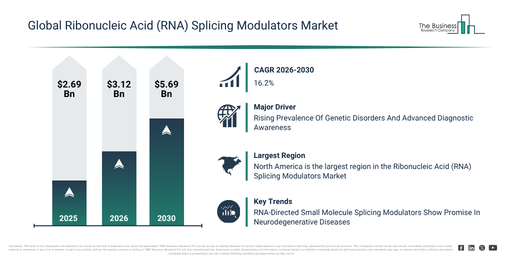
    The market for ribonucleic acid (RNA) splicing modulators has seen substantial growth in recent years. This market is anticipated to expand from $2.69 billion in 2025 to $3.12 billion in 2026, achieving a compound annual growth rate (CAGR) of 16.0%. The expansion observed historically is attributable to factors like the rising occurrence of genetic disorders, developments in molecular biology techniques, the proliferation of oncology therapeutics, increased research and development investments, and the adoption of antisense oligonucleotides.

    The ribonucleic acid (RNA) splicing modulators market size is projected to undergo significant expansion in the upcoming years. It is anticipated to grow to $5.69 billion by 2030, demonstrating a compound annual growth rate (CAGR) of 16.2%. This growth over the forecast period is fueled by the creation of AI-driven splicing modulators, the wider application of personalized medicine approaches, an increase in collaborations between pharmaceutical and biotechnology companies, enhancements in delivery mechanisms, and regulatory approvals for new therapies. Prominent trends for the forecast period include specific RNA splicing therapies, individualized genetic medicine, high-throughput screening platforms, the integration of bioinformatics tools, and advanced molecular modeling.

    Access Your Free Sample Report For In-Depth Market Analysis:

    https://www.thebusinessresearchcompany.com/sample_request?id=14237624&type=smp&name=Ribonucleic%20Acid%20%28RNA%29%20Splicing%20Modulators%20Market%20Report%202026

    What Major Factors Are Driving The Ribonucleic Acid (RNA) Splicing Modulators Market Forward?

    The escalating occurrence of genetic disorders is projected to propel the expansion of the ribonucleic acid (RNA) splicing modulators market in the future. Genetic disorders are conditions or illnesses resulting from irregularities in an individual’s DNA, encompassing mutations, deletions, or chromosomal alterations that impair normal biological functions. The increase in these disorders, attributed to heightened awareness and sophisticated diagnostic capabilities, facilitates the identification of more cases, enabling earlier detection and management of inherited conditions. RNA splicing modulators play a role in managing genetic disorders by targeting and rectifying aberrant RNA splicing events, thereby offering a therapeutic potential to address or control the genetic mutations responsible for these conditions. For example, in May 2024, the National Health Service, a UK-based government department, stated that 17,000 people live with sickle cell disease, an inherited genetic blood disorder, with roughly 250 new cases diagnosed each year. Thus, the rising prevalence of genetic disorders is a key factor driving the growth of the ribonucleic acid (RNA) splicing modulators market.

    Which Segments Define The Ribonucleic Acid (RNA) Splicing Modulators Market Segment Structure?

    The ribonucleic acid (RNA) splicing modulators market covered in this report is segmented –

    1) By Product Type: Small Molecule Modulators, Antisense Oligonucleotides, Small Interfering Ribonucleic Acid, Other Product Types

    2) By Route Of Administration: Subcutaneous, Intravenous, Intrathecal Central Nervous System Adjacent

    3) By Application: Cancer, Genetic Disorders, Neurological Disorders, Other Applications

    4) By End-User: Pharmaceutical Companies, Research Institutes, Hospitals And Clinics, Other End Users

    Subsegments:

    1) By Small Molecule Modulators: Splicing Factor Inhibitors, Ribonucleic Acid Binding Modulators, Kinase Modulators Affecting Splicing, Pre- Messenger Ribonucleic Acid Processing Modulators, Exon Skipping Enhancers

    2) By Antisense Oligonucleotides: Exon Skipping Antisense Oligonucleotides, Splice Site Modifying Antisense Oligonucleotides, Intronic Targeting Antisense Oligonucleotides, Messenger Ribonucleic Acid Degradation Inducing Antisense Oligonucleotides, Gene Expression Modulating Antisense Oligonucleotides

    3) By Small Interfering Ribonucleic Acid: Exon Skipping Small Interfering Ribonucleic Acid, Splice Site Small Interfering Ribonucleic Acid, Intronic Targeting Small Interfering Ribonucleic Acid, Pre- Messenger Ribonucleic Acid Processing Small Interfering Ribonucleic Acid, Gene Silencing Small Interfering Ribonucleic Acid

    4) By Other Product Types: Ribonucleoprotein Complex Modulators, Spliceosome Assembly Modulators, Ribonucleic Acid Editing Enzyme Modulators, Long Non-Coding Ribonucleic Acid Modulators, Messenger Ribonucleic Acid Modulators

    What Trends Are Affecting The Growth Of The Ribonucleic Acid (RNA) Splicing Modulators Market?

    Leading companies in the ribonucleic acid (RNA) splicing modulators market are concentrating on advancements in RNA-targeted drug discovery platforms, such as RNA-directed small molecule splicing modulators, with the goal of improving efficacy, enhancing safety, and addressing unmet needs in neurodegenerative diseases. RNA-directed small molecule splicing modulators are compact compounds that attach to RNA to modify pre-mRNA splicing, thereby correcting or adjusting splicing patterns to treat genetic diseases or cancers. For instance, in September 2025, Skyhawk Therapeutics, a US-based biotechnology company, released positive interim data from its Phase 1 clinical trial of SKY-0515 for Huntington’s disease. This is an orally administered, investigational small molecule RNA splicing modifier created through the company’s SKYSTAR platform. It exhibited dose-dependent reductions of mutant huntingtin protein (up to 62%) and PMS1 mRNA in patients, along with excellent brain penetration and a favorable safety profile, indicating a potential dual-mechanism strategy to target core pathogenic processes without operator intervention.

    Who Are The Established Players Within The Ribonucleic Acid (RNA) Splicing Modulators Market?

    Major companies operating in the ribonucleic acid (RNA) splicing modulators market are F. Hoffmann-La Roche Ltd, Pfizer Inc., Novartis AG, Biogen Inc., PTC Therapeutics Inc., Ionis Pharmaceuticals Inc., Abivax SA, Twist Bioscience Corporation, Wave Life Sciences Ltd, Arrakis Therapeutics Inc., Remix Therapeutics Inc., Anima Biotech Inc., Rgenta Therapeutics Inc., Avidity Biosciences Inc., Skyhawk Therapeutics Inc., Stoke Therapeutics Inc., Accent Therapeutics Inc., Chordia Therapeutics Inc., Panorama Medicine Inc., Serna Therapeutics Inc., Ribometrix Inc., Envisagenics Inc., Dyne Therapeutics Inc.

    Get The Full Ribonucleic Acid (RNA) Splicing Modulators Market Report:

    https://www.thebusinessresearchcompany.com/report/ribonucleic-acid-rna-splicing-modulators-market-report

    Which Region Accounts For The Largest Portion Of The Ribonucleic Acid (RNA) Splicing Modulators Market?

    North America was the largest region in the ribonucleic acid (RNA) splicing modulators market in 2025. Asia-Pacific is expected to be the fastest-growing region in the forecast period. The regions covered in the ribonucleic acid (RNA) splicing modulators market report are Asia-Pacific, South East Asia, Western Europe, Eastern Europe, North America, South America, Middle East, Africa.

    Request A Customized Ribonucleic Acid (RNA) Splicing Modulators Market Report For Competitive Insights:

    https://www.thebusinessresearchcompany.com/Customise?id=14237624&name=Ribonucleic%20Acid%20%28RNA%29%20Splicing%20Modulators%20Market%20Report%202026&type=smp

    Browse Through More Reports Similar to the Global Ribonucleic Acid (RNA) Splicing Modulators Market 2026, By The Business Research Company

    adeno-associated virus (avv) vectors in gene therapy market report 2026

    https://www.thebusinessresearchcompany.com/report/adeno-associated-virus-avv-vectors-in-gene-therapy-global-market-report

    gastric cancer therapy market report 2026

    https://www.thebusinessresearchcompany.com/report/gastric-cancer-therapy-global-market-report

    over the counter (otc) drugs market report 2026

    https://www.thebusinessresearchcompany.com/report/over-the-counter-otc-drugs-global-market-report

    Get in touch with us:

    The Business Research Company: https://www.thebusinessresearchcompany.com/

    Americas +1 310-496-7795

    Asia +44 7882 955267 & +91 8897263534

    Europe +44 7882 955267

    Email us at marketing@tbrc.info

    Follow us on:

    LinkedIn: https://in.linkedin.com/company/the-business-research-company

    YouTube: https://www.youtube.com/channel/UC24_fI0rV8cR5DxlCpgmyFQ

    Global Market Model: https://www.thebusinessresearchcompany.com/global-market-model
  • Protein-Folding Artificial Intelligence (AI) Platform Market Projected To Reach $7.57 Billion By 2030 With 32.2% CAGR

    Protein-Folding Artificial Intelligence (AI) Platform Market Projected To Reach $7.57 Billion By 2030 With 32.2% CAGR

    The Business Research Company’s 2026 market reports feature enhanced tools like market attractiveness analysis, TAM assessment, and company scoring matrices, along with interactive dashboards, deeper supply chain insights, and startup coverage strengthening the depth, usability, and strategic value of insights.

    What Is The Anticipated Rise In Market Value Of The Protein-Folding Artificial Intelligence (AI) Platform Market During The Forecast Period?

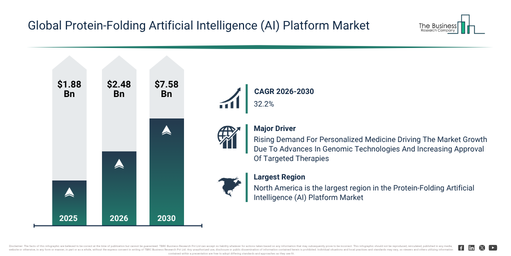
    The protein-folding artificial intelligence (AI) platform market has witnessed substantial growth in its size over recent years. It is anticipated to expand from $1.88 billion in 2025 to $2.48 billion in 2026, reflecting a compound annual growth rate (CAGR) of 32.0%. The expansion observed in the historic period stems from factors such as the increasing utilization of computational biology tools, an uptick in pharmaceutical research, the widespread availability of structural protein databases, a growing need for personalized medicine, and the advancement of high-performance computing systems.

    The protein-folding artificial intelligence (AI) platform market size is projected to experience significant expansion over the next few years. It is expected to reach $7.58 billion by 2030, demonstrating a compound annual growth rate (CAGR) of 32.2%. This projected growth is driven by the integration of AI and deep learning for protein folding, the expansion of cloud-based bioinformatics platforms, investments in specialized AI accelerators, increasing academic and biotech research initiatives, and the demand for faster drug discovery cycles. Key trends anticipated during the forecast period include AI-driven protein structure prediction, the incorporation of high-performance computing, automated molecular modeling, cloud-based bioinformatics platforms, and predictive drug discovery analytics.

    Access Your Free Sample Report For In-Depth Market Analysis:

    https://www.thebusinessresearchcompany.com/sample_request?id=35075992&type=smp&name=Protein-Folding%20Artificial%20Intelligence%20%28AI%29%20Platform%20Market%20Report%202026

    Which Major Drivers Are Influencing The Expansion Of The Protein-Folding Artificial Intelligence (AI) Platform Market?

    The increasing uptake of personalized medicine is set to fuel the expansion of the protein-folding artificial intelligence (AI) platform market. Personalized medicine offers a tailored healthcare approach, customizing treatments based on an individual’s unique biological and personal traits. Its rise is attributed to advancements in genomic technologies, which enable healthcare providers to swiftly and accurately analyze genetic data, facilitating more precise and effective therapies. Protein-folding AI platforms support personalized medicine by forecasting patient-specific protein structures, thereby guiding targeted drug choices and optimizing treatments. For example, the Personalized Medicine Coalition, a US-based non-profit organization, stated in February 2024 that the FDA approved 16 new personalized treatments for rare disease patients in 2023, an increase from six in 2022. These approvals for 2023 also encompassed seven cancer drugs and three for other conditions. Consequently, the expanding adoption of personalized medicine is a key driver for the protein-folding artificial intelligence (AI) platform market. Increased research and development (R&D) activities are anticipated to propel the growth of the protein-folding artificial intelligence (AI) platform market moving forward. R&D activities involve systematic endeavors to invent, enhance, or innovate products, processes, or services by applying scientific and technical knowledge. The surge in R&D is due to heightened global competition, prompting organizations to invest in innovation and advanced technologies for market differentiation and sustainable long-term growth. These activities benefit protein-folding AI platforms by facilitating the development and refinement of algorithms, enhancing protein structure predictions, and expediting the discovery of new therapeutics. For instance, the Office for National Statistics, a UK-based government agency, indicated in April 2025 that the UK government’s net expenditure on research and development (R&D) climbed to £17.4 billion ($22.1 billion) in 2023, representing an 8.2% increase from £16.1 billion ($20.45 billion) in 2022. Therefore, the expansion of research and development activities is a key factor boosting the protein-folding artificial intelligence (AI) platform market.

    What Are The Key Segment Divisions In The Protein-Folding Artificial Intelligence (AI) Platform Market Segment Structure?

    The protein-folding artificial intelligence (AI) platform market covered in this report is segmented –

    1) By Component: Software, Hardware, Services

    2) By Deployment Mode: On-Premises, Cloud

    3) By Application: Drug Discovery, Disease Research, Personalized Medicine, Biotechnology, Academic Research, Other Applications

    4) By End-User: Pharmaceutical And Biotechnology Companies, Research Institutes, Healthcare Providers, Other End Users

    Subsegments:

    1) By Software: Protein Structure Prediction Platforms, Molecular Modeling And Simulation Software, Bioinformatics Analysis Software, Data Visualization And Interpretation Tools, Machine Learning And Deep Learning Frameworks, Workflow Management And Automation Software

    2) By Hardware: High Performance Computing Systems, Graphics Processing Units, Central Processing Units, Data Storage Systems, High Speed Networking Infrastructure, Specialized Artificial Intelligence Accelerators

    3) By Services: Consulting And Advisory Services, System Integration Services, Cloud And Infrastructure Management Services, Model Development And Validation Services, Data Annotation And Curation Services, Maintenance And Technical Support Services

    Which Organizations Are Engaged In The Protein-Folding Artificial Intelligence (AI) Platform Market?

    Major companies operating in the protein-folding artificial intelligence (AI) platform market are Schrodinger Inc., XtalPi Inc., Isomorphic Labs Limited, Recursion Pharmaceuticals Inc., Nabla Bio Inc., Arzeda Corporation, Evozyne, ProteinQure Inc., Genesis Therapeutics Inc., Cradle Bio Inc., Profluent Inc., Evaxion Biotech A/S, Iambic Therapeutics Inc., Insilico Medicine Inc., Insitro Inc., Levitate Bio Inc., Shiru Inc., Tamarind Bio, Archon Biosciences, Neoncorte Bio, and Generate Biomedicines Inc.

    Get The Full Protein-Folding Artificial Intelligence (AI) Platform Market Report:

    https://www.thebusinessresearchcompany.com/report/protein-folding-artificial-intelligence-ai-platform-market-report

    Which Geographic Region Dominates The Protein-Folding Artificial Intelligence (AI) Platform Market?

    North America was the largest region in the protein-folding artificial intelligence (AI) platform market in 2025. Asia-Pacific is expected to be the fastest-growing region in the forecast period. The regions covered in the protein-folding artificial intelligence (AI) platform market report are Asia-Pacific, South East Asia, Western Europe, Eastern Europe, North America, South America, Middle East, Africa.

    Request A Customized Protein-Folding Artificial Intelligence (AI) Platform Market Report For Competitive Insights:

    https://www.thebusinessresearchcompany.com/Customise?id=35075992&name=Protein-Folding%20Artificial%20Intelligence%20%28AI%29%20Platform%20Market%20Report%202026&type=smp

    Browse Through More Reports Similar to the Global Protein-Folding Artificial Intelligence (AI) Platform Market 2026, By The Business Research Company

    adeno-associated virus (avv) vectors in gene therapy market report 2026

    https://www.thebusinessresearchcompany.com/report/adeno-associated-virus-avv-vectors-in-gene-therapy-global-market-report

    gastric cancer therapy market report 2026

    https://www.thebusinessresearchcompany.com/report/gastric-cancer-therapy-global-market-report

    over the counter (otc) drugs market report 2026

    https://www.thebusinessresearchcompany.com/report/over-the-counter-otc-drugs-global-market-report

    Get in touch with us:

    The Business Research Company: https://www.thebusinessresearchcompany.com/

    Americas +1 310-496-7795

    Asia +44 7882 955267 & +91 8897263534

    Europe +44 7882 955267

    Email us at marketing@tbrc.info

    Follow us on:

    LinkedIn: https://in.linkedin.com/company/the-business-research-company

    YouTube: https://www.youtube.com/channel/UC24_fI0rV8cR5DxlCpgmyFQ

    Global Market Model: https://www.thebusinessresearchcompany.com/global-market-model
  • Global Protein Stability Screening Platforms Market Forecast Through 2030 With Strategic Industry Perspectives

    Global Protein Stability Screening Platforms Market Forecast Through 2030 With Strategic Industry Perspectives

    The Business Research Company’s 2026 market reports feature enhanced tools like market attractiveness analysis, TAM assessment, and company scoring matrices, along with interactive dashboards, deeper supply chain insights, and startup coverage strengthening the depth, usability, and strategic value of insights.

    What Level Of Market Value Growth Is Predicted For The Protein Stability Screening Platforms Market From 2026 To 2030?

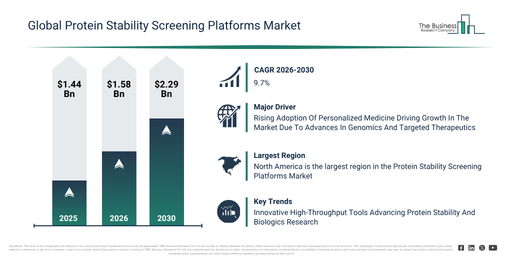
    The protein stability screening platforms market has experienced robust expansion in recent times. This market is projected to expand from $1.44 billion in 2025 to $1.58 billion in 2026, demonstrating a compound annual growth rate (CAGR) of 9.5%. Historically, this growth has been driven by factors such as the increasing demand for biologics, the widespread use of conventional stability testing methods, elevated investment in pharmaceutical research and development, the proliferation of monoclonal antibody therapies, and rigorous regulatory mandates.

    The market size for protein stability screening platforms is expected to experience robust growth in the upcoming years. It is anticipated to expand to $2.29 billion by 2030, demonstrating a compound annual growth rate (CAGR) of 9.7%. This expansion during the forecast period can be attributed to several factors, including the adoption of AI-driven protein stability platforms, their integration with IoT-enabled lab systems, the ongoing expansion of biopharmaceutical pipelines, a rising demand for real-time monitoring, and the development of predictive modeling software. Significant trends projected for the forecast period include high-throughput protein stability screening, automated formulation analysis, integration with laboratory information systems, real-time protein degradation monitoring, and predictive shelf-life modeling.

    Access Your Free Sample Report For In-Depth Market Analysis:

    https://www.thebusinessresearchcompany.com/sample_request?id=84127593&type=smp&name=Protein%20Stability%20Screening%20Platforms%20Market%20Report%202026

    Which Drivers Are Supporting The Protein Stability Screening Platforms Market Growth?

    The increasing acceptance and use of personalized medicine are anticipated to drive the expansion of the protein stability screening platforms market. Personalized medicine focuses on customizing medical interventions and health choices based on a person’s unique genetic makeup, molecular characteristics, and clinical data, aiming to enhance the effectiveness and safety of therapies. Its growth is primarily fueled by breakthroughs in genomics and molecular diagnostics, which allow for the detection of genetic differences and molecular indicators affecting disease development and drug reactions, thereby facilitating the creation of more precise treatments. Protein stability screening platforms are crucial in personalized medicine; they assess how proteins maintain stability, fold correctly, and interact in different environments, a process vital for refining the design of drugs and biologics. As an illustration, in February 2024, the Personalized Medicine Coalition, a U.S.-based non-profit organization, stated that the U.S. Food and Drug Administration (FDA) sanctioned 16 novel personalized treatments for patients with rare diseases in 2023, marking an increase from six approvals in 2022. Consequently, the increasing adoption of personalized medicine is indeed propelling the expansion of the protein stability screening platforms market.

    How Is The Protein Stability Screening Platforms Market Broken Down By Segment Categories?

    The protein stability screening platforms market covered in this report is segmented –

    1) By Protein Type: Monoclonal Antibodies, Recombinant Proteins, Vaccines And Antigens, Enzymes, Other Protein Types

    2) By Technology: Differential Scanning Calorimetry, Differential Scanning Fluorimetry, Spectroscopy, Chromatography, Other Technologies

    3) By Component Type: Instruments, Consumables, Software, Services

    4) By Application: Drug Discovery, Biopharmaceutical Development, Protein Engineering, Academic Research, Other Applications

    5) By End-User: Pharmaceutical & Biotechnology Companies, Academic And Research Institutes, Contract Research Organizations, Other End-Users

    Subsegments:

    1) By Monoclonal Antibodies: Human Monoclonal Antibodies, Chimeric Monoclonal Antibodies, Humanized Monoclonal Antibodies, Murine Monoclonal Antibodies

    2) By Recombinant Proteins: Recombinant Human Proteins, Recombinant Animal Proteins, Recombinant Microbial Proteins, Recombinant Plant Proteins

    3) By Vaccines and Antigens: Protein Subunit Vaccines, Conjugate Vaccines, Toxoid Vaccines, Virus Like Particle Vaccines

    4) By Enzymes: Hydrolases, Oxidoreductases, Transferases, Lyases, Isomerases, Ligases

    5) By Other Protein Types: Fusion Proteins, Cytokines, Hormones, Growth Factors

    Which Trends Are Guiding The Direction Of The Protein Stability Screening Platforms Market?

    Companies operating in the protein stability screening platforms market are increasingly concentrating on developing innovative high-throughput instruments that facilitate the rapid evaluation of protein stability, aggregation, and folding, thereby accelerating biopharmaceutical development and optimizing formulations. High-throughput tools are systems designed to perform a large number of experiments or analyses simultaneously, allowing researchers to efficiently generate robust datasets while reducing both time and sample consumption. For example, in January 2025, Unchained Labs Ltd., a U.S.-based life sciences tools company, introduced Aunty, a platform created to expedite biologics and gene therapy research. This system integrates full-spectrum fluorescence with static and dynamic light scattering, enabling the simultaneous assessment of thermal, aggregation, and colloidal stability. It operates with minimal sample volumes of approximately 8 µL in a 96-well plate format, supporting efficient, high-throughput protein characterization during the early stages of drug development.

    Which Players Are Present In The Protein Stability Screening Platforms Market Space?

    Major companies operating in the protein stability screening platforms market are Thermo Fisher Scientific Inc., GE Healthcare Life Sciences, Agilent Technologies Inc., Shimadzu Corporation, Bruker Corporation, Waters Corporation, Revvity Inc., Bio-Rad Laboratories Inc., Spectris plc., Malvern Panalytical Ltd., Promega Corporation, Unchained Labs Inc., NanoTemper Technologies GmbH, Creative Biostructure Inc., BMG LABTECH GmbH, Jasco Inc., Porvair Sciences Ltd., Zinsser Analytic GmbH, Jena Bioscience GmbH, Applied Photophysics Ltd., Enzo Life Sciences Inc.

    Get The Full Protein Stability Screening Platforms Market Report:

    https://www.thebusinessresearchcompany.com/report/protein-stability-screening-platforms-market-report

    Where Is The Protein Stability Screening Platforms Market Primarily Concentrated By Region?

    North America was the largest region in the protein stability screening platforms market in 2025. Asia-Pacific is expected to be the fastest-growing region in the forecast period. The regions covered in the protein stability screening platforms market report are Asia-Pacific, South East Asia, Western Europe, Eastern Europe, North America, South America, Middle East, Africa.

    Request A Customized Protein Stability Screening Platforms Market Report For Competitive Insights:

    https://www.thebusinessresearchcompany.com/Customise?id=84127593&name=Protein%20Stability%20Screening%20Platforms%20Market%20Report%202026&type=smp

    Browse Through More Reports Similar to the Global Protein Stability Screening Platforms Market 2026, By The Business Research Company

    adeno-associated virus (avv) vectors in gene therapy market report 2026

    https://www.thebusinessresearchcompany.com/report/adeno-associated-virus-avv-vectors-in-gene-therapy-global-market-report

    gastric cancer therapy market report 2026

    https://www.thebusinessresearchcompany.com/report/gastric-cancer-therapy-global-market-report

    over the counter (otc) drugs market report 2026

    https://www.thebusinessresearchcompany.com/report/over-the-counter-otc-drugs-global-market-report

    Get in touch with us:

    The Business Research Company: https://www.thebusinessresearchcompany.com/

    Americas +1 310-496-7795

    Asia +44 7882 955267 & +91 8897263534

    Europe +44 7882 955267

    Email us at marketing@tbrc.info

    Follow us on:

    LinkedIn: https://in.linkedin.com/company/the-business-research-company

    YouTube: https://www.youtube.com/channel/UC24_fI0rV8cR5DxlCpgmyFQ

    Global Market Model: https://www.thebusinessresearchcompany.com/global-market-model
  • Pre-Sterilized Nested Vials Market Analysis 2026–2030 Driven By Technological Advancements And Growth Factors

    Pre-Sterilized Nested Vials Market Analysis 2026–2030 Driven By Technological Advancements And Growth Factors

    The Business Research Company’s 2026 market reports feature enhanced tools like market attractiveness analysis, TAM assessment, and company scoring matrices, along with interactive dashboards, deeper supply chain insights, and startup coverage strengthening the depth, usability, and strategic value of insights.

    How Will The Market Value Of The Pre-Sterilized Nested Vials Market Progress Between 2026 And 2030?

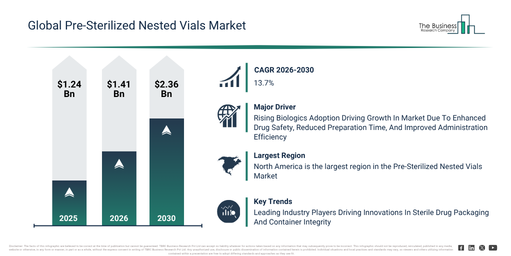
    The market for pre-sterilized nested vials has seen rapid expansion in recent years. This market is expected to expand from $1.24 billion in 2025 to $1.41 billion in 2026, achieving a compound annual growth rate (CAGR) of 13.5%. The historical growth of this market can be ascribed to factors such as increasing demand for injectable drugs, the adoption of pre-sterilized vials, the expansion of biologics and vaccines, a rise in contract manufacturing operations, and strict pharmaceutical packaging regulations.

    The pre-sterilized nested vials market is projected for significant expansion over the coming years, with its valuation anticipated to reach $2.36 billion by 2030, exhibiting a compound annual growth rate (CAGR) of 13.7%. This projected growth is driven by several factors, including the increasing automation of aseptic fill-finish processes, the emergence of sustainable nested vials, the scaling up of vaccine production, the incorporation of sophisticated polymer and glass materials, and the integration of digital tracking and monitoring systems. Key trends expected during this period involve the integration of automated aseptic filling, a wider embrace of pre-sterilized packaging, the automation of nested vial handling, advancements in material science, and the streamlining of regulatory compliance.

    Access Your Free Sample Report For In-Depth Market Analysis:

    https://www.thebusinessresearchcompany.com/sample_request?id=62313879&type=smp&name=Pre-Sterilized%20Nested%20Vials%20Market%20Report%202026

    What Key Factors Are Affecting The Pre-Sterilized Nested Vials Market Demand?

    The expanded use of biologics is projected to fuel the expansion of the pre-sterilized nested vials market. Biologics adoption signifies the increasing deployment of biologic treatments by healthcare providers and patients in regular clinical practice. This uptick is driven by the ability of biologics to offer targeted therapeutic outcomes, especially for chronic, autoimmune, and metabolic diseases where traditional small-molecule therapies frequently exhibit limited effectiveness. Pre-sterilized nested vials support the increasing application of biologics by supplying ready-to-use, contamination-free primary packaging options that guarantee product safety, uphold drug stability, and minimize preparation time during aseptic filling and administration. For instance, in October 2024, the Generics and Biosimilars Initiative (GaBI), a Belgium-based organization providing scientific information on generic and biosimilar medicines, reported that in addition to nine leading biologics, two other complex biologic drugs—Novo Nordisk’s Ozempic (semaglutide) and Eli Lilly’s Trulicity (dulaglutide), both prescribed for type 2 diabetes—recorded significant sales in 2023, totaling approximately US$14 billion and US$7.2 billion, respectively. Therefore, the growing adoption of biologics is a key driver for the pre-sterilized nested vials market.

    What Are The Different Segment Types In The Pre-Sterilized Nested Vials Market Segment Breakdown?

    The pre-sterilized nested vials market covered in this report is segmented –

    1) By Product Type: Glass Nested Vials, Plastic Nested Vials

    2) By Sterilization Method: Gamma Sterilization, Ethylene Oxide Sterilization, Steam Sterilization, Other Sterilization Methods

    3) By Capacity: 2R, 6R, 10R, 20R, Other Capacities

    4) By Application: Injectable Drugs Packaging, Biologics Packaging, Vaccine Packaging, Clinical Trial Packaging, Aseptic Fill-Finish Operations

    5) By End-User: Hospitals, Contract Manufacturing Organizations, Research Institutes, Other End-Users

    Subsegments:

    1) By Glass Nested Vials: Type I Borosilicate, Type II Soda Lime Treated, Type III Soda Lime, Neutral Glass

    2) By Plastic Nested Vials: Polypropylene, Polyethylene, Cyclo Olefin Polymer, Polycarbonate

    What Trends Are Affecting The Growth Of The Pre-Sterilized Nested Vials Market?

    Major companies operating in the pre-sterilized nested vials market are focusing on developing innovative solutions, such as container closure integrity, to ensure sterile drug delivery, prevent contamination, and maintain the stability and safety of pharmaceutical products. Container closure integrity refers to a packaging system’s ability to uphold a complete seal that prevents contamination, leakage, or loss of sterility. For instance, in May 2024, West Pharmaceutical Services Inc., a US-based manufacturing company, launched Daikyo Crystal Zenith (CZ) Nested Vials in a Tub. These are ready-to-use, pre-sterilized cyclic olefin polymer (COP) vials intended for sensitive therapies including cell/gene treatments and radiopharmaceuticals. Available in 2 mL (100 vials/tub) and 10 mL (48 vials/tub) sizes with ISO 8362-1 glass-like exterior dimensions, they guarantee cryogenic container closure integrity, low particulates (<2% USP <788>), high viral vector recovery, breakage resistance, and minimal chemical interactions.

    Who Are The Well-Known Companies In The Pre-Sterilized Nested Vials Market?

    Major companies operating in the pre-sterilized nested vials market are Corning Incorporated, Terumo Corporation, Nipro PharmaPackaging, West Pharmaceutical Services Inc., Gerresheimer AG, Datwyler Holding Inc., Stevanato Group, SCHOTT AG, Shandong Pharmaceutical Glass Co. Ltd., SGD Pharma, Bormioli Pharma, Adelphi Healthcare Packaging, DWK Life Sciences, Linuo Glassworks Group, SiO2 Materials Science, Jinan Youlyy Industrial Co. Ltd., Origin Pharma Packaging, Pacific Vial Manufacturing Inc., Daikyo Seiko Ltd., Qorpak, AptarGroup Inc., QCVIALZ LLC.

    Get The Full Pre-Sterilized Nested Vials Market Report:

    https://www.thebusinessresearchcompany.com/report/pre-sterilized-nested-vials-market-report

    Which Region Has The Greatest Market Share In The Pre-Sterilized Nested Vials Market?

    North America was the largest region in the pre-sterilized nested vials market in 2025. Asia-Pacific is expected to be the fastest-growing region in the forecast period. The regions covered in the pre-sterilized nested vials market report are Asia-Pacific, South East Asia, Western Europe, Eastern Europe, North America, South America, Middle East, Africa.

    Request A Customized Pre-Sterilized Nested Vials Market Report For Competitive Insights:

    https://www.thebusinessresearchcompany.com/Customise?id=62313879&name=Pre-Sterilized%20Nested%20Vials%20Market%20Report%202026&type=smp

    Browse Through More Reports Similar to the Global Pre-Sterilized Nested Vials Market 2026, By The Business Research Company

    adeno-associated virus (avv) vectors in gene therapy market report 2026

    https://www.thebusinessresearchcompany.com/report/adeno-associated-virus-avv-vectors-in-gene-therapy-global-market-report

    gastric cancer therapy market report 2026

    https://www.thebusinessresearchcompany.com/report/gastric-cancer-therapy-global-market-report

    over the counter (otc) drugs market report 2026

    https://www.thebusinessresearchcompany.com/report/over-the-counter-otc-drugs-global-market-report

    Get in touch with us:

    The Business Research Company: https://www.thebusinessresearchcompany.com/

    Americas +1 310-496-7795

    Asia +44 7882 955267 & +91 8897263534

    Europe +44 7882 955267

    Email us at marketing@tbrc.info

    Follow us on:

    LinkedIn: https://in.linkedin.com/company/the-business-research-company

    YouTube: https://www.youtube.com/channel/UC24_fI0rV8cR5DxlCpgmyFQ

    Global Market Model: https://www.thebusinessresearchcompany.com/global-market-model
  • Preclinical Antibody Development Market Forecast Highlighting Emerging Opportunities And Industry Developments Through 2030

    Preclinical Antibody Development Market Forecast Highlighting Emerging Opportunities And Industry Developments Through 2030

    The Business Research Company’s 2026 market reports feature enhanced tools like market attractiveness analysis, TAM assessment, and company scoring matrices, along with interactive dashboards, deeper supply chain insights, and startup coverage strengthening the depth, usability, and strategic value of insights.

    What Are The Market Size Estimates For The Preclinical Antibody Development Market In 2026 And 2030?

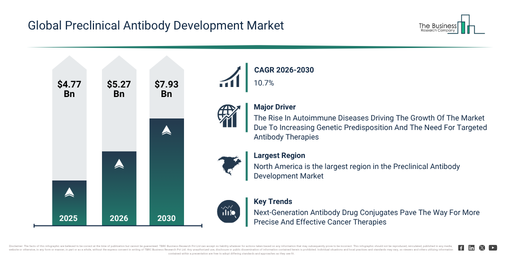
    The preclinical antibody development market has seen rapid expansion in recent years. This market is projected to increase from $4.77 billion in 2025 to $5.27 billion in 2026, at a compound annual growth rate (CAGR) of 10.5%. Historically, this growth was primarily fueled by the rising demand for therapeutic antibodies, advancements in monoclonal antibody technologies, the growth of research in oncology and infectious diseases, improvements in laboratory automation, and increased R&D investments by pharmaceutical companies.

    The preclinical antibody development market size is anticipated to undergo significant expansion in the coming years, with projections indicating a rise to $7.93 billion by 2030, exhibiting a compound annual growth rate (CAGR) of 10.7%. This expansion during the forecast period is attributable to factors such as the increasing adoption of AI-based antibody design platforms, the incorporation of predictive analytics into preclinical studies, the growing biotechnology research infrastructure, a heightened emphasis on personalized medicine, and a surge in collaborations between pharmaceutical and biotech companies. Notable trends expected during this period encompass high-throughput antibody screening, AI-driven candidate optimization, advanced in vitro assays, predictive toxicity modeling, and early-stage developability assessment.

    Access Your Free Sample Report For In-Depth Market Analysis:

    https://www.thebusinessresearchcompany.com/sample_request?id=73216258&type=smp&name=Preclinical%20Antibody%20Development%20Market%20Report%202026

    Which Primary Drivers Are Impacting The Preclinical Antibody Development Market Growth?

    The rising occurrence of autoimmune conditions is anticipated to fuel expansion in the preclinical antibody development market in the coming years. These disorders involve the immune system erroneously targeting healthy cells and tissues, resulting in persistent inflammation and cellular harm. The growing incidence of these conditions stems from a mix of genetic predispositions, environmental and lifestyle elements, shifts in immune-modulating influences, and enhanced understanding and diagnosis of diseases. The escalating impact of autoimmune ailments has created substantial unaddressed medical requirements, motivating pharmaceutical and biotech firms to intensify their research and development initiatives on specific biologic treatments. In this context, preclinical antibody development is crucial, facilitating the identification, testing, and refinement of antibodies intended to precisely regulate or suppress imbalanced immune reactions before they enter clinical trials. An illustrative example comes from February 2024, where Arthritis Australia, an Australia-based non-profit organization, reported that the population of males with rheumatoid arthritis (RA), an autoimmune disease, is 212,136 and females 362,137 in 2025. These figures are projected to climb by 2040, reaching approximately 280,040 males and 479,828 females. Consequently, the expanding occurrence of autoimmune diseases is indeed propelling the expansion of the preclinical antibody development market.

    Which Segment Classifications Are Used In The Preclinical Antibody Development Market Segment Analysis?

    The preclinical antibody development market covered in this report is segmented –

    1) By Type: Monoclonal Antibodies, Polyclonal Antibodies, Other Types

    2) By Service Type: Antibody Discovery, Humanization And Engineering, Affinity Maturation, Developability Assessment, Expression And Purification, In Vitro Functional Characterization

    3) By Application: Oncology, Infectious Diseases, Autoimmune Diseases, Other Applications

    4) By End-User: Pharmaceutical Companies, Biotechnology Companies, Research Institutes, Other End-Users

    Subsegments:

    1) By Monoclonal Antibodies: Murine Monoclonal Antibodies, Chimeric Monoclonal Antibodies, Humanized Monoclonal Antibodies, Fully Human Monoclonal Antibodies, Recombinant Monoclonal Antibodies

    2) By Polyclonal Antibodies: Primary Polyclonal Antibodies, Secondary Polyclonal Antibodies, Affinity Purified Polyclonal Antibodies, Antiserum Polyclonal Antibodies, Species Specific Polyclonal Antibodies

    3) By Other Types: Bispecific Antibodies, Single Domain Antibodies, Antibody Fragments, Conjugated Antibodies, Catalytic Antibodies

    Which Trends Are Shaping The Preclinical Antibody Development Market?

    Major companies operating in the preclinical antibody development market are increasingly concentrating on developing innovative modalities, such as antibody-drug conjugates (ADCs), to enhance targeted cancer treatments and improve their efficacy. ADCs represent a category of targeted therapeutics that merge the specific recognition of monoclonal antibodies with the powerful cytotoxic activity of small-molecule drugs. This enables the selective delivery of toxic payloads directly to cancer cells while reducing damage to healthy tissues. For instance, in November 2024, Celltrion Inc., a South Korea–based biopharmaceutical company, revealed the development of CT-P70 and CT-P71. These are two novel preclinical ADC candidates designed to target solid tumors, including non-small cell lung cancer and bladder cancer, respectively. Both ADCs comprise tumor-targeting antibodies conjugated to cytotoxic payloads, engineered to achieve precise tumor targeting with minimized off-target toxicity, potentially enhancing therapeutic indices compared to conventional monoclonal antibodies or chemotherapies. Such advanced ADC programs signify a broader industry shift from biosimilar manufacturing towards the creation of novel, differentiated biologic therapies.

    Which Firms Are Contributing To The Preclinical Antibody Development Market Ecosystem?

    Major companies operating in the preclinical antibody development market are Thermo Fisher Scientific Inc., WuXi AppTec Co Ltd., Charles River Laboratories International Inc., Sartorius Aktiengesellschaft, Samsung Biologics Co. Ltd., Evotec SE, KBI Biopharma Inc., GenScript Biotech Corporation, Abzena plc, Crown Bioscience Inc., AbCellera Biologics Inc., Adimab LLC, Creative Biolabs Inc., Boehringer Ingelheim BioXcellence GmbH, Integral Molecular Inc., ProMab Biotechnologies Inc., Eurofins Scientific SE, Ablexis Inc., Mabsilico Inc., Fujifilm Diosynth Biotechnologies Inc., Recipharm AB.

    Get The Full Preclinical Antibody Development Market Report:

    https://www.thebusinessresearchcompany.com/report/preclinical-antibody-development-market-report

    Which Region Accounts For The Largest Portion Of The Preclinical Antibody Development Market?

    North America was the largest region in the preclinical antibody development market in 2025. Asia-Pacific is expected to be the fastest-growing region in the forecast period. The regions covered in the preclinical antibody development market report are Asia-Pacific, South East Asia, Western Europe, Eastern Europe, North America, South America, Middle East, Africa.

    Request A Customized Preclinical Antibody Development Market Report For Competitive Insights:

    https://www.thebusinessresearchcompany.com/Customise?id=73216258&name=Preclinical%20Antibody%20Development%20Market%20Report%202026&type=smp

    Browse Through More Reports Similar to the Global Preclinical Antibody Development Market 2026, By The Business Research Company

    adeno-associated virus (avv) vectors in gene therapy market report 2026

    https://www.thebusinessresearchcompany.com/report/adeno-associated-virus-avv-vectors-in-gene-therapy-global-market-report

    gastric cancer therapy market report 2026

    https://www.thebusinessresearchcompany.com/report/gastric-cancer-therapy-global-market-report

    over the counter (otc) drugs market report 2026

    https://www.thebusinessresearchcompany.com/report/over-the-counter-otc-drugs-global-market-report

    Get in touch with us:

    The Business Research Company: https://www.thebusinessresearchcompany.com/

    Americas +1 310-496-7795

    Asia +44 7882 955267 & +91 8897263534

    Europe +44 7882 955267

    Email us at marketing@tbrc.info

    Follow us on:

    LinkedIn: https://in.linkedin.com/company/the-business-research-company

    YouTube: https://www.youtube.com/channel/UC24_fI0rV8cR5DxlCpgmyFQ

    Global Market Model: https://www.thebusinessresearchcompany.com/global-market-model
  • Pooled Clustered Regularly Interspaced Short Palindromic Repeats (CRISPR) Screening Market Outlook Through 2030 Featuring Market Trends And Industry Developments

    Pooled Clustered Regularly Interspaced Short Palindromic Repeats (CRISPR) Screening Market Outlook Through 2030 Featuring Market Trends And Industry Developments

    The Business Research Company’s 2026 market reports feature enhanced tools like market attractiveness analysis, TAM assessment, and company scoring matrices, along with interactive dashboards, deeper supply chain insights, and startup coverage strengthening the depth, usability, and strategic value of insights.

    What Is The Projected Increase In Market Value Of The Pooled Clustered Regularly Interspaced Short Palindromic Repeats (CRISPR) Screening Market During 2026–2030?

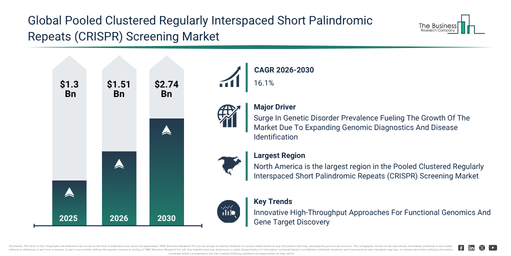
    The pooled clustered regularly interspaced short palindromic repeats (CRISPR) screening market size has seen rapid expansion in recent years. Its valuation is expected to increase from $1.3 billion in 2025 to $1.51 billion in 2026, achieving a compound annual growth rate (CAGR) of 15.9%. This historical development can be attributed to several factors including a growing need for functional genomics, increased uptake of CRISPR-Cas9 technology, advancements in pharmaceutical research and development, progress in gene editing tools, and the proliferation of academic research endeavors.

    The pooled clustered regularly interspaced short palindromic repeats (crispr) screening market size is expected to experience rapid growth in the next few years, projected to reach $2.74 billion by 2030, at a compound annual growth rate (CAGR) of 16.1%. This expansion during the forecast period is attributed to AI-enabled gene screening, the integration with cloud-based genomics platforms, increasing demand for personalized medicine applications, the expansion of biotech infrastructure, and automation in high-throughput screening. Major trends for this period include high-throughput screening techniques, integration with multi-omics data, automated crispr workflows, AI-driven gene target identification, and real-time functional genomics analysis.

    Access Your Free Sample Report For In-Depth Market Analysis:

    https://www.thebusinessresearchcompany.com/sample_request?id=56373934&type=smp&name=Pooled%20Clustered%20Regularly%20Interspaced%20Short%20Palindromic%20Repeats%20%28CRISPR%29%20Screening%20Market%20Report%202026

    What Major Factors Are Driving The Pooled Clustered Regularly Interspaced Short Palindromic Repeats (CRISPR) Screening Market Forward?

    The growing incidence of genetic conditions is anticipated to fuel expansion within the pooled clustered regularly interspaced short palindromic repeats (CRISPR) screening market. Genetic disorders originate from inherited or acquired DNA anomalies, impacting an individual’s normal development, metabolic processes, or physiological function. This increase in prevalence is partly due to factors like older parental age, enhanced diagnostic methods, and broader genetic screening, all contributing to elevated detection and reporting figures. Pooled CRISPR screening is vital for genetic disorder research, facilitating rapid, genome-wide identification of genes and pathways linked to diseases. An example is the Cystic Fibrosis Trust, a UK-based charity, which in October 2024, indicated that 11,148 cystic fibrosis patients were recorded in 2022, rising to 11,318 in 2023, marking an annual increase of approximately 1.5%. Consequently, the increasing occurrence of genetic disorders is boosting the growth of the pooled clustered regularly interspaced short palindromic repeats (CRISPR) screening market. Rising Research And Development Investments Driving Growth In The Market Due To Advancements In Real-Time Genomic Data Analysis

    Enhanced research and development funding is anticipated to stimulate the expansion of the pooled clustered regularly interspaced short palindromic repeats (CRISPR) screening market in the coming years. R&D investments involve dedicating resources to innovate new products, enhance current offerings, and advance technologies to foster innovation and sustainable business growth. Progressive technological breakthroughs are prompting greater R&D investments, as businesses are compelled to continually innovate and modernize their products and processes to keep pace with swift digital transformation and evolving industry benchmarks. These investments benefit CRISPR screening by facilitating the creation of sophisticated gene-editing instruments, refining protocols, and boosting precision and effectiveness for quicker identification of gene functions. For example, in 2023, the Office for National Statistics, a UK-based government body, reported that the UK government’s net expenditure on R&D climbed to £17.4 billion ($22.1 billion) in 2023, an increase from £16.1 billion ($20.45 billion) in 2022, indicating an 8.2% growth. Thus, the escalating research and development investments are a key factor in driving the growth of the pooled clustered regularly interspaced short palindromic repeats (CRISPR) screening market.

    How Is The Pooled Clustered Regularly Interspaced Short Palindromic Repeats (CRISPR) Screening Market Segmented Across Different Segment Categories?

    The pooled clustered regularly interspaced short palindromic repeats (crispr) screening market covered in this report is segmented –

    1) By Screening Type: Genome Wide Screening, Targeted Screening

    2) By Product Type: Libraries, Reagents And Kits, Instruments, Software, Services

    3) By Technology: Clustered Regularly Interspaced Short Palindromic Repeats (CRISPR) Cas9 Screening, Clustered Regularly Interspaced Short Palindromic Repeats (CRISPR) Interference Screening, Clustered Regularly Interspaced Short Palindromic Repeats (CRISPR) Activation Screening

    4) By Application: Functional Genomics, Drug Discovery, Cancer Research, Gene Regulation, Other Applications

    5) By End-User: Pharmaceutical And Biotechnology Companies, Academic And Research Institutes, Contract Research Organizations, Other End-Users

    Subsegments:

    1) By Genome Wide Screening: Knockout Screening, Activation Screening, Interference Screening

    2) By Targeted Screening: Gene Specific Knockout, Gene Specific Activation, Gene Specific Interference

    Which Trends Are Impacting The Progress Of The Pooled Clustered Regularly Interspaced Short Palindromic Repeats (CRISPR) Screening Market?

    Major companies operating in the pooled clustered regularly interspaced short palindromic repeats (CRISPR) screening market are actively developing innovative solutions like transcriptome-wide profiling to enable efficient high-throughput functional genomics and precise identification of gene targets for therapeutic and research applications. Transcriptome-wide profiling refers to the comprehensive analysis of all RNA transcripts expressed in a cell or tissue at a given time, providing valuable insights into gene activity, regulation, and cellular functions. As an illustration, in June 2023, Parse Biosciences Inc., a US-based biotechnology company, launched CRISPR Detect, a technology designed to facilitate high-scale single-cell pooled CRISPR screens. This innovation integrates with the company’s Evercode Whole Transcriptome platform to pair individual gene perturbations, using Cas12-based single guide ribonucleic acid (RNA) (sgRNAs), with whole-transcriptome expression profiles across up to one million cells per experiment, thereby overcoming previous throughput and cost barriers in droplet-based single-cell RNA-seq. This significantly broadens applications in genome-scale gene function analysis, regulatory networks, signaling pathways, and drug discovery, extending beyond targeted validation.

    Which Organizations Play A Role In The Pooled Clustered Regularly Interspaced Short Palindromic Repeats (CRISPR) Screening Market Landscape?

    Major companies operating in the pooled clustered regularly interspaced short palindromic repeats (crispr) screening market are Thermo Fisher Scientific Inc., Merck KGaA, Danaher Corporation, Applied Biological Materials Inc., Agilent Technologies Inc., Charles River Laboratories International Inc., QIAGEN N.V., GenScript Biotech Corporation, Twist Bioscience Corporation, Ginkgo Bioworks Inc., Element Biosciences Inc., Synthego Corporation, Bit.bio Limited, Bioneer Corporation, VectorBuilder Inc., Admera Health LLC, Addgene Inc., Creative Biogene Inc., Cellecta Inc., Vivlion Inc., GeneCopoeia Inc.

    Get The Full Pooled Clustered Regularly Interspaced Short Palindromic Repeats (CRISPR) Screening Market Report:

    https://www.thebusinessresearchcompany.com/report/pooled-clustered-regularly-interspaced-short-palindromic-repeats-crispr-screening-market-report

    Which Region Dominates The Pooled Clustered Regularly Interspaced Short Palindromic Repeats (CRISPR) Screening Market By Market Share?

    North America was the largest region in the pooled clustered regularly interspaced short palindromic repeats (CRISPR) screening market in 2025. Asia-Pacific is expected to be the fastest-growing region in the forecast period. The regions covered in the pooled clustered regularly interspaced short palindromic repeats (crispr) screening market report are Asia-Pacific, South East Asia, Western Europe, Eastern Europe, North America, South America, Middle East, Africa.

    Request A Customized Pooled Clustered Regularly Interspaced Short Palindromic Repeats (CRISPR) Screening Market Report For Competitive Insights:

    https://www.thebusinessresearchcompany.com/Customise?id=56373934&name=Pooled%20Clustered%20Regularly%20Interspaced%20Short%20Palindromic%20Repeats%20%28CRISPR%29%20Screening%20Market%20Report%202026&type=smp

    Browse Through More Reports Similar to the Global Pooled Clustered Regularly Interspaced Short Palindromic Repeats (CRISPR) Screening Market 2026, By The Business Research Company

    adeno-associated virus (avv) vectors in gene therapy market report 2026

    https://www.thebusinessresearchcompany.com/report/adeno-associated-virus-avv-vectors-in-gene-therapy-global-market-report

    gastric cancer therapy market report 2026

    https://www.thebusinessresearchcompany.com/report/gastric-cancer-therapy-global-market-report

    over the counter (otc) drugs market report 2026

    https://www.thebusinessresearchcompany.com/report/over-the-counter-otc-drugs-global-market-report

    Get in touch with us:

    The Business Research Company: https://www.thebusinessresearchcompany.com/

    Americas +1 310-496-7795

    Asia +44 7882 955267 & +91 8897263534

    Europe +44 7882 955267

    Email us at marketing@tbrc.info

    Follow us on:

    LinkedIn: https://in.linkedin.com/company/the-business-research-company

    YouTube: https://www.youtube.com/channel/UC24_fI0rV8cR5DxlCpgmyFQ

    Global Market Model: https://www.thebusinessresearchcompany.com/global-market-model
  • Pharmaceutical Supply Chain Integrity Market Growth Supported By Digital Transformation, Real-Time Tracking, And Blockchain Authentication Technologies

    Pharmaceutical Supply Chain Integrity Market Growth Supported By Digital Transformation, Real-Time Tracking, And Blockchain Authentication Technologies

    The Business Research Company’s 2026 market reports feature enhanced tools like market attractiveness analysis, TAM assessment, and company scoring matrices, along with interactive dashboards, deeper supply chain insights, and startup coverage strengthening the depth, usability, and strategic value of insights.

    How Much Growth In Market Value Is Expected For The Pharmaceutical Supply Chain Integrity Market Between 2026 And 2030?

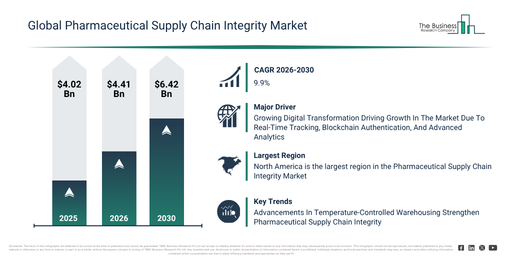
    The pharmaceutical supply chain integrity market has shown strong growth in recent years. It is forecast to increase from $4.02 billion in 2025 to $4.41 billion in 2026, with a compound annual growth rate (CAGR) of 9.6%. This historical growth can be attributed to factors such as a rise in counterfeit drug incidents, mandates for regulatory compliance, the expansion of global pharmaceutical trade, the adoption of barcode and serialization technology, and the demand for greater supply chain transparency.

    The pharmaceutical supply chain integrity market is expected to demonstrate significant expansion in the next few years. It is projected to reach $6.42 billion by 2030, growing at a compound annual growth rate (CAGR) of 9.9%. This anticipated growth is driven by the adoption of AI-powered monitoring systems, the implementation of cloud-based track and trace technologies, the continued expansion of healthcare and pharmaceutical logistics, the integration of IoT-enabled devices, and the application of predictive analytics for ensuring supply chain integrity. Prominent trends throughout the forecast period include the development of real-time track and trace solutions, enhancements in cold chain monitoring, the establishment of automated serialization processes, integration with ERP and SCM systems, and the utilization of predictive risk management for the supply chain.

    Access Your Free Sample Report For In-Depth Market Analysis:

    https://www.thebusinessresearchcompany.com/sample_request?id=41928312&type=smp&name=Pharmaceutical%20Supply%20Chain%20Integrity%20Market%20Report%202026

    Which Strong Drivers Are Impacting The Pharmaceutical Supply Chain Integrity Market Growth?

    The expanding digital transformation is anticipated to boost the pharmaceutical supply chain integrity market’s growth. Digital transformation involves embedding digital technologies across business functions to enhance operations, improve customer experiences, and foster innovation. Its adoption is on the rise as businesses leverage these technologies for better efficiency, rapid response to market shifts, and sustained competitiveness. Specifically, for pharmaceutical supply chain integrity, it facilitates real-time tracking, blockchain authentication, and sophisticated analytics, which collectively help in preventing counterfeit drugs, ensuring compliance with regulations, and preserving product quality across the entire supply chain. An example highlighting this trend is a November 2023 report from the UK’s Central Digital and Data Office, which indicated a 9% increase in the Government Digital and Data profession over six months, reaching a total of 28,337 professionals, driven by the government’s emphasis on digital transformation. Consequently, the expansion of digital transformation is a key driver for the pharmaceutical supply chain integrity market.

    What Segment Categories Shape The Pharmaceutical Supply Chain Integrity Market Segment Landscape?

    The pharmaceutical supply chain integrity market covered in this report is segmented –

    1) By Component: Software, Hardware, Services

    2) By Technology: Serialization, Track And Trace Systems, Radio Frequency Identification Systems

    3) By Deployment Mode: Cloud-Based Solutions, On-Premises Solutions

    4) By Application: Manufacturers, Distributors, Wholesalers, Pharmacies, Hospitals, Other Applications

    5) By End-User: Pharmaceutical Companies, Healthcare Providers, Logistics Providers, Other End Users

    Subsegments:

    1) By Software: Track and Trace Software, Cold Chain Monitoring Software, Serialization Software

    2) By Hardware: Barcode Scanners, Serialization Printers, Trackers And IoT Devices

    3) By Services: Consulting Services, Maintenance And Support Services, Integration And Implementation Services

    Which Trends Are Contributing To Changes In The Pharmaceutical Supply Chain Integrity Market?

    Leading companies within the pharmaceutical supply chain integrity market are concentrating on developing sophisticated solutions, such as temperature-controlled warehousing, to safeguard drug safety, maintain product effectiveness, and ensure compliance with regulatory standards across the entire supply chain. Temperature-controlled warehousing refers to specialized storage facilities designed to uphold specific temperature ranges, thereby preserving the quality, safety, and efficacy of temperature-sensitive pharmaceutical products throughout their journey. For example, in August 2025, Celcius Logistics Solutions Private Limited, an India-based cold chain logistics company, unveiled Celcius+, a dedicated temperature-controlled pharma cold chain division, backed by an initial $0.006 billion (?50 crore) investment. This initiative underscores GDP compliance, real-time surveillance using telematics and CCTV, AI-driven optimized routes, and a fleet of 100 reefer vehicles, all intended to minimize spoilage and ensure supply chain integrity from the point of manufacture to the end-user.

    Who Are The Companies Operating Across The Pharmaceutical Supply Chain Integrity Market Value Chain?

    Major companies operating in the pharmaceutical supply chain integrity market are Avery Dennison Corporation, Zebra Technologies Corporation, Testo SE & Co. KGaA, Marchesini Group S.p.A., Uhlmann Pac-Systeme GmbH & Co. KG, WIPOTEC GmbH, Schreiner Group GmbH & Co. KG, Antares Vision S.p.A., Controlant hf., TraceLink Inc., Optel Group Inc., Tive Inc., Roambee Corporation, Digimarc Corporation, SEA Vision S.r.l., ParkourSC Inc., Aeologic Technologies Private Limited, Kezzler AS, ACVISS Technologies Private Limited, Ciphercode Technologies Private Limited, AlpVision SA, Covectra Inc., Veratrak Ltd., PharmaSecure Inc., and Tracekey Solutions GmbH.

    Get The Full Pharmaceutical Supply Chain Integrity Market Report:

    https://www.thebusinessresearchcompany.com/report/pharmaceutical-supply-chain-integrity-market-report

    Which Region Leads The Pharmaceutical Supply Chain Integrity Market In Overall Market Size?

    North America was the largest region in the pharmaceutical supply chain integrity market in 2025. Asia-Pacific is expected to be the fastest-growing region in the forecast period. The regions covered in the pharmaceutical supply chain integrity market report are Asia-Pacific, South East Asia, Western Europe, Eastern Europe, North America, South America, Middle East, Africa.

    Request A Customized Pharmaceutical Supply Chain Integrity Market Report For Competitive Insights:

    https://www.thebusinessresearchcompany.com/Customise?id=41928312&name=Pharmaceutical%20Supply%20Chain%20Integrity%20Market%20Report%202026&type=smp

    Browse Through More Reports Similar to the Global Pharmaceutical Supply Chain Integrity Market 2026, By The Business Research Company

    adeno-associated virus (avv) vectors in gene therapy market report 2026

    https://www.thebusinessresearchcompany.com/report/adeno-associated-virus-avv-vectors-in-gene-therapy-global-market-report

    gastric cancer therapy market report 2026

    https://www.thebusinessresearchcompany.com/report/gastric-cancer-therapy-global-market-report

    over the counter (otc) drugs market report 2026

    https://www.thebusinessresearchcompany.com/report/over-the-counter-otc-drugs-global-market-report

    Get in touch with us:

    The Business Research Company: https://www.thebusinessresearchcompany.com/

    Americas +1 310-496-7795

    Asia +44 7882 955267 & +91 8897263534

    Europe +44 7882 955267

    Email us at marketing@tbrc.info

    Follow us on:

    LinkedIn: https://in.linkedin.com/company/the-business-research-company

    YouTube: https://www.youtube.com/channel/UC24_fI0rV8cR5DxlCpgmyFQ

    Global Market Model: https://www.thebusinessresearchcompany.com/global-market-model
  • Pharmaceutical And Life Sciences Real World Evidence Market Expansion Driven By Increasing Personalized Medicine Adoption And Advances In Genomic Technologies

    Pharmaceutical And Life Sciences Real World Evidence Market Expansion Driven By Increasing Personalized Medicine Adoption And Advances In Genomic Technologies

    The Business Research Company’s 2026 market reports feature enhanced tools like market attractiveness analysis, TAM assessment, and company scoring matrices, along with interactive dashboards, deeper supply chain insights, and startup coverage strengthening the depth, usability, and strategic value of insights.

    What Is The Estimated Market Size Of The Pharmaceutical And Life Sciences Real World Evidence Market In 2026, And How Will Its Value Evolve By 2030?

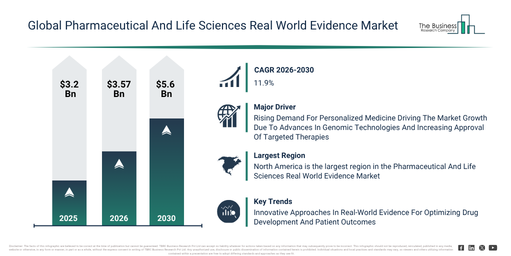
    The market size for pharmaceutical and life sciences real world evidence has expanded considerably in recent years. It is projected to increase from $3.2 billion in 2025 to $3.57 billion in 2026, achieving a compound annual growth rate (CAGR) of 11.7%. Historically, this expansion has been driven by several factors, including the increasing uptake of electronic health records, a heightened focus on drug safety monitoring, the expansion of patient registries, a rising need for evidence-based decision making, and the growth in pharmaceutical R&D investments.

    The pharmaceutical and life sciences real world evidence market is poised for significant expansion in the coming years, with its size projected to reach $5.6 billion by 2030, exhibiting a compound annual growth rate (CAGR) of 11.9%. This growth throughout the forecast period is primarily driven by factors such as the incorporation of AI-powered analytics, the broadening scope of RWE platforms and dashboards, the adoption of tools for predictive modeling, increased collaboration between payers and pharmaceutical entities, and the expanding role of real-world evidence in personalized medicine. Key developments expected during this timeframe include the assimilation of diverse real-world data sources, the application of predictive modeling for drug outcome assessment, the creation of patient-centric evidence, the streamlining of regulatory compliance, and the utilization of sophisticated analytics for market entry strategies.

    Access Your Free Sample Report For In-Depth Market Analysis:

    https://www.thebusinessresearchcompany.com/sample_request?id=86655969&type=smp&name=Pharmaceutical%20And%20Life%20Sciences%20Real%20World%20Evidence%20Market%20Report%202026

    What Key Factors Are Shaping The Pharmaceutical And Life Sciences Real World Evidence Market Landscape?

    The increasing need for individualized healthcare approaches is anticipated to fuel the expansion of the pharmaceutical and life sciences real-world evidence market in the future. Personalized medicine represents a method of tailoring healthcare and treatments specifically to a patient’s distinct biological and personal traits. The adoption of personalized medicine is rising because of breakthroughs in genomic technologies, which enable medical professionals to rapidly and precisely examine a patient’s genetic data, thereby facilitating more precise and impactful therapies. Within the pharmaceutical and life sciences sectors, real-world evidence supports personalized medicine through the analysis of actual patient information to ascertain the most efficacious and secure treatments for particular patient cohorts. As an illustration, in February 2024, the Personalized Medicine Coalition, a US-based non-profit organization, reported that in 2023, the FDA sanctioned 16 new personalized treatments for rare disease patients, an increase from six in 2022. Among the recently approved personalized treatments for 2023 were also seven cancer drugs and three remedies for other illnesses and conditions. Consequently, the escalating demand for personalized medicine is propelling the expansion of the pharmaceutical and life sciences real-world evidence market.

    Which Segment Types Are Examined In The Pharmaceutical And Life Sciences Real World Evidence Market Segment Study?

    The pharmaceutical and life sciences real world evidence market covered in this report is segmented –

    1) By Component: Services, Software, Data Sets

    2) By Evidence: Descriptive Studies, Analytical Studies, Patient-Reported Outcomes

    3) By Real-World Data Sources: Medical Claims, Clinical Trials, Clinical Setting, Patient Powered, Other Real-World Data Sources

    4) By Application: Drug Discovery And Development Support, Regulatory Submission And Label Expansion, Market Access And Reimbursement Strategy, Drug Safety And Pharmacovigilance Monitoring, Treatment Decision Support And Clinical Optimization, Comparative Effectiveness And Outcomes Research

    5) By End-User: Pharmaceutical And Biopharmaceutical Companies, Healthcare Payers And Providers, Medical Technology Companies, Regulatory And Health Technology Assessment Bodies, Contract Research Organizations And Academic Research Institutions

    Subsegments:

    1) By Services: Consulting Services, Regulatory Services Or Support, Data Management Services Or Data Integration

    2) By Software: RWE Platforms And Dashboards, Predictive Modeling Or Analytics Tools

    3) By Data Sets: Electronic Health Records, Patient Registries, Claims And Billing Data

    What Market Trends Are Affecting The Pharmaceutical And Life Sciences Real World Evidence Market?

    Major companies within the pharmaceutical and life sciences real-world evidence market are prioritizing the development of integrated data-driven platforms to enhance the effectiveness of clinical trials, improve patient participation, and facilitate regulatory and health economics submissions. These integrated platforms consolidate diverse real-world data sources, including patient-reported outcomes and data from wearable devices, into structured modules that streamline processes like recruitment, screening, enrollment, and continuous patient interaction. For instance, in September 2023, Maxis Clinical Sciences, a US-based boutique consulting firm, unveiled a comprehensive real-world evidence solution crafted to support patient-centric clinical research and drug development. This platform merges multiple data streams into pre-configured operational modules, thereby enabling faster trial execution while assisting with regulatory approvals, health economics and outcomes research (HEOR), and drug repurposing strategies.

    Which Players Are Part Of The Competitive Landscape Of The Pharmaceutical And Life Sciences Real World Evidence Market?

    Major companies operating in the pharmaceutical and life sciences real world evidence market are UnitedHealth Group Incorporated, Oracle Corporation, IQVIA Holdings Inc., ICON plc, Parexel International Corporation, Cegedim SA, Veradigm Inc., Tempus AI Inc., Saama Technologies LLC, Komodo Health Inc., Owkin Inc., Trinity Life Sciences LLC, TriNetX LLC, OM1 Inc., HealthVerity Inc., Claritas Rx Inc., PurpleLab Inc., Atropos Health PBC, EvidentIQ Group GmbH, CuriMeta Inc., Medaffcon Oy, and Mahalo Health Inc.

    Get The Full Pharmaceutical And Life Sciences Real World Evidence Market Report:

    https://www.thebusinessresearchcompany.com/report/pharmaceutical-and-life-sciences-real-world-evidence-market-report

    Which Region Is The Top Contributor To The Pharmaceutical And Life Sciences Real World Evidence Market By Share?

    North America was the largest region in the pharmaceutical and life sciences real world evidence market in 2025. Asia-Pacific is expected to be the fastest-growing region in the forecast period. The regions covered in the pharmaceutical and life sciences real world evidence market report are Asia-Pacific, South East Asia, Western Europe, Eastern Europe, North America, South America, Middle East, Africa.

    Request A Customized Pharmaceutical And Life Sciences Real World Evidence Market Report For Competitive Insights:

    https://www.thebusinessresearchcompany.com/Customise?id=86655969&name=Pharmaceutical%20And%20Life%20Sciences%20Real%20World%20Evidence%20Market%20Report%202026&type=smp

    Browse Through More Reports Similar to the Global Pharmaceutical And Life Sciences Real World Evidence Market 2026, By The Business Research Company

    adeno-associated virus (avv) vectors in gene therapy market report 2026

    https://www.thebusinessresearchcompany.com/report/adeno-associated-virus-avv-vectors-in-gene-therapy-global-market-report

    gastric cancer therapy market report 2026

    https://www.thebusinessresearchcompany.com/report/gastric-cancer-therapy-global-market-report

    over the counter (otc) drugs market report 2026

    https://www.thebusinessresearchcompany.com/report/over-the-counter-otc-drugs-global-market-report

    Get in touch with us:

    The Business Research Company: https://www.thebusinessresearchcompany.com/

    Americas +1 310-496-7795

    Asia +44 7882 955267 & +91 8897263534

    Europe +44 7882 955267

    Email us at marketing@tbrc.info

    Follow us on:

    LinkedIn: https://in.linkedin.com/company/the-business-research-company

    YouTube: https://www.youtube.com/channel/UC24_fI0rV8cR5DxlCpgmyFQ

    Global Market Model: https://www.thebusinessresearchcompany.com/global-market-model

  • Typing Tutor Software Market Forecast 2026–2035: Data Trends and Industry Insights

    Typing Tutor Software Market Forecast 2026–2035: Data Trends and Industry Insights

    Uncover key drivers, emerging technologies, and competitive movements shaping the typing tutor software market from 2026–2035 with trusted insights from The Business Research Company

    By how much is the Typing Tutor Software Market expected to grow between 2026 and 2030?

    The typing tutor software market has experienced substantial growth in recent years. This market is anticipated to expand from $0.72 billion in 2025 to $0.80 billion in 2026, achieving a compound annual growth rate (CAGR) of 11.7%. The historical development of this market can be attributed to several factors, including the increasing implementation of typing software in schools, a rising engagement with digital literacy, the expanding utilization of online learning platforms, an intensified focus on workplace efficiency, and a growing recognition of the importance of keyboarding proficiency.

    The typing tutor software market is anticipated to experience substantial growth in the upcoming years, with projections indicating it will reach $1.24 billion by 2030, expanding at a compound annual growth rate (CAGR) of 11.4%. This projected growth throughout the forecast period stems from factors such as the increased adoption of cloud-based typing tutors, a burgeoning demand for gamified learning modules, their growing integration into corporate training programs, the expansion of mobile-based typing applications, and a rising need for multilingual typing utilities. Noteworthy trends for the forecast duration include advancements in AI personalization, enhanced technology integration with cloud and mobile platforms, innovations in gamified and interactive lessons, dedicated research and development in adaptive typing algorithms, and their seamless integration with learning management systems.

    Access Your Free Sample Report for In-Depth Market Insights:

    https://www.thebusinessresearchcompany.com/sample.aspx?id=30773&type=smp

    Which Drivers Are Influencing Market Acceleration In The Typing Tutor Software Market?

    The market for typing tutor software is anticipated to expand due to the rising prevalence of digital literacy and computer skills education. These training programs and tools aim to boost individuals’ competence in operating computers, various software applications, and digital platforms effectively. The growing uptake of such training stems from the pervasive integration of technology across both educational and professional settings. The typing tutor software market facilitates digital literacy and computer skills development by offering interactive software designed to enhance typing speed, accuracy, and general computer proficiency for people across all age groups. As an illustration, a report from the UK government agency, the Department for Science, Innovation & Technology, indicated that in England, by February 2025, 36% of internet-using adults had participated in digital skills training over the preceding year, marking an increase of 14 percentage points from 22% in 2022/23. Consequently, the expanding engagement in digital literacy and computer skills training is a key factor propelling the expansion of the typing tutor software market.

    What Segments Are Identified Within The Structure Of The Typing Tutor Software Market?

    The typing tutor software market covered in this report is segmented –

    1) By Type Of Software: Online Typing Tutor, Offline Typing Tutor, Mobile Typing Tutor, Desktop Typing Tutor

    2) By Platform: Desktop-Based Software, Web-Based Software, Mobile-Based Software

    3) By User Demographics: Students, Professionals, Corporates, Institutions, Home Users

    4) By Skill Level: Beginners, Intermediate, Advanced

    5) By Age Group: Children, Adults

    Subsegments:

    1) By Online Typing Tutor: Web-Based Learning Platforms, Cloud-Hosted Typing Programs, Browser-Integrated Typing Modules, Subscription-Based Typing Courses, Interactive Typing Practice Tools

    2) By Offline Typing Tutor: Installable Desktop Programs, Standalone Training Applications, Local Data Storage Typing Tools, One-Time Purchase Software Packages, Keyboard Skill Improvement Modules

    3) By Mobile Typing Tutor: Smartphone Typing Applications, Tablet Typing Training Apps, Touchscreen Typing Practice Tools, Gamified Typing Learning Apps, Skill Tracking And Progress Analytics Apps

    4) By Desktop Typing Tutor: Windows-Based Typing Programs, Mac-Compatible Typing Software, Advanced Keyboard Training Suites, Professional Typing Skill Development Tools, Customizable Typing Curriculum Modules

    Which Innovation Trends Are Advancing Developments Within The Typing Tutor Software Market?

    Major companies operating in the typing tutor software market are focusing on developing advanced features, such as advanced multi-language custom typing test config capabilities, to improve user engagement, skill personalization, and language-inclusive learning outcomes. Advanced multi-language custom typing test config refers to the ability of software to allow users to create, tailor, and execute typing tests in multiple languages with configurable difficulty, content themes, and performance metrics, enabling learners to practice typing across diverse linguistic contexts and personal goals. For instance, in November 2025, TypingMaster Oy, a Finland-based provider of typing training software, released TypingMaster Version 12, which introduces advanced multi-language custom typing test config functionality. This update allows learners to customize typing tests in a wide range of languages and layouts, select specific text themes, and adjust parameters such as time limits and error tolerance. Coupled with real-time performance feedback, adaptive exercises, and detailed progress analytics, the feature enhances personalized learning for users of all skill levels. The launch highlights the growing importance of flexible, multi-language typing education tools that address global user needs.

    Which Major Industry Participants Are Leading The Typing Tutor Software Market Growth?

    Major companies operating in the typing tutor software market are Typing.com Inc., Ratatype Ltd., TypingClub Inc., KAZ Typing Ltd., Typing Master Finland Oy, SpeedTypingOnline LLC, TypingPal Inc., edclub Inc., Typing Instructor Corporation, Typequick Pty Ltd., TypingDNA Ltd., Keybr.com Inc., AgileFingers Oy, Typesy LLC, TypingBolt LLC, Sense-Lang GmbH, Typing Trainer GmbH, TypingTest.com Inc., The Typing Cat Ltd., RapidTyping Software Ltd.

    Access The Complete Report For Deeper Market Insights:

    https://www.thebusinessresearchcompany.com/report/typing-tutor-software-market-report

    Which Region Is Expected To Experience The Fastest Growth In The Typing Tutor Software Market?

    North America was the largest region in the typing tutor software market in 2025. Asia-Pacific is expected to be the fastest-growing region in the forecast period. The regions covered in the typing tutor software market report are Asia-Pacific, South East Asia, Western Europe, Eastern Europe, North America, South America, Middle East, Africa.

    Request Your Customized Typing Tutor Software Market Research Report for Competitive Advantage:

    https://www.thebusinessresearchcompany.com/customise?id=30773&type=smp

    Browse Through More Reports Similar to the Global Typing Tutor Software Market 2026, By The Business Research Company

    Private Tutoring Market Report 2026

    https://www.thebusinessresearchcompany.com/report/private-tutoring-global-market-report

    Course Authoring Software Market Report 2026

    https://www.thebusinessresearchcompany.com/report/course-authoring-software-global-market-report

    form automation software global market report

    https://www.thebusinessresearchcompany.com/report/form-automation-software-global-market-report

    Get in touch with us:

    The Business Research Company: https://www.thebusinessresearchcompany.com/

    Americas +1 310-496-7795

    Asia +44 7882 955267 & +91 8897263534

    Europe +44 7882 955267

    Email us at marketing@tbrc.info

    Follow us on:

    LinkedIn: https://in.linkedin.com/company/the-business-research-company

    YouTube: https://www.youtube.com/channel/UC24_fI0rV8cR5DxlCpgmyFQ

    Global Market Model: https://www.thebusinessresearchcompany.com/global-market-model

  • RadioFrequency ElectroSurgery Generators Market Growth Projection: Expected to Surpass $3.42 Billion by 2030 at 11.3% CAGR

    RadioFrequency ElectroSurgery Generators Market Growth Projection: Expected to Surpass $3.42 Billion by 2030 at 11.3% CAGR

    Uncover key drivers, emerging technologies, and competitive movements shaping the radiofrequency electrosurgery generators market from 2026–2035 with trusted insights from The Business Research Company

    What is the expected shift in the RadioFrequency ElectroSurgery Generators Market’s size between 2026 and 2030?

    The radiofrequency electrosurgery generator market has experienced significant expansion in recent times. Its valuation is projected to increase from $2.00 billion in 2025 to $2.23 billion in 2026, demonstrating a compound annual growth rate (CAGR) of 11.6%. This historical expansion can be linked to factors such as the greater acceptance of minimally invasive surgical techniques, the increasing occurrence of chronic illnesses, a rising need for electrosurgical interventions, the expansion of hospital and surgical center facilities, and the growing application of radiofrequency (RF)-based coagulation and cutting instruments.

    The radiofrequency electrosurgery generator market size is projected for significant expansion in the coming years. It is forecast to reach $3.43 billion in 2030 at a compound annual growth rate (CAGR) of 11.3%. This expansion during the forecast period is attributable to an escalating demand for precise surgical systems, a rise in the adoption of advanced RF energy platforms, an increased volume of outpatient surgical procedures, growing healthcare investments in surgical technology, and a heightened preference for minimally invasive radiofrequency (RF)-based treatments. Key trends anticipated over the same period encompass technological progress in radiofrequency (RF) energy delivery systems, breakthroughs in safety and power modulation features, the evolution of integrated electrosurgery platforms, ongoing research and development in intelligent and automated generators, and improvements in digital monitoring and connectivity functionalities.

    Access Your Free Sample Report for In-Depth Market Insights:

    https://www.thebusinessresearchcompany.com/sample.aspx?id=30719&type=smp

    Which Drivers Are Shaping Strategic Decisions In The RadioFrequency ElectroSurgery Generators Market?

    The increasing demand for minimally invasive surgical procedures is projected to drive the growth of the radiofrequency electrosurgery generators market in the future. Minimally invasive surgeries are performed through small incisions utilizing specialized instruments, leading to reduced tissue damage, shorter hospital stays, and faster recovery compared to open surgeries. The demand for these procedures is increasing due to patient preferences for less postoperative pain, lower infection risk, and a quicker return to daily activities, as well as clinician preferences for precision and operational efficiency. Radiofrequency electrosurgery generators support minimally invasive surgical procedures by enabling precise tissue cutting and controlled coagulation, which results in less bleeding, faster healing, and improved patient outcomes. For instance, in June 2024, the American Society of Plastic Surgeons, a US-based non-profit organization, reported that minimally invasive procedures grew by 7% in 2023, exceeding the growth rate of surgical procedures by 2%. Hand surgeries such as carpal tunnel, arthritis, and trigger finger collectively accounted for 207,887 procedures, marking a 2% rise from 2022. Therefore, the growing shift toward minimally invasive surgery is fueling the expansion of the radiofrequency electrosurgery generators market.

    What Segment Categories Are Covered In The RadioFrequency ElectroSurgery Generators Market?

    The radiofrequency electrosurgery generators market covered in this report is segmented –

    1) By Product Type: Monopolar Radiofrequency (RF) Electrosurgery Generators, Bipolar Radiofrequency (RF) Electrosurgery Generators, Hybrid Or Combo Radiofrequency (RF) Electrosurgery Generators, Portable Radiofrequency (RF) Electrosurgery Generators, High-Power Radiofrequency (RF) Electrosurgery Generators

    2) By Technology: Analog Radiofrequency (RF) Generators, Digital Radiofrequency (RF) Generators, Automated Power Control Generators, Impedance-Controlled Radiofrequency (RF) Generators

    3) By Application: General Surgery, Cardiovascular Surgery, Orthopedic Surgery, Gynecological Surgery, Urological Surgery, Neurological Surgery, Ear, Nose, And Throat (ENT) Surgical, Other Applications

    4) By End-User: Hospitals, Ambulatory Surgical Centers (ASCs), Dentistry And Oral Surgery Clinics, Specialty Clinics, Pain Management Clinics, Burn And Trauma Centers, Endoscopy Centers, Orthopedic And Sports Medicine Clinics, Research And Clinical Trial Centers, Other End-Users

    Subsegments:

    1) By Monopolar Radiofrequency (RF) Electrosurgery Generators: Cutting Generators, Coagulation Generators, Combination Generators

    2) By Bipolar Radiofrequency (RF) Electrosurgery Generators: Standard Bipolar Generators, Advanced Bipolar Generators, Precision Bipolar Generators

    3) By Hybrid Or Combo Radiofrequency (RF) Electrosurgery Generators: Monopolar/Bipolar Combo Generators, Energy Adjustable Generators, Multi-Mode Generators

    4) By Portable Radiofrequency (RF) Electrosurgery Generators: Battery Operated Generators, Compact Tabletop Generators, Handheld Generators

    5) By High-Power Radiofrequency (RF) Electrosurgery Generators: Industrial Use Generators, Hospital Use Generators, Research Use Generators

    Which Trends Are Influencing The Development Of The RadioFrequency ElectroSurgery Generators Market?

    Major companies operating in the radiofrequency electrosurgery generators market are concentrating on developing innovative solutions, such as next-generation electrosurgical devices, to achieve a competitive advantage. Next-generation electrosurgical devices are advanced surgical instruments that utilize controlled radiofrequency energy to cut, coagulate, or ablate tissue with superior precision, enhanced safety features, and reduced collateral damage compared to traditional electrosurgical tools. For instance, in October 2025, Medtronic plc, a US-based medical devices company, introduced its next-generation electrosurgical device in India, featuring adaptive energy control for consistent performance, an ergonomic design for improved surgical handling, and integrated safety monitoring to minimize complications. This trend underscores the increasing focus on patient safety, procedural efficiency, and clinical outcomes. While implementing these devices requires investment in training and infrastructure, the benefits of precision and reliability are significantly driving interest among hospitals and surgical centers in the radiofrequency electrosurgery generators market.

    Which Major Firms Are Strengthening Their Position In The RadioFrequency ElectroSurgery Generators Market?

    Major companies operating in the radiofrequency electrosurgery generators market are Johnson & Johnson, Medtronic plc, Stryker Corporation, Boston Scientific Corporation, B. Braun Melsungen Aktiengesellschaft, Telea Electronic Engineering S.r.l., Olympus Corporation, Smith & Nephew plc, Shenzhen Mindray Bio-Medical Electronics Co. Ltd., Cook Medical LLC, Integra LifeSciences Holdings Corporation, Merit Medical Systems Inc., CONMED Corporation, Erbe Elektromedizin GmbH, XcelLance Medical Technologies Private Limited, Sutter Medizintechnik GmbH, Elliquence LLC, Utah Medical Products Inc., BOWA-Electronic GmbH & Co. KG, Creo Medical Group plc

    Access The Complete Report For Deeper Market Insights:

    https://www.thebusinessresearchcompany.com/report/radiofrequency-electrosurgery-generators-market-report

    Which Region Shows The Strongest Potential For Future Expansion In The RadioFrequency ElectroSurgery Generators Market?

    North America was the largest region in the radiofrequency electrosurgery generator market in 2025. Asia-Pacific is expected to be the fastest-growing region in the forecast period. The regions covered in the radiofrequency electrosurgery generators market report are Asia-Pacific, South East Asia, Western Europe, Eastern Europe, North America, South America, Middle East, Africa.

    Request Your Customized RadioFrequency ElectroSurgery Generators Market Research Report for Competitive Advantage:

    https://www.thebusinessresearchcompany.com/customise?id=30719&type=smp

    Browse Through More Reports Similar to the Global RadioFrequency ElectroSurgery Generators Market 2026, By The Business Research Company

    Electrosurgical Generator Market Report 2026

    https://www.thebusinessresearchcompany.com/report/electrosurgical-generator-global-market-report

    Electric Generators Market Report 2026

    https://www.thebusinessresearchcompany.com/report/electric-generators-global-market-report

    electrosurgical devices and equipment global market report

    https://www.thebusinessresearchcompany.com/report/electrosurgical-devices-and-equipment-global-market-report

    Get in touch with us:

    The Business Research Company: https://www.thebusinessresearchcompany.com/

    Americas +1 310-496-7795

    Asia +44 7882 955267 & +91 8897263534

    Europe +44 7882 955267

    Email us at marketing@tbrc.info

    Follow us on:

    LinkedIn: https://in.linkedin.com/company/the-business-research-company

    YouTube: https://www.youtube.com/channel/UC24_fI0rV8cR5DxlCpgmyFQ

    Global Market Model: https://www.thebusinessresearchcompany.com/global-market-model