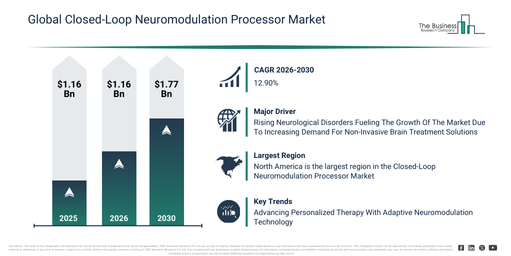
Featuring market attractiveness scoring, total addressable market sizing, company benchmarking matrices, interactive Excel dashboards, deeper supply chain intelligence, emerging startup tracking, and granular product-level insights, The Business Research Company’s 2026 market reports are built to deliver research that is both more actionable and more strategically valuable.
Closed-Loop Neuromodulation Processor Market Size, Value And Growth Trajectory Through 2030
The closed-loop neuromodulation processor market has witnessed rapid expansion over recent years. Its size is expected to increase from $2.52 billion in 2025 to $2.85 billion in 2026, exhibiting a compound annual growth rate (CAGR) of 13.2%. The historical development of this market can be attributed to the rising incidence of neurological disorders, the requirement for precise neuromodulation, innovations in implantable devices, the widespread use of DBS/SCS systems, and an uptick in research investment within neurotechnology.
The closed-loop neuromodulation processor market size is expected to undergo substantial growth in the upcoming years. It is projected to expand to $4.63 billion in 2030, demonstrating a compound annual growth rate (CAGR) of 12.9%. This expansion during the forecast period is fueled by the creation of AI-enabled adaptive processors, the broadening use of external wearable controllers, its incorporation with telemedicine, the increase in home-based neuromodulation therapy, and growing adoption in emerging markets. Significant trends anticipated in the forecast period encompass real-time neural feedback, adaptive stimulation algorithms, integration with wearable controllers, remote monitoring capabilities, and the optimization of multimodal therapy.
Get A Free Sample Report With In-Depth Market Insights:
Closed-Loop Neuromodulation Processor Market Growth Factors: What’s Supporting Expansion?
The rising prevalence of neurological disorders is projected to propel the growth of the closed-loop neuromodulation processor market moving forward. Such conditions involve impairments to the nervous system, affecting brain, spinal cord, or nerve function, and can result in difficulties with movement, thought, or sensation. The increase in neurological disorders is attributable to an aging global population, which in turn raises the incidence of diseases like Alzheimer’s and Parkinson’s. Closed-loop neuromodulation processors are instrumental in managing these disorders by consistently monitoring brain activity and delivering precise electrical stimulation in real time to regulate abnormal neural signals. For example, the Institute for Health Metrics and Evaluation, a US-based research organization, reported that neurological conditions impacted 43% of the global population in 2022, with projections indicating this could double by 2050. Therefore, the expanding scope of neurological disorders is a key driver for the growth of the closed-loop neuromodulation processor market.
Closed-Loop Neuromodulation Processor Market Segment Landscape: Which Areas Lead Development?
The closed-loop neuromodulation processor market covered in this report is segmented –
1) By Product Type: Implantable Processors, External Processors
2) By Technology: Deep Brain Stimulation, Spinal Cord Stimulation, Vagus Nerve Stimulation, Other Technologies
3) By Application: Chronic Pain Management, Epilepsy, Parkinson’s Disease, Depression, Other Applications
4) By End-User: Hospitals, Specialty Clinics, Research Institutes, Other End Users
Subsegments:
1) By Implantable Processors: Deep Brain Stimulation (DBS) Processors, Spinal Cord Stimulation (SCS) Processors, Vagus Nerve Stimulation (VNS) Processors, Sacral Nerve Stimulation (SNS) Processors, Peripheral Nerve Stimulation (PNS) Processors
2) By External Processors: Wearable Neuromodulation Controllers, Handheld Programming Devices, External Pulse Generators, Charging Systems And Power Management Units, Wireless Communication Interfaces
Closed-Loop Neuromodulation Processor Market Industry Trends: What’s Reshaping Demand?
Leading companies within the closed-loop neuromodulation processor market are concentrating on integrating brain-computer interface (BCI) technology to boost treatment precision, enhance symptom management, and tailor patient care for individuals with neurological disorders. A brain-computer interface (BCI) is a technology designed to facilitate direct communication between the brain and an external device. It achieves this by detecting, interpreting, and converting neural signals into commands that can operate computers, prosthetics, or therapeutic systems. These interfaces are often incorporated into neuromodulation or rehabilitation equipment, enabling real-time monitoring and adaptive therapy based on a patient’s brain activity. For instance, in February 2025, Medtronic plc, a US-based medical technology company, secured United States Food and Drug Administration (FDA) approval for its BrainSense Adaptive Deep Brain Stimulation (aDBS) and BrainSense Electrode Identifier (EI), signifying the largest commercial rollout of brain-computer interface technology. This specific closed-loop neuromodulation system continuously tracks a patient’s brain activity and automatically modifies stimulation in real time, thereby customizing therapy for Parkinson’s disease. Clinical trials revealed improved symptom control, decreased motor fluctuations, and better patient outcomes compared to traditional continuous DBS.
Closed-Loop Neuromodulation Processor Market Competitive Landscape: Which Companies Lead The Industry?
Major companies operating in the closed-loop neuromodulation processor market are Abbott Laboratories, Medtronic PLC, Boston Scientific Corporation, Beijing PINS Medical, CorTec, NeuroPace, Saluda Medical, NeuSpera Medical, Inbrain Neuroelectronics, Blackrock Neurotech, Great Lakes NeuroTechnologies, SensArs Neuroprosthetics, BioControl Medical, Precision Neuroscience, Motif Neurotech, Synergia Medical, BrainQ Technologies, Soterix Medical (partially relevant), Synergia Medical, Inbrain Neuroelectronics
View The Full Closed-Loop Neuromodulation Processor Market Report:
Closed-Loop Neuromodulation Processor Market Regional Breakdown: Where Is Demand Concentrated?
North America was the largest region in the closed-loop neuromodulation processor market in 2025. Asia-Pacific is expected to be the fastest-growing region in the forecast period. The regions covered in the closed-loop neuromodulation processor market report are Asia-Pacific, South East Asia, Western Europe, Eastern Europe, North America, South America, Middle East, Africa.
Reach Out To Our Team:
The Business Research Company: https://www.thebusinessresearchcompany.com/
Americas: +1 310-496-7795
Asia: +44 7882 955267 & +91 8897263534
Europe: +44 7882 955267
Email us at: marketing@tbrc.info
Follow us on:
LinkedIn: https://in.linkedin.com/company/the-business-research-company
YouTube: https://www.youtube.com/channel/UC24_fI0rV8cR5DxlCpgmyFQ
Global Market Model: https://www.thebusinessresearchcompany.com/global-market-model