Unlock Global Insights – Save 20% on Market Reports with Code ONLINE20
What Is The Expected Total Market Size Of The Computer-Aided Detection Industry By The Forecast Year 2029?
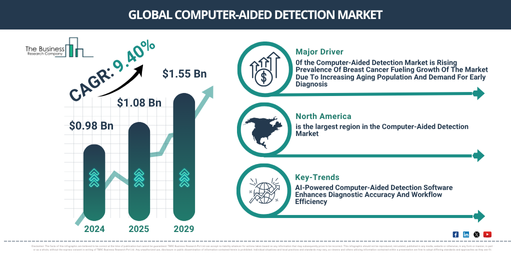
The computer-aided detection market size has experienced significant expansion in recent years. It is projected to increase from $0.98 billion in 2024 to $1.08 billion in 2025, registering a compound annual growth rate (CAGR) of 9.7%. The market’s growth in the past can be attributed to factors such as rising cancer incidence rates, the expanding use of medical imaging modalities, an increasing shortage of radiologists, various government screening programs, and a greater emphasis on early detection.
The computer-aided detection market is projected to experience substantial expansion in the coming years. By 2029, its valuation is anticipated to reach $1.55 billion, demonstrating a compound annual growth rate (CAGR) of 9.4%. This projected growth is driven by factors such as an expanding elderly demographic, increasing volumes of imaging data, the rise of telehealth and remote diagnostic services, the growing significance of precision medicine, and advancements in healthcare infrastructure. Key trends expected during this period involve the incorporation of deep learning, real-time decision support capabilities, the emergence of cloud-based CAD platforms, advancements in multimodal CAD systems, and the integration with natural language processing technologies.
Unlock Your Free Sample Report for Exclusive Market Data:
https://www.thebusinessresearchcompany.com/sample.aspx?id=24507&type=smp
Which Major Market Drivers Are Shaping The Future Of The Computer-Aided Detection Market?
The increasing occurrence of breast cancer is anticipated to drive expansion in the computer-aided detection market in the future. Breast cancer is defined as a malignant growth that forms within breast cells, typically starting in the ducts or lobules, with the potential to metastasize to nearby tissues or other bodily regions if not identified and addressed promptly. The incidence of breast cancer is primarily escalating due to lifestyle modifications, including increasing obesity, which leads to higher estrogen levels, fostering the proliferation of cancer cells. Computer-aided detection (CAD) improves the diagnosis of breast cancer by analyzing medical images for signs of abnormalities, facilitating earlier and more accurate identification. This technology assists radiologists in detecting tumors that might otherwise be missed, thereby enhancing the precision of screening procedures. For example, data from October 2024, provided by the American Cancer Society, a US-based cancer organization, revealed that new invasive breast cancer cases among US women climbed to about 310,720. In a similar vein, diagnoses of ductal carcinoma in situ (DCIS) saw an increase to 56,500. Moreover, in October 2022, the American Cancer Society, a US-based cancer organization, reported an estimated 287,850 new invasive breast cancer cases and 51,400 DCIS cases diagnosed in women throughout the United States. Consequently, the growing incidence of breast cancer is propelling the expansion of the computer-aided detection market.
What Are The Segment Types Shaping The Computer-Aided Detection Market?
The computer-aided detection market covered in this report is segmented –
1) By Product: Mammography, Ultrasound Imaging, Magnetic Resonance Imaging, Tomosynthesis, Computed Tomography, Other Products
2) By Application: Tuberculosis, Breast Cancer, Lung Cancer, Colon Cancer, Prostate Cancer, Liver Cancer, Bone Cancer, Neurological Indications
3) By End-User: Hospitals, Clinics, Diagnostic Centres, Other End-Users
Subsegments:
1) By Mammography: Full-Field Digital Mammography (FFDM), Screen-Film Mammography (SFM), Three-Dimensional (3D) Mammography
2) By Ultrasound Imaging: Automated Breast Ultrasound (ABUS), Handheld Ultrasound, Doppler Ultrasound, Elastography
3) By Magnetic Resonance Imaging: Breast Magnetic Resonance Imaging (MRI), Brain Magnetic Resonance Imaging (MRI), Abdominal Magnetic Resonance Imaging (MRI), Musculoskeletal Magnetic Resonance Imaging (MRI)
4) By Tomosynthesis: Breast Tomosynthesis, Chest Tomosynthesis, Orthopedic Tomosynthesis
5) By Computed Tomography: Chest Computed Tomography (CT), Abdominal Computed Tomography (CT), Brain Computed Tomography (CT), Cardiac Computed Tomography (CT)
6) By Other Products: Nuclear Medicine, X-Ray Imaging, Optical Imaging, Thermography
Which Ongoing Trends Are Expected To Shape The Computer-Aided Detection Market Outlook?
Leading companies within the computer-aided detection market are concentrating on creating sophisticated solutions, such as artificial intelligence (AI)-powered computer-aided detection (CADe) software, to improve diagnostic accuracy, optimize image analysis, and facilitate early disease identification. This AI-powered CADe software utilizes artificial intelligence to examine medical images for signs of abnormalities, thereby boosting diagnostic precision and assisting in the timely detection of conditions like cancer. For example, in March 2025, Align Technology, Inc., a Switzerland-based supplier of digital orthodontics and restorative dentistry, launched Align X-ray Insights for the purpose of dental radiograph analysis. This system employs AI to enhance dental imaging analysis for more accurate diagnostics, concurrently improving workflow efficiency by delivering real-time insights directly within established imaging systems. The software’s objective is to support dental professionals in delivering precise, prompt patient care across the EU and UK.
Who Are The Top Performing Companies In The Computer-Aided Detection Market In Recent Years?
Major companies operating in the computer-aided detection market are Hitachi Ltd., International Business Machines Corporation (IBM), Fujifilm Holdings Corporation, Siemens Healthineers AG, Koninklijke Philips N.V., GE Healthcare Technologies Inc., Hologic Inc., Canon Medical Systems Corporation, Agfa-Gevaert NV, Carestream Health Inc., ESAOTE S.p.A., Aidoc Medical Ltd., Median Technologies S.A., iCAD Inc., Riverain Technologies LLC, Nano-X Imaging Ltd., Zebra Medical Vision Ltd., CureMetrix Inc., EDDA Technology Inc., THERAPIXEL S.A.S.
Download The Full Report For Exclusive Market Findings:
https://www.thebusinessresearchcompany.com/report/computer-aided-detection-global-market-report
What Are The Key Regional Factors Influencing The Computer-Aided Detection Market Growth?
North America was the largest region in the computer-aided detection market in 2024. Asia-Pacific is expected to be the fastest-growing region in the forecast period. The regions covered in the computer-aided detection market report are Asia-Pacific, Western Europe, Eastern Europe, North America, South America, Middle East, Africa.
Request A Customized Version Of The Computer-Aided Detection Market Report:
https://www.thebusinessresearchcompany.com/customise?id=24507&type=smp
Browse Through More Reports Similar to the Global Computer-Aided Detection Market 2025, By The Business Research Company
Geomarketing Global Market Report 2025
https://www.thebusinessresearchcompany.com/report/geomarketing-global-market-report
Artificial Intelligence In Marketing Global Market Report 2025
Product Analytics Global Market Report 2025
https://www.thebusinessresearchcompany.com/report/product-analytics-global-market-report
Get in touch with us:
The Business Research Company: https://www.thebusinessresearchcompany.com/
Americas +1 310-496-7795
Asia +44 7882 955267 & +91 8897263534
Europe +44 7882 955267
Email us at info@tbrc.info
Follow us on:
LinkedIn: https://in.linkedin.com/company/the-business-research-company
YouTube: https://www.youtube.com/channel/UC24_fI0rV8cR5DxlCpgmyFQ
Global Market Model: https://www.thebusinessresearchcompany.com/global-market-model