Drug Resistant Virus Treatment Market Growth Potential: What The Latest Forecast Reveals
Built to provide research that’s more actionable and strategically valuable, The Business Research Company’s 2026 market reports include market attractiveness analysis, total addressable market sizing, company benchmarking matrices, interactive Excel dashboards, broader supply chain intelligence, emerging startup tracking, and in-depth product insights.
Drug Resistant Virus Treatment Market Forecast: What Value Will The Market Reach By 2030?
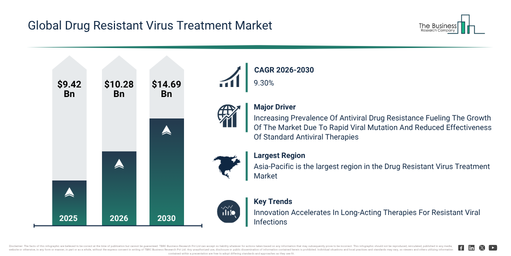
The market for drug-resistant virus treatments has experienced strong growth in recent years. It is projected to increase from $9. 42 billion in 2025 to $10. 28 billion in 2026, achieving a compound annual growth rate (CAGR) of 9. 1%. This historical growth can be attributed to limited diversity in antiviral drugs, the emergence of drug resistance cases in HIV and hepatitis, reliance on single-mechanism antiviral therapies, the expansion of global viral outbreak monitoring systems, and an increase in hospital-based infectious disease treatment protocols.
The drug resistant virus treatment market is set for significant expansion over the next few years. It is forecast to achieve a valuation of $14.69 billion by 2030, growing at a compound annual growth rate (CAGR) of 9.3%. This anticipated growth can be attributed to factors such as the development of precision antiviral therapies, the increasing occurrence of multi-drug resistant viral strains, heightened investment in monoclonal antibody research, the expansion of genomic-based resistance tracking, and the strengthening of global pandemic preparedness programs. Prominent trends expected during this forecast period include the adoption of next-generation antiviral drug combination therapies, the creation of broad-spectrum antiviral resistance inhibitors, personalized viral resistance profiling diagnostics, the use of adaptive clinical trial designs for resistant viral strains, and the broadening of monoclonal antibody-based rescue therapies.
Get A Free Sample Report With In-Depth Market Insights:
Drug Resistant Virus Treatment Market Growth Factors Behind Sustained Expansion
The rising occurrence of antiviral drug resistance is anticipated to drive the expansion of the drug-resistant virus treatment market in the future. This resistance refers to a virus’s capacity to evolve and persist even when exposed to antiviral drugs, thereby diminishing the medication’s efficacy. The increase in antiviral drug resistance stems from the fast mutation rates of viruses, allowing them to rapidly acquire resistance against current therapies. Treatments for drug-resistant viruses address antiviral drug resistance through the use of alternative or combined antiviral therapies. These therapies aim at various viral mechanisms to suppress strains that have become unresponsive to conventional medications. As an illustration, in November 2025, the World Health Organization (WHO), an intergovernmental organization headquartered in Switzerland, indicated that if no mitigation strategies are implemented, HIV drug resistance to Dolutegravir (DTG) is foreseen to significantly increase among individuals experiencing failure of DTG-based ART, climbing from 18% in 2023 to 42% by 2035. Consequently, the growing prevalence of antiviral drug resistance is a key factor propelling the expansion of the drug-resistant virus treatment market.
Drug Resistant Virus Treatment Market Segmentation And Category Overview
The drug resistant virus treatment market covered in this report is segmented –
1) By Virus Type: Human Immunodeficiency Virus Drug Resistant, Hepatitis B Virus Treatment Experienced, Cytomegalovirus Resistant Or Refractory, Influenza Resistant Strains, Herpes Simplex Virus Or Varicella Zoster Virus Acyclovir Resistant, Other Virus Types
2) By Therapy Class: Small Molecule Antivirals, Long Acting Injectables, Monoclonal Antibodies, Host Targeted Therapies, Combination Regimens
3) By Treatment Setting: Outpatient, Inpatient, Specialty Infusion Centers
4) By Route Of Administration: Oral, Intravenous, Subcutaneous, Intramuscular
5) By End User: Hospitals, Specialty Clinics, Homecare Settings
Subsegments:
1) By Human Immunodeficiency Virus Drug Resistant: First Line Resistance, Second Line Resistance, Multi Drug Resistance, Transmitted Drug Resistance, Acquired Drug Resistance
2) By Hepatitis B Virus Treatment Experienced: Nucleoside Analogue Resistant, Lamivudine Resistant, Entecavir Resistant, Tenofovir Partial Response, Multi Drug Resistant Hepatitis B
3) By Cytomegalovirus Resistant Or Refractory: Ganciclovir Resistant, Foscarnet Resistant, Cidofovir Resistant, Multi Drug Resistant Cytomegalovirus, Refractory Cytomegalovirus Infection
4) By Influenza Resistant Strains: Neuraminidase Inhibitor Resistant, Adamantane Resistant, Oseltamivir Resistant, Zanamivir Reduced Susceptibility, Multi Drug Resistant Influenza
5) By Herpes Simplex Virus Or Varicella Zoster Virus Acyclovir Resistant: Acyclovir Resistant Herpes Simplex, Acyclovir Resistant Varicella Zoster, Foscarnet Resistant Herpes Virus, Cidofovir Resistant Herpes Virus, Multi Drug Resistant Herpes Virus
6) By Other Virus Types: Respiratory Syncytial Virus Resistant, Adenovirus Resistant, Enterovirus Resistant, Norovirus Resistant, Emerging Viral Resistant Infections
Drug Resistant Virus Treatment Market Industry Trends Fueling Future Revenue Growth
Major companies within the drug resistant virus treatment market are prioritizing the development of innovative therapies, notably twice-yearly long-acting capsid inhibitor prophylactics, to enhance adherence and deliver sustained protection against drug-resistant viral infections. These twice-yearly long-acting capsid inhibitor prophylactics are injectable antiviral treatments designed to target the viral capsid, thereby blocking replication over an extended duration, which helps patients maintain viral suppression and prevent drug-resistant infections with just two doses per year. For instance, in June 2025, Gilead Sciences Inc., a US-based biopharmaceutical company, obtained U. S. Food and Drug Administration (FDA) approval for Yeztugo (lenacapavir), a twice-yearly long-acting HIV-1 capsid inhibitor. This approval is specifically for pre-exposure prophylaxis (PrEP) to mitigate the risk of sexually acquired HIV-1 infection in adults and adolescents weighing at least 35 kg, establishing it as the first and sole twice-yearly PrEP option sanctioned in the United States. Yeztugo comprises lenacapavir, which obstructs the HIV capsid protein essential for viral assembly and replication, and is administered via two subcutaneous injections that offer up to six months of protection, providing significant advantages such as extended dosing intervals, exceptional efficacy in clinical trials (= 99.9% protection), and improved adherence compared with daily oral PrEP regimens such as FTC/TDF.
Drug Resistant Virus Treatment Market Competitive Overview And Top Companies
Major companies operating in the drug resistant virus treatment market are Johnson & Johnson, F. Hoffmann-La Roche Ltd., Merck & Co. Inc., Pfizer Inc., AbbVie Inc., Sanofi S. A., Novartis AG, AstraZeneca plc, Bristol-Myers Squibb Company, GlaxoSmithKline plc, Gilead Sciences Inc., Regeneron Pharmaceuticals Inc., Moderna Inc., BioNTech SE, Alnylam Pharmaceuticals Inc., Enanta Pharmaceuticals Inc., Vir Biotechnology Inc., Atea Pharmaceuticals Inc., Arbutus Biopharma Corporation, Chimerix Inc.
View The Full Drug Resistant Virus Treatment Market Report:
Drug Resistant Virus Treatment Market Top Region: Where Does Most Revenue Come From?
Asia-Pacific was the largest region in the drug resistant virus treatment market in 2025. Asia-Pacific is expected to be the fastest-growing region in the forecast period. The regions covered in the drug resistant virus treatment market report are Asia-Pacific, South East Asia, Western Europe, Eastern Europe, North America, South America, Middle East and Africa.
Reach Out To Our Team:
The Business Research Company: https://www.thebusinessresearchcompany.com/
Americas: +1 310-496-7795
Asia: +44 7882 955267 & +91 8897263534
Europe: +44 7882 955267
Email us at: marketing@tbrc.info
Follow us on:
LinkedIn: https://in.linkedin.com/company/the-business-research-company
YouTube: https://www.youtube.com/channel/UC24_fI0rV8cR5DxlCpgmyFQ
Global Market Model: https://www.thebusinessresearchcompany.com/global-market-model