Enhanced with market attractiveness analysis, total addressable market evaluation, company benchmarking matrices, interactive Excel dashboards, expanded supply chain intelligence, emerging startup coverage, and detailed product insights, The Business Research Company’s 2026 market reports deliver more actionable and strategically valuable research.
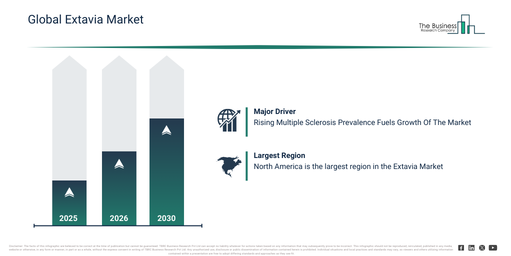
Extavia Market Expansion From $ Billion In 2026 To $ Billion In 2030
Growth during the historical period was driven by several key factors: the early regulatory approval of interferon beta treatments, the increasing prevalence of multiple sclerosis, the ongoing requirement to manage relapses, neurologists’ established comfort with injectable therapies, and the availability of long-term clinical data from their sustained use.
Growth during the forecast period is driven by rising multiple sclerosis diagnosis rates, the widespread adoption of combination therapy strategies, the expansion of specialized neurology services, better patient adherence initiatives, and persistent demand within mature markets. Key developments shaping the forecast horizon involve the ongoing application of interferon-based treatments, a strong focus on long-term MS care, increased attention toward minimizing relapse occurrences, steady reliance on injectable therapies, and the broadening availability of disease-modifying treatments.
Download A Free Sample Report For Comprehensive Market Insights:
Extavia Market Expansion Supported By Key Demand Factors
The rising number of multiple sclerosis cases is set to drive growth in the extavia market moving forward. Multiple sclerosis (MS) is a chronic autoimmune disorder that impacts the central nervous system (CNS), comprising the brain and spinal cord. This increase in MS prevalence stems from various factors such as improved diagnostic capabilities, heightened awareness, and possible shifts in environmental and lifestyle influences. Extavia is a drug containing interferon beta-1b, designed to treat relapsing-remitting multiple sclerosis (RRMS) by lowering relapse frequency and decelerating disease advancement through subcutaneous injections. As an example, in January 2023, SingleCare Administrators, a US-based discount medical plan organization, reported that nearly one million people in the United States were affected by MS, with an estimated 2.8 million individuals living with the condition worldwide. Consequently, the growing prevalence of multiple sclerosis is fueling the expansion of the extavia market.
The increasing embrace of personalized medicine is projected to propel the extavia market’s future expansion. Personalized medicine involves treatments customized to an individual’s genetic profile, lifestyle, and unique health needs, seeking to deliver more effective and precise care. The shift toward personalized medicine is fueled by its capacity to provide targeted therapies with greater efficacy and reduced side effects. This approach advances extavia by facilitating customized treatment strategies that enhance effectiveness and improve results for multiple sclerosis patients. For instance, in February 2024, the Personalized Medicine Coalition, a US-based nonprofit, noted that the FDA approved 16 new personalized treatments for rare diseases in 2023, rising from six in 2022. Thus, the growing adoption of personalized medicines is accelerating the extavia market’s progress.
Growing investments in healthcare are anticipated to strengthen the extavia market’s expansion in the coming period. Healthcare investments involve channeling financial resources into entities, technologies, services, or innovations within the healthcare sector. These investments are increasing due to heightened demand for managing chronic diseases among aging populations and funding for advanced technologies like telemedicine that enhance healthcare delivery. Greater healthcare spending supports the use of Extavia by enabling wider access to disease-modifying therapies for multiple sclerosis, allowing healthcare systems to invest in ongoing treatment, monitoring, and supportive care necessary for managing chronic neurological conditions. For example, in May 2024, the Office for National Statistics, a UK government body, reported that healthcare expenditure rose by 5.6% in nominal terms from 2022 to 2023, a notable increase compared to the 0.9% growth observed in 2022. Hence, rising healthcare investments are driving the extavia market forward.
Extavia Market Categorization By Product Type And Application
The extavia market covered in this report is segmented –
1) By Clinical Indication: Relapsing-Remitting Multiple Sclerosis (RRMS), Secondary Progressive Multiple Sclerosis (SPMS), Other Multiple Sclerosis Forms
2) By Distribution Channel: Hospital Pharmacies, Specialty Pharmacies, Online Pharmacies
3) By Application: Subcutaneous Injection, Long-Term Disease Management, Prophylactic Use
Extavia Market Company Landscape And Strategic Competition
Major companies operating in the extavia market are Novartis AG
Access The Complete Extavia Market Report:
Extavia Market Global Footprint: Which Region Holds Market Leadership?
North America was the largest region in the extavia market in 2025. Asia-Pacific is expected to be the fastest-growing region in the forecast period. The regions covered in the extavia market report are Asia-Pacific, Western Europe, Eastern Europe, North America, South America, Middle East, Africa.
Get in touch with us:
The Business Research Company: https://www.thebusinessresearchcompany.com/?utm_source=BlogsPR&utm_medium=Paid&utm_campaign=home_page_test
Americas: +1 310-496-7795
Asia: +44 7882 955267 & +91 8897263534
Europe: +44 7882 955267
Email us at: marketing@tbrc.info
Follow us on:
LinkedIn: https://in.linkedin.com/company/the-business-research-company
YouTube: https://www.youtube.com/channel/UC24_fI0rV8cR5DxlCpgmyFQ
Global Market Model: https://www.thebusinessresearchcompany.com/global-market-model