Frontotemporal Dementia Market Forecast Highlights Expansion From $3.53 Billion To $4.99 Billion Through 2030
Delivering more actionable and strategically valuable research, The Business Research Company’s 2026 market reports feature market attractiveness analysis, total addressable market evaluation, company benchmarking matrices, interactive Excel dashboards, expanded supply chain intelligence, emerging startup coverage, and detailed product insights.
Frontotemporal Dementia Market Expansion Outlook: What Revenue Opportunities Lie Ahead?
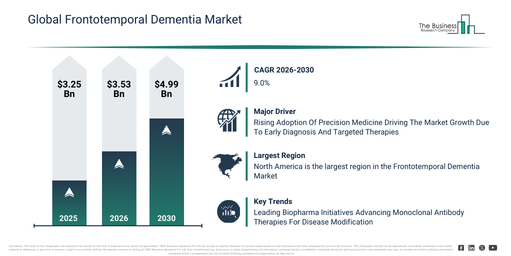
The frontotemporal dementia market size has observed strong growth in recent years. It is projected to expand from $3.25 billion in 2025 to $3.53 billion in 2026, at a compound annual growth rate (CAGR) of 8.8%. The historical growth can be attributed to improved clinical recognition of frontotemporal dementia, the expansion of specialized neurology clinics, increased availability of neuroimaging technologies, rising awareness among healthcare professionals, and the development of standardized diagnostic criteria.
The frontotemporal dementia market is projected to experience substantial growth in the upcoming years, with its size expected to reach $4.99 billion by 2030, exhibiting a compound annual growth rate (CAGR) of 9.0%. This anticipated expansion during the forecast period is driven by factors such as increasing investments in neurodegenerative disease research, a rising adoption of precision medicine approaches, the broadening availability of digital health tools for cognitive assessment, a growing emphasis on disease-modifying therapies, and the proliferation of caregiver support and management programs. Furthermore, significant trends foreseen in this period include the increased utilization of advanced neuroimaging diagnostics, a rising embrace of genetic and biomarker testing, a heightened focus on early and accurate disease differentiation, the expansion of multidisciplinary care models, and the enhanced integration of digital cognitive assessment tools.
Download A Free Sample Report For Comprehensive Market Insights:
Frontotemporal Dementia Market Demand Drivers: What Is Fueling Industry Growth?
The expanding field of precision medicine is anticipated to propel the future growth of the frontotemporal dementia market. This approach involves tailoring medical treatment to an individual’s distinct biological and lifestyle characteristics. Its adoption is on the rise, spurred by progress in genomics and biotechnology, which enable more precise identification of disease origins and focused therapies, thereby enhancing patient outcomes. For frontotemporal dementia (FTD), precision medicine facilitates early and accurate diagnosis via genetic and biomarker analysis, and it also directs the creation of targeted treatments that address specific molecular pathways implicated in the condition, leading to improved treatment efficacy and slower disease progression. For instance, according to the Personalized Medicine Coalition, a US-based non-profit organization, the US Food and Drug Administration (FDA) sanctioned 16 new personalized treatments for rare disease patients, an increase from six in 2022. Among the new personalized treatments approved for 2023 were also seven cancer drugs and three for various other diseases and conditions. Consequently, the expansion of precision medicine is acting as a key driver for the frontotemporal dementia market’s growth.
Frontotemporal Dementia Market Segment Outlook: Which Categories Are Expanding The Fastest?
The frontotemporal dementia market covered in this report is segmented –
1) By Disease Type: Behavioral Variant Frontotemporal Dementia (bvFTD); Primary Progressive Aphasia (PPA); Frontotemporal Dementia With Motor Neuron Disease (FTD-MND)
2) By Drug Class: Cholinesterase Inhibitors; N-Methyl-D-Aspartate (NMDA) Receptor Antagonists; Antidepressants; Antipsychotics
3) By Diagnostic Methods: Clinical Evaluation; Neuroimaging; Genetic Testing
4) By Treatment Approach: Symptom Management; Medications; Speech And Occupational Therapy
5) By End User: Hospitals; Specialty Clinics; Long-Term Care Facilities
Subsegments:
1) By Behavioral Variant Frontotemporal Dementia (bvFTD): Disinhibited Type; Apathetic Type; Stereotypic Type; Hyperorality Type
2) By Primary Progressive Aphasia (PPA): Nonfluent Variant; Semantic Variant; Logopenic Variant
3) By Frontotemporal Dementia With Motor Neuron Disease (FTD-MND): Amyotrophic Lateral Sclerosis Associated; Progressive Muscular Atrophy Associated; Primary Lateral Sclerosis Associated
Frontotemporal Dementia Market Innovation Trends: Which Developments Are Transforming The Industry?
Leading companies operating within the frontotemporal dementia market are concentrating on developing innovative solutions like monoclonal antibody therapy to slow disease progression and address underlying pathological mechanisms. Monoclonal antibody therapy involves a treatment that uses laboratory-made antibodies, specifically designed to target particular proteins or cells in the body, aiding in disease treatment by blocking, neutralizing, or marking harmful cells for destruction. For instance, in February 2024, Alector Inc., a US-based clinical-stage biotechnology company, partnered with GSK Plc., a UK-based biopharma company, and received the FDA Breakthrough Therapy Designation for latozinemab (AL001). This therapy is engineered to treat frontotemporal dementia due to progranulin gene mutation (FTD-GRN) by inhibiting the sortilin receptor and elevating progranulin (PGRN) levels in the brain to tackle lysosomal dysfunction and neurodegeneration. Phase 2 trials indicated safe, sustained PGRN increases (over 2-fold in plasma/CSF) with trends suggesting a slowing of clinical progression.
Frontotemporal Dementia Market Key Companies And Competitive Benchmarking
Major companies operating in the frontotemporal dementia market are Novartis AG, Eli Lilly and Company, Siemens Healthineers AG, Alector Inc., Denali Therapeutics Inc., Sangamo Therapeutics Inc., QurAlis Inc., TauRx Pharmaceuticals Ltd., AC Immune SA, AviadoBio Ltd., Passage Bio Inc., Muna Therapeutics Inc., Neurimmune Therapeutics Inc., Coya Therapeutics Inc., Aquinnah Pharmaceuticals Inc., Asceneuron SA, CAMP4 Therapeutics Inc., Libra Therapeutics Inc., SOLA Biosciences Inc., Transposon Therapeutics Inc.
Access The Complete Frontotemporal Dementia Market Report:
Frontotemporal Dementia Market Geographic Distribution And Regional Opportunities
North America was the largest region in the frontotemporal dementia market in 2025. Asia-Pacific is expected to be the fastest-growing region in the forecast period. The regions covered in the frontotemporal dementia market report are Asia-Pacific, South East Asia, Western Europe, Eastern Europe, North America, South America, Middle East, Africa.
Get in touch with us:
The Business Research Company: https://www.thebusinessresearchcompany.com/
Americas: +1 310-496-7795
Asia: +44 7882 955267 & +91 8897263534
Europe: +44 7882 955267
Email us at: marketing@tbrc.info
Follow us on:
LinkedIn: https://in.linkedin.com/company/the-business-research-company
YouTube: https://www.youtube.com/channel/UC24_fI0rV8cR5DxlCpgmyFQ
Global Market Model: https://www.thebusinessresearchcompany.com/global-market-model