Unlock Global Insights – Save 20% on Market Reports with Code ONLINE20
What Is The Future Market Size Estimation For The Immunoglobulin Fusion Protein Market Covering 2025–2034?
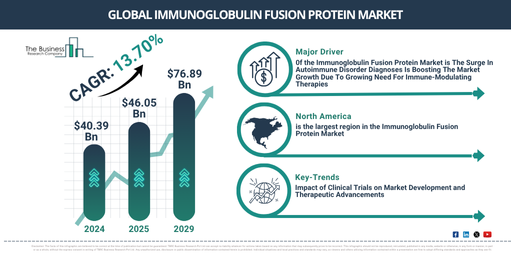
The immunoglobulin fusion protein market has witnessed substantial growth in recent years. It is anticipated to expand from $40.39 billion in 2024 to $46.05 billion in 2025, progressing at a compound annual growth rate (CAGR) of 14.0%. This historical growth can be attributed to several factors including the rising occurrence of autoimmune diseases, increased utilization of biologics, an expanding need for targeted therapies, enhanced diagnostic abilities, and a surge in investment in biologics research and development.
The immunoglobulin fusion protein market size is projected to experience substantial expansion over the coming years. This market is set to reach $76.89 billion by 2029, demonstrating a compound annual growth rate (CAGR) of 13.7%. This anticipated growth during the forecast period is driven by factors such as an increasing geriatric population, the broadening of clinical trials for fusion proteins, an escalating demand for personalized medicine, favorable regulatory support for orphan drugs, and a rise in home-based immunotherapy treatments. Key developments expected within this period involve a move towards subcutaneous formulations, the incorporation of ai in protein design, the creation of bispecific fusion proteins, collaborations between pharma and biotech firms, and progress in protein engineering.
Unlock Your Free Sample Report for Exclusive Market Data:
https://www.thebusinessresearchcompany.com/sample.aspx?id=24568&type=smp
Which Drivers Are Shaping The Immunoglobulin Fusion Protein Industry’s Market Share?
The immunoglobulin fusion protein market is anticipated to experience growth in the future due to the increasing prevalence of autoimmune disorders. These disorders are conditions where the body’s immune system mistakenly attacks its own healthy cells and tissues. The rising incidence of autoimmune disorders primarily results from a combination of genetic predisposition and environmental factors; inherited genes increase an individual’s susceptibility, while triggers like infections or lifestyle choices contribute to the development of these conditions. Immunoglobulin fusion protein assists in managing autoimmune disorders by modulating the immune response to reduce inflammation and prevent the immune system from targeting the body’s own tissues. For instance, in November 2024, according to Versorgungsatlas.de, a Germany-based organization, in 2022, among 73,241,305 insured individuals, 6,304,340 were diagnosed with at least one autoimmune disease, yielding a raw prevalence rate of 8.61%. Therefore, the increasing prevalence of autoimmune disorders is a key driver for the expansion of the immunoglobulin fusion protein market.
What Are The Leading Segments Analyzed In The Immunoglobulin Fusion Protein Market?
The immunoglobulin fusion protein market covered in this report is segmented –
1) By Type: Monoclonal Antibodies, Polyclonal Antibodies, Bispecific Antibodies, Recombinant Antibodies
2) By Drug Class: Immunosuppressive Drugs, Immunostimulatory Drugs
3) By Mode of Administration: Intravenous, Subcutaneous, Intramuscular
4) By Application: Autoimmune Disease, Eye Diseases, Diabetes, Hemophilia
5)By End User: Hospitals, Clinics, Research Institutes
Subsegments:
1) By Monoclonal Antibodies: Human Monoclonal Antibodies, Humanized Monoclonal Antibodies, Chimeric Monoclonal Antibodies, Murine Monoclonal Antibodies
2) By Polyclonal Antibodies: Animal-Derived Polyclonal Antibodies, Human-Derived Polyclonal Antibodies, Recombinant Polyclonal Antibodies
3) By Bispecific Antibodies: Tandem Single-Chain Variable Fragment, Dual-Variable Domain Antibodies, Bispecific T-Cell Engagers (BiTEs), Dual-Affinity Re-Targeting Antibodies
4) By Recombinant Antibodies: Fragment Antibodies, Full-Length Recombinant Antibodies, Antibody-Drug Conjugates (ADCs), Engineered Antibody Domains
How Are Emerging Market Trends Shaping The Immunoglobulin Fusion Protein Industry Landscape?
Leading companies in the immunoglobulin fusion protein market are concentrating on conducting clinical trials to develop innovative products, such as bispecific antibody fusion protein, aiming to enhance therapeutic efficacy and address multiple disease pathways. A bispecific antibody fusion protein is defined as a genetically engineered molecule capable of simultaneously binding to two distinct targets, thereby contributing to improved targeted therapy by either bringing immune cells closer to tumor cells or blocking multiple disease pathways concurrently. For instance, in February 2025, Innovent Biologics, Inc., a China-based biotechnology company, secured its second Fast Track Designation (FTD) from the U.S. Food and Drug Administration (FDA) for IBI343, a bispecific antibody fusion protein aimed at advanced solid tumors. IBI343 is engineered to simultaneously interact with tumor-associated antigens and immune effector cells, consequently boosting the precision and potency of anti-tumor immune responses. This designation is expected to speed up the clinical development and regulatory review of IBI343, highlighting its potential to meet significant unmet medical needs in oncology.
Which Key Market Players Are Investing In Expansion And Innovation Of Immunoglobulin Fusion Protein Market?
Major companies operating in the immunoglobulin fusion protein market are Pfizer Inc., AbbVie Inc., Bayer Aktiengesellschaft, Sanofi S.A., Bristol-Myers Squibb Company, Gilead Sciences Inc., Eli Lilly and Company, Amgen Inc., Teva Pharmaceutical Industries Limited, Regeneron Pharmaceuticals Inc., Sobi, 3SBio Inc., Innovent Biologics Inc., Chengdu Kanghong Pharmaceutical Group Co. Ltd., Samsung Bioepis Co. Ltd., Proteintech Group Inc., KRISHGEN Biosystems, Abnova (Taiwan) Corporation, Celgen Biopharma Inc., Chimerigen Laboratories LLC
Download The Full Report For Exclusive Market Findings:
https://www.thebusinessresearchcompany.com/report/immunoglobulin-fusion-protein-global-market-report
Which Regional Markets Are Contributing Most To The Immunoglobulin Fusion Protein Industry Expansion?
North America was the largest region in the immunoglobulin fusion proteins market in 2024. Asia-Pacific is expected to be the fastest-growing region in the forecast period. The regions covered in the immunoglobulin fusion protein market report are Asia-Pacific, Western Europe, Eastern Europe, North America, South America, Middle East, Africa.
Request A Customized Version Of The Immunoglobulin Fusion Protein Market Report:
https://www.thebusinessresearchcompany.com/customise?id=24568&type=smp
Browse Through More Reports Similar to the Global Immunoglobulin Fusion Protein Market 2025, By The Business Research Company
Immunoglobulins Global Market Report 2025
https://www.thebusinessresearchcompany.com/report/immunoglobulins-global-market-report
Monoclonal Antibodies Global Market Report 2025
https://www.thebusinessresearchcompany.com/report/monoclonal-antibodies-global-market-report
Recombinant Proteins Global Market Report 2025
https://www.thebusinessresearchcompany.com/report/recombinant-proteins-global-market-report
Get in touch with us:
The Business Research Company: https://www.thebusinessresearchcompany.com/
Americas +1 310-496-7795
Asia +44 7882 955267 & +91 8897263534
Europe +44 7882 955267
Email us at info@tbrc.info
Follow us on:
LinkedIn: https://in.linkedin.com/company/the-business-research-company
YouTube: https://www.youtube.com/channel/UC24_fI0rV8cR5DxlCpgmyFQ
Global Market Model: https://www.thebusinessresearchcompany.com/global-market-model