Uncover key drivers, emerging technologies, and competitive movements shaping the gastrointestinal cancer market from 2026–2035 with trusted insights from The Business Research Company
What upper market value could the Gastrointestinal Cancer Market reach by 2030 starting from 2026 levels?
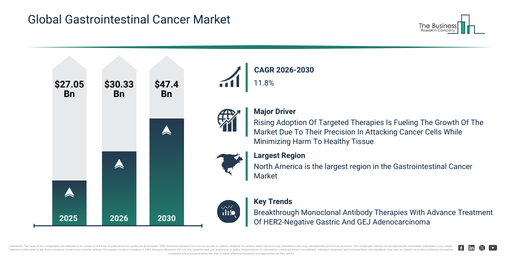
The gastrointestinal cancer market has experienced rapid expansion in recent years. Its projected growth will see it rise from $27.05 billion in 2025 to $30.33 billion in 2026, demonstrating a compound annual growth rate (CAGR) of 12.1%. Historically, this expansion has been driven by factors such as the increasing incidence of gastrointestinal cancers, advancements in diagnostic imaging capabilities, greater public awareness regarding early cancer detection, progress in oncology drug development, and enhanced availability of cancer treatment centers.
The gastrointestinal cancer market is projected to experience substantial expansion over the coming years. This market is anticipated to reach $47.4 billion by 2030, demonstrating a compound annual growth rate (CAGR) of 11.8%. This projected growth is driven by factors such as enhanced funding for personalized oncology, the growing acceptance of biomarker-based diagnostic methods, the broadening of immuno-oncology treatment options, the increasing utilization of less invasive diagnostic tools, and greater spending on cancer healthcare. Key trends anticipated during this period involve the rising implementation of targeted GI cancer treatments, an increase in the application of molecular diagnostics, a stronger emphasis on combined immunotherapy approaches, the expansion of early cancer detection initiatives, and more comprehensive integration of precision medicine.
Access Your Free Sample Report for In-Depth Market Insights:
https://www.thebusinessresearchcompany.com/sample.aspx?id=24546&type=smp
Which Drivers Are Influencing Long-Term Growth In The Gastrointestinal Cancer Market?
The increasing integration of targeted therapies is anticipated to fuel the expansion of the gastrointestinal cancer market in the coming years. These treatments precisely inhibit cancer cell proliferation by engaging with specific molecular targets, thereby minimizing damage to healthy cells. Their design focuses on disrupting particular molecular pathways or genetic mutations that drive diseases, particularly cancer. In contrast to conventional methods such as chemotherapy, which affect both healthy and cancerous cells, targeted therapies concentrate on the distinct features of a patient’s illness. For gastrointestinal (GI) cancer, these therapies operate by influencing specific genes or proteins that govern tumor development, leading to precise and effective interventions. This approach leads to improved patient outcomes and fewer adverse reactions compared to standard chemotherapy. An illustrative example, reported in July 2023 by the American Society of Gene & Cell Therapy (ASGCT), a US-based professional membership organization, and Citeline, a US-based provider of drugs and devices, showed that by the close of quarter one (Q1) 2023, there were 247 gene therapies in Phase II. This figure subsequently increased by 5%, reaching 260 by the conclusion of quarter two (Q2). Consequently, the increased uptake of targeted therapies is propelling the expansion of the gastrointestinal cancer market.
Which Segments Are Driving Activity In The Gastrointestinal Cancer Market?
The gastrointestinal cancer market covered in this report is segmented –
1) By Cancer Type: Colorectal Cancer, Stomach Cancer, Esophageal Cancer, Pancreatic Cancer, Liver Cancer, Other Cancer Types
2) By Diagnostics: Endoscopy, Biopsy, Molecular Diagnostics, Imaging, Other Diagnostics
3) By Treatment: Chemotherapy, Immunotherapy, Targeted Therapy, Radiation Therapy, Surgery, Other Treatments
4) By End-User: Hospitals, Oncology Centers, Research Institutes, Diagnostic Laboratories, Other End-Users
Subsegments:
1) By Colorectal Cancer: Colon Cancer, Rectal Cancer, Recurrent Colorectal Cancer, Metastatic Colorectal Cancer
2) By Stomach Cancer: Adenocarcinoma, Gastrointestinal Stromal Tumors (GIST), Lymphoma, Carcinoid Tumors
3) By Esophageal Cancer: Adenocarcinoma, Squamous Cell Carcinoma, Small Cell Carcinoma, Other Rare Esophageal Tumors
4) By Pancreatic Cancer: Exocrine Pancreatic Cancer, Endocrine (Neuroendocrine) Pancreatic Tumors, Metastatic Pancreatic Cancer, Resectable Or Unresectable Tumors
5) By Liver Cancer: Hepatocellular Carcinoma (HCC), Intrahepatic Cholangiocarcinoma, Hepatoblastoma, Secondary (Metastatic) Liver Cancer
6) By Other Cancer Types: Small Intestine Cancer, Anal Cancer, Gallbladder Cancer, Gastrointestinal Carcinoid Tumor
Which Trends Are Shaping Activity Within The Gastrointestinal Cancer Market?
Major companies operating in the gastrointestinal cancer market are focused on developing advanced solutions, such as monoclonal antibody treatment, to improve patient survival rates and minimize treatment-related side effects. Monoclonal antibody treatment involves using laboratory-produced antibodies that precisely identify and attach to cancer cells, assisting the immune system in targeting and eliminating them. For instance, in September 2024, Astellas Pharma Inc., a Japan-based pharmaceutical company, launched VYLOY (zolbetuximab) in combination with fluoropyrimidine- and platinum-containing chemotherapy, which received approval from the European Commission. It is a first-line treatment for adults with locally advanced unresectable or metastatic HER2-negative gastric or gastroesophageal junction (GEJ) adenocarcinoma whose tumors express claudin 18.2 (CLDN18.2). This approval makes VYLOY the first and only therapy in the European Union targeting CLDN18.2, a biomarker in about 38% of these patients, based on positive clinical trial data from the SPOTLIGHT and GLOW studies.
Which Major Firms Are Strengthening Their Position In The Gastrointestinal Cancer Market?
Major companies operating in the gastrointestinal cancer market are Pfizer Inc., Johnson & Johnson, Roche Holding AG, Merck & Co. Inc., Bayer AG, Sanofi S.A., Bristol-Myers Squibb Company, AstraZeneca PLC, Novartis AG, GlaxoSmithKline plc, Takeda Pharmaceutical Company Limited, Eli Lilly and Company, Amgen Inc., Ipsen Biopharmaceuticals Inc., Exelixis Inc., BeiGene Ltd., Boehringer Ingelheim International GmbH, Zai Lab Limited, Taiho Pharmaceutical Co. Ltd
Access The Complete Report For Deeper Market Insights:
https://www.thebusinessresearchcompany.com/report/gastrointestinal-cancer-global-market-report
Which Regions Are Poised For Strategic Growth In The Gastrointestinal Cancer Market?
North America was the largest region in the gastrointestinal cancer market in 2025. Asia-Pacific is expected to be the fastest-growing region in the forecast period. The regions covered in the gastrointestinal cancer market report are Asia-Pacific, South East Asia, Western Europe, Eastern Europe, North America, South America, Middle East, Africa.
Request Your Customized Gastrointestinal Cancer Market Research Report for Competitive Advantage:
https://www.thebusinessresearchcompany.com/customise?id=24546&type=smp
Browse Through More Reports Similar to the Global Gastrointestinal Cancer Market 2026, By The Business Research Company
Colorectal Cancer Molecular Diagnostics Market Report 2026
Gastric Cancer Drugs Market Report 2026
https://www.thebusinessresearchcompany.com/report/gastric-cancer-drugs-global-market-report
Colorectal Cancer Drugs Market Report 2026
https://www.thebusinessresearchcompany.com/report/colorectal-cancer-drugs-global-market-report
Get in touch with us:
The Business Research Company: https://www.thebusinessresearchcompany.com/
Americas +1 310-496-7795
Asia +44 7882 955267 & +91 8897263534
Europe +44 7882 955267
Email us at info@tbrc.info
Follow us on:
LinkedIn: https://in.linkedin.com/company/the-business-research-company
YouTube: https://www.youtube.com/channel/UC24_fI0rV8cR5DxlCpgmyFQ
Global Market Model: https://www.thebusinessresearchcompany.com/global-market-model