Personal Emergency Response Systems (PERS) Market Growth Is Accelerating As Industry Transformation Continues
Through market attractiveness analysis, total addressable market evaluation, company benchmarking matrices, interactive Excel dashboards, expanded supply chain intelligence, emerging startup coverage, and detailed product insights, The Business Research Company’s 2026 market reports provide more actionable and strategically valuable research.
The personal emergency response systems (PERS) market has witnessed significant growth recently, driven by demographic shifts and technological advancements. As more seniors choose to live independently and healthcare systems evolve, demand for these safety devices is rising steadily. Let’s explore the market size, key factors influencing growth, emerging trends, leading players, and regional insights shaping this expanding industry.
Personal Emergency Response Systems Market Size and Growth Forecast
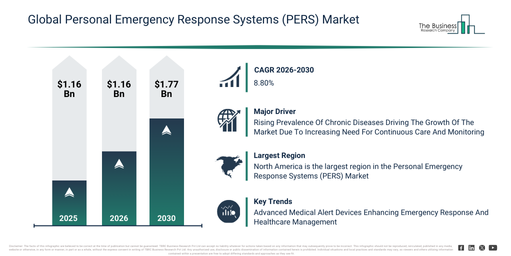
The PERS market has demonstrated strong expansion in recent years. It is projected to increase from $8.23 billion in 2025 to $8.97 billion in 2026, marking a compound annual growth rate (CAGR) of 9.0%. This earlier growth phase was propelled by factors such as the aging population, increased preference among seniors for independent living, heightened demand for emergency healthcare services, shortages in caregiver availability, and greater awareness around elderly safety. Moving forward, the market is expected to reach $12.6 billion by 2030, driven by a CAGR of 8.8%. The forecast period will benefit from innovations like smart home integration, AI-enabled emergency detection technologies, expanding home healthcare services, government initiatives supporting elderly care, and growing adoption of mobile health solutions. Key trends predicted for this phase include the rise of wearable emergency devices, the spread of GPS-enabled mobile PERS, incorporation of fall detection sensors, enhanced home safety systems for seniors, and voice-activated emergency response features.
Download A Free Sample Report For Comprehensive Market Insights:
https://www.thebusinessresearchcompany.com/sample.aspx?id=22095&type=smp
Chronic Disease Prevalence Driving Increased Demand for PERS
One of the most important factors pushing the growth of the personal emergency response systems market is the rising number of individuals suffering from chronic illnesses. Conditions such as diabetes, heart disease, and arthritis are long-lasting and require ongoing management. The surge in chronic health issues is closely linked to aging populations and unhealthy lifestyle habits, which increase risks like obesity, insulin resistance, and inflammation—key contributors to these diseases. This growing burden of chronic conditions boosts the need for PERS, as these systems provide continuous monitoring and fast access to medical assistance when emergencies occur. For example, in June 2024, the UK’s National Health Service reported that in 2023, 549,000 more people in England were at risk of developing type 2 diabetes, bringing the total number of individuals with pre-diabetes to 3,615,330, a nearly 20% rise from 2022. Such statistics highlight the increasing demand for emergency monitoring solutions that promote safety and peace of mind.
How Market Segments Are Shaping Personal Emergency Response Systems
This market is categorized into several important segments for better clarity and product targeting. By type, it is divided into Landline Personal Emergency Response Systems and Mobile Personal Emergency Response Systems. Components include smoke detectors, bed sensors, pull-cord systems, fall detection sensors, and flood detectors. End-users range across nursing homes, home-based users, assisted living facilities, hospices, and senior living communities. Further subdivisions offer more detail: for landline systems, options include Basic Landline PERS, Auto-Alert Landline PERS, and Voice-Activated Landline PERS. Mobile systems are split into GPS-enabled Mobile PERS, Non-GPS Mobile PERS, Wearable Mobile PERS, and Smartphone-based Mobile PERS. These classifications help meet diverse needs across different user groups and environments.
Access The Complete Personal Emergency Response Systems (PERS) Market Report:
Innovations and Advanced Technologies Defining the Market’s Next Chapter
Leading companies in the PERS market are investing heavily in developing cutting-edge devices that enhance real-time monitoring and emergency response. These medical alert systems typically include wearable help buttons connected to emergency services, offering critical support during health crises. For instance, in February 2025, LogicMark, Inc., a US manufacturer, introduced the Guardian Alert 911 Plus, an advanced device featuring fall detection capabilities, 4G LTE connectivity, and a sleek, unobtrusive design. This new product allows users—especially aging adults and those with medical conditions—to maintain independence while benefiting from hands-free emergency assistance without ongoing fees.
Key Players Competing in the Personal Emergency Response Systems Market
The competitive landscape includes well-known companies such as ADT Inc, Tunstall Healthcare, Lifeline Systems Company, Medical Guardian, LifeStation, LifeFone Medical Alert Services, LifeWatch, Rescue Alert, AlertOne Services LLC, GreatCall, Bay Alarm Medical, Lifelink USA, Galaxy Medical Alert Systems, Alarm Systems, MediPendant, QMedic, Life Guardian LLC, Philips Lifeline, and Philips Personal Emergency Response Solutions. These organizations continually innovate to offer more reliable, user-friendly, and technologically sophisticated products to consumers worldwide.
Personal Emergency Response Systems Market Regional Overview and Growth Opportunities
In 2025, North America held the leading share of the PERS market, reflecting strong demand driven by an aging population and advanced healthcare infrastructure. The global market also includes key regions such as Asia-Pacific, South East Asia, Western and Eastern Europe, South America, the Middle East, and Africa. The Asia-Pacific region is expected to show rapid growth in the coming years, fueled by increasing awareness, rising elderly populations, and expanding healthcare services in emerging economies. This regional diversity provides a broad canvas for market expansion and innovation.
Get in touch with us:
The Business Research Company: https://www.thebusinessresearchcompany.com/
Americas: +1 310-496-7795
Asia: +44 7882 955267 & +91 8897263534
Europe: +44 7882 955267
Email us at: marketing@tbrc.info
Follow us on:
LinkedIn: https://in.linkedin.com/company/the-business-research-company
YouTube: https://www.youtube.com/channel/UC24_fI0rV8cR5DxlCpgmyFQ
Global Market Model: https://www.thebusinessresearchcompany.com/global-market-model